Rocca di Monfalcone: A Late-Antique Fortress in Italy




Site at a Glance
- Rating
- 4.4
- Popularity
- Low
- Country
- Italy
- Primary era
- Early Modern
- External website
- Open
- Eras represented
- Classical, Medieval, Early Modern
- Civilizations
- Ostrogothic, Venetian
- Site type
- Military
- Remains
- Fort
On this page9 sections
History
Rocca di Monfalcone is a late-antique fortress in Italy, standing above Monfalcone in Friuli-Venezia Giulia. Traditionally attributed to the Ostrogoths and dated to around AD 490, it occupies a hill that had already been fortified in prehistoric times. Its position and long military history reflect the strategic importance of the eastern frontier of northeastern Italy.
Prehistoric and late-antique origins
The hilltop was occupied before the present fortress existed. Visible remains of a castelliere, a prehistoric fortified settlement enclosed by defensive earthworks or stone walls, survive on the summit. The later fortress is traditionally believed to have been ordered by Theodoric the Great, the Ostrogothic king who ruled Italy in the late fifth and early sixth centuries. It was associated with his victory over Odoacer, a Germanic military ruler who had governed Italy, at the Isonzo.
According to the traditional interpretation attributed to L’Asquini, the fortress originally carried the name Verruca Montis Falconis, meaning “summit of Mount Falcon.” The word verruca was later shortened to rocca, giving rise to the name used today.
Ecclesiastical and feudal rule
In 967, Emperor Otto I donated Monfalcone and its fortress to the Patriarchate of Aquileia. This was an ecclesiastical principality whose patriarch also exercised territorial authority in northeastern Italy and nearby regions. The fortress first appears in surviving written records in 1289, during conflict between the Republic of Venice and the feudal lords of the County of Gorizia and the Duchy of Carinthia.
In 1409, the fortress passed to the County of Gorizia through Count Henry of Ortenburg. Venetian rule began in 1420, when Venice conquered the territory of Monfalcone and incorporated the stronghold into its frontier defenses.
Venetian military rebuilding
After the Venetian conquest, the Rocca received the garrison previously stationed at Castello di Belforte. Repairs and reinforcement followed in 1431, 1436, 1457, and 1462. The walls were repaired and equipped with a parapet, adapting the hilltop position to the military needs of the period.
The fortress endured several Turkish attacks without being captured. In 1514, however, mercenaries belonging to the League of Cambrai seized it and killed the infantrymen defending it. The League was an alliance formed in 1508 by several European powers against Venice.
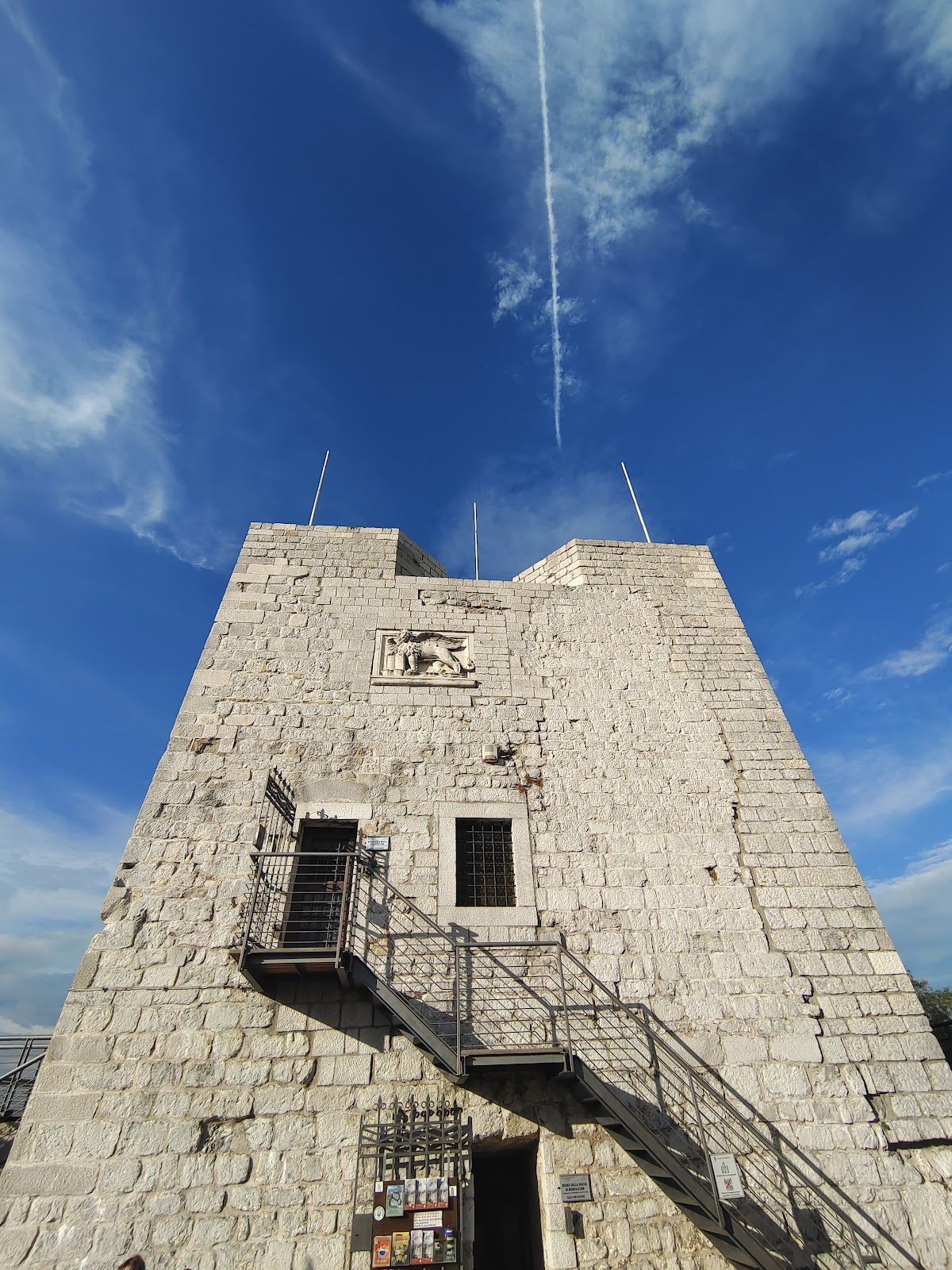
Venetian control returned in 1525, a date recorded on a carved stone plaque above the entrance to the central tower. At the initiative of Giovanni Diedo, Venice’s podestà of Monfalcone, the fortress was substantially rebuilt from its foundations to accommodate firearms. A podestà was a chief civic official appointed to govern a city or territory, often for an external ruling power. The rebuilding also created a square central tower for storing gunpowder.
Decline and modern interpretation
By the end of the sixteenth century, the construction of the fortress at Palmanova had reduced the Rocca’s defensive importance. It became an observation post on the eastern frontier of the Venetian Republic. This change did not prevent the Uskoks, frontier soldiers and raiders active along the Adriatic and its hinterlands, from sacking Monfalcone and the fortress in 1615.
A permanent Venetian garrison remained at the Rocca until 1797, when the Republic of Venice fell during Napoleon’s advance. The abandoned fortress later suffered attacks during the First World War.
The Soprintendenza ai Monumenti, a monument-preservation authority, restored the fortress between 1950 and 1955. From 1968, care of the site was entrusted to the Gruppo Speleologico Monfalconese “Amici del Fante,” a local organization dedicated to the study and interpretation of caves and other underground cavities. Founded in 1948, the group first recovered the bodies of soldiers and civilians thrown into foibe, deep karst cavities associated particularly with the northeastern Adriatic. It later expanded its work to natural underground formations in Friuli-Venezia Giulia.
The group’s investigations in speleology, geology, paleontology, and history led to the creation of the museum at the Rocca. A paleontological museum opened there in 1970 before later moving to the city center and being replaced at the fortress by the present speleological museum. The Rocca is recognized as Italian national heritage.
Remains
Hilltop setting and prehistoric fortification
The Rocca occupies a hill at the edge of Monfalcone, at an elevation of approximately 79 metres. The surviving structure is about 15 metres high and is built of stone, including rubble masonry. The summit also preserves visible remains of the earlier castelliere, placing the late-antique fortress within a hilltop setting that had already been selected for fortified occupation.
Fortress walls and central tower
The fortress walls retain the work associated with Venetian reinforcement in the fifteenth century. Their repairs and parapet belonged to the defensive adaptations carried out in 1431, 1436, 1457, and 1462. Later rebuilding in the sixteenth century altered the stronghold for firearms and gave it a square stone tower at the centre. The tower’s purpose was to store gunpowder, while a carved stone plaque above its entrance marks the restoration of Venetian control in 1525.
Speleological exhibition
The permanent speleological exhibition occupies the summit of the fortress hill. It grew from the research of the Gruppo Speleologico Monfalconese “Amici del Fante,” whose work covers caves, karst landscapes, geology, paleontology, and local history. Karst is terrain formed when soluble rock dissolves, producing caves, underground passages, sinkholes, and related natural cavities. The museum presents the causes and processes of karst formation and conducts educational activities in schools. Its direction and laboratories are located separately in the city at Via Valentinis 134, while the former paleontological collection established at the Rocca in 1970 was transferred to the urban center.