Theveste: A Historical Roman and Byzantine Site in Algeria
Table of Contents


Visitor Information
Google Rating: 3.5
Popularity: Very Low
Google Maps: View on Google Maps
Country: Algeria
Civilization: Byzantine, Phoenician, Roman
Remains: City

Context
Theveste is situated near the contemporary city of Tebessa in northeastern Algeria, occupying a strategic plateau at the eastern margin of the Aurès Mountains. This elevated position provided natural defensive advantages and commanding views over the adjacent plains. The site lies close to the modern Algerian-Tunisian border within a semi-arid environment, characterized by seasonal water availability that supported settlement and agriculture. Its location formed a nexus between inland Saharan routes and Mediterranean coastal corridors, facilitating regional connectivity.
Originally established as a Roman colony in the 1st century CE, Theveste succeeded earlier indigenous Numidian settlements. Over time, it developed into a significant military and administrative center during the Roman Imperial era. Following the collapse of Western Roman authority, the city came under Byzantine control, which introduced new fortifications and administrative structures. The Islamic conquests of the 7th century CE led to a decline in urban prominence, with archaeological evidence indicating a reduction in settlement density and activity by the early medieval period. Excavations initiated in the 19th century have revealed extensive Roman and Byzantine architectural remains, including fortifications and public edifices, though some have suffered from erosion and modern urban encroachment. Current conservation efforts by Algerian heritage institutions aim to preserve and further investigate the site’s complex historical layers.
History
Theveste’s historical significance derives from its role as a cultural and political crossroads in North Africa, reflecting successive phases of indigenous, Punic, Roman, Byzantine, and Islamic influence. Initially a prominent Numidian settlement, it evolved into a Roman colonia and military stronghold, later becoming a Christian episcopal center. The city’s fortunes fluctuated through Vandal invasions, Byzantine reconquest, and Islamic conquest, each phase leaving distinct archaeological and historical imprints.
Numidian and Punic Period (c. 9th century BCE – 2nd century BCE)
Prior to Roman domination, Theveste was embedded within the indigenous Berber (Numidian) cultural milieu, with archaeological evidence attesting to human occupation in the surrounding region since the Paleolithic and Neolithic periods. The settlement was known as Hecatomphyle—meaning “city of a hundred gates”—a name reflecting its urban character and recorded by Greek sources as Theveste or Hekatompyle, occasionally confused with Thebes of Egypt. During the early first millennium BCE, Carthaginian influence extended into the area, culminating in the city’s capture by the Carthaginian general Hannon the Great around 247 BCE. Subsequently, from approximately 174 to 150 BCE, Theveste came under the control of the Numidian king Massinissa, who administered it as a significant agricultural hub within his expanding kingdom. The city’s fortified nature and agricultural productivity positioned it as a key node linking inland Berber communities with Mediterranean trade networks.
Roman Conquest and Early Imperial Period (146 BCE – 3rd century CE)
Following the Roman Republic’s conquest of North Africa in 146 BCE, the region encompassing Theveste was incorporated into the province of Africa Proconsularis. Theveste itself was formally established as a Roman colony in 75 CE, situated near the earlier Berber settlement at the foot of the Aurès Mountains to secure control over the mountainous frontier. During the 1st century CE, the Legio III Augusta was stationed at Theveste before relocating to Lambaesis, underscoring the city’s military importance. Under Emperor Trajan, the city likely attained colonia status, reflecting its elevated administrative and civic standing within the imperial system. Theveste developed into a strategic military and commercial center, connected by eight principal roads facilitating regional trade and troop movements.
The city reached its demographic and economic peak under Emperor Septimius Severus (193–211 CE), with population estimates approaching 30,000 inhabitants. It emerged as a principal locus of Romanization in southern Algeria, alongside Mascula, Timgad, and Lambèse. Some sources suggest that during Hadrian’s reign (117–138 CE), the population may have reached approximately 50,000, making Theveste the second-largest city in the region after Carthage. The construction of the Arch of Caracalla in 214 CE served as a monumental northern gateway, featuring four identical facades at a major road intersection. The early 3rd-century Temple of Minerva, adorned with mosaic decorations and containing prehistoric artifacts such as coins, weapons, and lamps, indicates a continuity of cultural reverence. Additionally, a small Roman theatre was erected during this period, reflecting the city’s military and civic functions. The presence of a Roman aqueduct, parts of which remain partially operational, attests to the city’s infrastructural sophistication.
Late Roman and Christian Period (3rd – 5th centuries CE)
In late antiquity, Theveste became a significant Christian episcopal see within the province of Numidia. Historical records document several bishops, including Lucius, who attended the Council of Carthage in 256 CE and was martyred in 258 CE, and Felix, who was exiled by the Vandals in 484 CE. The city was a center of the Donatist schism, hosting councils and theological debates. Christian martyrdom played a prominent role in local identity, with saints such as Maximilianus (martyred 295 CE) and Crispina (martyred 304 CE) associated with the city. By the early 5th century, Crispina’s burial site outside the city had become a major pilgrimage destination, marked by a large basilica complex comprising chapels, baptismal urns, catacombs, and gardens.
The 4th-century amphitheatre, architecturally divided into two sections, reflects adaptations to evolving social or military requirements. Theveste also hosted a Manichaean community during the 4th and 5th centuries, as evidenced by the discovery of a Latin Manichaean codex in a nearby cave in 1918. The extension of Roman citizenship to all inhabitants under Septimius Severus facilitated the city’s integration into the imperial framework. Throughout this period, Theveste’s civic identity shifted from a primarily military base to a religious and administrative center, maintaining urban vitality despite broader imperial challenges.
Vandal and Byzantine Period (5th – 6th centuries CE)
The 5th century CE was marked by significant upheaval as the Vandals invaded North Africa, raiding Theveste but not completely destroying it. In 496 CE, Berber tribes led by the chieftain Jaldas sacked the city, which was subsequently retaken by the Vandal king Thrasamund. These events initiated a period of demographic and economic decline. In 530 CE, the Byzantine general Solomon reconquered the region, incorporating Theveste into the Byzantine Exarchate of Africa. Solomon undertook extensive restoration, including the construction of new defensive walls in 535 CE, known locally as “Solomon’s Walls.” These fortifications enclosed the old town center, featured thirteen square towers, and included four gates, one of which incorporated the Arch of Caracalla. The walls were erected in response to persistent Berber rebellions led by the chieftain Antalas. Solomon also commissioned a tomb in Theveste, which remains extant.
Early Islamic and Medieval Period (7th – 13th centuries CE)
The Islamic conquest of the Maghreb in the 7th century CE resulted in the near destruction of Theveste’s urban fabric. Nevertheless, a reduced settlement persisted within the Byzantine walls, likely inhabited by surviving Christian Berbers and later Muslim populations. The city, known in its Arabized form as Tébessa, appears sporadically in medieval Arabic geographical sources from the 9th and 13th centuries as a madîna (city). During the Hafsid dynasty, local governance was exercised by a sheikh named Muḥammad b. ʿAbdūn. Medieval Arabic texts describe Tébessa as an ancient city constructed with large stone blocks, retaining visible pre-Islamic monuments, including two temples (hayâkil) and a building for spectacles (dâr al-mal‘ab). Despite diminished urban prominence, the site maintained a degree of continuity into the medieval period, reflecting the persistence of its monumental heritage amid changing political and religious landscapes.
Daily Life and Importance by Period
Numidian and Punic Period (c. 9th century BCE – 2nd century BCE)
During the Numidian and Punic eras, Theveste functioned primarily as a Berber settlement with a strong indigenous cultural identity, later influenced by Carthaginian presence. The population consisted predominantly of Numidian Berbers engaged in agriculture, particularly grain and olive cultivation, supported by the fertile plateau and seasonal water availability. Social organization likely revolved around tribal and clan structures, with elites such as local chieftains or kings, including Massinissa, overseeing agricultural production and regional governance. Gender roles probably conformed to indigenous patterns, with men responsible for herding and farming, and women managing domestic tasks.
Material culture comprised simple dwellings constructed from local stone and mudbrick, with limited evidence of elaborate interior decoration. Trade and craft activities were modest but connected to Carthaginian networks, as indicated by the city’s capture by Hanno the Great and its role as an agricultural hub. The city’s name, Hecatomphyle, suggests a fortified urban character, possibly featuring multiple gates controlling access. Religious practices likely combined indigenous Berber beliefs with Punic deities, although specific temples or cult sites from this period remain archaeologically elusive. Theveste’s regional role was that of a fortified agricultural center linking inland Berber communities with Mediterranean trade routes.
Roman Conquest and Early Imperial Period (146 BCE – 3rd century CE)
Following Roman annexation, Theveste was transformed into a Roman colonia, attracting settlers including military veterans and administrators. The population became ethnically diverse, comprising Roman citizens, local Berbers, and Romanized elites. Epigraphic evidence attests to civic officials such as duumviri and municipal magistrates, indicating a structured local government. Family life reflected Roman patriarchal norms, with social stratification encompassing landowners, artisans, soldiers, and slaves.
The economy expanded significantly, with agriculture remaining central—grain, olives, and vineyards were cultivated on estates and smaller farms. The city’s strategic location made it a military base for Legio III Augusta and a commercial hub connected by eight major roads facilitating trade in olive oil, wine, and ceramics. Workshops producing pottery and textiles likely operated at household or small-scale levels. Diet included bread, olives, fish, and locally produced wine and oil. Clothing consisted of Roman-style tunics, cloaks, and sandals, worn by both locals and settlers.
Urban residences featured mosaic floors and painted walls, especially in public buildings such as the Temple of Minerva, which also housed prehistoric artifacts reflecting cultural continuity. The city’s forum, the triumphal Arch of Caracalla, and a small theatre supported civic life and public entertainment. Water supply was ensured by a Roman aqueduct, parts of which remain functional. Religious life transitioned from pagan worship of deities such as Minerva to the gradual introduction of Christianity by the 3rd century. Theveste’s role was that of a prominent colonia and military-administrative center, key to Roman control of the Aurès Mountains and southern Algeria.
Late Roman and Christian Period (3rd – 5th centuries CE)
During late antiquity, Theveste evolved into a major Christian episcopal see, with a population comprising Romanized citizens, local Berbers, clergy, and religious minorities such as Manichaeans. Bishops like Lucius and Felix played important ecclesiastical roles, and Christian martyrdom shaped communal identity. Family structures remained patriarchal, with Christian teachings influencing social customs and education, likely including catechesis and scriptural instruction.
Economic activities continued to focus on agriculture, supplemented by religious pilgrimage centered on sites such as the basilica complex dedicated to Saint Crispina. This complex included chapels, baptismal fonts, catacombs, and gardens, indicating an organized religious community supporting pilgrims and clergy. The amphitheatre, divided architecturally into two sections, suggests adaptations for social or military functions. Diet and clothing remained consistent with earlier Roman patterns, while domestic interiors featured mosaic decoration and Christian symbols. Markets and trade persisted, supported by the city’s road connections. Religious festivals and councils, including Donatist assemblies, highlight Theveste’s role as a theological center.
The city’s civic importance shifted from military to ecclesiastical leadership, with bishops holding significant influence. The granting of Roman citizenship under Septimius Severus facilitated integration, while the presence of Manichaean texts reveals religious diversity. Theveste thus functioned as a regional religious hub with sustained urban life despite broader imperial decline.
Vandal and Byzantine Period (5th – 6th centuries CE)
The Vandal invasions and subsequent Berber raids caused demographic decline and economic disruption, reducing Theveste’s population and urban complexity. Nevertheless, the city was not abandoned; a smaller community of Romanized Berbers, soldiers, and administrators persisted. Byzantine reconquest under Solomon restored civic structures and reinforced social hierarchy through military and administrative officials.
Economic life contracted but remained focused on subsistence agriculture and local crafts. The construction of Solomon’s Walls, enclosing the old town with thirteen towers and four gates, reflects a defensive priority amid ongoing Berber unrest. The city’s infrastructure included restored public buildings and a tomb erected by Solomon, indicating continued Byzantine religious and political presence. Daily life adapted to a more militarized and defensive context, with limited public entertainment and reduced commercial activity. Religious practices remained Christian, now under Byzantine orthodoxy, with ecclesiastical authorities maintaining influence. Household interiors likely became simpler, reflecting economic constraints. Theveste’s role shifted to a fortified Byzantine outpost guarding the Aurès frontier, combining military, administrative, and religious functions within a diminished urban footprint.
Early Islamic and Medieval Period (7th – 13th centuries CE)
The Islamic conquest led to near destruction of Theveste’s urban fabric, but a small settlement endured within the Byzantine walls, inhabited mainly by Christian Berbers and later Muslim populations. The city, known as Tébessa, retained remnants of its Roman and Byzantine heritage, including two temples and a building for spectacles, attesting to continuity of monumental architecture.
Remains
Architectural Features
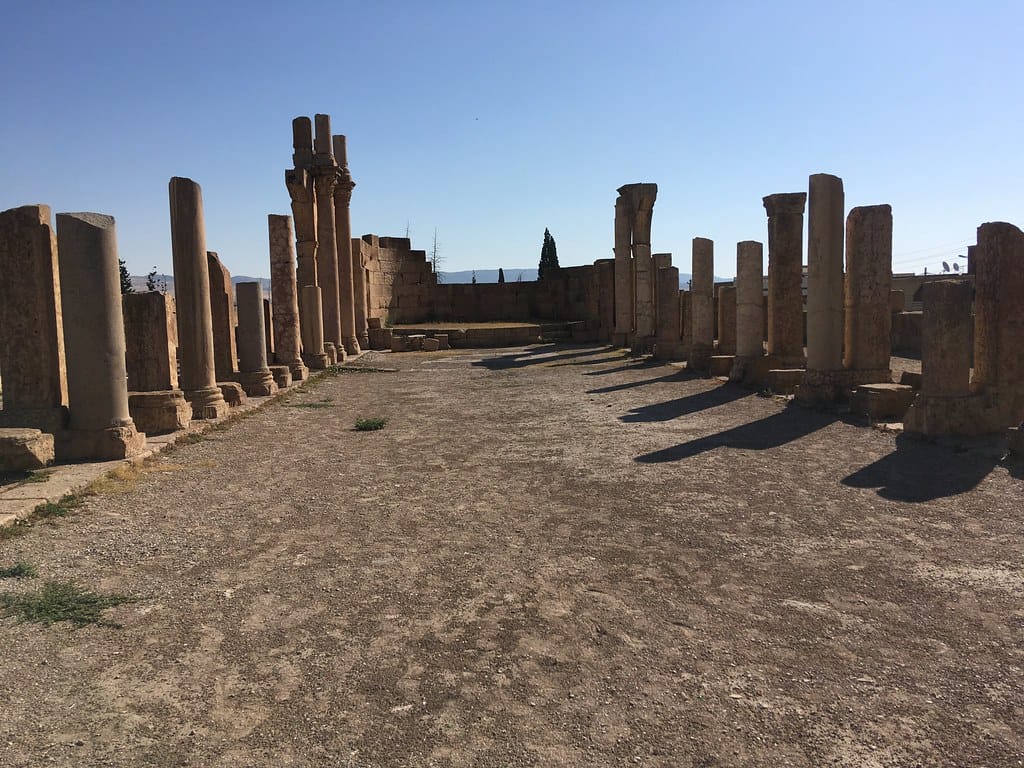
Theveste’s extant archaeological fabric predominantly comprises Roman and Byzantine constructions dating from the 1st to the 6th centuries CE. The city was originally enclosed by Roman fortifications, later superseded by the more compact Byzantine walls constructed in the 6th century CE. The masonry primarily consists of large ashlar stone blocks, with some use of Roman concrete (opus caementicium) in structural elements. The urban layout centers on a forum area surrounded by military, civic, religious, and entertainment buildings. The Byzantine fortifications, known as “Solomon’s Walls,” enclose a reduced urban footprint compared to the Roman city, reflecting contraction during late antiquity. Surface traces and scattered monumental blocks indicate the former extent of the city beyond the currently excavated zones. Decorative mosaics and inscriptions are present in several structures, attesting to the city’s artistic and epigraphic heritage. The Roman aqueduct system, partially preserved and still functional in sections, demonstrates advanced water management infrastructure.
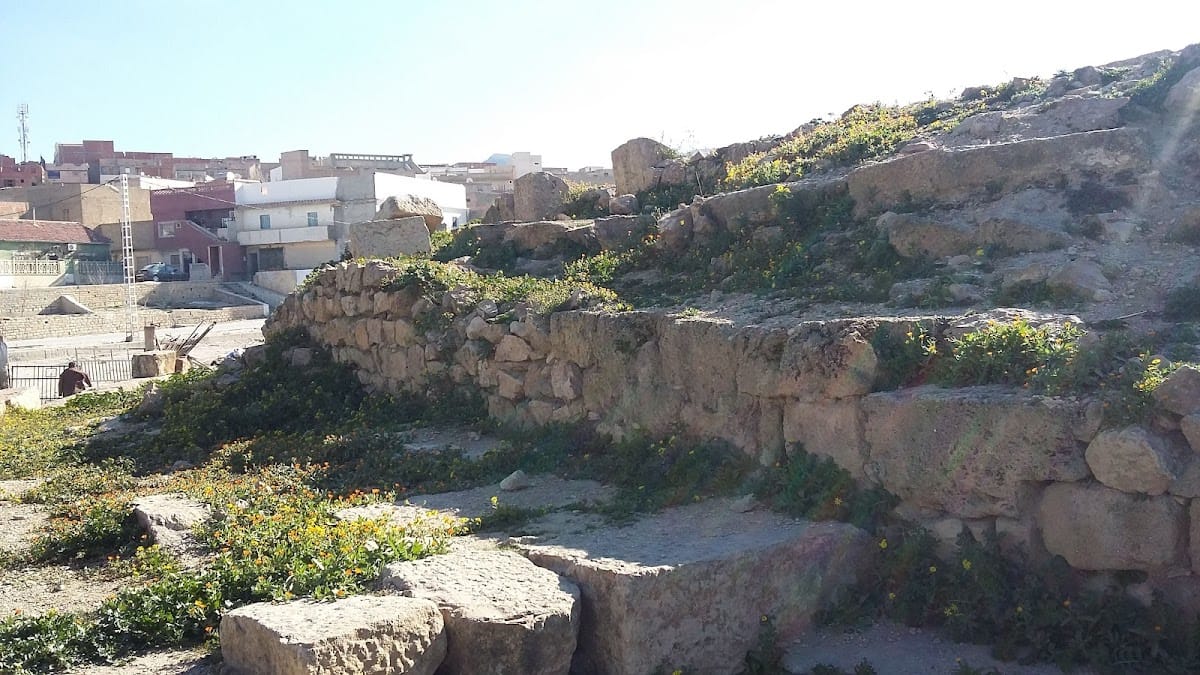
Over time, some Roman buildings were repurposed during Byzantine occupation. Natural erosion and modern urban development have caused partial loss of remains, but key architectural elements survive in situ, allowing reconstruction of the city’s historical phases.
Key Buildings and Structures
Arch of Caracalla
Constructed in 214 CE to honor Emperor Septimius Severus and his son Caracalla, the Arch of Caracalla served as the northern entrance to Theveste. The monument is square in plan, situated at the junction of two major roads, and features four identical facades oriented toward each cardinal direction. Built of large ashlar blocks, the arch was incorporated into the Byzantine defensive walls in the 6th century CE, becoming one of the four principal gates of “Solomon’s Walls.” While some decorative elements have been lost, the arch’s main structural components remain well preserved, providing insight into Roman monumental architecture and urban planning.
Temple of Minerva
Dating from the early 3rd century CE, the Temple of Minerva is a religious structure located within the city’s urban fabric. The temple’s interior walls retain mosaic decorations of notable quality. Excavations within the temple precinct uncovered prehistoric artifacts, including coins, weapons, and lamps, suggesting a continuity or reverence for earlier cultural materials. The masonry consists of dressed stone blocks, and surviving wall sections and floor mosaics allow partial reconstruction of the temple’s layout and decorative program. The temple was dedicated to Minerva, the Roman goddess of wisdom and strategic warfare, reflecting the city’s religious practices during the Imperial period.
Basilica of St. Crispinus
Situated outside the old city walls to the north of the Arch of Caracalla, the Basilica of St. Crispinus dates to the late 4th century CE and is among the largest basilicas in Roman Africa. Constructed of stone masonry, the complex includes multiple chapels, baptismal urns, catacombs, and garden areas. The basilica is surrounded by pathways, monumental steps, stables, and other Roman edifices, indicating a substantial religious precinct. It was consecrated to Saint Crispina, a local Christian martyr whose burial site became a major pilgrimage destination by the early 5th century. Substantial wall remains and funerary installations survive, providing evidence of the basilica’s architectural scale and religious function.
Byzantine Walls (“Solomon’s Walls”)
Constructed in 535 CE under the Byzantine general Solomon, these fortifications enclose the old town center of Theveste. The walls are built of large stone blocks and feature thirteen square towers spaced along the perimeter. Four gates provide access to the exterior, one of which incorporates the Arch of Caracalla. The walls survive in varying states of preservation, with some towers and wall sections standing to considerable height. These fortifications reflect a contraction of the urban area compared to the earlier Roman city limits and were erected in response to Berber rebellions during the Byzantine period.
Roman Theatre
The Roman theatre, constructed in the 1st century CE during Theveste’s role as a base for Legio III Augusta, is modest in scale. Remaining elements include portions of the seating area and stage building, built of stone masonry. The theatre’s layout conforms to Roman architectural conventions but lacks extensive surviving decorative features. Preservation is partial, with some seating tiers and supporting walls extant, allowing limited reconstruction of its original form and function.
Amphitheatre
Dating from the 4th century CE, the amphitheatre is characterized by an elliptical plan and is architecturally divided into two distinct sections, possibly reflecting social or functional differentiation. Constructed of stone, surviving remains include parts of the outer walls and seating areas. Much of the superstructure has been lost, but the extant fabric permits a basic understanding of its design and internal division.
Roman Aqueduct
The Roman aqueduct system supplied water to Theveste and remains partially functional today. Visible sections comprise stone channels and masonry supports. Although incomplete, the surviving infrastructure demonstrates the city’s capacity for urban water management. Detailed measurements or capacity data have not been published.
Other Remains
The Roman forum area contains multiple architectural fragments, including foundations and wall sections of public buildings. Surrounding the basilica and forum are remains of stables, walkways, and monumental steps constructed from large stone blocks. Surface traces and scattered blocks indicate the former presence of additional Roman edifices, though many are fragmentary. Excavations have also uncovered inscriptions and funerary monuments within the urban area. Some residential and economic structures have been identified but remain less well preserved.
Archaeological Discoveries
Excavations at Theveste have yielded a diverse assemblage of artifacts spanning from the Numidian through Byzantine periods. Pottery includes locally produced tableware and imported amphorae, indicating trade connections. Numerous inscriptions have been documented, including epitaphs of bishops such as Palladius and Faustinus, dating to the 6th century CE, which provide valuable information on ecclesiastical figures and civic officials. Coins bearing the images of emperors such as Septimius Severus and Caracalla confirm occupation during their reigns. Tools related to agriculture and crafts have been recovered from domestic and workshop contexts. Domestic objects include oil lamps and cooking vessels. Religious artifacts encompass statuettes and altars associated with the Temple of Minerva and Christian basilicas. Notably, a Latin Manichaean codex of 26 leaves was discovered in a nearby cave in 1918, attesting to the presence of Manichaean communities during the 4th and 5th centuries CE.
Preservation and Current Status
Theveste’s ruins exhibit variable preservation. The Arch of Caracalla and Byzantine walls remain largely intact, though some sections show erosion and structural damage. The Temple of Minerva and Basilica of St. Crispinus retain substantial wall segments and mosaic decoration, but parts have collapsed or been lost. The Roman theatre and amphitheatre survive in fragmentary form, with partial seating and wall remains. The aqueduct is incomplete but continues to convey water in some sections.
Restoration efforts by Algerian heritage authorities have stabilized key structures, particularly the Byzantine walls and the Arch of Caracalla. Some reconstructions employ modern materials to support original masonry. Natural erosion, vegetation growth, and urban expansion pose ongoing threats to the site. Conservation work continues, focusing on protecting exposed remains and conducting controlled excavations to clarify the city’s historical phases.
Unexcavated Areas
Several parts of Theveste remain unexcavated or insufficiently studied, including peripheral residential districts and potential industrial zones. Surface surveys and historic cartographic sources suggest buried remains beyond current excavation boundaries. Modern urban development restricts access to some areas, limiting archaeological investigation. Future excavations are planned but must balance heritage preservation with local land use considerations.
