Castello Tramontano: A 16th-Century Feudal Castle in Matera, Italy


Visitor Information
Google Rating: 4
Popularity: Medium
Country: Italy
Civilization: Unclassified
Site type: Military
Remains: Castle

History
Castello Tramontano is located in Matera, Italy, and was constructed by the local feudal lord during the early 16th century. The castle’s origins are tied to the late medieval and early modern period when feudal control played a significant role in southern Italian cities.
The construction of Castello Tramontano began in 1501 under Count Giovan Carlo Tramontano, who became the feudal lord of Matera after receiving the county in 1496. This appointment was controversial since the crown had previously assured the people of Matera that their city would remain free from feudal rule. The castle was intended not primarily as a military defense for the city but as a means for Count Tramontano to enforce his authority over the surrounding territory.
Before the castle’s construction, the site hosted a Norman residence characterized by eight square towers connected by a bridge. This earlier fortification was partially dismantled to accommodate new round bastions, adapted for evolving military needs under Giovanni Antonio Orsini del Balzo, a notable regional figure. The substantial cost of the new castle—around 25,000 ducats—was covered by imposing heavy taxes on the local population, which led to growing resentment among the citizens.
This resentment culminated in a conspiracy by the locals, who assassinated Count Tramontano near the cathedral on 29 December 1514. Following his death, work on the castle was halted and the structure remained incomplete. Although the castle itself was never finished, later archaeological discoveries reveal that plans for additional defensive features, such as an extra tower foundation and underground chambers, had been laid out beneath what is now Piazza Vittorio Veneto in Matera. These findings confirm the ambitious nature of the original project.
In the 21st century, conservation efforts began in 2008, supported in part by lottery funding under Italian legislation. These restoration projects aim to preserve and recover key elements of Castello Tramontano and its surrounding parkland, with special attention to reconstructing the moat and the characteristic tufa stone walls that define the site’s historical appearance.
Remains
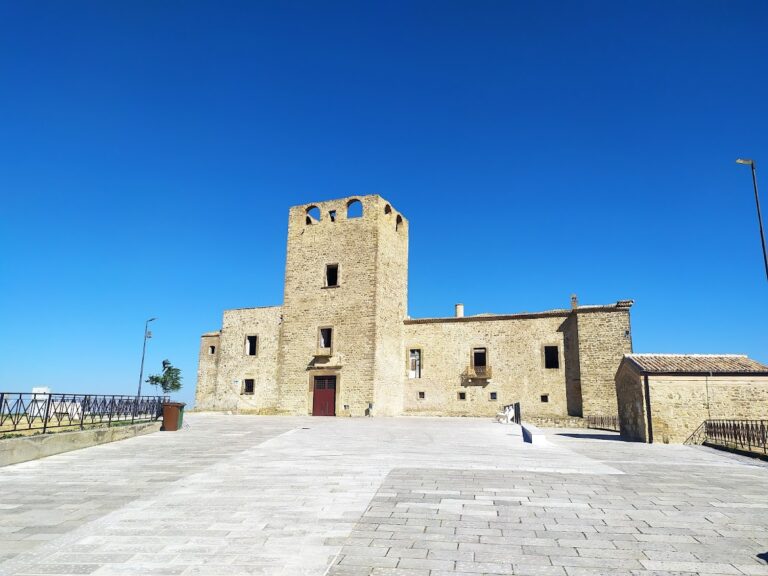
Castello Tramontano is built in the Aragonese architectural style, marked by its central keep, or maschio, which stands taller than the two flanking, round side towers. All three structures feature crenellations—battlement notches used for defense—and loopholes, narrow vertical slits that allowed defenders to observe and shoot while remaining protected. This arrangement illustrates the castle’s role as a fortified residence designed to assert feudal dominance rather than withstand large-scale sieges.
Originally, the two round side towers were connected by a bridge, a feature that has since been lost. There was also an intended walkway linking Castello Tramontano to the nearby Castiglione Normanno, though this corridor was never completed. The castle occupies a prominent position on Lapillo Hill, overlooking Matera’s historic center from outside the old city walls, providing commanding views of the surrounding landscape.
Archaeological excavations beneath Matera’s central square have uncovered remaining foundations of a defensive tower and subterranean chambers associated with the castle’s planned expansions. These discoveries suggest that the castle was to have a larger and more intricate system of fortifications than what was ultimately finished.
Restoration projects have focused on rehabilitating the castle’s moat as well as its walls, which are constructed from tufa, a type of porous limestone common in the region. These efforts help maintain the structural integrity of the surviving elements and highlight the characteristic building materials used in the castle’s original construction.
Today, the remains of Castello Tramontano stand as partially restored structures that evoke its incomplete past. The combination of above-ground crenellated towers and below-ground archaeological features provide tangible evidence of the castle’s historical ambition and the interruption caused by political unrest during the early 1500s.
Nearby sites