Amphitheatre of Saintes: A Roman Entertainment Venue in France


Visitor Information
Google Rating: 4.2
Popularity: Medium
Google Maps: View on Google Maps
Official Website: www.ville-saintes.fr
Country: France
Civilization: Roman
Remains: Entertainment

History
The Amphitheatre of Saintes is located in the city of Saintes, France, and was built by the Romans during their occupation of the region. It stands in what was once Mediolanum Santonum, the capital of the Santones tribe and an important center in the Roman province of Gallia Aquitania.
Construction of the amphitheatre likely began under the reign of Emperor Augustus or his successor Tiberius, placing its origins in the early first century AD. The building was completed around 40 AD, possibly during the rule of Emperor Claudius, as confirmed by an inscription fragment found on site bearing his name. This dating aligns with architectural features typical of the Julio-Claudian period. The amphitheatre served as a venue for public spectacles such as gladiatorial combats and animal fights, entertaining the citizens of the city and the surrounding province.
In the late third century AD, the amphitheatre underwent repairs or renovations, indicated by the discovery of a wooden gutter from that time encircling the arena. This suggests the structure remained in use well into the later Roman Empire. However, by the first half of the fourth century, the amphitheatre was abandoned. Over time, the arena gradually filled with sediment, and the building’s stones were quarried for reuse in local fortifications and medieval constructions, reflecting a shift in the city’s needs and resources.
During the eighth century, the area within the seating sections, known as the cavea, saw new habitation, marking a transformation from a public entertainment space to a residential zone. The amphitheatre’s historical importance was recognized from the eighteenth century onward, leading to its designation as a historic monument in 1840, with this status reaffirmed in 1914. Archaeological excavations and restoration efforts took place in 1877 and 1906, including the removal of accumulated sediment from the arena floor. In 1982, severe flooding caused damage, particularly to the western vomitorium, one of the passageways used by spectators.
More recently, a comprehensive preservation and restoration program began in 2021, following detailed archaeological investigations. Today, the amphitheatre continues to serve the community by hosting cultural events such as summer operas, linking its ancient past with contemporary life.
Remains
The Amphitheatre of Saintes occupies a narrow valley oriented east to west, a natural setting that the Romans skillfully incorporated into its design. The overall shape is elliptical, measuring approximately 126 meters along its longest axis and 102 meters across its shorter axis. The central arena, where events took place, spans about 65 by 39 meters. The seating area, or cavea, could hold between 12,000 and 15,000 spectators, arranged on stone tiers closest to the arena and likely wooden seats above.
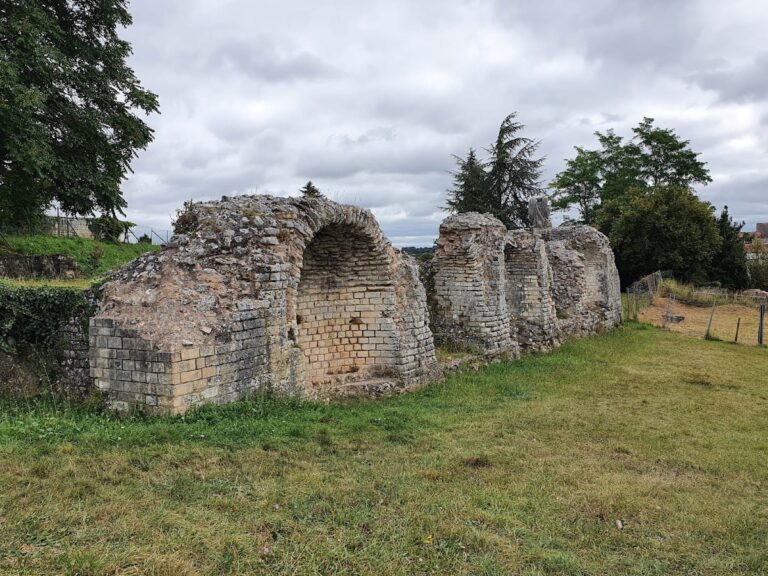
The cavea takes advantage of the rocky slopes on the north and south sides, which provided natural support and reduced the need for extensive masonry. At the western end, an embankment, possibly predating the amphitheatre, supports masonry walls that close off the structure. The eastern side, facing the Charente River, is fully constructed with a series of radiating vaulted chambers forming two levels of arcades on the façade. This combination of solid and hollow construction techniques is characteristic of Roman amphitheatres in Gaul.
A sturdy wall about two meters high and nearly one meter thick, built from large, precisely fitted ashlar blocks, encloses the arena, separating the spectators from the events below. Two main gates allowed access to the arena: the eastern gate known as Sanavivaria, or “gate of the living,” and the western gate called Libitinensis, or “gate of the dead,” the latter now blocked in modern times. Flanking the corridors leading to the arena are service rooms that may have functioned as holding cells for gladiators or animals, opening both onto the corridors and the arena itself.
At the base of the cavea along the shorter axis, two small rooms likely served as sacella, or shrines, topped by an honorary loggia, indicating a place for religious or ceremonial functions within the amphitheatre. The stone seating near the arena remains partially preserved, while the upper tiers, originally constructed of wood, have not survived.
Spectators reached their seats via about 28 staircases descending from an external esplanade that encircles the amphitheatre from the north to the west. This esplanade lies roughly 10 to 11 meters below the top of the cavea. The staircases are bordered by walls that create compartments within the embankment, organizing the flow of visitors. Unlike some Roman amphitheatres, this one does not have a ground-floor annular gallery; instead, a gallery exists only on the first floor near the eastern gate, accessible by adjacent staircases.
A notable later addition is Sainte-Eustelle’s fountain, located midway down the southern seating slope. Installed in the twelfth century, this fountain was created when the amphitheatre’s surroundings were backfilled, causing spring water to flow into the cavea.
The arena floor itself contains no basement service rooms but features a drainage channel running lengthwise. This channel collects rainwater from the seating area through an annular gutter at the base of the podium wall and directs it toward the nearby Charente River, demonstrating careful attention to water management.
Construction materials vary throughout the amphitheatre. Small limestone rubble was used for the annular and radial walls, while flat stones set on edge form the vaults and arcades. Large blocks were reserved for the podium wall, staircases, entrance piers, and the lowest rows of seating, reflecting their structural importance.
The amphitheatre is situated near an ancient necropolis to the east, where the dead were buried during Roman times. Despite partial quarrying during the Middle Ages, the foundations of the cavea and arena remain largely intact, allowing the original form of the structure to be clearly understood. The site lies southwest of the ancient city center, adjacent to the historic road connecting Saintes to Bordeaux, with the modern city having grown around it since the nineteenth century.
Nearby sites