Volubilis: An Ancient Roman Municipium and Historical Site in Morocco
Table of Contents



Visitor Information
Google Rating: 4.5
Popularity: Medium
Google Maps: View on Google Maps
Country: Morocco
Civilization: Early Islamic, Phoenician, Roman
Remains: City

Context
Volubilis is situated on a basaltic volcanic plateau at the base of Jebel Zerhoun, near the modern town of Moulay Idriss Zerhoun in north-central Morocco. The site overlooks a fertile agricultural plain north of present-day Meknès, benefiting from abundant watercourses and rich soils that supported extensive cultivation, particularly of olives and cereals.
Archaeological stratigraphy reveals human occupation at Volubilis dating back to the Neolithic and Bronze Age periods, with intensified urban development during the late Punic and Mauretanian eras. Under Roman administration from the first century CE, the site experienced significant architectural expansion and artistic production, especially in the second and third centuries CE, as evidenced by extensive mosaics and monumental construction. Material culture and inscriptions attest to continued occupation into Late Antiquity, including Christian religious presence. After the late third century, evidence indicates a decline in building activity and a contraction of the inhabited area.
European travelers documented the ruins from the eighteenth century onward, while systematic archaeological investigations commenced under French protectorate authorities in the early twentieth century. Post-independence Moroccan efforts have continued conservation, excavation, and site management. Volubilis was designated a UNESCO World Heritage Site in 1997, recognized for its exceptional preservation of a Roman colonial town and its testimony to cultural interactions spanning from antiquity through the Islamic period. The site retains extensive masonry remains, mosaics in situ, and stratified deposits that continue to inform its complex chronology and functions.
History
Volubilis provides a layered historical record reflecting the cultural and political transformations of northern Morocco from indigenous Berber origins through Punic, Roman, and Islamic periods. Its development illustrates the integration of local traditions with imperial structures and the shifting dynamics of regional power over more than a millennium.
Berber and Punic Period (Before 1st century BCE)
Prior to Roman domination, Volubilis emerged as a Berber settlement strategically located on a fertile plateau near the Zerhoun mountains. Archaeological evidence, including Neolithic and Bronze Age pottery with affinities to Iberian and North African styles, attests to early occupation. By the third century BCE, the site had developed into a proto-Carthaginian urban center, as indicated by the remains of a temple dedicated to the Punic deity Baal and inscriptions in the Phoenician language. Volubilis was incorporated within the Kingdom of Mauretania, an indigenous Berber polity influenced by Punic and Hellenistic cultures, and likely functioned as its capital during the fourth and third centuries BCE.
Governance was administered by suffetes, magistrates of Punic origin, demonstrating continuity in local political institutions that persisted even after Roman annexation. The urban plan comprised approximately 12 hectares enclosed by mudbrick walls on stone foundations, arranged in a regular pattern characteristic of Phoenician settlements. The economy was predominantly agricultural, with olive cultivation central to subsistence and trade, supported by fertile soils and water from nearby wadis. Religious life centered on Punic cults, with civic ceremonies likely overseen by the suffetes, integrating political and religious authority within the community.
Roman Conquest and Administration (1st century BCE – Late 3rd century CE)
The Roman period at Volubilis commenced with the installation of Juba II as king of Mauretania in 25 BCE. Educated in Rome and married to Cleopatra Selene II, Juba II transformed Volubilis into a royal capital and residence, fostering the adoption of Roman architectural and artistic styles. Following the Roman annexation of Mauretania in 44 CE under Emperor Claudius, Volubilis was incorporated as a municipium, conferring Roman citizenship on its inhabitants and replacing the traditional Punic suffetes with Roman magistrates such as duumvirs and aediles, thereby integrating the city into the imperial administrative framework.
Under Roman rule, Volubilis expanded to cover approximately 42 hectares, enclosed by a 2.6-kilometer-long stone wall featuring 34 towers and six principal gates, including the Tingis Gate dated to 168/169 CE. The city’s population is estimated at up to 20,000, predominantly Romanized Berbers alongside minorities of Europeans, Greeks, Syrians, Jews, and Arabs. The economy thrived on agriculture, especially olive oil production, supported by fertile hinterlands. Volubilis was connected by roads to regional centers such as Lixus and Tingis but remained isolated from the eastern province of Mauretania Caesariensis due to hostile Berber tribes.
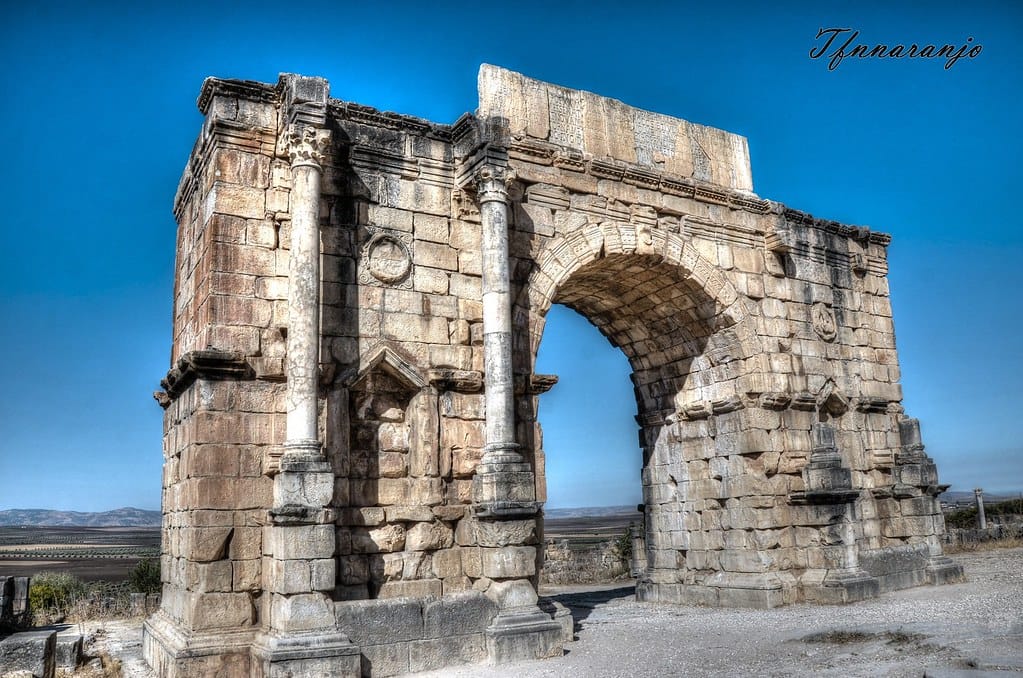
Military defense was maintained through a ring of five forts housing auxiliary cohorts recruited from Gaul, Hispania, Belgica, Parthia, and Syria, securing the frontier. Public architecture from the second and early third centuries CE includes a large basilica for civic administration and justice, a Capitoline Temple dedicated to Jupiter, Juno, and Minerva (rebuilt in 218 CE), a forum with markets and imperial statues, multiple temples including one dedicated to Saturn built over a former Punic sanctuary, and at least three public bath complexes. The Arch of Caracalla, erected in 217 CE by procurator Marcus Aurelius Sebastenus, commemorated Emperor Caracalla and his mother Julia Domna; constructed of local limestone, it originally featured a bronze chariot and was richly adorned with statues and medallions.
Residential architecture ranged from modest two-room mudbrick houses to expansive patrician villas with peristyles, private baths, and elaborately decorated mosaic floors depicting mythological and animal motifs, exemplified by the Houses of Orpheus, Athlete, Ephebe, Knight, Labours of Hercules, and Venus. The city’s infrastructure included a sophisticated aqueduct system built circa 60–80 CE, supplying water to public fountains, baths, and private residences, with sewage drains channeling waste to the river. Socially, the elite participated in Roman municipal institutions, including a senate (ordo), duumvirs, aediles, flamines, and collegia, supporting imperial cults and local religious practices that combined Roman, Berber, Oriental, Jewish, and later Christian elements. Volubilis remained loyal to Rome during the revolt of 40–44 CE led by Aedemon, a freedman of King Ptolemy, and was rewarded with citizenship and tax exemptions. The Gordian Palace, the city’s largest building with 74 rooms, served as the governor’s residence and included shops and an olive oil factory; inscriptions from this site document treaties with local Berber chieftains, reflecting the gradual decline of Roman authority in the late third century.
Late Roman and Post-Roman Period (Late 3rd century – 7th century CE)
The Crisis of the Third Century precipitated the weakening of Roman control in Mauretania, culminating in the abandonment of Volubilis by imperial authorities around 280 CE as part of a strategic withdrawal to coastal cities. Despite the official Roman departure, the city continued to be inhabited by a Latinized Christian community for several centuries. Archaeological evidence includes Christian funerary inscriptions and iconography such as a “Good Shepherd” statue. The aqueduct fell into disrepair, and the urban center shifted westward toward the Wadi Khoumane, where a new defensive wall was constructed in the fifth or sixth century using reused Roman masonry.
Volubilis suffered a probable earthquake at the end of the fourth century CE, which buried numerous bronze statues. Numismatic finds include coins from late Roman emperors such as Constantine II, Constantius II, Gratian, and Theodosius, alongside Christian inscriptions dated to the sixth and seventh centuries. The city’s population declined, and municipal institutions faded, though Latin remained in use until at least 681 CE. The city was protected by three military camps and forts located within five to twenty kilometers, housing auxiliary troops and local Berber contingents. Religious life centered on Christianity, with ecclesiastical leadership likely supplanting former civic magistracies, maintaining continuity of faith amid political fragmentation.
Early Islamic and Idrisid Period (8th – 11th centuries CE)
The Arab conquest reached northern Morocco by 708 CE, and Volubilis, known as Walīlī or Oualila, came under Islamic influence. The Awraba Berber tribe, originating from Libya, inhabited the city. Much of the old Roman urban center was abandoned and repurposed as a cemetery, while habitation concentrated within a smaller walled area. Islamic coinage from the eighth century confirms the integration of Volubilis into early Islamic economic and political networks. Arab and Berber settlements coexisted, with Arab settlers residing outside the old city walls.
Idris I, a descendant of the Prophet Muhammad fleeing Abbasid persecution, established the Idrisid dynasty in Volubilis around 787–788 CE. He was proclaimed imam in the city under the Awraba chieftain Ishaq ibn Mohammad. Archaeological excavations near the Wadi Khoumane uncovered a large complex with interlocking courtyards and a hammam, identified as Idris I’s headquarters, dated by coins and pottery to his reign. Idris I married Kanza of the Awraba and fathered Idris II, who was also proclaimed imam in Volubilis but later relocated the capital to Fes, diminishing Volubilis’s political significance. In 818 CE, the Rabedis, a Muslim group expelled from Córdoba, settled in Volubilis. The city remained inhabited until the eleventh or twelfth century but was largely abandoned by the fourteenth century, with the population relocating to nearby Moulay Idriss Zerhoun. The tomb of Idris I was originally located in Volubilis but was later transferred to Moulay Idriss Zerhoun, where a mausoleum was constructed and became a pilgrimage site.
Post-Medieval Decline and Modern Rediscovery (17th century – Present)
Volubilis remained relatively intact until the mid-eighteenth century when the 1755 Lisbon earthquake caused significant structural damage. Subsequently, the site was extensively quarried for building materials, particularly during the reign of Sultan Moulay Ismail (late seventeenth to early eighteenth century), who repurposed stones and marble for his imperial capital at Meknes. Early European travelers such as John Windus (1722) and James Gray Jackson (1820) documented the ruins, describing monumental remains including the triumphal arch, basilica, and scattered marble columns.
Systematic archaeological excavations began in the late nineteenth century under Henri de la Martinière and continued during the French protectorate by Marcel and Jane Dieulafoy and Louis Chatelain, with assistance from German prisoners of war during World War I. These investigations uncovered numerous public buildings, private residences, mosaics, and inscriptions. Restoration efforts in the twentieth century focused on key monuments such as the Arch of Caracalla, Capitoline Temple, basilica, and Tingis Gate, alongside conservation of mosaics and olive oil production workshops. Since 2000, joint Moroccan-British excavations have revealed Idris I’s headquarters and early medieval town sections. In 1997, Volubilis was inscribed as a UNESCO World Heritage Site, recognized for its exceptional preservation and its testimony to cultural exchanges from antiquity through the Islamic period.
Daily Life and Importance by Period
Berber and Punic Period (Before 1st century BCE)
During the Berber and Punic phases, Volubilis functioned as a fortified settlement governed by suffetes, magistrates of Punic origin, indicating a structured civic administration rooted in indigenous and Carthaginian traditions. The population primarily consisted of Berber agriculturalists cultivating olives and cereals on the fertile plateau near Jebel Zerhoun, supported by nearby watercourses. Social organization likely centered on extended family units and tribal affiliations, with local elites overseeing governance and religious ceremonies.
Economic activities were predominantly agricultural, with olive cultivation central to subsistence and trade. Trade and transport were facilitated by the site’s strategic position overlooking fertile plains, enabling exchange with neighboring Berber communities and Punic trading networks extending possibly to Iberia.
Roman Conquest and Administration (1st century BCE – Late 3rd century CE)
Under Roman rule, Volubilis became a prosperous municipium with an estimated population of up to 20,000, predominantly Romanized Berbers alongside minorities of Europeans, Syrians, Jews, and Arabs. Social stratification was pronounced, with an elite class participating in municipal governance through duumviri, aediles, and a senate (ordo), while enslaved persons constituted approximately 10% of the population. Family structures included nuclear and extended households, often centered around patrician villas or modest dwellings.
Economically, olive oil production dominated, evidenced by at least 58 oil-pressing workshops integrating mills, presses, and decantation basins operating at both industrial and domestic scales. Agriculture also included grain cultivation and animal husbandry. Commercial life was vibrant, with over 120 shops, bakeries, and bronze workshops. The Gordian Palace combined administrative, residential, and industrial functions, including an olive oil factory. Roads connected Volubilis to Lixus and Tingis, facilitating regional trade, though hostile tribes limited eastern links.
Diet consisted of bread, olives, fish, and locally produced olive oil, with wine likely imported or produced in smaller quantities. Domestic interiors ranged from simple two-room mudbrick houses to expansive villas featuring peristyles, private baths, and richly decorated mosaic floors portraying mythological and animal motifs, such as in the Houses of Orpheus and Venus.
Public amenities included a large basilica for administration and justice, a Capitoline Temple, multiple temples, forums, and at least three bath complexes supplied by a sophisticated aqueduct system. Religious life was pluralistic, combining Roman state cults (including the imperial cult and Capitoline triad), local Berber deities, Oriental cults (Isis, Mithra), Judaism, and later Christianity.
Late Roman and Post-Roman Period (Late 3rd century – 7th century CE)
Following the Roman withdrawal around 280 CE, Volubilis experienced demographic decline and infrastructural deterioration, with the aqueduct falling into disrepair and urban life shifting westward toward the Wadi Khoumane. The population remained Latinized and predominantly Christian, as attested by funerary inscriptions and iconography such as the “Good Shepherd” statue. Municipal institutions faded, but Latin persisted until at least 681 CE.
Economic activities contracted, focusing on sustaining local needs with grain storage and limited craft production. The construction of a smaller defensive wall in the fifth or sixth century using reused Roman materials indicates continued concern for security amid regional instability. A probable late fourth-century earthquake further impacted the urban fabric, accelerating decline.
Socially, the community comprised Christian Berbers and Romanized inhabitants, with military presence maintained through nearby forts housing auxiliary troops and local contingents. Religious life centered on Christian worship, with ecclesiastical leadership likely replacing former civic magistracies. Educational practices probably included Christian instruction, though direct evidence is scant. Volubilis’s role shifted from a Roman provincial capital to a diminished regional center maintaining continuity of faith and culture during Late Antiquity.
Early Islamic and Idrisid Period (8th – 11th centuries CE)
The Arab conquest introduced Islam and new ethnic groups, notably the Awraba Berber tribe, who inhabited Volubilis (Walīlī). The old Roman city center was largely abandoned and repurposed as a cemetery, while habitation concentrated within a smaller walled area. Islamic coins from the eighth century confirm the integration of Volubilis into early Islamic economic and political networks.
Economic life included grain storage and possibly glassmaking, supporting a modest urban community. Domestic architecture adapted to Islamic norms, though detailed decoration is poorly documented. Religious practices centered on Islam, with mosques and ritual purity facilities replacing earlier Christian and pagan sites. Volubilis’s political importance declined after Idris II moved the capital to Fes, reducing its regional prominence, though it remained inhabited until the eleventh or twelfth century.
By the post-medieval period, Volubilis was largely abandoned.
Remains
Architectural Features
Volubilis occupies a basalt plateau covering approximately 42 hectares, enclosed by a substantial stone city wall constructed in the late second century CE. The Roman fortifications extend about 2.6 kilometers with an average thickness of 1.6 meters, built of rubble masonry and ashlar blocks. The circuit includes 34 towers spaced roughly every 50 meters and six principal gates, several flanked by towers. A portion of the eastern wall has been reconstructed to a height of 1.5 meters. Near the central tumulus, a 77-meter stretch of the original pre-Roman mudbrick wall on a stone foundation survives. Additionally, an early medieval wall constructed with reused stones stands west of the Arch of Caracalla, dating to the fifth or sixth century CE, enclosing a reduced residential area.
The urban layout reflects a primarily civic and residential character, with a central forum, public buildings, temples, baths, and numerous private houses. The city expanded notably under Roman rule, reaching its greatest extent in the second and early third centuries CE. After the late third century, building activity declined, and the inhabited area contracted, as evidenced by the construction of the smaller early medieval enclosure. Construction techniques include opus quadratum (ashlar masonry) for monumental buildings and rubble masonry for walls, with extensive use of local limestone and basalt.
Key Buildings and Structures
Arch of Caracalla
Situated at the eastern terminus of the Decumanus Maximus, the Arch of Caracalla was erected in 217 CE by Marcus Aurelius Sebastenus, the city’s governor. Constructed from local grey limestone, the arch measures approximately 20 meters in width, with an archway 8 meters high and 6 meters wide; its original height is estimated at 14 meters. The monument was originally crowned by a bronze chariot drawn by six horses. Statues of nymphs once adorned the base, pouring water into marble basins. Medallion busts of Emperor Caracalla and his mother Julia Domna decorated the arch but have been defaced. The dedicatory inscription, reconstructed from fragments found in 1722, praises Caracalla’s titles and the city’s gratitude for his tax remission. The arch sustained damage during the 1755 Lisbon earthquake and was partially restored by French archaeologists between 1930 and 1934, though the restoration remains incomplete and subject to scholarly debate.
Basilica
The basilica, completed in the early third century CE during the reign of Emperor Macrinus, functioned as the center for civic administration and justice. It measures 42.2 meters in length and 22.3 meters in width and originally had two stories. The interior features two rows of columns framing apses at each end, where magistrates sat. The outer wall, faced with columns, overlooks the 1,300 square meter forum. Constructed in opus quadratum with stucco facing, the building’s interior height reaches approximately 15 meters. The basilica opens onto the curia, a council chamber for magistrates. It is considered one of the finest Roman basilicas in Africa and is likely modeled on the basilica at Leptis Magna.
Capitoline Temple
Located behind the basilica within an originally arcaded courtyard, the Capitoline Temple is dedicated to the Roman triad of Jupiter, Juno, and Minerva. The temple comprises a single cella (inner chamber) accessed by 13 steps leading up from the courtyard, with an altar positioned in front. Its layout is unusual, facing the back wall of the basilica, and it may have been constructed atop an earlier shrine. An inscription dated 218 CE records its reconstruction. The temple underwent partial restoration in 1955 and substantial restoration in 1962, including reconstruction of most steps, cella walls, and columns. Within the temple precinct, four smaller shrines existed, one dedicated to Venus.
Temple of Saturn (so-called)
Situated on the eastern side of the city, isolated by the Fertassa wadi ravine, this temple was built or converted atop an earlier Punic sanctuary, possibly dedicated to Baal. The sanctuary is enclosed by a surrounding wall and features a three-sided portico. Inside stands a small temple with a cella on a shallow podium. The identification as a Temple of Saturn is hypothetical and not universally accepted. The temple covers approximately 3,200 square meters and was in use from the first to third centuries CE. It was restored during the construction of the Marcus Aurelius city walls in 168–169 CE.
Other Temples
Near the Capitoline Temple, a Punic-style open-air temple (Temple A) dating to the third century BCE was discovered but destroyed before Juba II’s reign. Northwest of the forum, twin temples (designated G13 and H13), built in the second to early first century BCE, have been excavated; one is thought to have served the imperial cult. Temple C, located near the tumulus and basilica, dates to the early third century CE and measures about 600 square meters with a triportico plan. It was destroyed soon after the Roman withdrawal.
Forum
The forum lies at the city center, covering approximately 1,300 square meters. It was accessible via two staircases and enclosed by two gates. The forum underwent extensive remodeling from the first to early third century CE. The eastern side housed the basilica and curia, while the western side contained a porticoed building and a temple. The paved forum contained numerous statues of emperors and local dignitaries, though only pedestals remain. Fourteen inscriptions have been found here, including imperial dedications and honors to prominent local families.
Public Baths
Volubilis contained at least three public bath complexes. The Baths of Gallienus, redecorated in the 260s CE, are the most elaborate. The North Baths, possibly constructed during Hadrian’s reign (early second century CE), cover about 1,500 square meters and include a 724 square meter exercise area (palestra) and a 300 square meter courtyard. These baths featured hypocaust heating systems and were supplied by the city’s aqueduct. Other bath complexes include the Baths of the Capitol and the Baths of the House with the Cistern. Outside the city walls, a hammam dating to the eighth or ninth century CE demonstrates continuity of Roman bath architecture into the Islamic period.
Aqueduct and Water Supply
The aqueduct, constructed around 60–80 CE, brought water from a spring in the hills behind the city to a large fountain near the Arch of Caracalla. It ran mostly underground beneath the Decumanus Secundus street and distributed water through a network of channels to public fountains, baths, and private homes. Sewage and waste were carried away by drains to the river. The aqueduct underwent modifications in the second and third centuries CE, including the addition of filtration basins.
Houses and Palaces
The city contains numerous private residences ranging from modest houses to large patrician villas. The House of Orpheus, located in the southern sector, is named for a large circular mosaic depicting Orpheus playing a harp to animals. The House of the Athlete, near the forum, contains a mosaic of an acrobat riding a donkey backwards and fishing scenes. The House of the Ephebe features a prominent courtyard and mosaics including Bacchus in a chariot drawn by leopards or tigers.
The House of the Knight, adjacent to the House of the Ephebe, includes a mosaic of Bacchus discovering the sleeping Ariadne and incorporates commercial spaces with multiple shops and a large olive-pressing complex. The House of the Labours of Hercules, a palatial residence with 41 rooms covering about 2,000 square meters, contains a mosaic depicting the twelve labors of Hercules along with Jupiter, Ganymede, and the four seasons, dating to the reign of Emperor Commodus.
The Gordian Palace, the largest building in the city, was rebuilt in the mid-third century CE and likely served as the governor’s residence. It combines two houses into a complex of 74 rooms with courtyards and private baths. The front includes a colonnaded area with a dozen shops and an oil factory with three presses and storage. Decoration is plain, with few mosaics and mostly opus sectile floors. Inscriptions found here document treaties with local Berber chieftains.
The House of Venus, located on the eastern side beneath a prominent cypress tree, is one of the most luxurious residences. It was fully decorated with mosaics in seven corridors and eight rooms, including a central courtyard mosaic depicting chariot races with teams of peacocks, geese, and ducks. The house included private baths. The Venus mosaic was removed to Tangier. The house was destroyed after the city’s fall around 280 CE, with evidence of fire damage in some mosaics. A bronze bust of Cato the Younger was discovered here in 1918, along with another bronze bust possibly representing Juba II found nearby.
Headquarters of Idris I
Located just outside the city walls on the floodplain of the Oued Khoumane, this complex dates to the late eighth century CE and is identified as the headquarters of Idris I. It consists of interlocking courtyard buildings, the largest containing an L-shaped hammam (bathhouse) with a cold room, plunge pool, warm room with vaulted ceiling, and hot room heated by a furnace. The courtyard contained large grain silos. Adjacent courtyards served reception and domestic functions, including a room painted red with a low bench or divan. The architectural plan differs markedly from the simpler structures inside the city walls.
Burial
A large tumulus of uncertain origin stands near the middle of the excavated area between the old and new parts of the city; its function remains debated. Christian burials and epitaphs have been found near the city center, especially around the Arch of Caracalla. Muslim necropolises dating from the Islamic period are located near the late medieval enclosure and close to the triumphal arch.
Other Remains
Over 50 villas have been discovered in the surrounding region. Within the city, more than 121 shops have been identified, many functioning as bakeries. Fifty-eight olive oil pressing complexes have been excavated, each typically including a mill, decantation basin, and press with counterweight. Numerous bronze artifacts suggest local production or distribution of bronze goods. The city had a complex drainage system, including a sewer beneath the Decumanus Maximus covered with limestone slabs. Latrines existed, though wooden seats have left little trace. A ring of five forts and two additional forts formed a defensive perimeter around the city, housing auxiliary cohorts from various provinces. The Jewish community is attested by Hebrew, Greek, and Latin funerary inscriptions and menorah-shaped lamps, marking Volubilis as the southwesternmost site with ancient Hebrew inscriptions. Early medieval walls and structures include a 660-meter-long enclosure protecting the reduced city area.
Archaeological Discoveries
Excavations at Volubilis have uncovered a wide range of artifacts spanning from the Neolithic through the Islamic periods. Pottery includes local and imported amphorae and tableware from Punic, Roman, and early Islamic contexts. Over 800 inscriptions have been recorded, including imperial dedications, municipal honors, Christian epitaphs, and treaties with Berber chieftains. Coins from various Roman emperors such as Constantine II, Constantius II, Gratian, and Theodosius have been found, as well as early Islamic coinage from the eighth century onward.
Tools related to agriculture and craft production have been recovered, alongside domestic objects such as lamps and cooking vessels. Religious artifacts include statuettes, altars, and ritual vessels from Punic, Roman, and Christian contexts. Bronze statues and busts, including representations of Cato the Younger and possibly Juba II, have been discovered in domestic and public settings. Mosaics depicting mythological, animal, and everyday scenes are present in several houses and public buildings. These finds provide evidence of local production, trade connections, and diverse religious practices over many centuries.
Preservation and Current Status
The ruins of Volubilis are generally well-preserved, with large stretches of the city walls, public buildings, and private houses visible. The Arch of Caracalla, basilica, Capitoline Temple, and Tingis Gate have undergone restoration, some of which involved reconstruction using modern materials. The arch’s restoration between 1930 and 1934 remains incomplete and has been subject to scholarly debate. The Capitoline Temple and basilica were restored in the mid-twentieth century, including reconstruction of steps, walls, and columns. The Tingis Gate was restored in 1967.
Many mosaics remain in situ, though some, such as the Venus mosaic, have been removed for conservation. The site faces environmental challenges including erosion and vegetation growth, as well as past damage from looting and the 1755 Lisbon earthquake. Ongoing excavation and conservation efforts are conducted by Moroccan heritage authorities in collaboration with international teams. Some areas are stabilized but not fully restored to preserve archaeological integrity. Conservation programs continue to clarify the site’s chronology and functions.
Unexcavated Areas
Approximately half of the 42-hectare site remains unexcavated. Several districts, including residential quarters and peripheral areas, are known from surface surveys and historic maps but have not been systematically explored. Geophysical studies have been limited, and some areas are restricted due to conservation policies or modern land use. Future excavations are planned but proceed cautiously to balance research with preservation. The early medieval enclosure and sections outside the Roman walls await further study to better understand the city’s contraction and transformation during Late Antiquity and the Islamic period.