Lussonium Fort: A Roman Military Outpost on the Danube in Hungary



Visitor Information
Google Rating: 4.5
Popularity: Low
Google Maps: View on Google Maps
Official Website: paks.hu
Country: Hungary
Civilization: Roman
Remains: Military

History
Lussonium Fort was established by the Romans on the western bank of the Danube River, near present-day Dunakömlőd in Hungary. It formed part of the Pannonian section of the Danubian Limes, the fortified frontier marking the northern boundary of the Roman Empire. The fort’s location on a prominent hill allowed control over a nearby river crossing and surveillance of the border region.
The fort was founded in the mid-1st century AD, likely during the reign of Emperor Claudius or Nero. This dating is supported by the discovery of Italian Terra Sigillata and Terra Nigra pottery, which were common Roman fine wares of that period. Lussonium served as a military base to guard against incursions by the Sarmatian Jazyges, a nomadic people living beyond the Danube.
Throughout its history, Lussonium was garrisoned by the Cohors I Alpinorum equitata, an auxiliary unit combining infantry and cavalry. This cohort, numbering between 500 and 1000 soldiers, was responsible for patrolling and defending the frontier. The fort was part of a larger defensive system including other forts, watchtowers, and legionary camps along the Danube.
In the late 3rd and early 4th centuries, Lussonium underwent rebuilding, replacing earlier wooden defenses with stone walls. This period also saw the construction of a large stone barracks and a multi-story tower near the southern gate. The fort’s military importance continued into the late 4th century, when a smaller fort with wooden structures and a large stone tower was built, reflecting changing defensive needs.
Religious life at Lussonium included worship of deities such as Jupiter Dolichenus and Mithras, as indicated by inscriptions and reliefs found on site. These cults were popular among Roman soldiers and reflect the spiritual practices within the garrison.
The fort remained occupied until the 5th century AD, when it was abandoned during the early Migration Period. This period saw widespread movement of peoples and the decline of Roman control in the region. After abandonment, the site gradually fell into ruin.
Archaeological interest in Lussonium began in 1969 following the discovery of military diplomas. Systematic excavations resumed in 1998, revealing extensive remains and artifacts. Restoration efforts between 2003 and 2008 helped preserve parts of the fort and its towers. Lussonium is now recognized as an important Roman archaeological site within Tolna County and forms part of the Danube Limes UNESCO World Heritage area.
Remains
Lussonium’s layout reflects its role as a Roman military fort guarding the Danube frontier. The original fort measured about 220 meters long and between 40 and 70 meters wide. Early defenses consisted of wood and earth ramparts, with timber-framed barracks built using wooden posts spaced half a meter apart and filled with clay bricks.
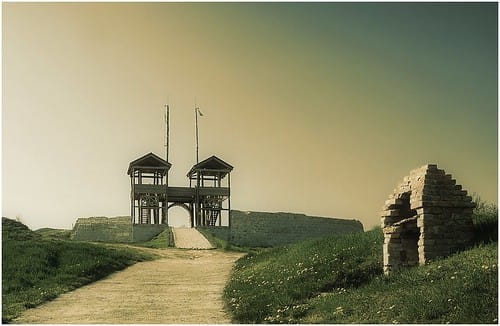
In the late Roman period, the fort was rebuilt in stone. The defensive wall stretched approximately 250 meters, with a thickness between 1.3 and 1.5 meters. Two single-lane gates stood at the north and south ends, each flanked by rectangular towers measuring just over 3 by 4 meters. These towers had walls nearly one meter thick externally and slightly thinner inside.
A large stone barracks building, measuring 27 by 14.5 meters, was located along the southern wall. It featured a wooden portico and was divided into two main sections with multiple entrances facing the portico. Near the southern gate, archaeologists uncovered a late Roman multi-story tower, 10 by 10 meters in size, with walls 2.3 meters thick. This tower was built over earlier structures.
The fort was surrounded by defensive ditches, initially 8 meters wide and 3 to 4 meters deep. These were later expanded to 12 meters wide and 4 to 5 meters deep, enhancing the fort’s protection. Excavations have revealed remains of northern ramparts, southern gate towers, and substantial wall sections. However, parts of the eastern defenses have been lost due to erosion and riverbank collapse.
Artifacts found at Lussonium include military diplomas, stamped bricks from various units and officers, iron helmets, shield bosses, tools, bronze weights, and lead-glazed lamps. Religious objects such as votive bronze plaques and altars dedicated to Jupiter Dolichenus, along with a relief depicting the Mithras bull-slaying scene, highlight the spiritual life of the soldiers.
West of the fort, the civilian settlement or vicus contained 3rd to 4th-century houses with stone foundations and porticoes. Archaeologists also found cisterns and refuse pits, indicating a settled community supporting the military presence.
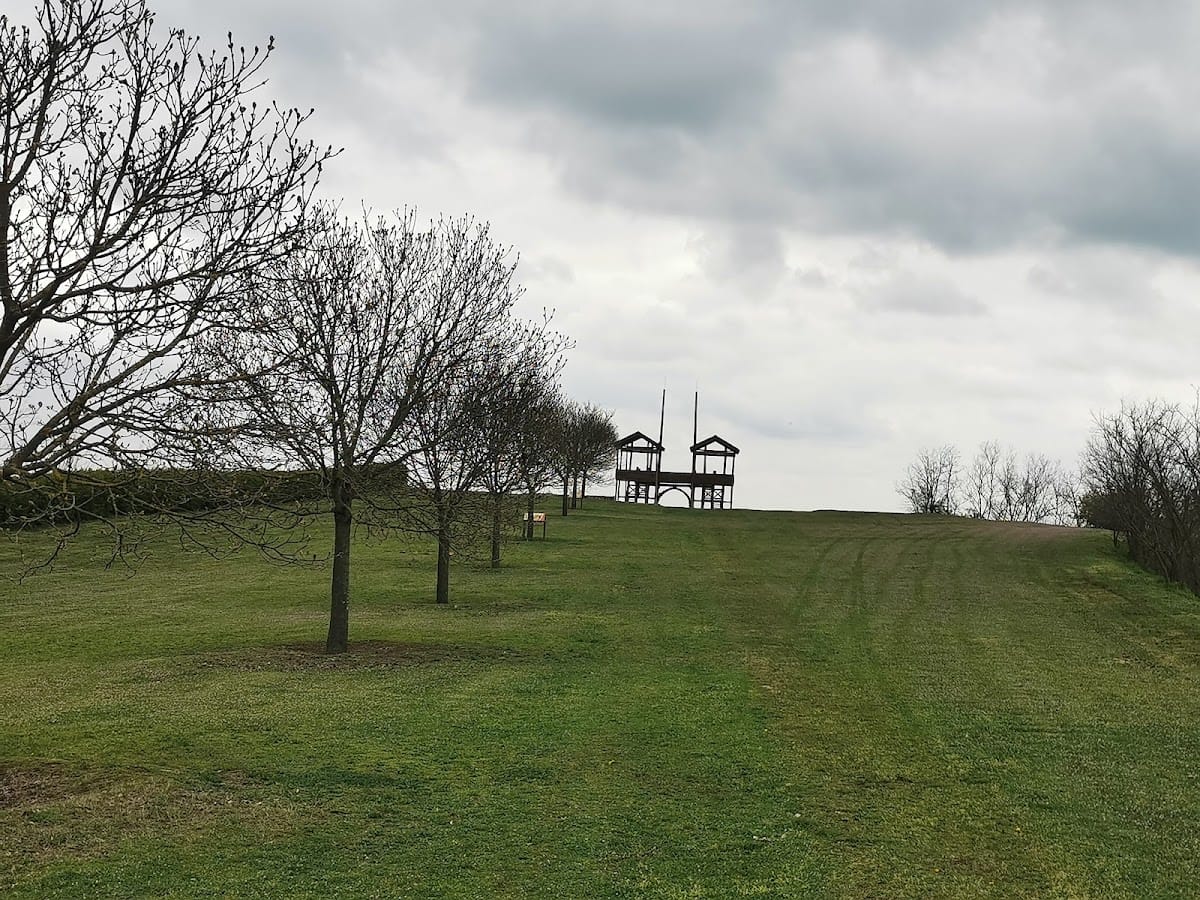
Today, parts of Lussonium’s northern and southern gates and barracks have been partially restored. The site preserves important archaeological remains that illustrate the fort’s long history as a Roman frontier garrison.
