Castles in Portugal: Explore Island Strongholds, Walled Towns and Royal Palaces
Castles in Portugal include compact keeps, hilltop citadels, fortified towns and residences with ceremonial rooms and gardens. Their walls can follow a river island or spread into bastions around an entire settlement. The collection also includes fortified religious complexes, where chapels and communal buildings developed within an earlier castle enclosure.
Primary Function: All
Type: All
Civilization: All
Popularity: All
Rating: All

Castelo de São Filipe is a sixteenth-century coastal fortress above Setúbal, Portugal, built during the Iberian Union and later expanded during the…
The Fort of São Francisco do Queijo, also called Castelo do Queijo, is a coastal fortress in Porto rebuilt in 1643 and later shaped by Portugal’s…

The Castle of Bragança developed as a fortified frontier settlement in northeastern Portugal, gaining walls, towers, and a major keep through…
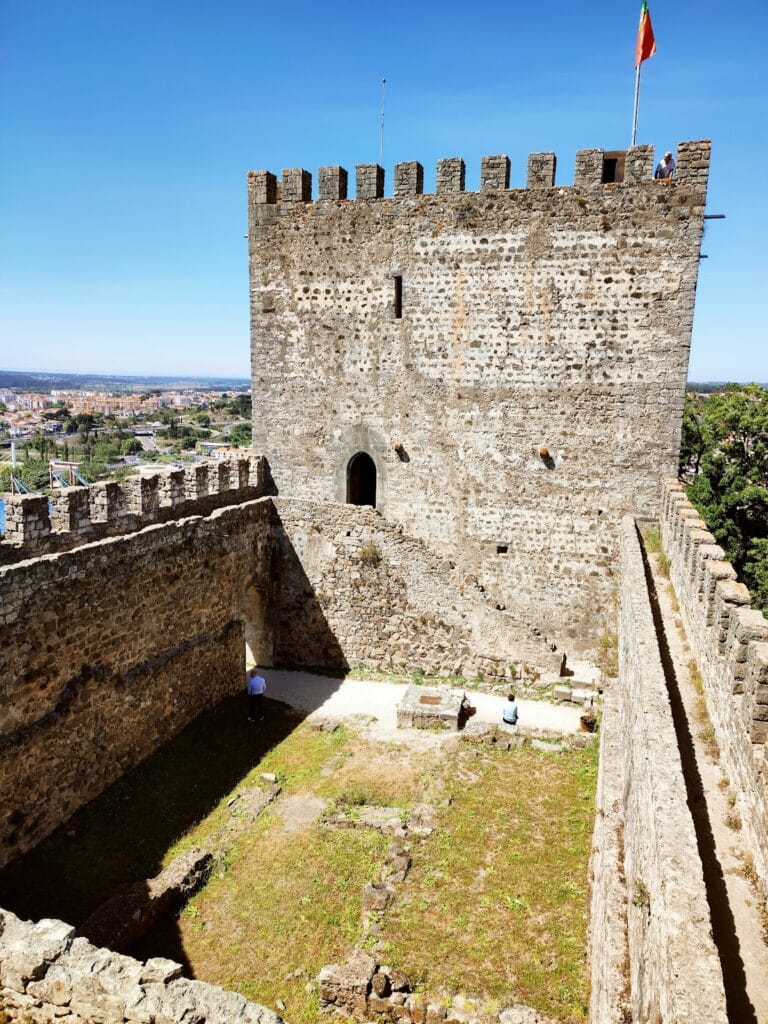
The Castle of Leiria developed from a twelfth-century frontier fortress into a royal residence, civic landmark, and layered architectural complex…
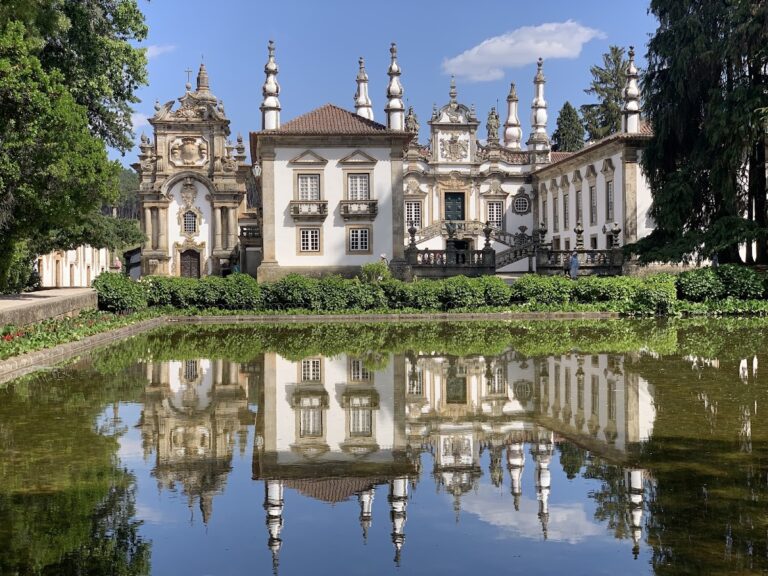
Mateus Palace near Vila Real is an eighteenth-century Northern Baroque manor designed by Nicolau Nasoni, with earlier winery buildings, a chapel,…

The Palace of the Dukes of Braganza began as the residence of Afonso, the first Duke of Braganza, and developed through royal confiscation, decline,…
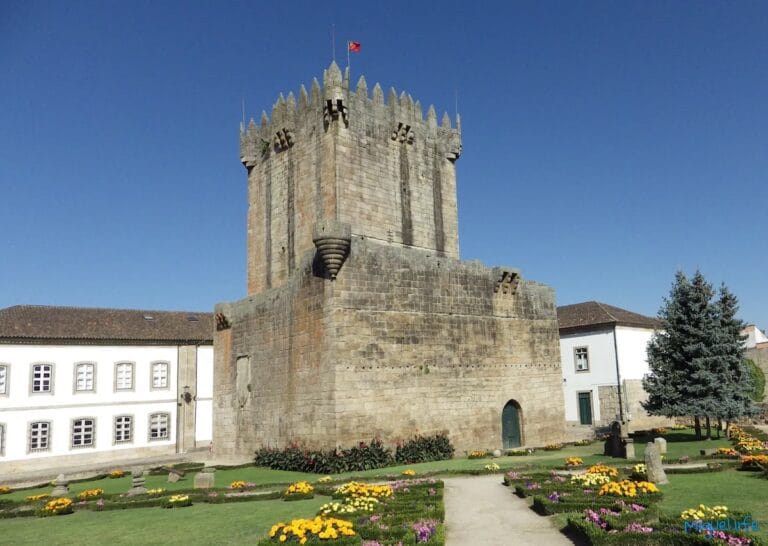
Castle of Chaves is a medieval fortress above the Tâmega River in northern Portugal, shaped by Roman, Muslim, Portuguese, and early modern military…
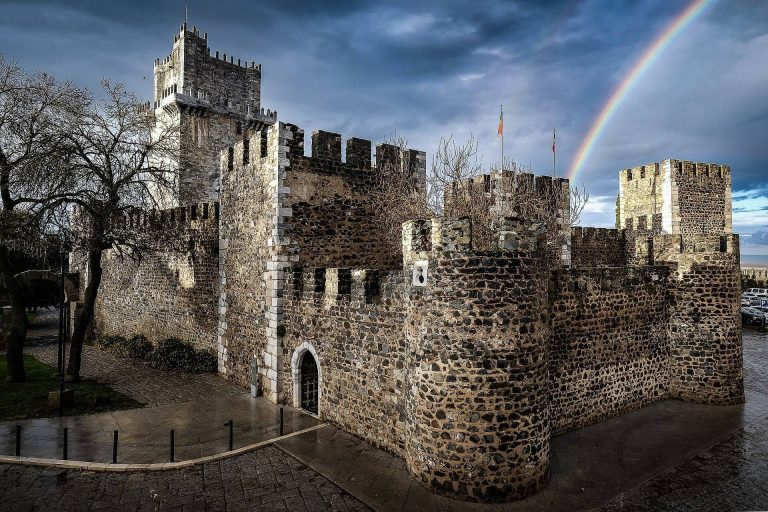
The Castle of Beja developed from Roman fortifications into a medieval Portuguese stronghold, later enlarged during the Restoration War and…
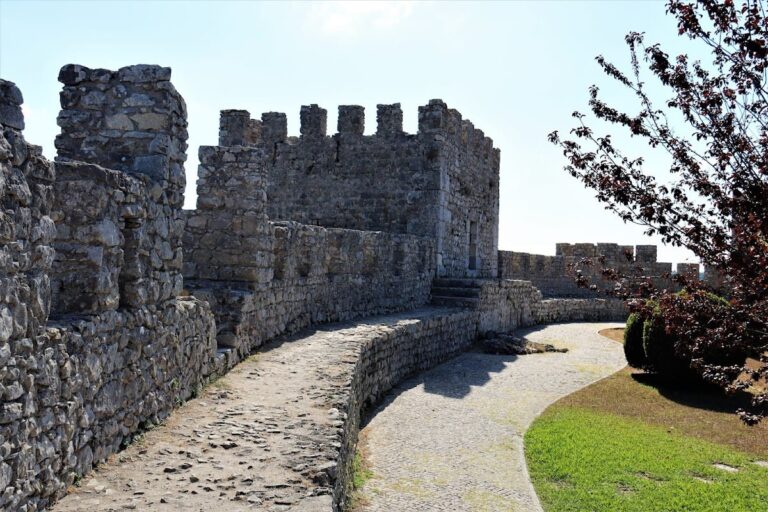
The Castle of Montemor-o-Velho guarded the Mondego frontier through successive Christian and Muslim occupations. Its surviving complex preserves…

Castelo de Palmela preserves Islamic, Portuguese medieval, and early-modern defensive phases, along with churches and convent buildings associated…
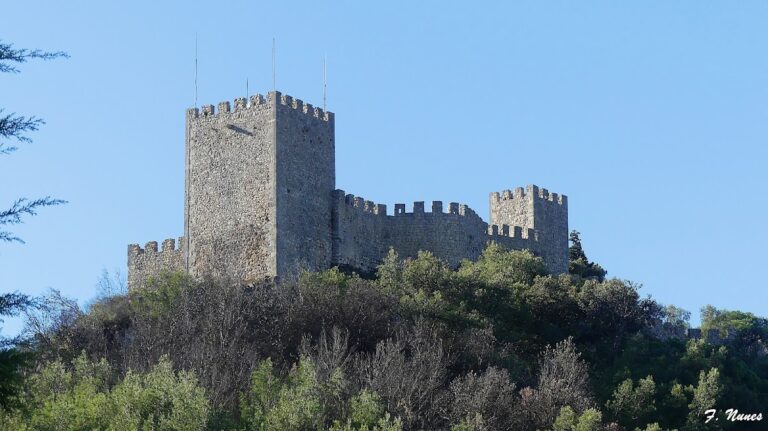
Castelo de Sesimbra is a medieval fortress above Sesimbra’s natural harbour, shaped by Muslim, Portuguese, military-religious, and artillery phases…
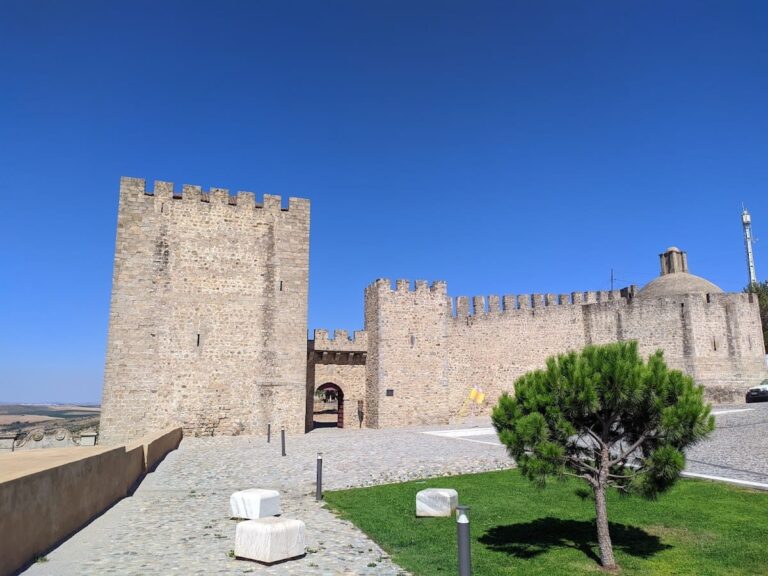
The Castle of Elvas developed from an ancient hillfort and Roman settlement into a medieval stronghold and part of Portugal’s frontier defenses. Its…
For details on how to use the maps, which sites are included, how popularity and ratings are determined, and how sites are classified, see the help page.
On this page5 sections
Enclosed strongholds at Silves and Almourol
Silves Castle occupies the summit above the town and the Arade River. Towers and connecting walls follow an irregular perimeter, with a double entrance protected by two towers. Its Islamic-period enclosure was altered after the Christian conquest: pointed doorways and vaulted rooms in some towers belong to later medieval work. Modern restoration also rebuilt sections of walls and battlements.
The elevated citadel formed only one part of a larger defensive settlement. Town walls extended below it, while a protected route descended towards the river to secure water access. This relationship between summit enclosure and lower town distinguishes Silves from an isolated castle.
Almourol Castle stands on a granite island in the Tagus. Its walls enclose two levels: circular towers protect the lower court, while steps lead into an upper enclosure containing the square keep. Inscriptions record building work associated with the Templar master Gualdim Pais in 1171. The island, lower walls and inner keep created successive obstacles, although extensive later restoration shaped the standing masonry.
Walled settlements at Monsaraz and Almeida
At Monsaraz, the castle occupies the highest part of a hilltop town. A wall circuit encloses the settlement, with gates built from granite among predominantly schist masonry. The pointed Town Gate retains medieval measuring marks on its jamb, a small detail connecting the defended entrance with the town’s commercial life.
Seventeenth-century artillery works strengthened Monsaraz during the Portuguese Restoration War. Almeida presents a more extensive bastioned arrangement: six principal bastions and triangular outer works surround the older settlement, with a dry moat and covered way beyond them. The main approach passes through two tunnel gateways separated by a bridge.
Almeida’s medieval castle survives mainly as foundations after the explosion of 1810. The substantial structures here are the later town defences, whose low, projecting works were designed for cannon rather than the tall keep-and-curtain arrangement at Almourol.
Tomar’s Convent of Christ: a Templar oratory within the castle
The Convent of Christ developed within the fortified hilltop complex at Tomar. Walls, round towers and a keep surround a group of religious and residential buildings. The Charola, the Templars’ centralized oratory, has an octagonal inner space surrounded by a sixteen-sided passage.
Later construction connected the Charola to a new church through a large arch, turning the older oratory into its chancel. Painted panels and polychrome sculpture were added during the Manueline remodelling. This makes the interior a direct record of changing religious use: a compact medieval sanctuary became part of a larger church while retaining its distinctive central plan.
Queluz Palace: colonnades and garden courts
Queluz Palace uses low ranges and taller pavilions to organize royal accommodation around courts and gardens. On the public side, curved wings form a semicircular forecourt. Elsewhere, the Robillon Wing has a Doric colonnade and a roof terrace edged with a balustrade and sculpture.
The sloping ground allows one side of that wing to appear much lower than the other, while graduated stairs connect its different levels. A major fire in 1934 damaged many interiors, followed by extensive restoration. The palace’s formal approaches and garden-facing architecture add a residential setting to the collection’s military and religious enclosures.
Explore the collection
Explore sites on the map or in the grid. Map icons reflect each site’s primary function, helping you identify different kinds of places at a glance. Narrow this collection by primary function, by a site type within the castle and residence group, or by civilization and era. Additional filters cover popularity and rating. Select a map marker to view the site’s details and open its article, or open the article from its grid entry.