Castle of Almeida: From Medieval Frontier Castle to Star Fortress

Site at a Glance
- Rating
- 4.6
- Popularity
- Medium
- Country
- Portugal
- Primary era
- Early Modern
- Eras represented
- Medieval, Early Modern, Modern
- Civilizations
- Portuguese
- Site type
- Military
- Remains
- Fort
On this page15 sections
History
Castle of Almeida is a historic fortress in Almeida, Portugal, whose earliest castle was associated with Muslim occupation before the site became a medieval Christian frontier stronghold. Its history extends from prehistoric and Roman-era settlement through the Reconquista and the consolidation of the Portuguese frontier, culminating in a Vaubanesque star fortress completed around the medieval castle in 1641.
Early occupation and the medieval frontier
The site is believed to have first been occupied by a prehistoric hillfort. Roman, Suevic, Visigothic, and Muslim communities later used the elevated location. The Muslim inhabitants are associated with the earliest castle and with the settlement’s former name, Talmeyda, which referred to the table-like form of the terrain.
During the Reconquista, the prolonged Christian conquest of territories held by Muslim rulers in the Iberian Peninsula, Almeida and its castle successively passed under Leonese, Muslim, and Portuguese control. By 1217, the castle formed part of the defensive line guarding the Côa valley and the frontier between Portugal and León, later Spain. It served both as a settlement and as a defensive centre for Ribacôa, the historic border region centred on the valley of the Côa River.
Royal reconstruction and frontier consolidation
On 8 November 1296, King Dinis granted Almeida a foral, a royal charter establishing or confirming a settlement’s legal rights and obligations, and ordered the reconstruction of the castle and walls. Portugal’s definitive possession of Ribacôa was secured by the Treaty of Alcañices in 1297. Dinis then pursued a wider programme of frontier consolidation that included Almeida and neighbouring castles.
The castle was enlarged in 1369, and both the castle and the town walls were renewed during the reign of King Ferdinand. Ferdinand intended to use Almeida as a base for an attack on Castile. A peace settlement in 1373 temporarily ceded Almeida and its lands to Castile for three years.
During the Portuguese Succession Crisis, the castle’s alcalde, a medieval municipal or castle governor, declared for Beatriz and Castile. King John I conquered the town in 1386 with the help of Portuguese nobles in Castile. Almeida became part of the Portuguese Crown in 1407, and King Afonso V later donated it to Pedro de Menezes.
Manueline strengthening and the creation of a military post
During the reign of King Manuel I, the castle walls and fortifications were strengthened and enlarged under the direction of the architect Mateus Fernandes. The works were completed in 1508, and Manuel issued a new charter in 1510. Almeida was among the frontier castles included in Duarte de Armas’s Book of Fortresses, compiled between 1509 and 1510 after his personal visits to the sites.
From 1517, buildings in the town were demolished to make way for a larger fortress project. A tax of 100 réis was imposed on each person to help finance the walls and garrison. The defensive structures later fell into decay between 1580 and 1640, a period that ended with the restoration of the Portuguese Crown.
After 1640, King John IV created a Council of War and a Junta of the Frontiers to reinforce the border fortresses. Álvaro de Abranches da Câmara, the first Military Governor of Beira, ordered a new defensive structure at Almeida. João Saldanha e Sousa began the project with trenches, and Almeida became a fortified military post in 1641.
The seventeenth-century star fortress
The modern fortress, completed in 1641 around the medieval castle, was designed by David Álvares as a twelve-pointed star fort in a Vaubanesque manner. Vaubanesque fortification refers to the angular defensive system associated with the French engineer Sébastien Le Prestre de Vauban, using projecting bastions, ravelins, protected passages, and artillery platforms. Álvares supervised the works from 1641 to 1643.
Further alterations and proposed expansions involved Fernão Teles de Menezes, Fernão Teles Cotão, Carlos Lassart, Pierre Gilles de Saint Paul, Rodrigo Soares Pantoja, Agostinho de Andrade Freire, and Rodrigo de Castro. During the seventeenth century, the castle also began to serve as a gunpowder store.
The fortress remained unfinished in 1661. Its circuit had not yet been fully completed, and the moat still awaited construction. Spanish forces attacked on 2 July 1663 but were repelled. After the peace treaty of 1668, building continued near the Santo António Gate, along the gate’s approach to the Cruz ravelin, and on the walls. The Chapel of Vera Cruz was demolished in 1680 to permit further enlargement.
An explosion in 1695 killed 40 people and heavily damaged nearby houses and fortifications. The disaster led to a change in the configuration of the castle. Almeida later served as a garrison and base of operations during the War of the Spanish Succession, the European conflict fought from 1702 to 1714 over the succession to the Spanish throne.
Eighteenth-century works and the Seven Years’ War
In 1736, an explosion occurred in the warehouse of the São Pedro bastion. Between 1737 and 1738, the Royal engineer Manuel de Azevedo Fortes directed works with the assistance of Pinto de Alpoim and Jacinto Lopes da Costa. He proposed further defences, barracks, vaulted rooms, kitchens, powder magazines, and posterns, or secondary entrances. Most of these proposals were not completed.
The Lisbon earthquake of 1 November 1755 damaged the walls and destroyed the infantry barracks. By March 1762, the fortress had largely reached its present dimensions and profile, although several ravelins, the esplanade, and the battlements remained unfinished. João Alexandre de Charmont and other engineers corrected parapets, laid new paths, altered battlements and coverings, and worked on a kitchen and casemates, which were protected chambers for troops or artillery.
During the Seven Years’ War, Portugal declared war on France and Spain in 1762. Spanish forces under the Count of Aranda besieged Almeida from 16 to 25 August. The Portuguese capitulated, and Spain held the fortress until it was returned to Portugal on 11 April 1763 under the postwar settlement.
After the war, Francisco Maclean, Almeida Jacques Funck, Miguel Luís Jacob, and other military officials surveyed the fortress and proposed repairs and additions. These included new powder magazines at the São Pedro bastion and the Santa Bárbara ravelin. A proposal of 1796 called for a battery on the site of a temporary enemy installation.
French invasions and the destruction of the medieval castle
During the War of the Oranges in 1801, the defence of Beira was assigned to the Marquess of Alorna, while Gustavo Adolfo Hércules de Chermont commanded the fortress. The first French invasion took Almeida without resistance on 13 January 1808. French forces under Louis-Henri Loison occupied it on 5 June that year, although control was later returned to Portugal. A second French invasion in 1809 did not reach Almeida.
During the third French invasion, André Masséna’s forces bombarded Almeida from 15 August 1810. An artillery strike detonated a powder magazine in the cathedral beside the castle. The resulting explosion destroyed the medieval castle and damaged parts of the fortress and town. Approximately 4,000 prepared charges, 68,000 kilograms of black powder, and 1,000,000 musket cartridges were involved. Six hundred defenders were killed and 300 wounded.
Brigadier General William Cox capitulated on 27 August, and French forces occupied the fortress under General Brenier. Wellington planned its recapture in April 1811. On 7 May, Masséna ordered the fortress to be destroyed. When the French withdrew on 10 May through the São João de Deus bastion, they also destroyed the artillery. Allied forces retook the site, but later plans alternated between reviving and dismantling the fortification.
William Carr Beresford ordered the works stopped and the fortification mined in 1817. In 1819, the governor ordered the square buried and the castle converted into a park or promenade. These decisions shaped the later treatment of the medieval remains within the larger military enclosure.
Nineteenth-century decline and modern preservation
During the Liberal Wars, the Portuguese civil conflict between supporters of constitutional liberalism and supporters of King Miguel’s absolutism, Almeida’s municipal authority supported King Miguel while the garrison remained loyal to King Pedro. Miguelist forces besieged the fortress in 1828, and its garrison surrendered on 16 July. Miguelist troops remained until their evacuation in April 1834. Revolutionary forces captured the fortress in 1844 during the conflict surrounding the restoration of the 1822 Constitution.
In 1853, the Duke of Saldanha appointed a commission to assess Almeida’s military future. The commission considered it one of the strongest fortifications in the kingdom and recommended repairs. Almeida returned to first-class fortification status in 1887, but the fortress was partly destroyed in 1893 during improvements intended to increase accessibility and convert it from a defensive installation. Most of the artillery was removed in 1894, and the fortress was declassified in 1895.
At the beginning of the twentieth century, connections were made between the Cruz ravelin and its magistral gate, the principal gate through the main fortified enclosure. From 1980, the fortress acquired socio-cultural and historical functions, including exhibitions and research facilities, and a military museum opened in the Cruz Gate. A permanent exhibition on the 23rd Infantry Regiment and multipurpose facilities were installed in the Santo António Gate guardhouse in 1996. The Centre for Studies into Military Architecture was established in the Santo António ravelin in 2002.
Responsibility for the property passed to the Portuguese Institute of Architectural Heritage in 1992 and to the Regional Directorate of Culture of the Centre in 2007. The medieval castle remains and the wider fortress were classified as a National Monument in 1928. Almeida is also recognized as a Historic Village, and the fortress is owned by the Portuguese Republic.
Remains
Setting and fortified layout
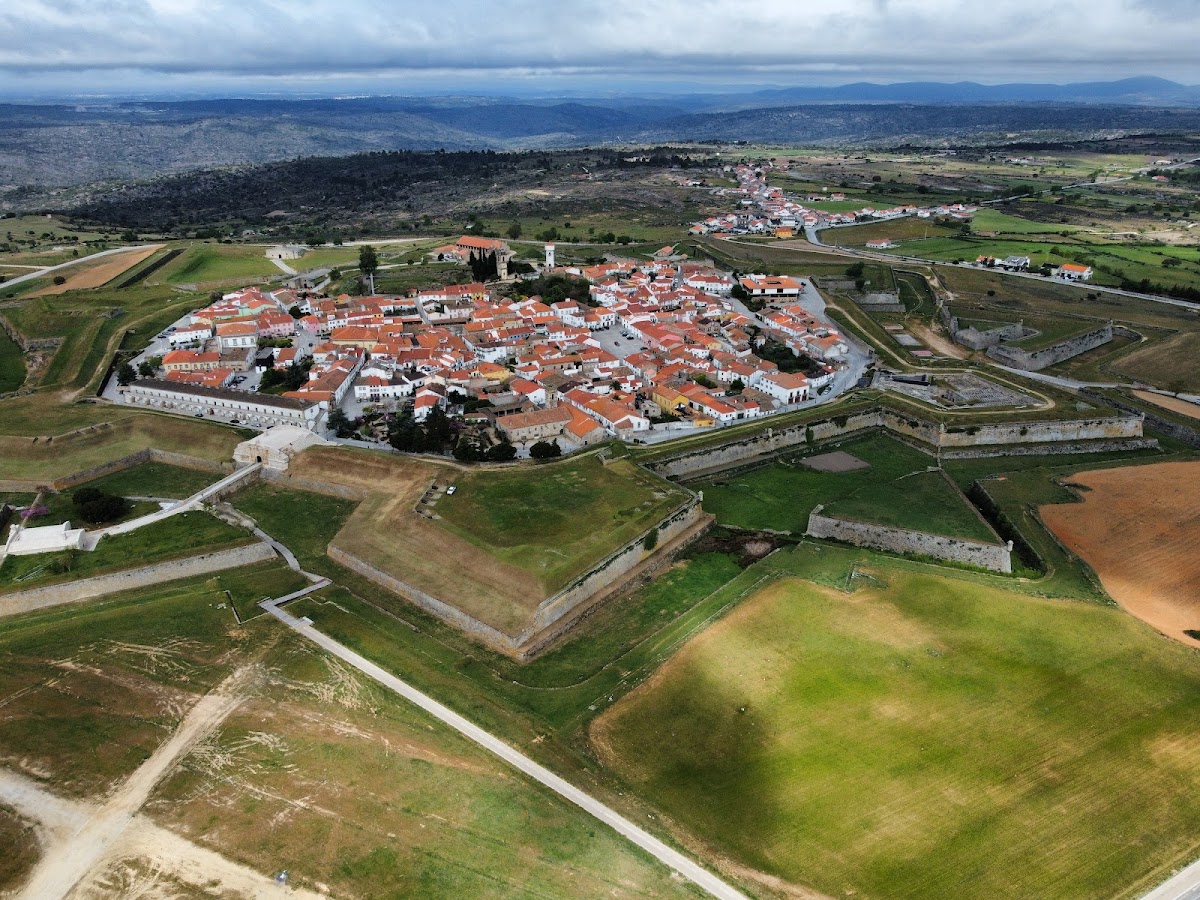
The site occupies an isolated urban setting on the western edge of Almeida, about 7 kilometres from the Castile-León plateau and approximately 763 metres above the valley of the River Côa. The modern fortress encloses the older part of the settlement. The medieval castle lies in the western, elevated part of the village, where a viewing platform has been built over its foundations.
The fortress has an irregular hexagonal plan made up of six unequal polygonal bastions joined by curtain walls, the main walls connecting fortified projections. Its perimeter measures approximately 2.4 kilometres and produces a twelve-pointed star-shaped outline. Six triangular ravelins, detached defensive works placed in front of a fortress wall or gate, reinforce the perimeter, which is completed by a dry moat and covered way, a protected passage along or around the fortification.
Bastions and ravelins
The six bastions are São Francisco, São João de Deus, Santa Bárbara, Nossa Senhora das Brotas or do Trem, Santo António, and São Pedro. A bastion is a projecting fortification that allows defenders to fire along the faces of adjacent walls. The São João de Deus ravelin contains large integrated bunkers. A postern between the São João de Deus bastion and the surrounding walls leads to a green area beside the fortified enclosure.
The three northern ravelins have masonry parapets topped by stone escarpment walls, the sloping outer faces of defensive ditches or ramparts. Cylindrical watchtowers with domed roofs stand at their angled corners, while raised platforms accommodated cannon and mortar positions. The three southern ravelins have masonry parapets crowned by earth ramparts and also contain raised artillery and mortar platforms.
Gates and associated buildings
Principal southeastern entrance
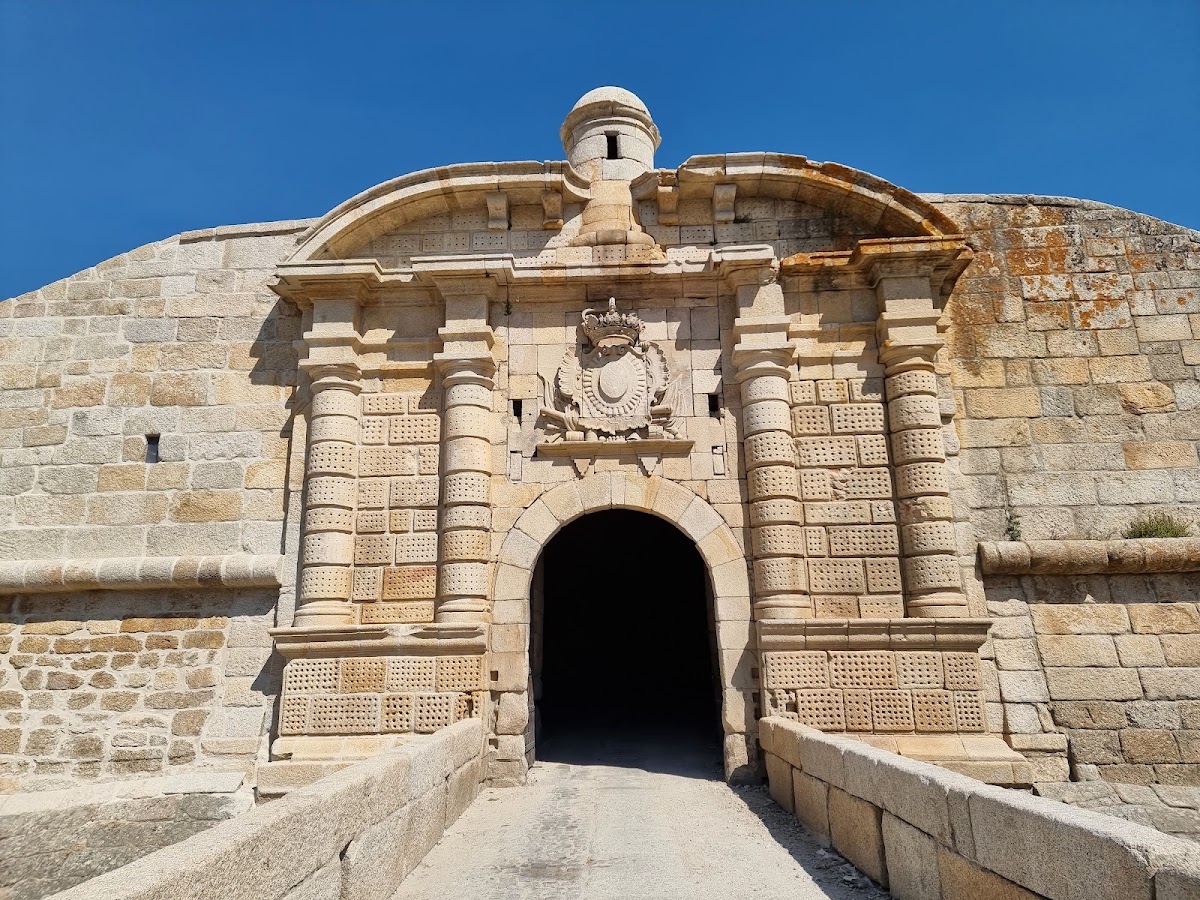
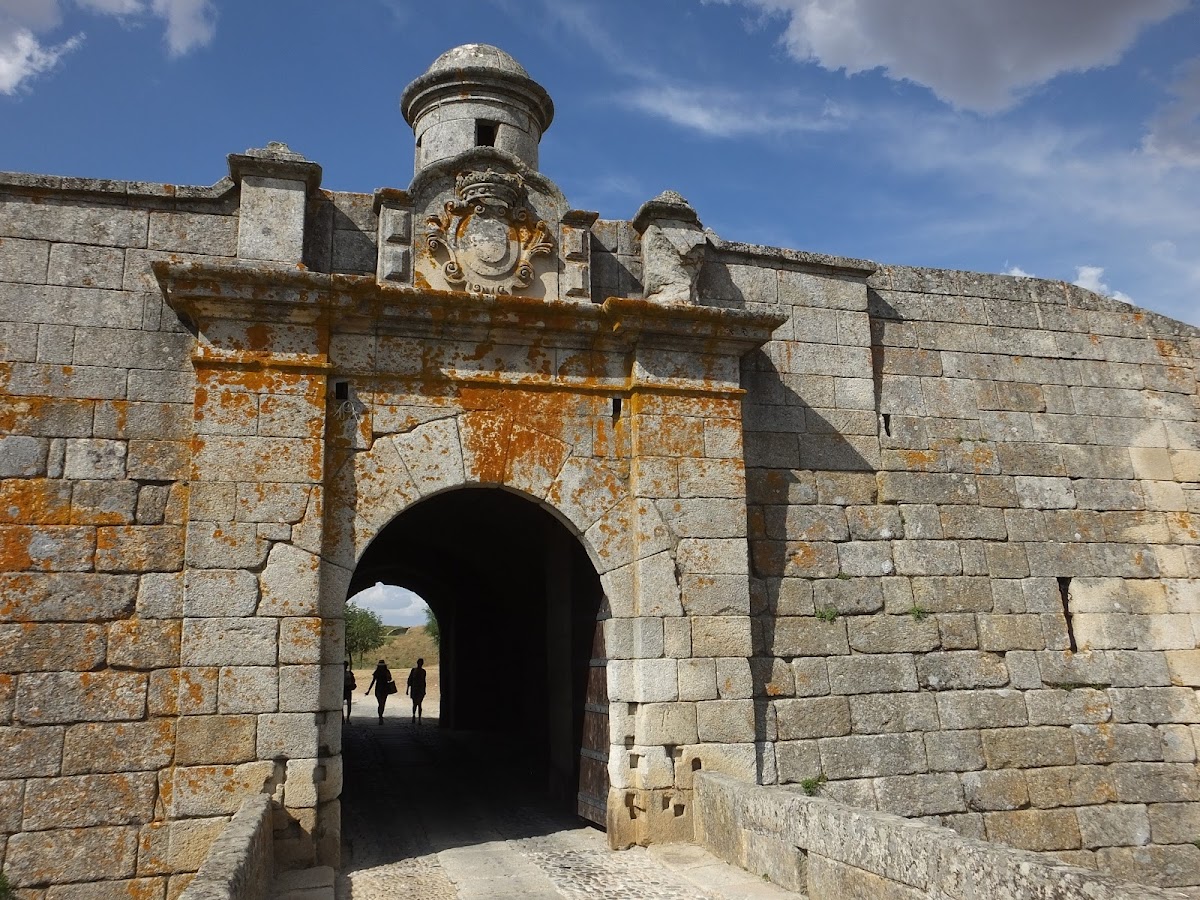
The principal entrance lies in the southeastern curtain wall between the Santo António-São Pedro and São Francisco bastions. It consists of two long tunnel gateways separated by a bridge over the dry moat. The outer gateway is the Porta da Muralha, while the inner gateway is the São Francisco Gate. Its facade has an arched entrance framed by paired Doric columns, a semicircular pediment, and a heraldic coat of arms above the entrance.
Cruz Gate and military buildings
The Cruz Gate stands beside the infantry barracks of Terreiro das Freiras and near the Church and Hospital of the Misericórdia. The military museum occupies the Cruz Gate. Near the São João de Deus bastion is the Pousada de Nossa Senhora das Neves, while the former artillery train building, also called the Royal Riding School, occupies the bastion’s embankment.
The fortress also includes the guardhouse of the Santo António Gate. In 1996, this building received a permanent exhibition on the 23rd Infantry Regiment and multipurpose facilities. The Santo António ravelin later became the location of the Centre for Studies into Military Architecture, established in 2002.
Medieval castle and archaeological remains
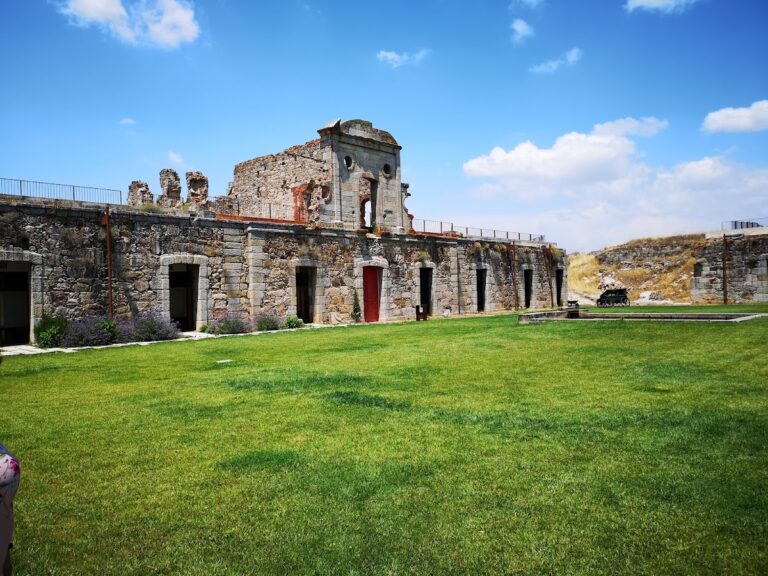
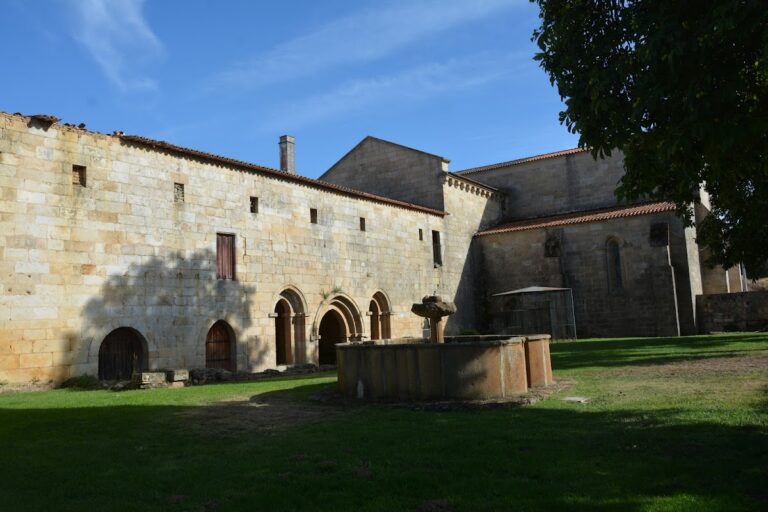
The medieval castle survives mainly as ruins and foundations within the later fortress. Its principal structure was razed by the 1810 powder-magazine explosion. Archaeological excavations have exposed sections of the medieval walls and the original moat, helping define the earlier defensive enclosure beneath the seventeenth-century fortification.
The fortress’s surviving fabric combines masonry and stone, including granite, with wood, cement, and glazed ceramic tile. Curtain walls, earthworks, parapets, escarpments, bunkers, ravelins, bastions, covered ways, artillery platforms, and tunnel gateways together express the successive military phases that transformed the medieval castle into a large fortified enclosure.
Nearby sites