Castle of Montemor-o-Velho: A Medieval Fortress in Portugal
Site at a Glance
- Rating
- 4.6
- Popularity
- Medium
- Country
- Portugal
- Primary era
- Medieval
- External website
- Open
- Eras represented
- Medieval, Early Modern
- Civilizations
- Kingdom of León, Portuguese
- Site type
- Military
- Remains
- Castle
On this page10 sections
History
The Castle of Montemor-o-Velho is a medieval fortress in Portugal, above the town of Montemor-o-Velho on the right bank of the Mondego River. Its surviving stronghold was developed by Christian powers during the medieval period, while the site itself had earlier prehistoric, Roman, Visigothic, and Muslim occupation. Its position was connected with tin extracted in Beira Alta and transported along the Mondego, giving the settlement a wider strategic and economic setting.
Early fortification and the Mondego frontier
The earliest documentary references to Montemor-o-Velho and its castle date from the ninth century. In 848, Ramiro I of Asturias and his uncle, Abbot João of the Monastery of Lorvão, took the castle. Ramiro entrusted the territory to João, who was responsible for maintaining its garrison and appointed D. Bermudo, the son of his sister D. Urraca, as governor. That same year, the castle resisted a siege by the forces of Abderramão II, the emir of Córdoba.
From the second half of the tenth century until the beginning of the eleventh, control of the territory between the Douro and Mondego rivers shifted repeatedly between Christian and Muslim powers. The Chronicle of the Goths states that Almanzor conquered the original fortification on 2 December 990 and apparently rebuilt it under Froila Gonçalves. Christian forces recovered it under Mendo Luz in 1006 or 1017, after which Gonçalo Viegas governed the castle. Muslim forces took it again in 1026, and Gonçalo Trastamariz recovered it in 1034.
Permanent Christian control followed Ferdinand the Great’s conquest of Coimbra in 1064. This secured the Mondego frontier and placed the castle within a reorganized defensive region. Ferdinand entrusted military control of the Coimbra area to Count Sesnando Davides, who pacified and defended the territory and directed the construction or reconstruction of several castles, including those at Coimbra, Lousã, Montemor-o-Velho, Penacova, and Penela.
Rebuilding and the formation of Portugal
After Ferdinand’s death, repairs and reinforcements were carried out during the reign of Alfonso VI of León and Castile. The work was probably ordered in 1088, before Count Sesnando’s death in 1091, after successive campaigns had damaged the castle and depopulated the surrounding region. The church inside the fortress began in 1090 under the presbyter Vermudo, on the condition that half of its revenues would belong to the See of Coimbra. It was completed in 1095, when the donation was recorded.
A charter issued in 1095 described the earlier fortification as destroyed by the Muslims and abandoned among overgrown ruins. Count Henry confirmed the charter before 1111, probably in 1109, when further work on the castle was mentioned. In 1128, during the assertion of Portugal’s independence, there is no record that the castle’s governor, Paio Midis, opposed Afonso Henriques, the ruler associated with the establishment of the Portuguese kingdom. The castle was also mentioned by the Arab geographer Dreses in the middle of the twelfth century.
Royal possessions and medieval conflict
Montemor-o-Velho later formed part of the possessions assigned to royal sons and daughters who were not heirs to the throne. It belonged to Teresa, daughter of Sancho I, from 1211, and later to Afonso IV from 1322. In the fifteenth century it was also held by Pedro, Duke of Coimbra, from 1416.
The succession dispute after Sancho I’s death brought the castle into conflict with Afonso II. Its governor refused homage to the king because the castle and its domains had been granted by testament to Teresa and Mafalda. Afonso II besieged the fortress after Teresa took refuge there. Pope Innocent III intervened in 1216, ordering that Montemor-o-Velho and Alenquer be delivered to the Knights Templar, a religious-military order that held estates and defended territories in the medieval Latin Christian world. A new charter for Montemor-o-Velho is mentioned in 1212.
In 1245, during the conflict between Sancho II and Afonso III, Bishop Tiburcio and several canons of the See of Coimbra sought refuge in the castle’s alcazaba, the fortified inner citadel, because they felt unsafe in Coimbra. The castle’s governor had declared for Sancho II. During the rebellion of the future Afonso IV against his father, King Denis, the undermanned fortress was captured without combat by the prince’s forces on 1 January 1322.
The castle underwent extensive reform during the fourteenth century. This work probably included the construction of the barbican, an advanced defensive enclosure outside the main wall, and the northern section of the outer enclosure. The fortress remained closely connected with royal power and military command. On 6 January 1355, Afonso IV met his counselors in the alcazaba to decide the fate of Inês de Castro, whose relationship with the Portuguese infante Pedro had become a major political crisis. The king left the castle the following day, and Inês was executed.
Later military history and preservation
The castle retained military and strategic importance in later centuries. Its large enclosure was said to accommodate as many as 5,000 men-at-arms, and its command continued to be entrusted to prominent Portuguese nobles. In 1472, Afonso V made João of Portugal Marquis of Montemor-o-Velho. João later became Duke of Braganza.
During the succession crisis of 1580, D. António, Prior of Crato, is believed to have visited the castle while spending five days in the town and attempting to organize the defense of Portuguese independence along the Mondego line. During the Peninsular War, the Iberian phase of the wider Napoleonic Wars, French troops under Jean-Andoche Junot occupied the castle’s buildings between 1807 and 1808. In 1811, during the retreat of André Masséna’s defeated forces, the castle and town were looted and damaged.
Following the suppression of Portugal’s religious orders in 1834, the parade ground became the town cemetery, and local inhabitants reused some of the castle’s stones. In 1877, one tower was adapted as a clock tower. A preservation campaign begun by António Rodrigues Campos in 1929 led to restoration work. The castle and the Church of Santa Maria da Alcáçova were classified together as a National Monument under a decree published on 23 June 1910.
Remains
Fortified enclosure and defensive works
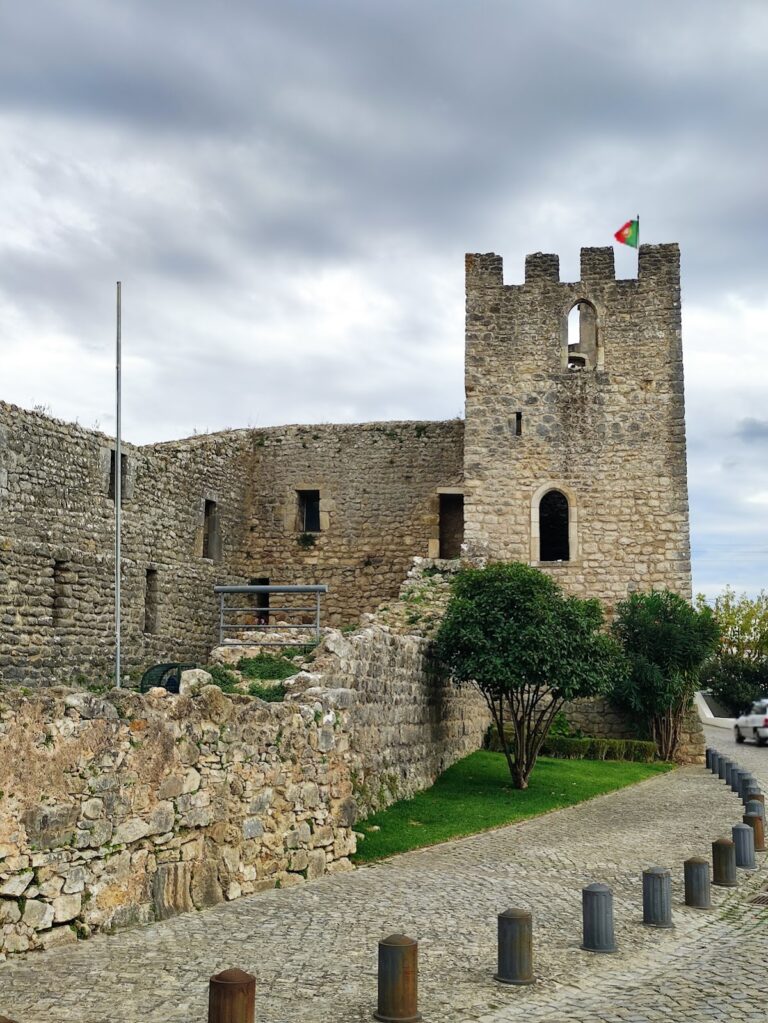
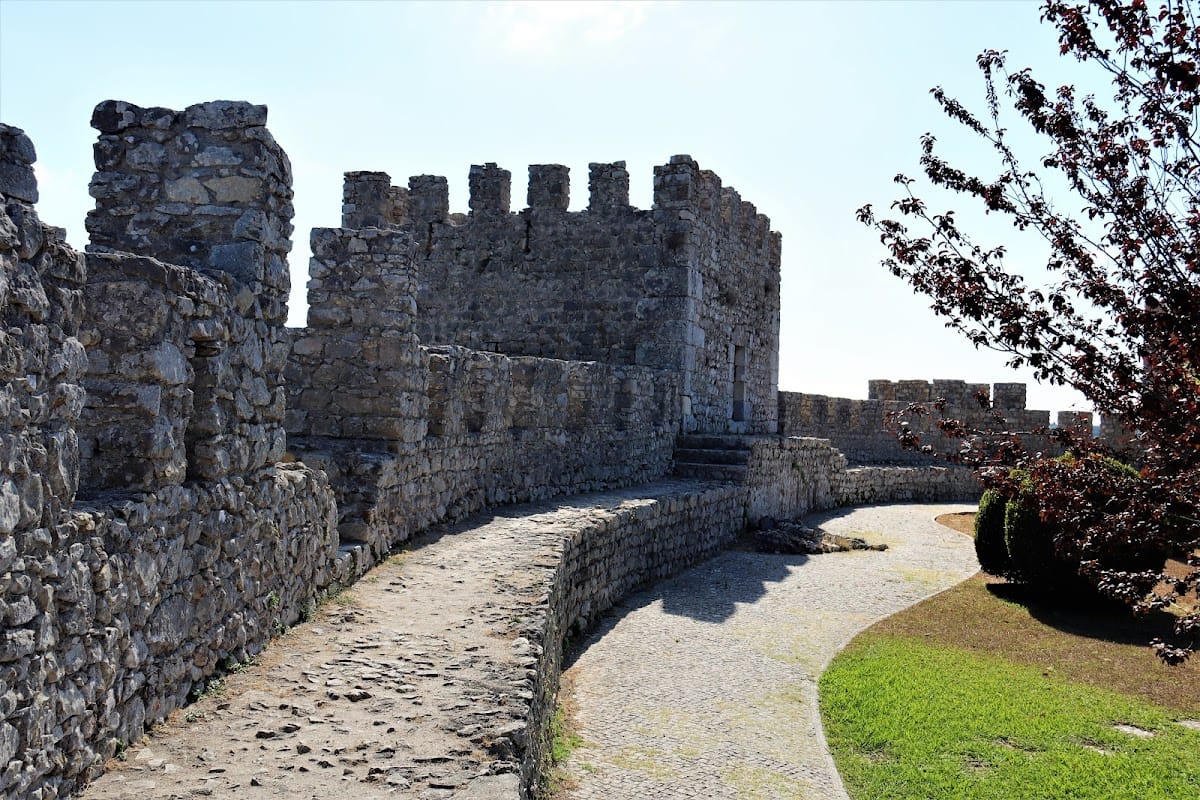
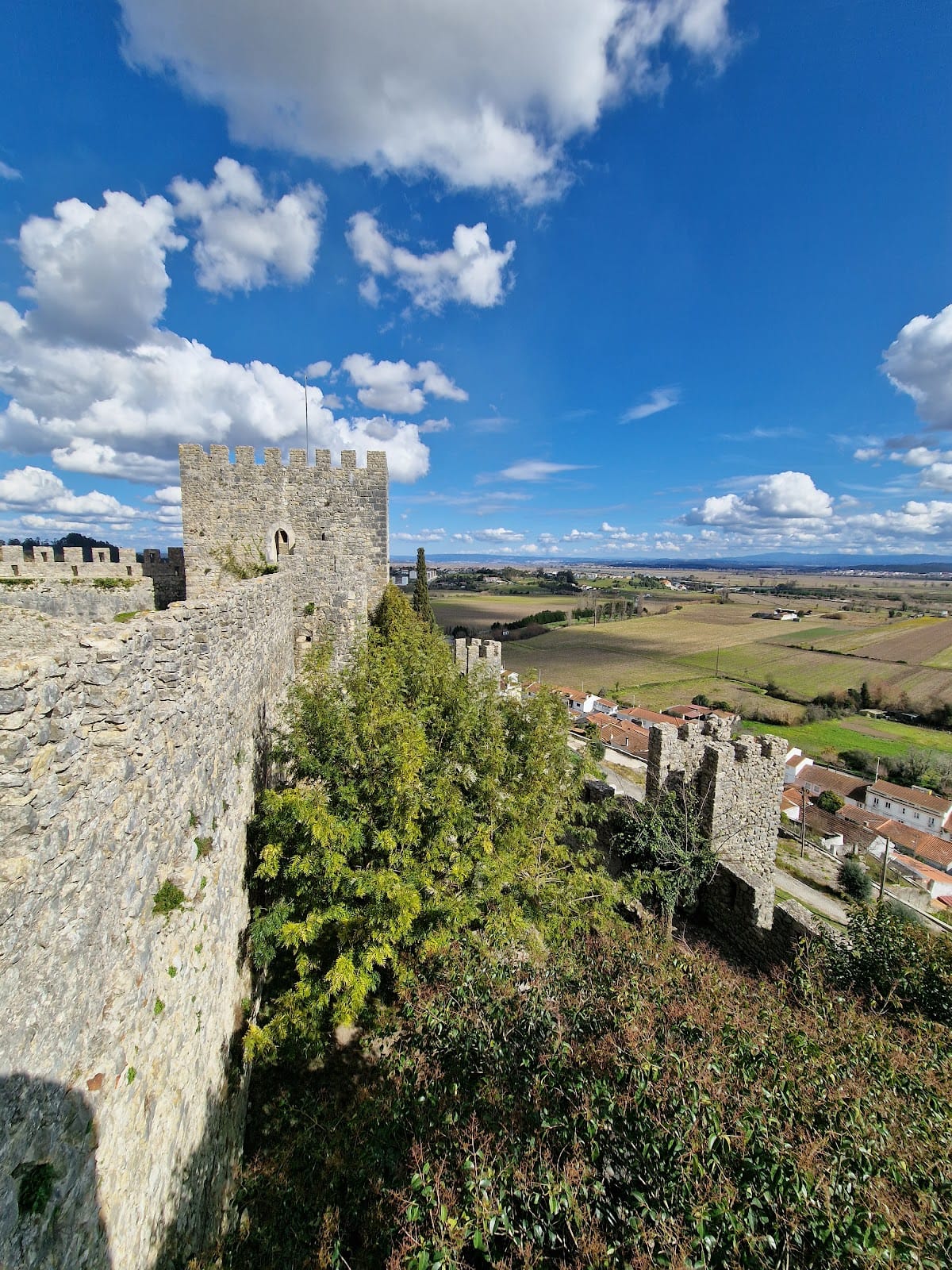
The castle stands 56 metres above sea level in a commanding position over Montemor-o-Velho, on the right bank of the Mondego, which lay near its mouth during the relevant historical period. Built in stone masonry, the complex has an irregular plan. Its defensive organization includes the castelejo, the castle’s inner fortified enclosure, a principal enclosure, a crenellated barbican, a northern enclosure, and a smaller eastern redoubt.
The castelejo occupies the angular area between the keep on the southeast and the northern curtain wall. Four turrets reinforce it. The keep stands on the eastern side, has a square plan, and rises through several floors. The turrets have square or semicircular plans, and two of them contain pointed-arch openings. A pointed arch is formed by two curves that meet at an apex, a form used in several parts of the surviving complex.
The barbican contains two gates. The Porta da Peste stands southeast of the complex beside the keep and replaced the ruined principal gate. The Porta da Nossa Senhora do Rosário lies to the south and was remodeled at a later date. On the northwest-facing slope, sections of wall descend from the barbican. Two curtain walls, connecting defensive walls between towers, rise perpendicular to the main body of the castle and end in substantial square towers.
Palace and internal buildings
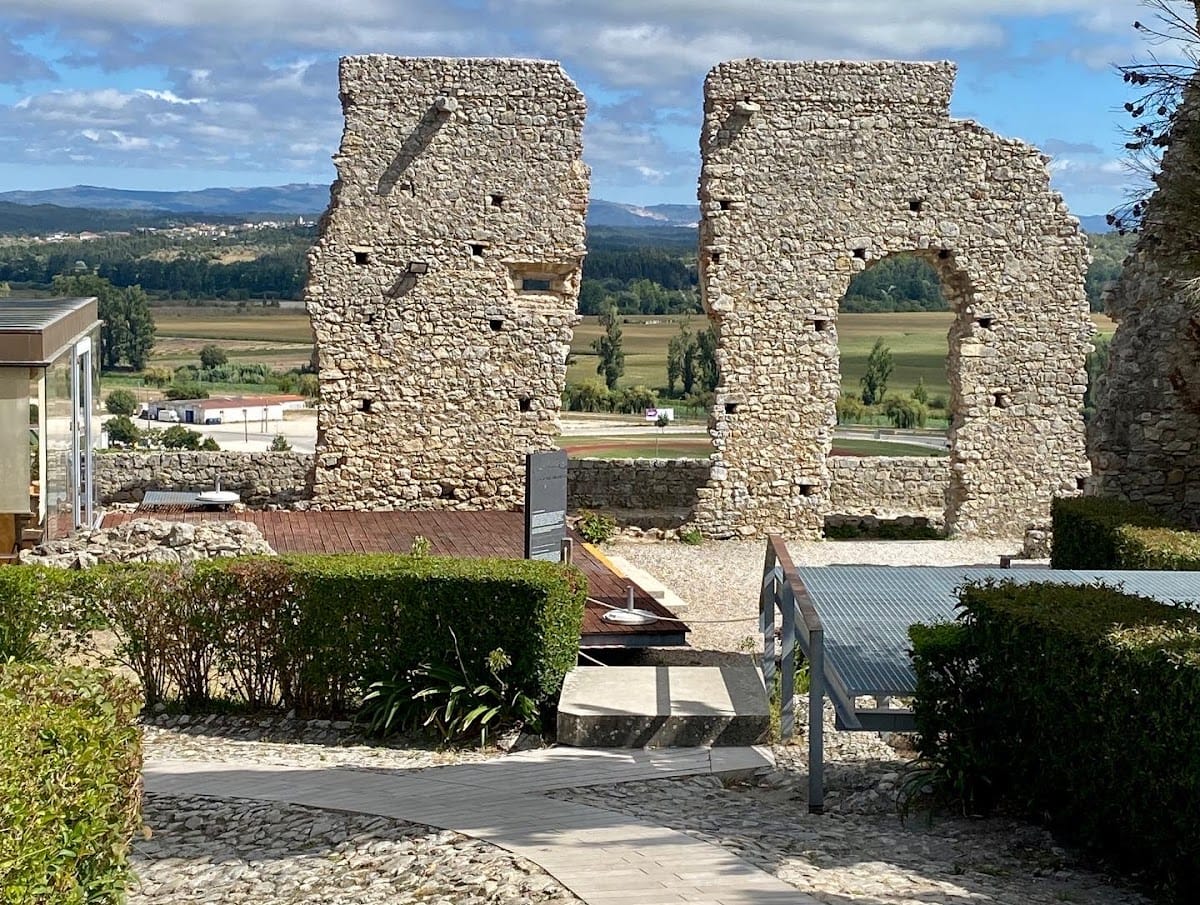
Ruins of the former lordly palace occupy the southwest sector and extended into the barbican area. D. Urraca, sister of Teresa of León, began the palace in the eleventh century. The infantas who were daughters of Sancho I later remodeled it into an aristocratic residence. The surviving remains therefore preserve part of the castle’s residential history alongside its military structures.
The castle interior contains the Church of Santa Maria da Alcáçova, the Chapel of Santo António, which runs parallel to the barbican, and the Church of Madalena. The present form of the Church of Madalena dates from the fifteenth and sixteenth centuries. Ruins of the Chapel of São João survive in the new enclosure, adding further evidence of the religious buildings that occupied the fortress.
Church of Santa Maria da Alcáçova
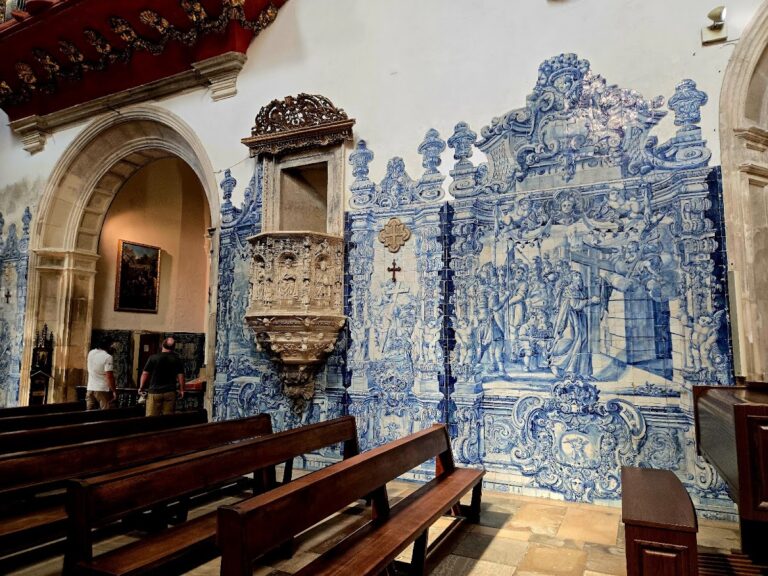
The Church of Santa Maria da Alcáçova originated in the eleventh century, but rebuilding and additions over several centuries changed its original design. It was definitively rebuilt during the first quarter of the sixteenth century in the Manueline period, a Portuguese style combining late Gothic forms with elaborate maritime, natural, and heraldic ornament. The work is attributed to Francisco Pires and was commissioned by D. Jorge de Almeida, the bishop-count of Coimbra.
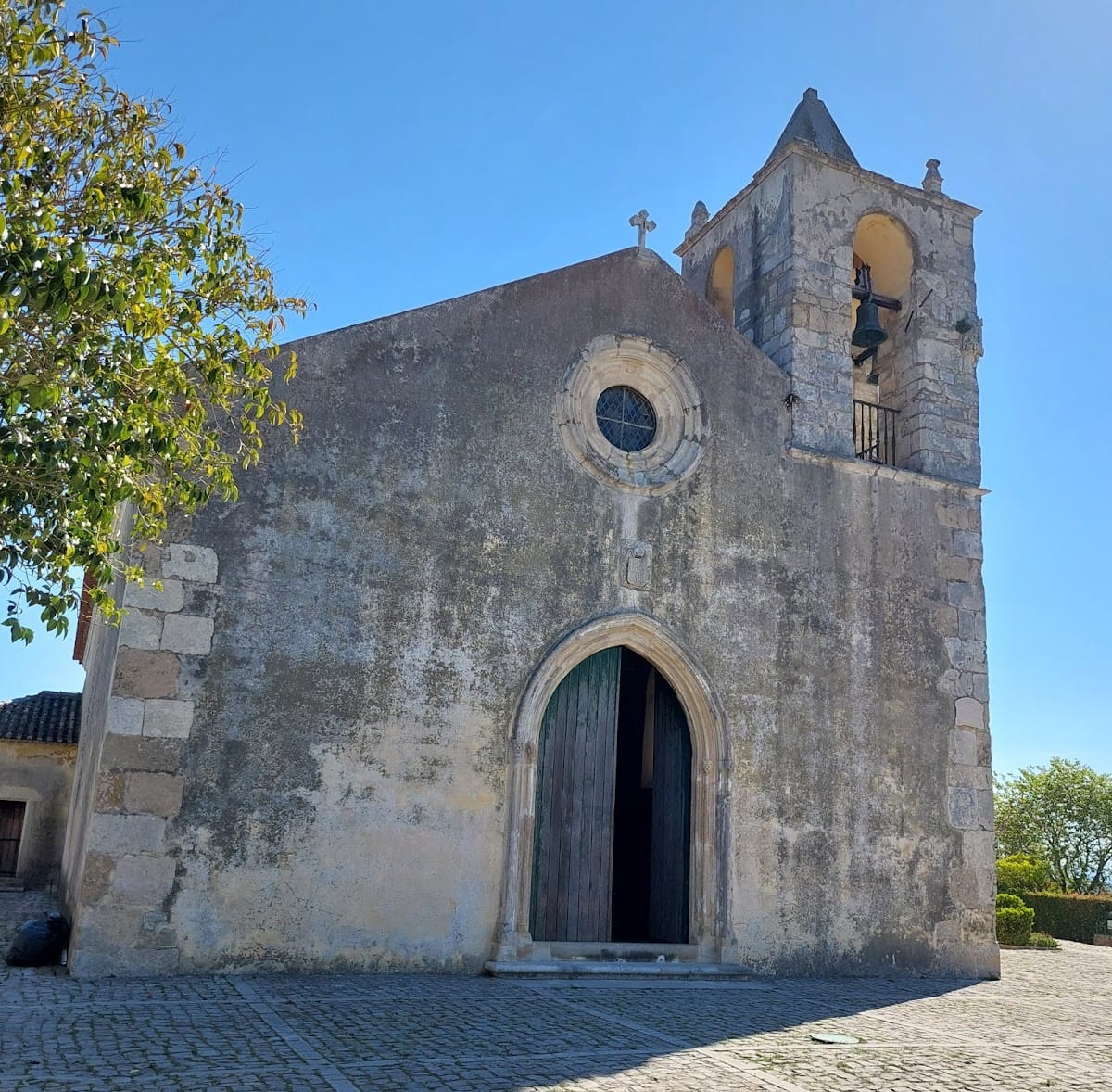
The church has an austere facade. Its pointed-arch portal is surmounted by the coat of arms of D. Jorge de Almeida, while a triangular gable and a bell tower complete the front, with the tower positioned on the right. The lateral entrance is Manueline and framed by a multilobed arch, whose edge is formed by several rounded or pointed lobes.
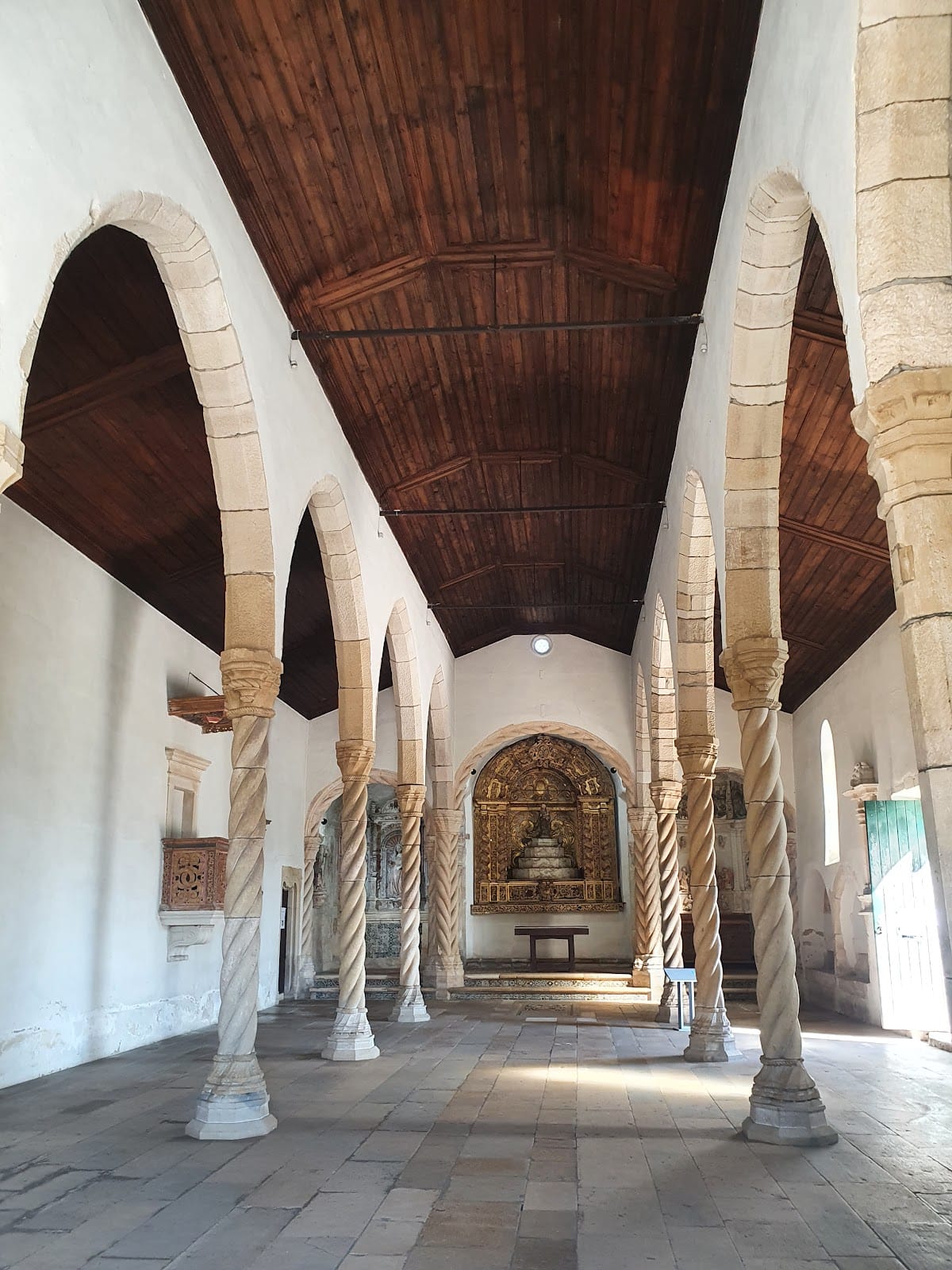
Inside, three naves, or longitudinal divisions, end in chapels. Pointed arches supported by columns with spiral shafts articulate the interior. Sculpture from several periods remains within the church, including the image of Nossa Senhora do Ó and the Angel of the Annunciation, attributed to Mestre Pero and dated approximately 1330 to 1340.
Evidence of earlier occupation and devotional tradition
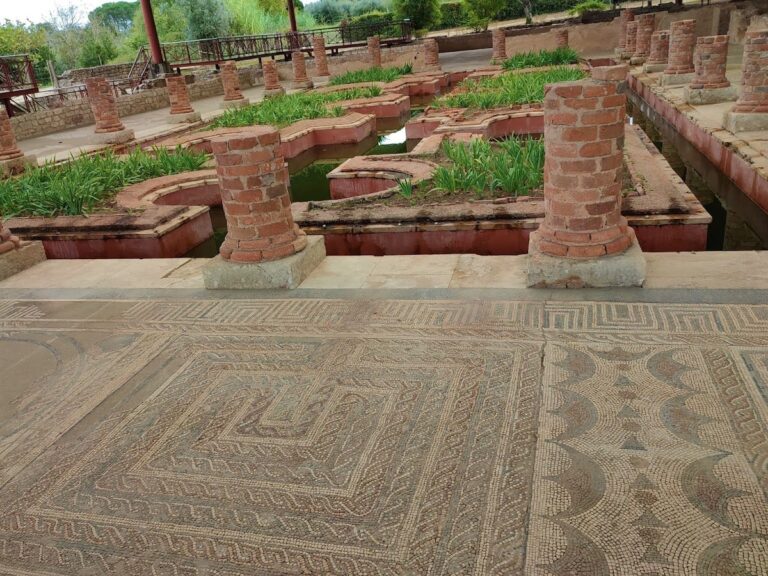
Roman-period stone ashlar blocks are incorporated into the base of the medieval keep. These reused blocks provide physical evidence of the site’s Roman occupation and connect the surviving medieval fortress with the earlier history of the hill.
A local image of Nossa Senhora da Vitória bears a red scar on its neck. It commemorates the traditional miracle associated with the legend of Abbot João and the ninth-century siege by the forces of Abderramão II, preserving a devotional memory connected with the castle’s early Christian history.