Castelo de Palmela: A Medieval Fortress in Portugal


Site at a Glance
- Rating
- 4.7
- Popularity
- Medium
- Country
- Portugal
- Primary era
- Medieval
- External website
- Open
- Eras represented
- Medieval, Early Modern
- Civilizations
- Crusader, Order of Santiago, Portuguese
- Site type
- Military
- Remains
- Castle
On this page13 sections
History
Castelo de Palmela is a historic castle in Portugal, built and enlarged through Islamic and Portuguese medieval phases on the site of earlier occupation. It stands on the eastern foothills of the Arrabida range, where its position shaped the repeated struggles for control of the southern approaches to the Tagus.
Early occupation and Islamic fortification
Human occupation in the surrounding region reaches back to prehistory, particularly the Neolithic period. Some scholars place the foundation of a settlement at the site of present-day Palmela in 310 BC and attribute a fortification made during the Romanization of the Iberian Peninsula, in AD 106, to the Lusitanian praetor Áulio Cornelio, also identified by some as Áulio Cornelio Palma. These attributions remain uncertain.
The site was occupied first by the Visigoths and later by Muslim communities. The initial Muslim fortification was established between the eighth and ninth centuries and expanded substantially from the tenth to the twelfth century. Its history then became closely connected with the Reconquista, the medieval Christian reconquest of Iberian territories ruled by Muslim powers.
Portuguese conquest and the Order of Santiago
After Afonso Henriques conquered Lisbon in 1147, Palmela came under Portuguese control when its Muslim defenders withdrew to Alcácer do Sal. Muslim forces recovered the southern bank of the Tagus, and Palmela changed hands again. Portuguese forces reconquered it in 1158, lost it in 1161, and captured it permanently on 24 June 1165 after the Battle of Palmela. Reinforcement work began the following year.
In 1186, after Sancho I became king, Palmela, Almada, and Alcácer do Sal were granted to the Order of Santiago, a military religious order that defended Christian territories and participated in the Reconquista. The order’s master granted Palmela its charter. Almohad forces, belonging to a North African Muslim dynasty and caliphate that ruled parts of Iberia, recovered Alcácer do Sal, Palmela, and Almada in 1191, severely damaging the defenses.
Palmela was reconquered at the beginning of the thirteenth century. The Portuguese sovereign ordered repairs and confirmed the grant of Palmela and its associated territories to the monks of Santiago. The order had established its headquarters at Palmela before 1210, when the king’s will already referred to its members as the brothers of Palmela. The wider lands south of the Tagus were recovered after the Christian victory at the Battle of Las Navas de Tolosa in 1212.
On 24 February 1255, Afonso III confirmed the Order of Santiago’s possession of Palmela, Alcácer do Sal, Almada, and Arruda through its master, Paio Peres Correia, and the order’s commander. King Dinis confirmed Palmela’s charter in 1323. The castle’s keep, the principal fortified tower of a castle, is believed to belong to this phase.
Late medieval changes and military use
During the Castilian siege of Lisbon in March 1382, Palmela’s southern suburbs were sacked and burned. In the crisis of 1383 to 1385, the master of Santiago, Fernando Afonso de Albuquerque, went to Lisbon in the spring of 1384 to support the Master of Avis, who was acting as regent by popular acclamation. He also took part in the second embassy sent to England.
After Nuno Álvares Pereira’s victory at the Battle of Atoleiros in 1384, large bonfires were lit on the towers of Palmela Castle to signal his approach to the Master of Avis during the Castilian siege of Lisbon. The signal reportedly brought great rejoicing to those under siege.
During the reign of John I, the castle was enlarged and reinforced in 1423. The king also ordered a church and convent to be built. After the Order of Santiago became independent of Castile, it established itself permanently at Palmela from 1443.
In 1484, during the suppression of the Duke of Viseu’s conspiracy against John II, Garcia de Meneses, bishop of Évora, was imprisoned in a waterless cistern inside the keep and died there several days later. A later account states uncertainly that he may have been poisoned. King Manuel I granted Palmela a new charter in 1512.
Early-modern defenses and later occupation
During the War of the Spanish Succession, King Peter II ordered the modernization of Palmela’s defenses. The work added bastioned lines designed to withstand artillery fire. Bastions are projecting defensive platforms, while ravelins and tenailles are additional angular works used to protect the main walls and artillery positions. The castle was seriously damaged by the earthquake of 1755.
The brothers of Palmela remained in occupation until 1834, when religious orders were abolished in Portugal. A contingent of the Portuguese Army then occupied the site. The explorer Brito Capelo was born there in 1841, the son of the garrison commander.
Castelo de Palmela was classified as a Portuguese National Monument by a decree published on 23 June 1910. Before the 1940 Centenary commemorations, interventions included the demolition of some constructions and alterations to the windows of the Church of Santiago. The former convent buildings were converted into a pousada, a historic building adapted as an inn or hotel, from 1945 and joined the Pousadas de Portugal network during the 1970s. Archaeological prospecting has taken place inside the castle precinct since the late twentieth century, and some spaces were later adapted as museum rooms, service areas, and commercial areas.
Remains
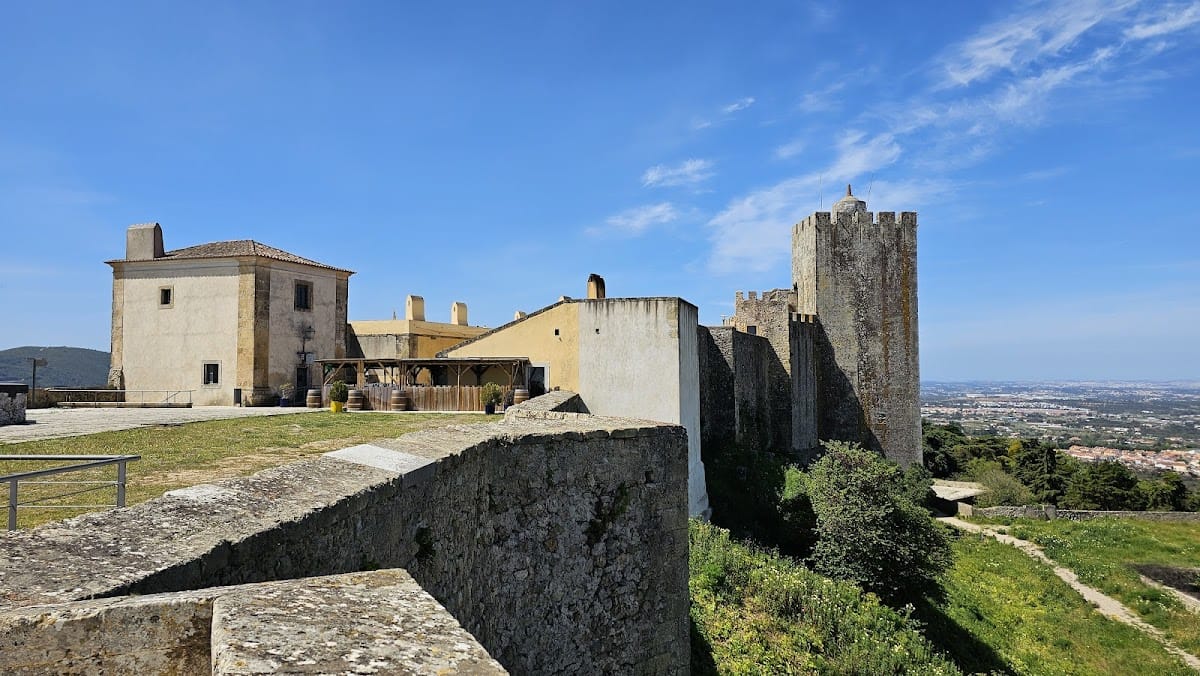
Castelo de Palmela occupies an elevation of approximately 240 metres above sea level on the eastern foothills of the Arrabida range, between the estuaries of the Tagus and Sado rivers and near the mouth of the Sado. Within the Arrabida Natural Park and the area known as the Costa Azul, it follows the terrain through an irregular, organic polygonal plan. Square and circular towers reinforce its walls, while three successive enclosure lines form the defensive perimeter without moats.
Defensive enclosures
Inner enclosure and keep
The inner enclosure dates from the twelfth and thirteenth centuries. It contains the oldest wall, two cylindrical towers, and the keep. A cistern opens inside the keep, and a stone staircase connects its different floors. The tower was probably remodelled in the fourteenth century, when its structure was strengthened, its height increased, and its summit fitted with battlements bearing ornamental initials.
Intermediate enclosure
Built in the fifteenth century, the intermediate enclosure has more robust walls. It surrounds the parade ground and contains the Church of Santa Maria, the convent, and the Church of Santiago de Palmela, bringing the principal religious and communal buildings within the fortified complex.
External enclosure
The external enclosure was constructed in the seventeenth century as an artillery defense. Its bastions, ravelins, and tenailles formed projecting and angular works adapted to resist artillery fire, adding an early-modern layer to the medieval defensive system.
Churches and convent buildings
Church of Santa Maria
The Church of Santa Maria was built in the twelfth century and rebuilt during the Renaissance. It stands within the intermediate enclosure and forms part of the religious architecture incorporated into the castle’s later medieval layout.
Convent and Church of Santiago
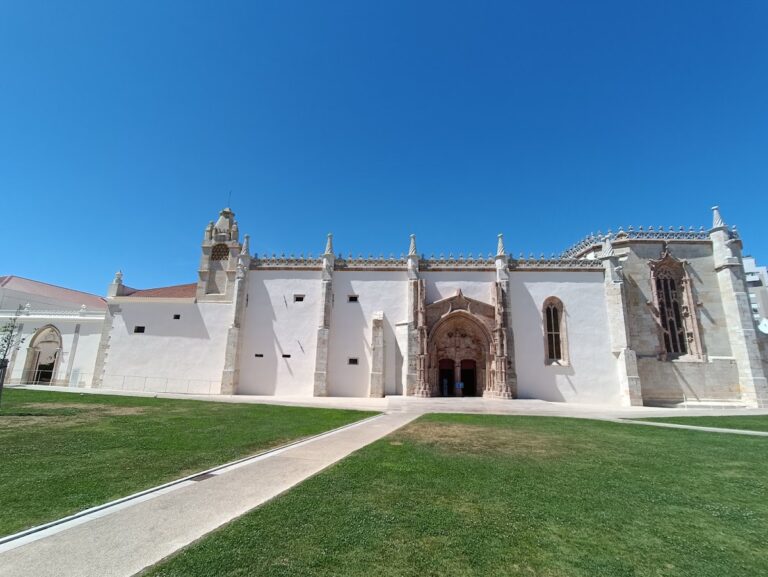
The convent and the Church of Santiago of Palmela are Gothic works from the fifteenth-century building phase. They reflect the permanent establishment of the Order of Santiago at Palmela from 1443. The church’s windows were altered during interventions carried out before the 1940 Centenary commemorations.
The keep’s internal cistern and the surviving walls, towers, enclosures, churches, and convent buildings together preserve the castle’s successive defensive and institutional arrangements. From the keep, the view extends as far as Lisbon in clear weather, reflecting the elevated position of the complex between the Tagus and Sado.