Pichlschloss: A Historic Noble Estate in Neumarkt in der Steiermark, Austria
Visitor Information
Google Rating: 4.9
Popularity: Low
Official Website: www.pichlschloss.at
Country: Austria
Civilization: Early Modern, Modern
Site type: Domestic
Remains: Palace
History
Pichlschloss is located in the municipality of Neumarkt in der Steiermark, Austria. Its origins trace back to a small noble estate first recorded in 1332 under the name “Puhlern.” Initially, this estate was subordinate to the Stubenberg lordship, reflecting the feudal structures of medieval Austria.
Around the year 1500, the estate experienced a decline in status and influence but later regained its independence during the 16th century. Early in the 1500s, it transformed into a peasant property owned by Joachim Muerer, a citizen from the nearby town of Knittelfeld. This period marked a significant shift away from purely noble possession towards more local, civic ownership.
In 1565, the estate saw a revival under Bartlme Haslinger, who had been ennobled by King Ferdinand I in 1543. Haslinger purchased the property and between then and 1569 undertook substantial construction to convert it into a Renaissance-style noble residence. This rebuilding represented the estate’s re-establishment as a noble seat with architectural elements reflecting the Renaissance period.
Ownership changed hands again in the early 17th century. In 1604, the Mayer family, later known as Pirker, took possession but sold it a decade later in 1614 to Hans Pichler. His family was ennobled in 1625 as von Pichl and received the elevated title von Freydenpichl in 1660. The von Pichl family maintained control of the estate until 1776, when it was sold to Lorenz Mörzl, a farmer who acquired the property as a freeholder. During this time, the name “Pichlschloss” became commonly used to refer to the estate.
Throughout the 19th century, the estate changed ownership several times, passing through the Plankensteiner family from 1826 to 1856, followed by the Freiherren von Dickmann. In 1883, a new phase began when the property was converted for health-related uses, becoming a spa and sanatorium. This adaptation marked a shift from a noble estate to a facility serving therapeutic and wellness purposes.
In the early 20th century, from 1909 onward, the estate was operated as a sanatorium by the Mandl family and later by Dr. Paumgartner. During the Nazi period, its role evolved to serve as a mother-child home and maternity hospital designated for German children at risk from bombing raids. After World War II, Pichlschloss returned to its function as a sanatorium.
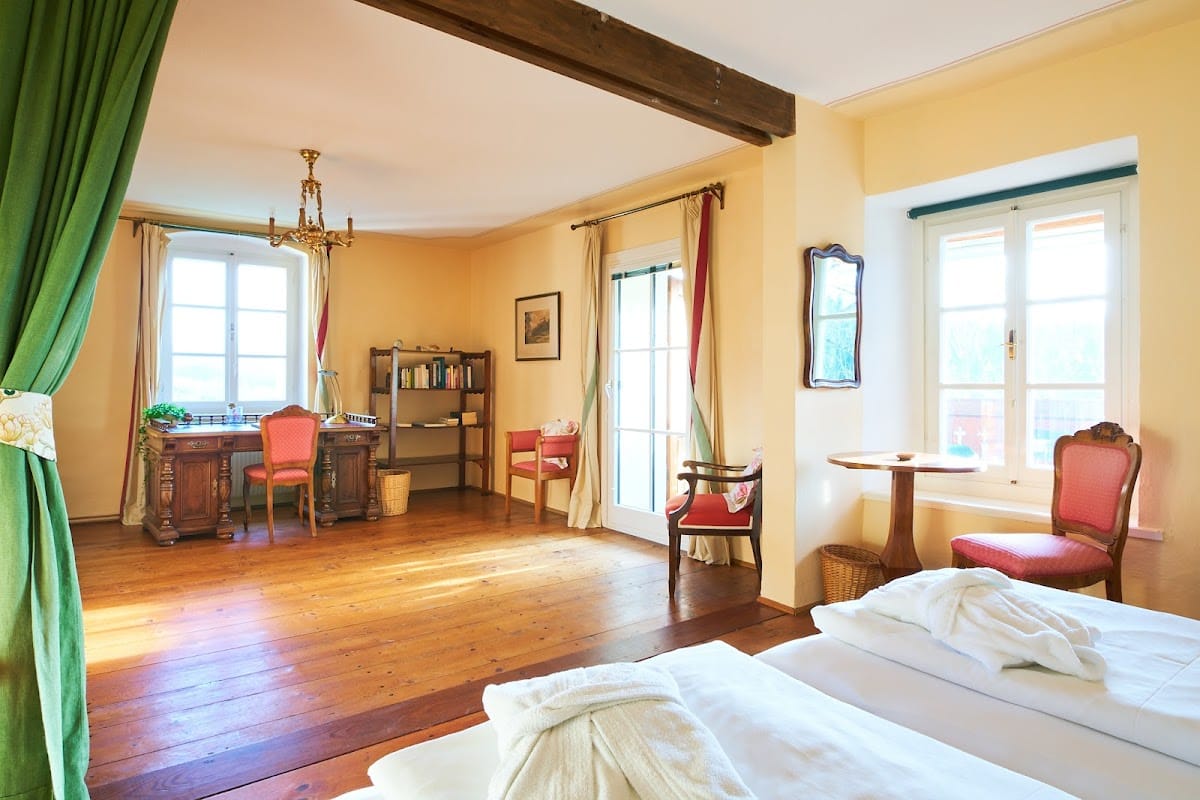
Today, the estate remains in private family ownership, having been passed down through three generations, and functions as a hotel. Throughout its history, the building has preserved its legacy as a noble estate reflecting cultural and historical adaptations spanning from the late medieval era to the early modern period.
Remains
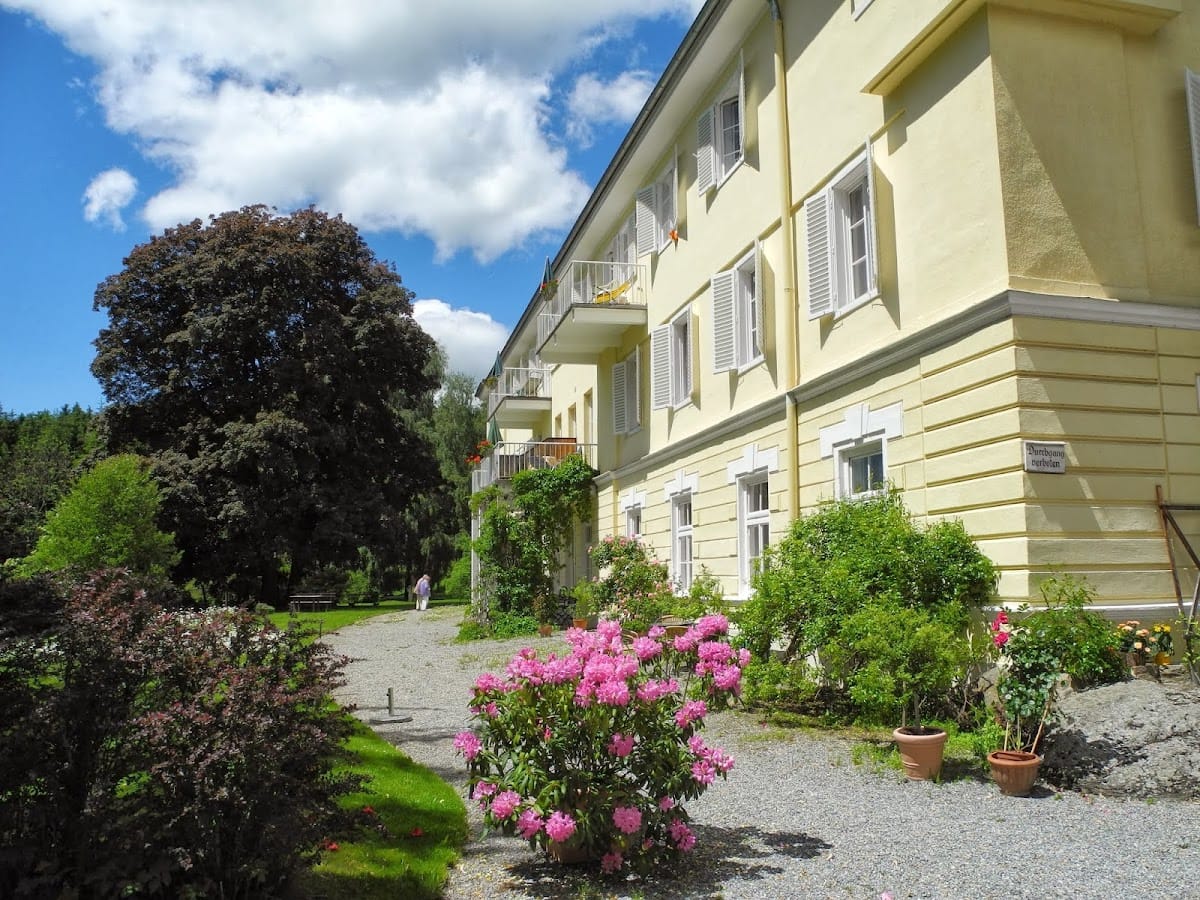
The Pichlschloss complex consists of two main wings forming a roughly rectangular shape oriented almost north-south. The north wing dates from the late 16th to early 17th century, while the south wing encompasses the original core of the noble estate built around the mid-16th century. These wings are linked by a central entrance section projecting east to west, constructed around 1569, creating a unified building mass.
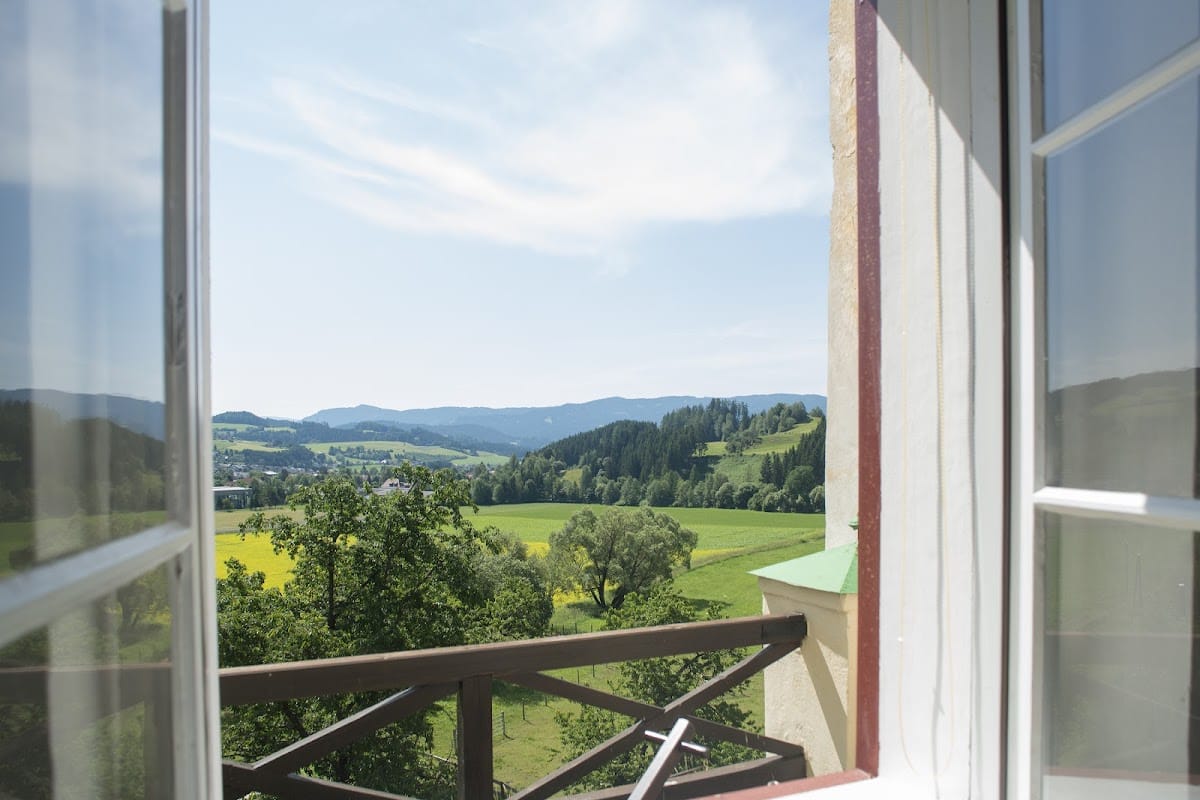
The roofs of the buildings exhibit hipped designs with continuous eaves, characteristic of the period. Notably, the northern roof of the north wing features a wooden dormer that once housed a manual elevator, a practical element reflecting historical use. Attached to the west side of the north wing is a two-bay annex built in the Baroque style, complete with a flat roof and a balcony added in the 19th century. This balcony, known as an altane, has iron grille balustrades decorated with vertical bars and circular motifs set between masonry pillars.
Facades are generally plain and unembellished, though the upper stories of the north facade include chamfered window frames in Renaissance style. Both wings have projecting bays, known as risalits, positioned on their west façades—the north wing’s near the center, and the south wing’s in the second axis from its southern end. On the southwest upper floors of the south wing, modern wooden balconies have been installed.
The main historic entrance is situated on the west-facing projection of the central connecting section, oriented northeast. It features a finely crafted Renaissance stone portal with a rounded, chamfered gate frame surrounded by a rectangular border and multiple layers of molded cornices. The spandrels of the portal carry the coats of arms belonging to Bartlme Haslinger and likely his wife—His shield combines elements like a lion and tree, while his wife’s depicts a woman clad in traditional Spanish attire—alongside the split date “1569,” marking the construction period. The gate itself is reinforced with diamond-shaped iron plates, fitted with pull knobs and a keyhole plate designed in the Josephine-classical style.
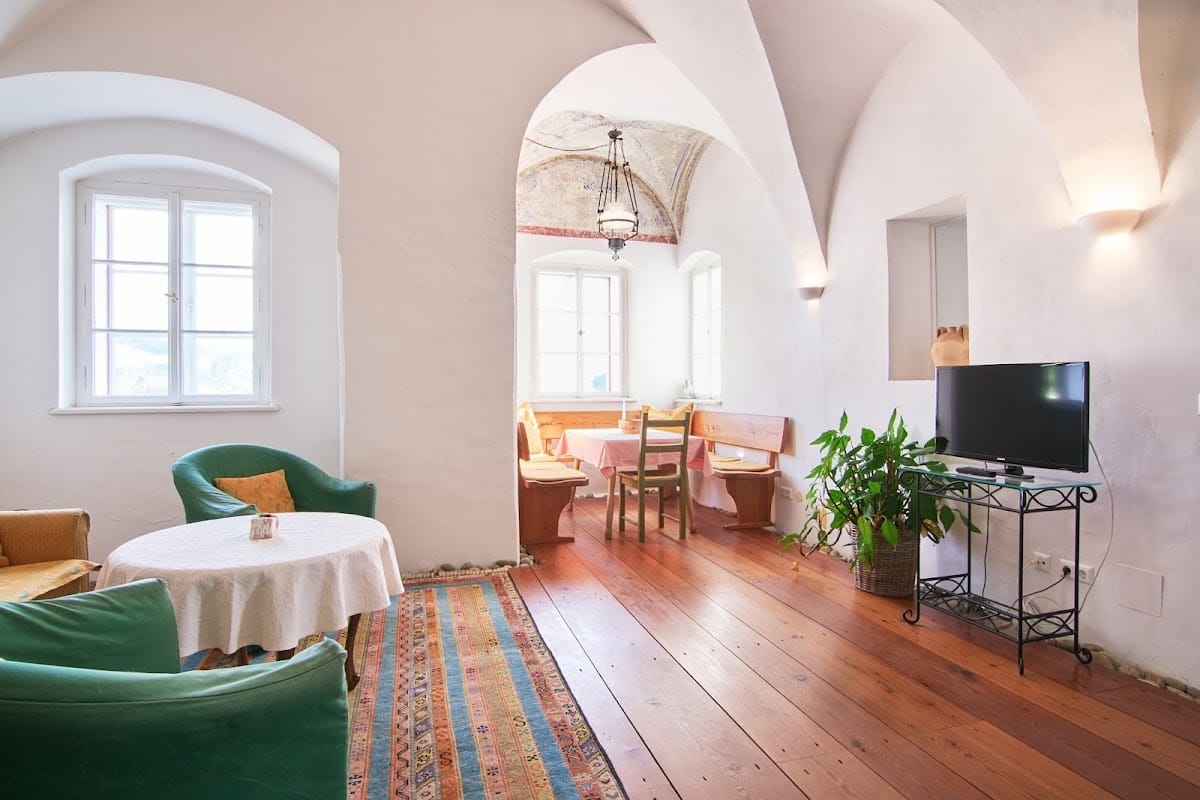
Inside, the entrance hall boasts a groin-vaulted ceiling, a vault created by the intersection of two barrel vaults at right angles, decorated with the painted coat of arms of Lorenz Ehrenreich von Pichl dated 1647. From here, vaulted rooms extend into the north and south wings, featuring groin and cross vaults consistent with Renaissance and Baroque architectural traditions. The south wing includes early to mid-16th-century rooms covered by pointed groin vaults, indicating the medieval origins of this part of the building.
Most interior doors feature framed paneling with hardware dating from the 17th through 19th centuries. The ground floor entrance leads to a vaulted staircase with a single flight that connects to the first floor, an area serving as the Beletage, or the main and most finely decorated living floor. Here, some doors showcase intricate 18th-century inlaid frames, latticework, and Rocaille-style motifs, which suggest foreign influences. One room in the north wing houses an ornate cylindrical cooker stove topped with decorative vases, exemplifying the Classicist style.
Ceilings throughout the residence tend to be flat, occasionally bordered by simple molded stucco frames. The attic, originally used for grain and storage, was repurposed in the 20th century and includes a large room with a heavy wooden beam ceiling and a recently added private chapel.
To the north of the main building lies a former mill dating back to the 18th century. Around 1900, this structure was converted into a residence, retaining much of its original architectural character. It features a central corridor flanked by rooms, a rear staircase with a single flight, and flat ceilings in most rooms. The hallway and stairwell boast barrel vaults. The mill has a half-hipped gable roof and a tiled chimney distinguished by double-arched smoke outlets framed with cornices.
Surrounding Pichlschloss are terraced slopes stabilized by retaining walls constructed of rubble stone, dating from the 16th and 17th centuries. These terraces are enclosed by fences set on masonry pillars capped with pyramid-shaped stones dating to around 1900, alternating with sections of wooden fencing from more recent periods. This blend of structures reflects the estate’s ongoing adaptation and maintenance through centuries.
Nearby sites