Gelida Castle (Castell de Gelida): A Medieval Fortress in Spain
Site at a Glance
- Rating
- 4.4
- Popularity
- Low
- Country
- Spain
- Primary era
- Medieval
- External website
- Open
- Eras represented
- Medieval
- Civilizations
- Crown of Aragon
- Site type
- Military
- Remains
- Castle
On this page13 sections
History
Gelida Castle, also known as Castell de Gelida, is an ancient fortress, archaeological site, and necropolis in Gelida, Spain. Occupying a strategic position above the Anoia River, the medieval complex was first recorded in 945 and later developed through successive Romanesque and Gothic building phases. Its history reflects the changing control of a fortified territory on the approach to the Penedès plain.
Origins and medieval lordship
The castle first appears in written records in 945, when Riquilda, wife of Sunyer I, the tenth-century Count of Barcelona, referred to it in a donation supporting the monastery of Santa Cecília de Montserrat. The monastery soon held allodial property there, meaning land and its associated rights held without the direct control of a superior lord.
Following Al-Mansur’s raid in 985, Ènnec Bonfill, lord of Cervelló and a great-nephew of the ninth-century count Guifré el Pilós, acquired the castle by exchange. The transaction included the church, tithes, and other rights connected with the territory. The Cervelló family and its descendants retained control until the thirteenth century.
During the early twelfth century, Almoravid forces reached the fortress after ravaging the Penedès. The Almoravids were a North African Muslim dynasty and military power that expanded into Iberia during the eleventh and twelfth centuries. Their advance was probably halted at the castle walls. This episode became associated with the liberties and privileges that Ramon Berenguer III, Count of Barcelona, granted to the inhabitants of Olèrdola.
In 1267, Guerau VI of Cervelló granted privileges to the territorial community and obliged his descendants to respect them. In 1297, Guerau VII sold the castle and other family possessions to Jaume II, king of the Crown of Aragon. Jaume II exchanged the castle in 1309 with the Countess of Pallars.
Transfers of ownership and wartime upheaval
The barony of Gelida, a feudal territorial lordship, was sold in 1337 to Pere III, judge of Arborea, an autonomous medieval polity in Sardinia. In 1367, his granddaughter Beatriu sold it to Berenguer Bertran, a banker from Barcelona. The castle subsequently passed among the families of Cervelló, Montcada, Arborea, and Bertran.
The lord of Gelida actively supported the war against Joan II, the fifteenth-century king whose conflicts included the Catalan Civil War. In 1465, the castle housed Peter of Portugal, a Portuguese nobleman who held the senior military office of constable of Portugal. The Bertran family temporarily lost control of the site during these events and recovered it after renewing its oath of loyalty to the king.
In 1529, Anna Violant Bertran and Estaper married Joan of Erill-Orcau and Requesens. Minor works and repairs followed during the sixteenth century. The later fate of the fortress is less certain. It is probable, though not documented, that Felip V ordered its demolition after the War of the Spanish Succession.
Reuse, preservation, and archaeological study
During the eighteenth century, stone from the castle was reused in other construction. In 1780, the rector of Sant Pere requested permission to remove stone from the site for the church bell tower. Josep Pasqual de Marimon i Perellós, fifth Marquis of Cerdanyola, sold the castle in 1815 to the Leblond family, whose members were military personnel. In 1909, the Altimires acquired it from the Genés family, descendants of the Leblonds.
The Associació d’Amics del Castell de Gelida was founded in 1965 to manage and recover the heritage of the castle area. The complex became municipal property in 1968, and the association now manages it as a museum and interpretation space. Archaeological interventions during the 1990s documented several areas and structures and clarified the sequence of construction phases. Later work consolidated and stabilized architectural elements and added facilities for interpretation and management, including walkways and railings.
Gelida Castle has been protected as a Cultural Asset of National Interest in the category of historic monument since 1949. It is also recorded as a Spanish Asset of Cultural Interest from 1988.
Remains
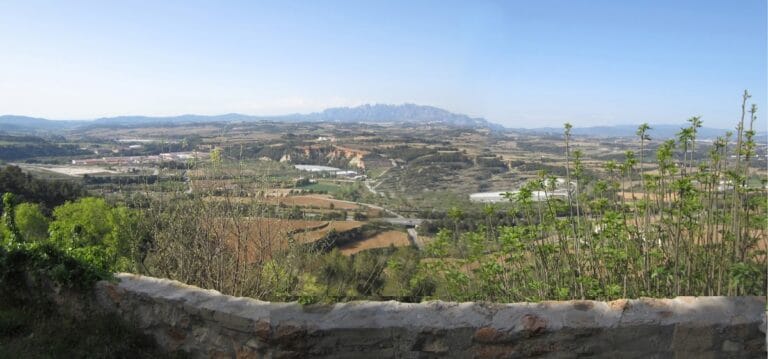
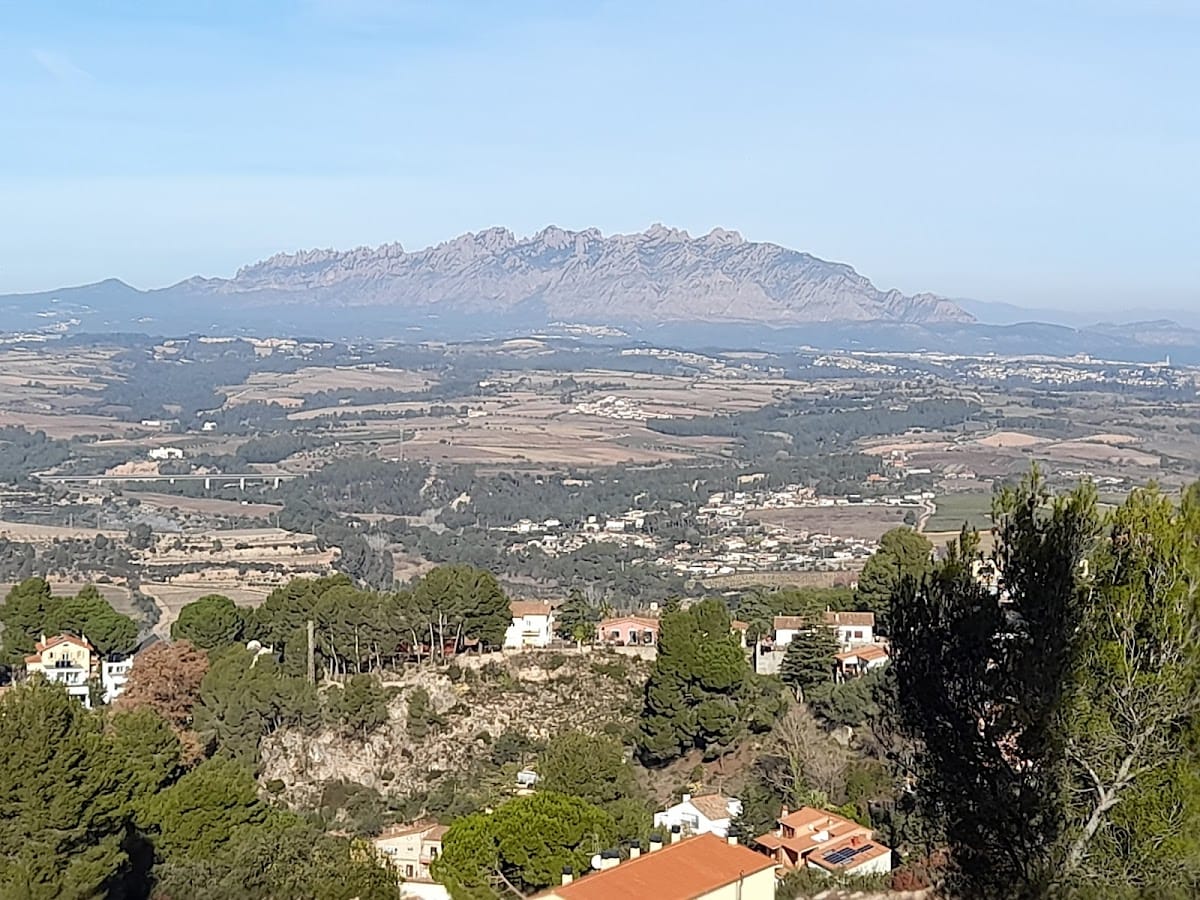
The complex occupies the top of a cliff on the Serra de l’Ordal, on the right bank of the Anoia River. From this elevated position, the site overlooks Gelida, the lower river course, and the entrance to the Penedès plain. The hill reaches approximately 250 to 290 metres in elevation and is bounded by the Cantillepa and San Miguel torrents to the north and south. The fortified enclosure extends from southeast to northwest, with its highest point toward the southwest.
Fortified sectors and early structures
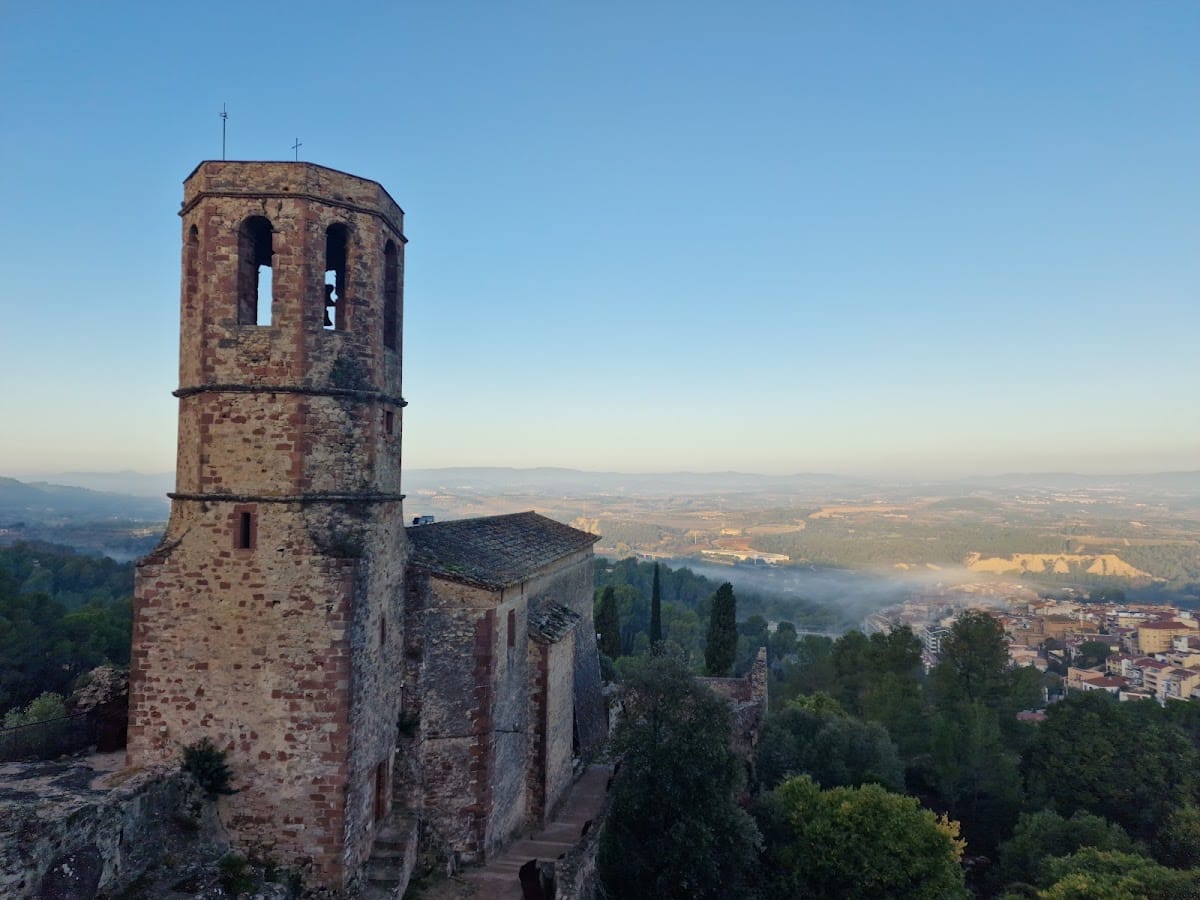
The site is arranged in three sectors. The upper sector contains the castle proper within an enclosure about 30 metres wide and 30 metres long. Farther west is an esplanade measuring approximately 90 by 30 metres, while the westernmost sector contains the church and the later present entrance. The partly ruined complex preserves Romanesque and Gothic elements alongside archaeological remains from several construction areas and phases.
Polygonal building and early wall
The upper enclosure contains a polygonal building that probably formed part of one of the earliest fortifications. It measures about 10 by 5 metres. Three walls are approximately 2 metres thick, while the other two are about 60 centimetres thick, suggesting that the structure belonged to a larger enclosure. Its small, lightly worked or unworked stones are arranged in places to imitate opus spicatum, a herringbone pattern of masonry. The polygonal structure is probably slightly earlier than 1060.
Not long afterward, a substantial wall approximately 55 metres long was built across the western side of the upper sector, where access was easiest. This wall formed part of the defensive organization of the castle and helped define the upper enclosure.
Semi-elliptical half-tower
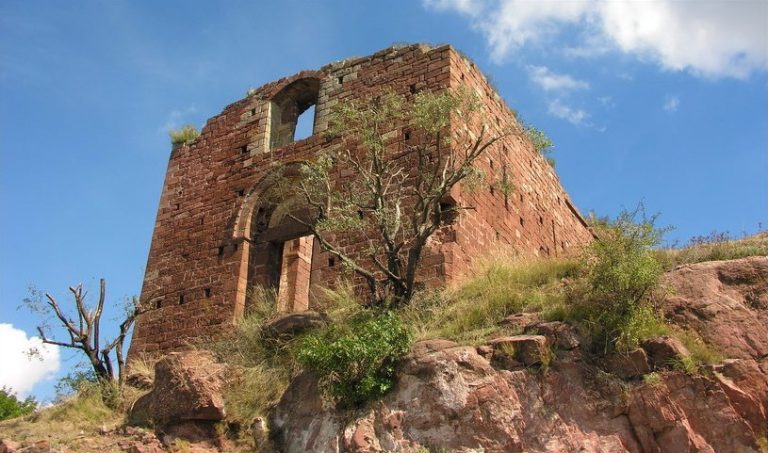
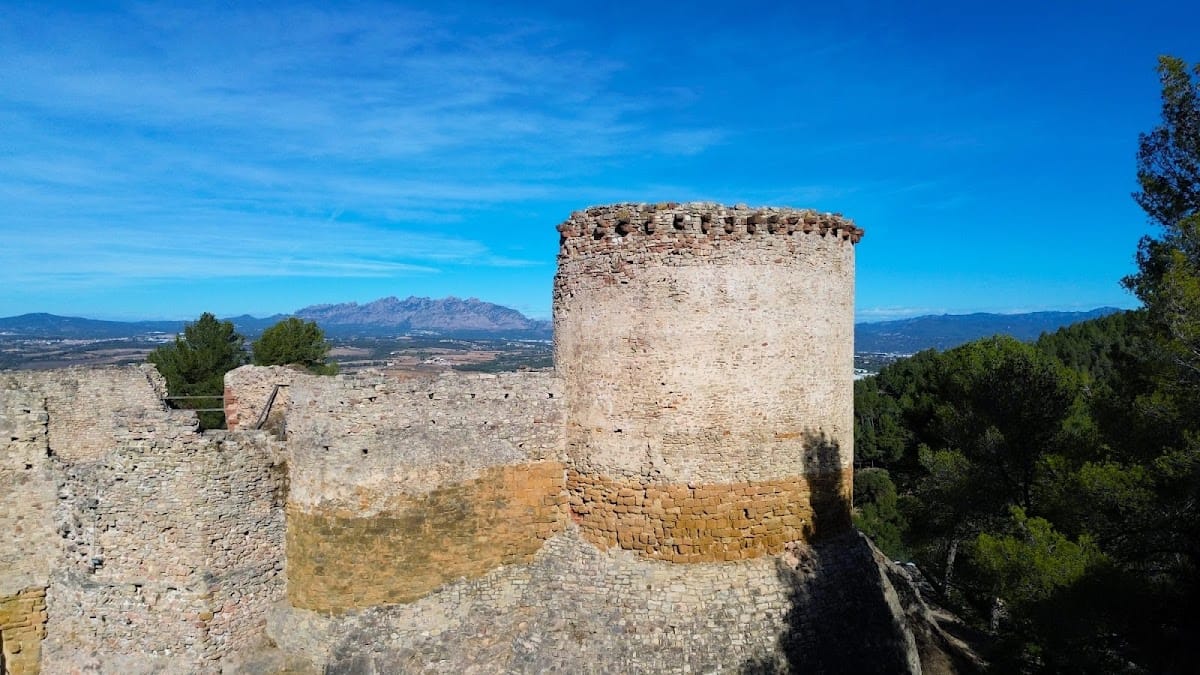
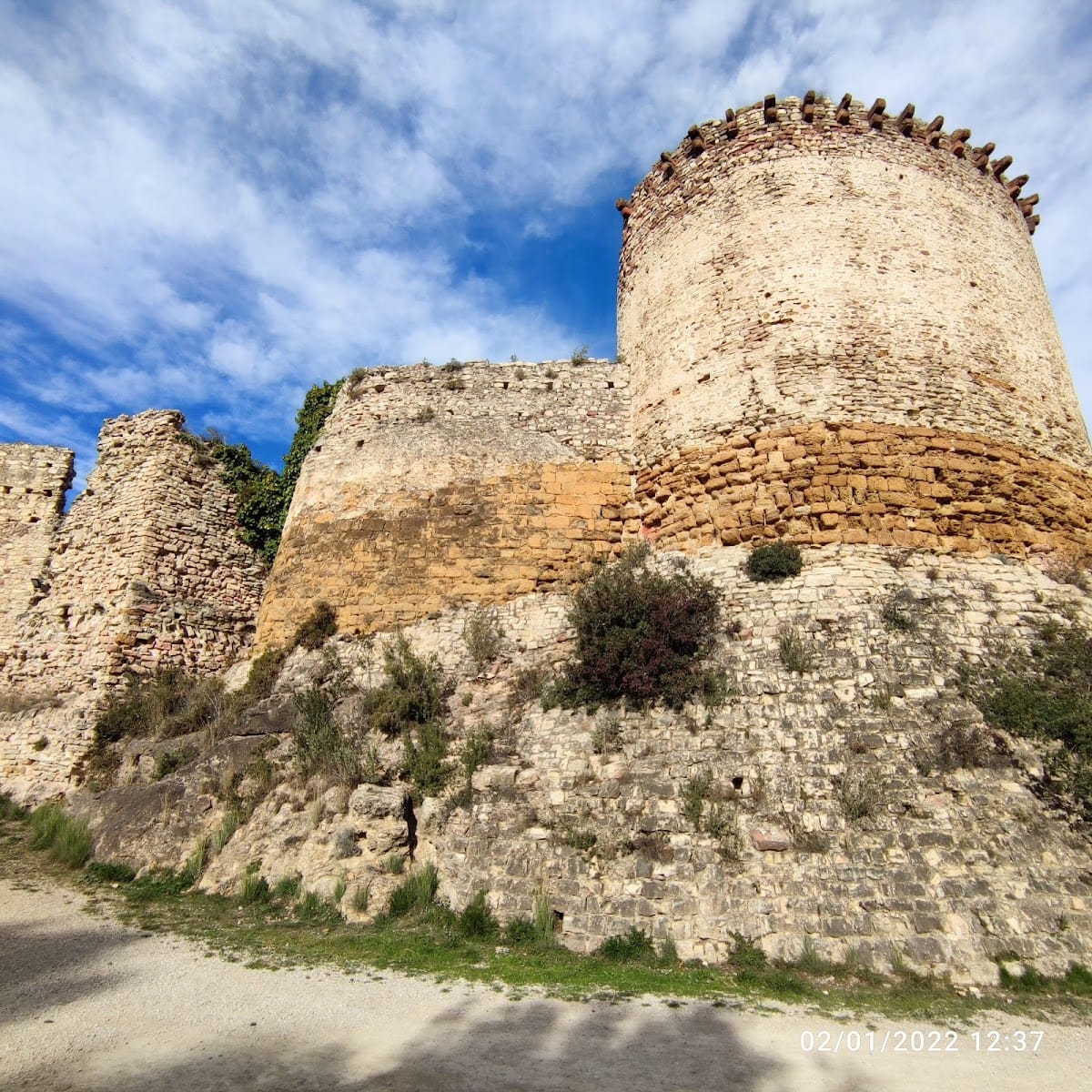
East of the polygonal structure stands a large semi-elliptical half-tower joined to a section of the defensive wall. Its lower ten or twelve courses consist of large, carefully squared blocks of ochre-coloured ashlar. Smaller stones were used above them, and a row of later corbels, projecting blocks that support a structure above, crowns the tower.
Keep and chapel apse
The northern part of the upper sector contains the remains of a large keep, the principal fortified tower of a castle. It has a diameter of 5.5 metres and walls 3.1 metres thick. Only its lower portion survives, although the tower was probably once very tall. The keep and some of the perimeter walls may date from the twelfth century.
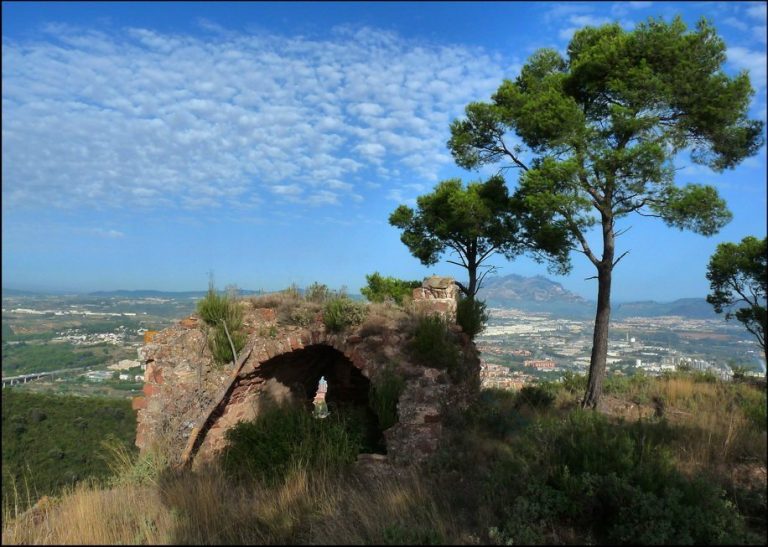
Beside the eastern wall is an apse, the rounded or polygonal end of a church commonly containing the altar. It belongs to a small castle chapel and may also date from the twelfth century.
Later defensive and service buildings
Western rebuilding and water system
Around the fourteenth century, the entire western wall of the upper sector was rebuilt. A cistern, a tank for collecting and storing water, was constructed at the same time with a system for distributing the stored supply. These works altered the organization of the upper enclosure and formed part of a later phase in the castle’s development.
Entellada entrance and working area
During the fifteenth century, building activity concentrated in the westernmost sector, especially around the church. The entrance portal known as the Entellada was built there and ends in a semicircular arch. Storage buildings and facilities for processing oil and wine were also constructed in this part of the complex.
Sant Pere del Castell de Gelida
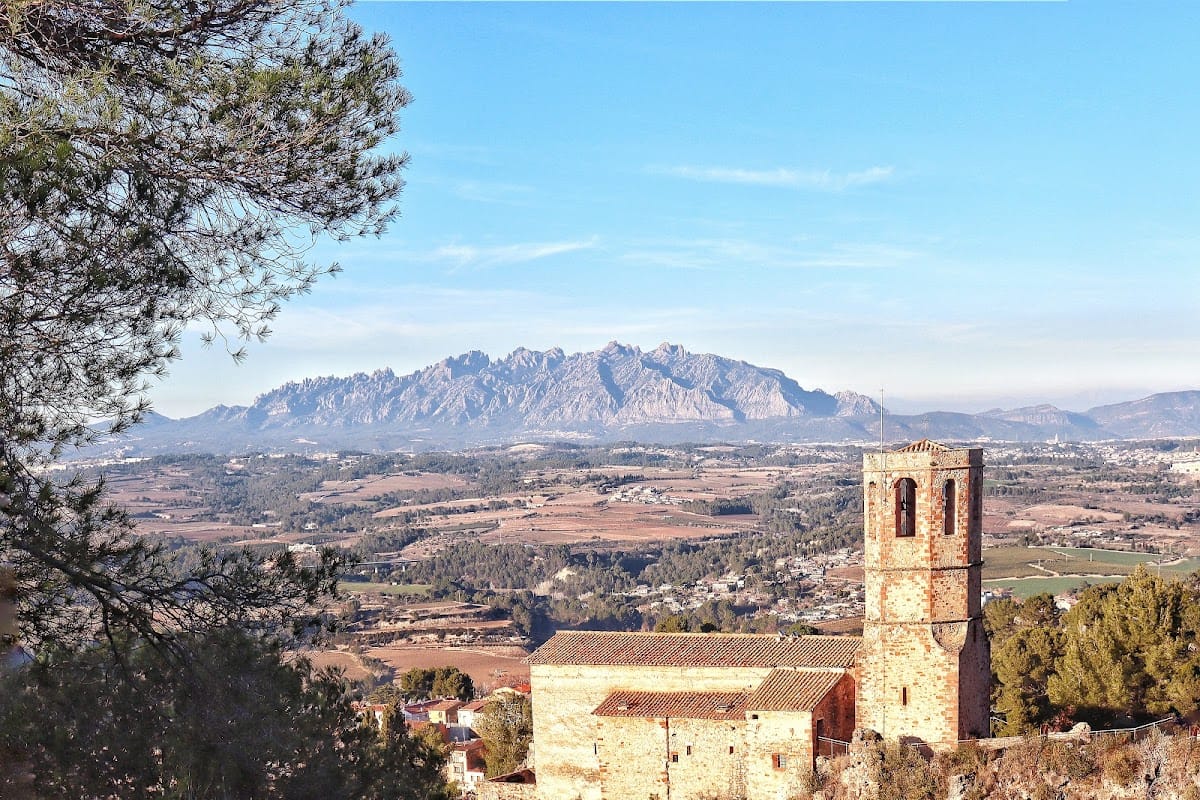
Sant Pere del Castell de Gelida stands adjacent to the castle and is dedicated to Saint Peter. The church is recorded as early as 945 and is described as the only building in the complex still standing. Its survival provides a substantial architectural element within a site otherwise characterized by partly ruined structures and archaeological remains from successive periods.