Dunluce Castle: Medieval Stronghold and Seat of the Earls of Antrim
Site at a Glance
- Rating
- 4.6
- Popularity
- Medium
- Country
- United Kingdom
- Primary era
- Medieval
- External website
- Open
- Eras represented
- Medieval, Early Modern
- Civilizations
- English
- Site type
- Military
- Remains
- Castle
On this page7 sections
History
Dunluce Castle is a medieval castle in the United Kingdom, on the coast of County Antrim in Northern Ireland, built initially as an Anglo-Norman stronghold in the thirteenth century. An earlier Irish or Celtic fort occupied the basalt outcrop in antiquity and the early medieval period, although little survives and its history remains uncertain.
Medieval origins and the McQuillans
Richard Óg de Burgh, the Red Earl and second Earl of Ulster, built the first castle at Dunluce during the thirteenth century. The earliest surviving castle elements are two large drum towers on the eastern side, constructed as part of a later stronghold erected by the McQuillans after they became Lords of the Route. This medieval territory covered part of north-eastern County Antrim.
Dunluce was in McQuillan possession by 1513. The family held the lordship of the Route from the late thirteenth century until the MacDonnells displaced them after victories in two major battles during the middle and later sixteenth century. The McQuillans and MacDonnells were Gaelic or Gaelicized aristocratic clans whose rivalry shaped control of the castle and the surrounding territory.
MacDonnell rule and the earldom
After his brother James MacDonald, sixth chief of the MacDonald clan of Antrim and Dunnyveg, died, Sorley Boy MacDonnell took Dunluce in 1584. He retained the castle, enlarged it in a Scottish style, and swore allegiance to Queen Elizabeth I. His son, Randal MacDonnell, later became the first Earl of Antrim under King James I.
Dunluce served as the residence of the MacDonnell chiefs of Antrim and the MacDonald chiefs of Dunnyveg in Scotland, as well as the seat of the Earls of Antrim. Randal MacDonnell and his wife, Katherine Villiers, Duchess of Buckingham, furnished the castle lavishly. Their granddaughter, Rose MacDonnell, was born there in 1613.
In 1588, the Spanish Armada, the fleet sent by Philip II of Spain against England, was scattered by storms. One of its heavily armed galleasses, the Girona, wrecked on rocks near Dunluce. Its cannons were placed in the castle gatehouses, while the remaining cargo was sold to fund repairs and strengthening works.
Abandonment and archaeological rediscovery
A local story says that part of the kitchen fell into the sea, killing the cooks except for a kitchen boy and prompting the lord’s wife to refuse to live at Dunluce. The story is doubtful because the kitchen survives, but a collapse in the eighteenth century did bring down the northern wall and residential buildings into the sea.
The castle remained the seat of the Earl of Antrim until the MacDonnells were impoverished in 1690 after the Battle of the Boyne. Dunluce then declined, was abandoned, and was partly dismantled for building materials used in nearby buildings. In 2011, major excavations beside the castle uncovered substantial remains of a lost town destroyed during the Irish uprising of 1641. Randal MacDonnell had established the town around 1608, before the Plantation of Ulster, the English and Scottish colonization project that reorganized landholding and settlement in the province.
Dunluce Castle is a state-care historic monument under Northern Ireland’s heritage authorities, while the adjacent earthworks are a scheduled historic monument. The site lies in the Dunluce townland within the Coleraine area. Its cultural presence has continued through Norman Hay’s 1921 symphonic poem Dunluce, its identification as an inspiration for Cair Paravel in The Chronicles of Narnia, and appearances or references in films, songs, and album artwork, including Led Zeppelin’s Houses of the Holy in 1973, George Millar’s “Castle Dunluce,” Gary Moore’s After the War, and Jandek’s Glasgow Friday.
Remains
Castle rock and defenses
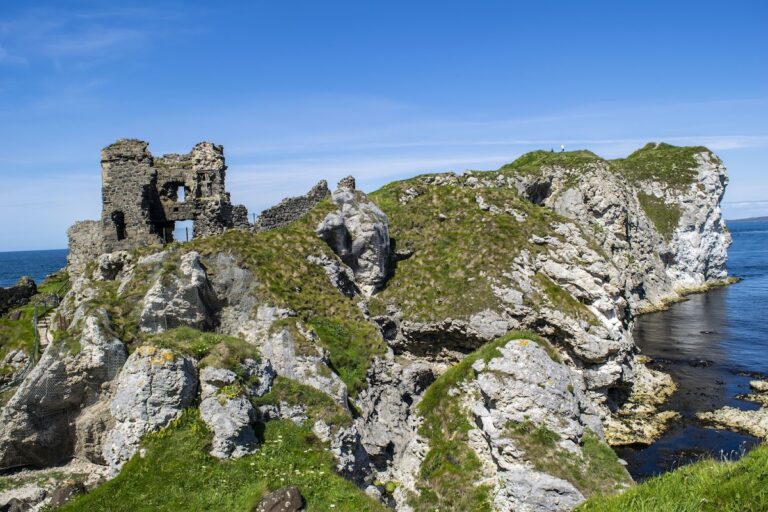
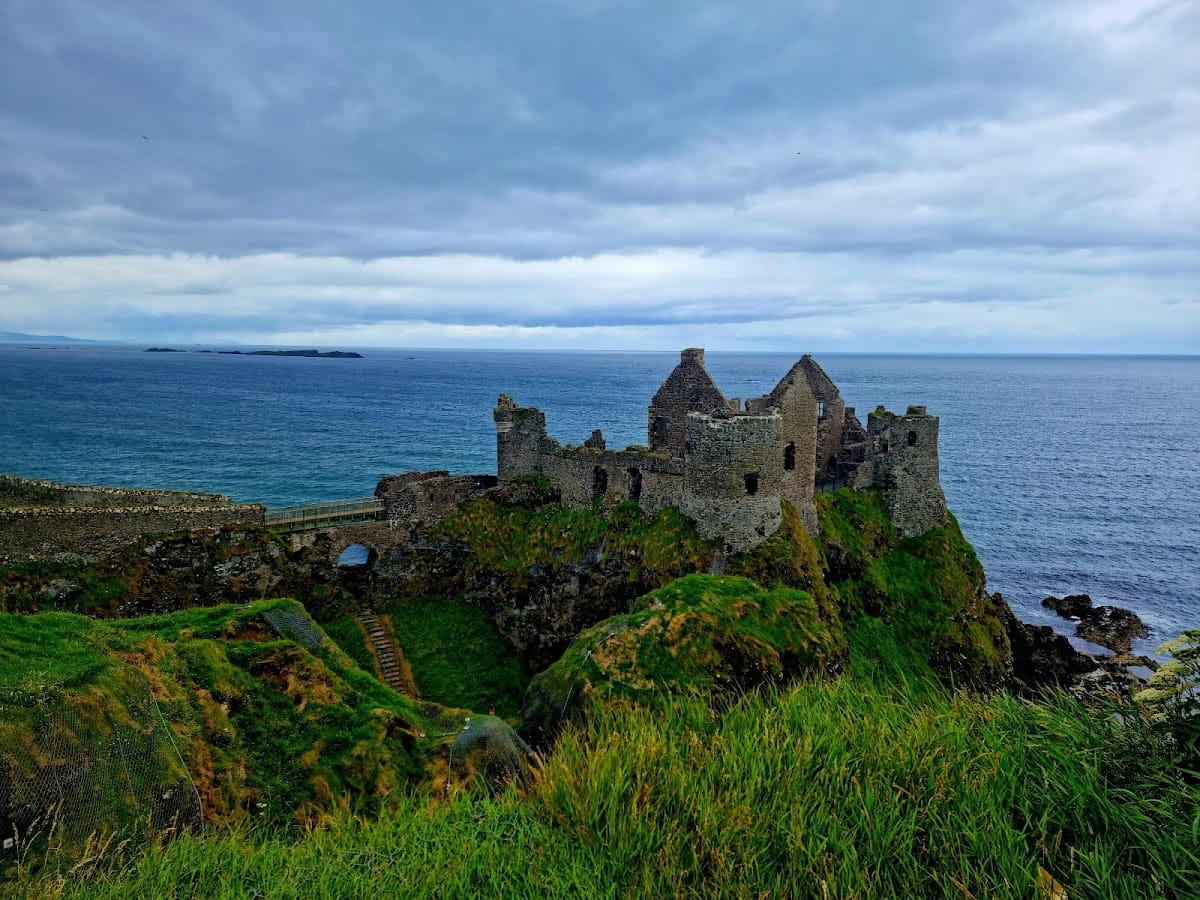
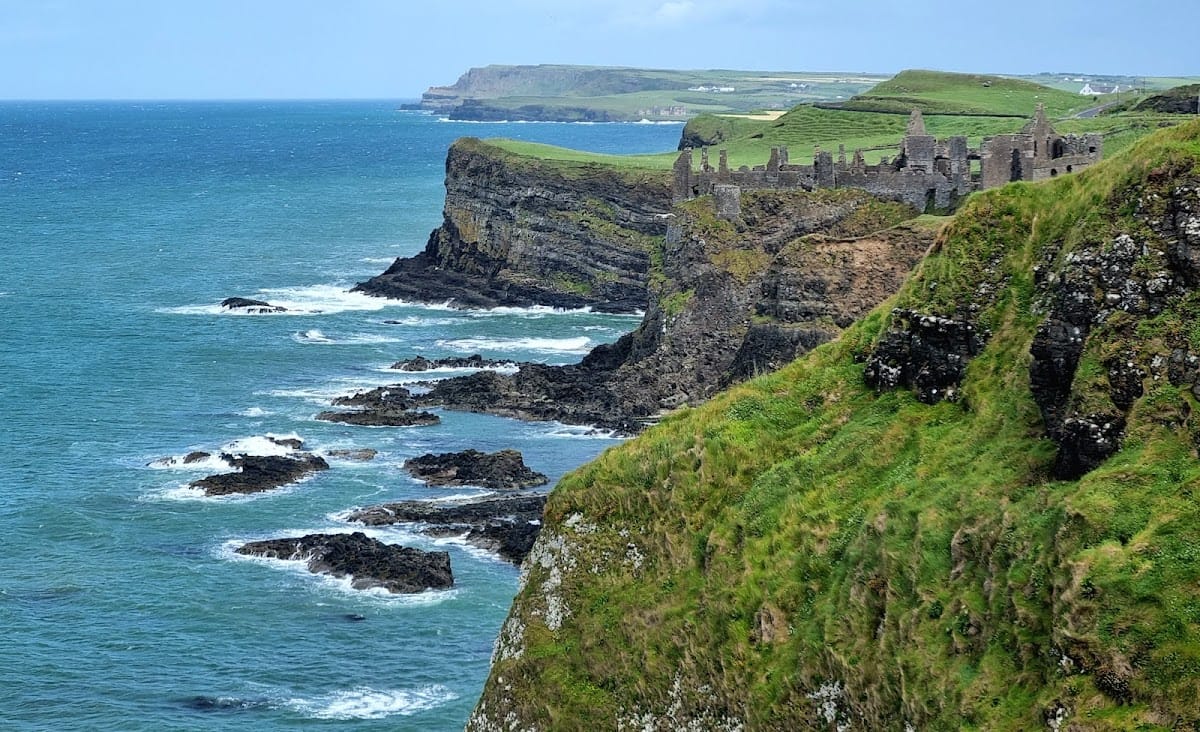
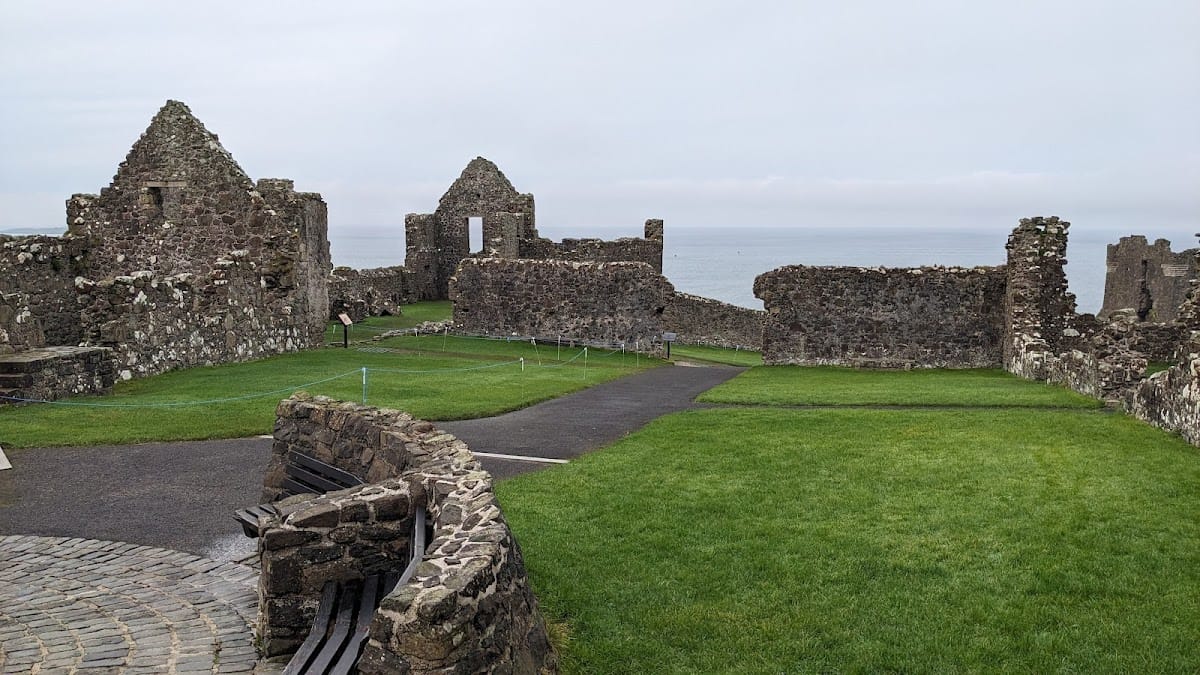
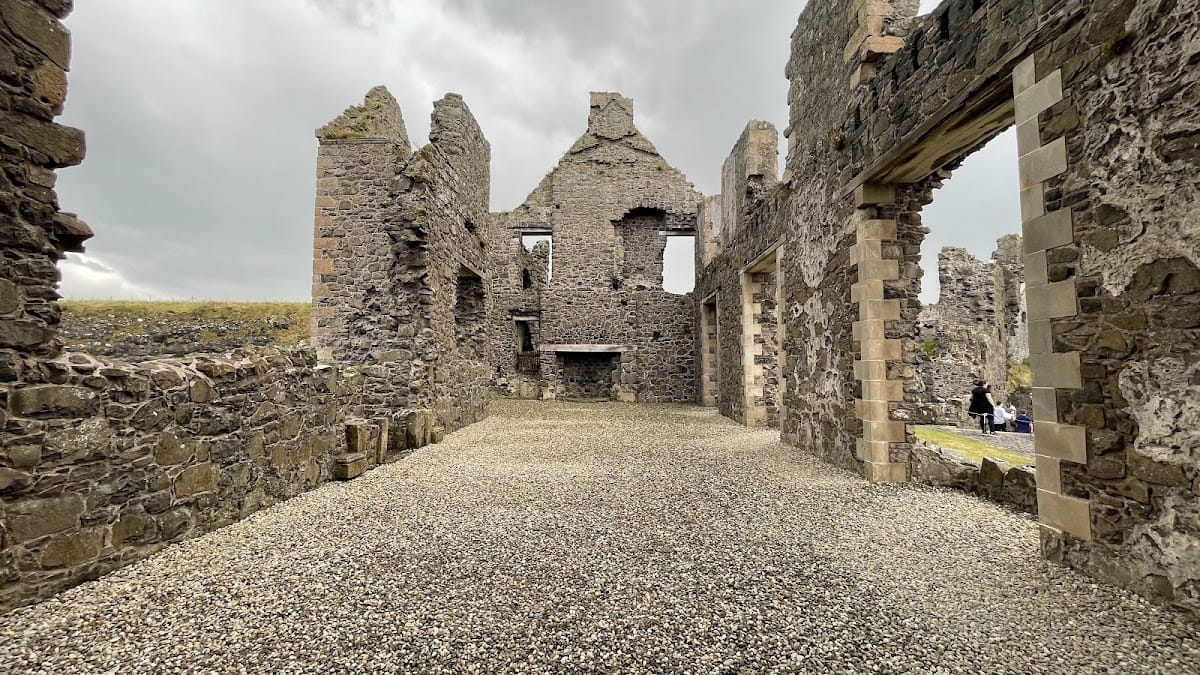
The castle stands on a basalt outcrop between Portballintrae and Portrush. Sheer drops and the surrounding sea isolate the rock from the mainland, with a bridge providing access. The surviving complex is substantially ruined, although its southern, western, and eastern walls remain standing. Two eastern drum towers, each about 9 metres in diameter, belong to the stronghold associated with the McQuillans. The gatehouses still preserve the position of the Girona’s cannons, installed after the 1588 wreck. The northern wall and parts of the residential buildings fell into the sea during the eighteenth-century collapse.
The planned town
The settlement beside the castle was laid out on a geometric grid. Excavations revealed a complex network of streets together with water-supply works, drainage or sewerage infrastructure, and indoor toilets, features unusual in early seventeenth-century Europe. The exposed remains occupy the coastal setting beside the castle rock, basalt cliffs, sea, and bridge. By 2011, excavation had reached only about 5 percent of the town, while approximately 95 percent remained for further investigation.