Kinbane Castle: A Sixteenth-Century MacDonnell Stronghold in Northern Ireland

Site at a Glance
- Rating
- 4.8
- Popularity
- Medium
- Country
- United Kingdom
- Primary era
- Early Modern
- External website
- Open
- Eras represented
- Early Modern
- Civilizations
- English
- Site type
- Military
- Remains
- Castle
On this page7 sections
History
Kinbane Castle is a sixteenth-century coastal stronghold near Ballycastle in the United Kingdom, built in 1547 by Colla MacDonnell, a member of the Gaelic MacDonnell clan. The castle occupied a strategically placed limestone promontory on the Causeway Coast and became involved in the MacDonnells’ resistance to English rule in County Antrim.
The MacDonnell stronghold
The MacDonnells were a Gaelic Irish-Scottish clan whose chiefs combined political, military, and landholding authority. During the sixteenth century, they controlled coastal areas of County Antrim. Colla’s father, Alexander MacDonnell, was lord of the Scottish peninsula of Kintyre and the Isle of Islay. Colla’s marriage to Evelyn MacQuillan also helped reconcile the previously hostile MacQuillan and MacDonnell noble families.
Sieges and restoration
English forces besieged Kinbane in 1551 during a campaign intended to destroy the MacDonnell clan. The castle withstood the assault. A second siege followed in 1555, when artillery fire partly damaged the building, but Kinbane again survived. Colla MacDonnell restored the castle in 1556, and he died there in 1558.
After Colla’s death, his brother Sorley Boy MacDonnell inherited Kinbane. He later exchanged it for Colonsay Castle, which belonged to Colla’s son and heir, Gillaspic MacDonnell. Kinbane subsequently passed to Owen MacIan Dubh MacAllister, second lord of Loup and chief of the MacAlister clan. Sorley Boy granted the castle to him as a reward for the MacAlisters’ loyal service to the MacDonnells.
MacAllister ownership and later tradition
Owen MacIan Dubh MacAllister was killed in 1571 while fighting the garrison of Carrickfergus Castle alongside Sorley Boy MacDonnell. Kinbane remained with Owen’s descendants until the eighteenth century, after which it was abandoned and became a ruin.
A ravine below the castle is known as Lag na Sassenach, meaning “Hollow of the English.” A sixteenth-century tradition links the name to an attempted surprise attack on Kinbane. According to the tradition, a signal fire on the castle tower summoned Irish clans, who surrounded and killed the English soldiers in the ravine.
Kinbane is a Scheduled Historic Monument, a legally protected archaeological or historic site whose preservation is regulated by the state. It also lies within the eastern part of the Causeway Coast Area of Outstanding Natural Beauty, a protected landscape designation recognizing notable scenic and environmental qualities.
Remains
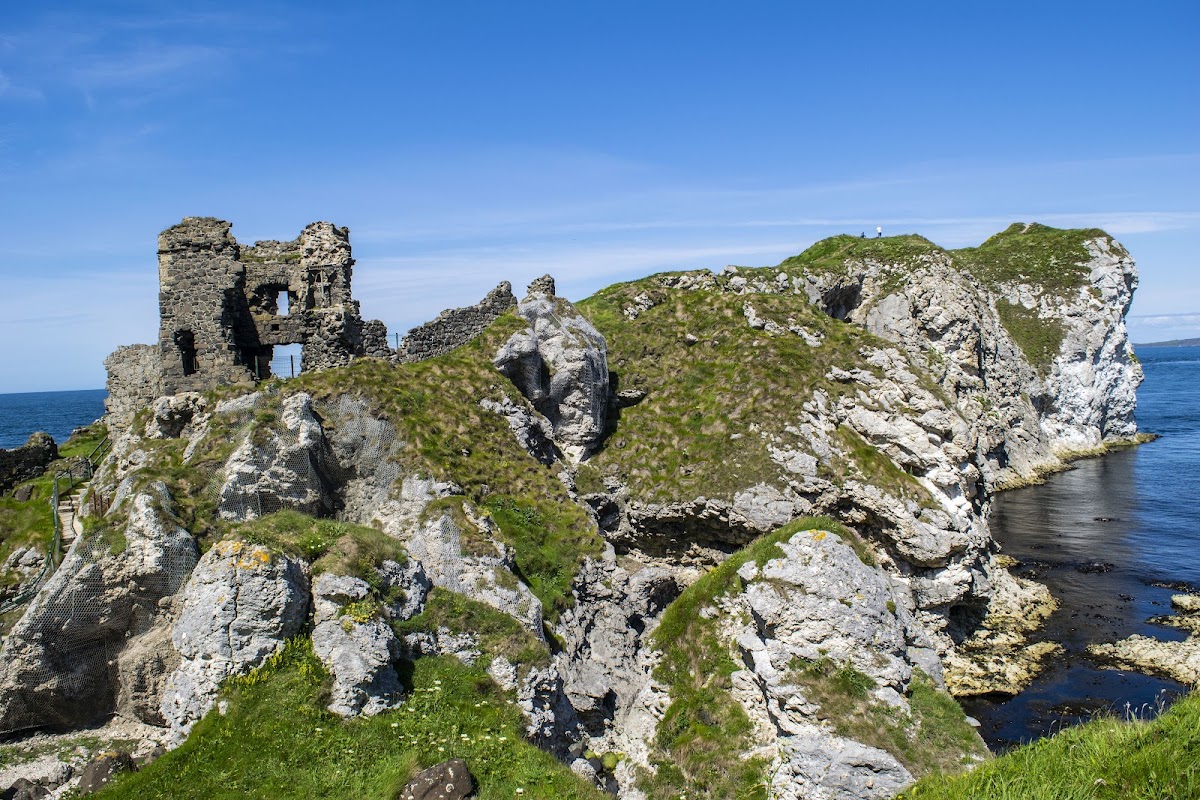
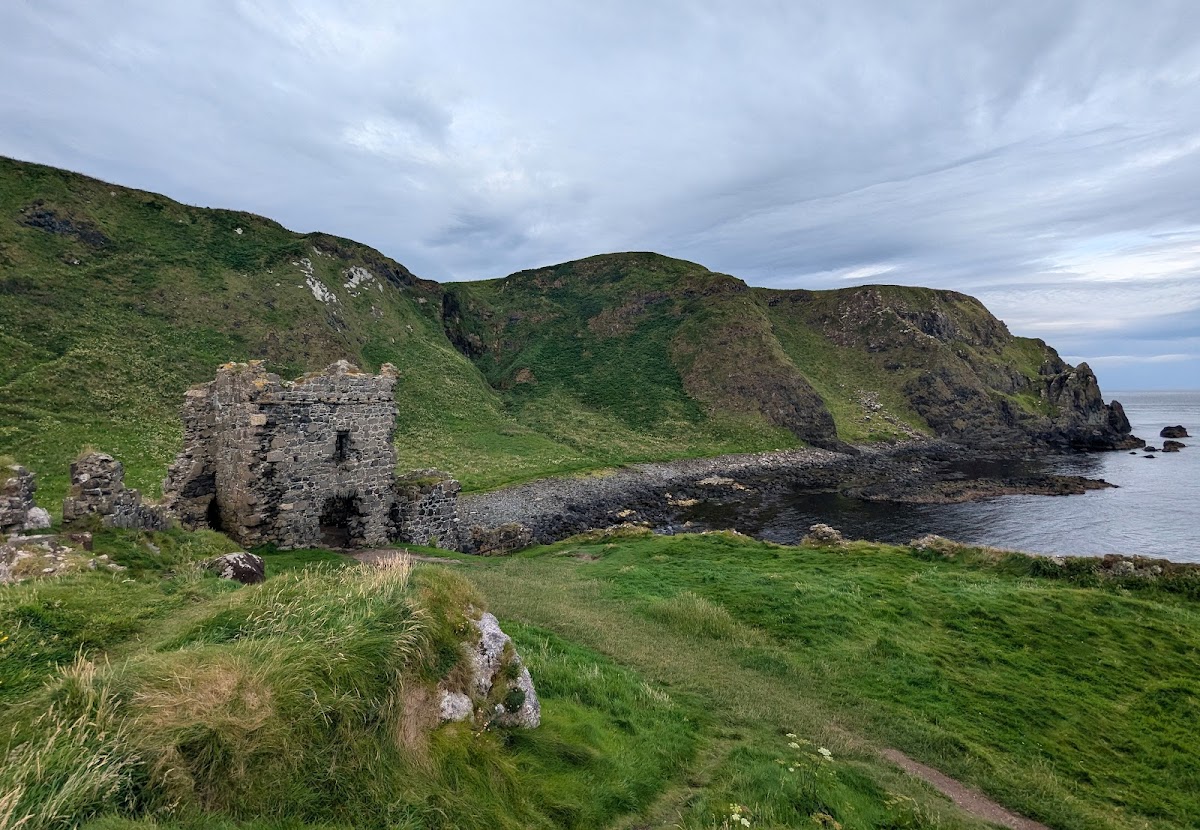
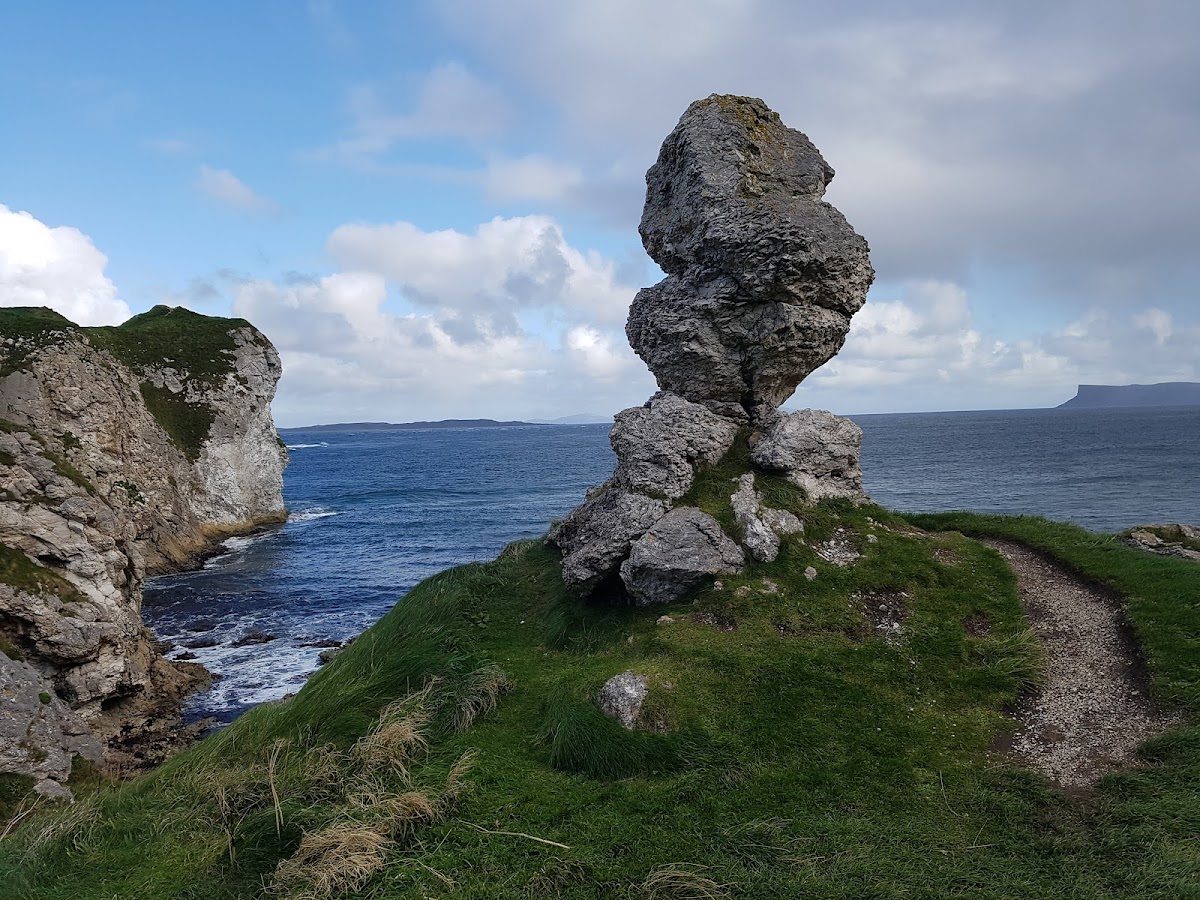
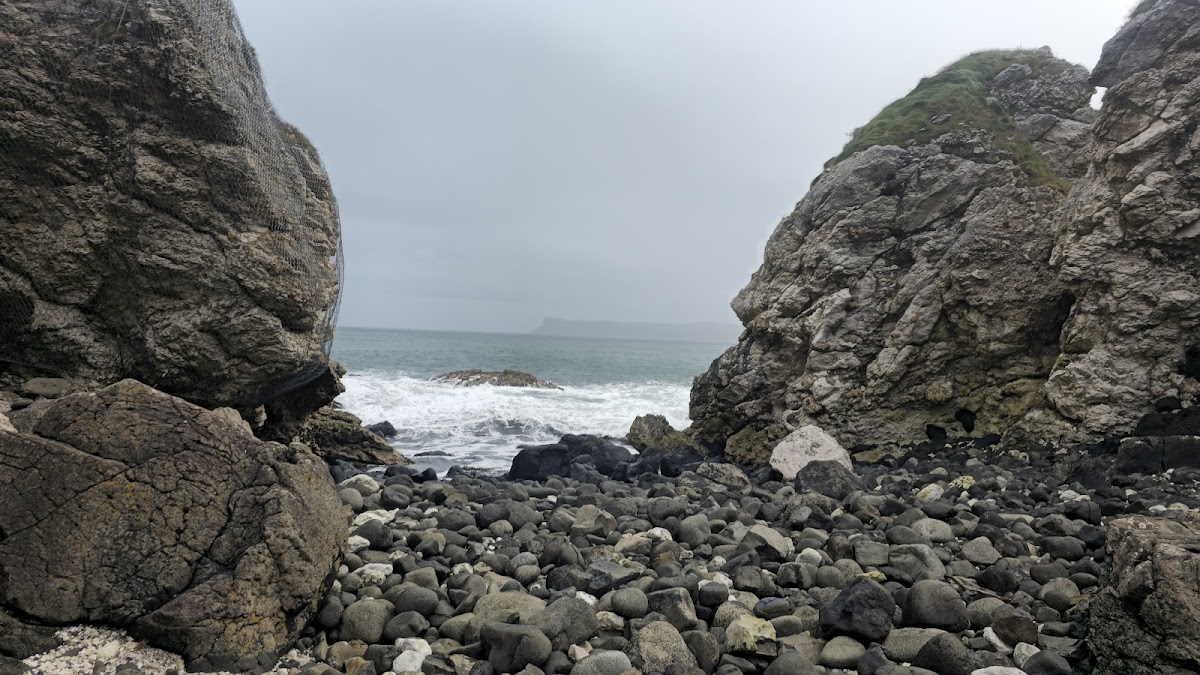
The ruin stands on a long, narrow limestone promontory projecting into the sea on the Causeway Coast, in the townland of Cregganboy, County Antrim. Its approach is narrow and stepped, a physical arrangement that contributed to the castle’s defensibility. The promontory lies about 3 kilometres west of Ballycastle in a straight line, or approximately 4 to 5 kilometres by local roads, and is around 7 kilometres from the southwestern tip of Rathlin Island across the sea.
Castle layout
The principal building was a two-storey stone structure set within a large courtyard. Additional buildings occupied the courtyard, with some probably made of wood. This arrangement combined a substantial residential tower with a wider enclosed area for other parts of the castle settlement.
Surviving tower and landscape
The surviving remains consist chiefly of the fragmentary residential castle tower, now in ruins. The surrounding rock formation includes the ravine of Lag na Sassenach. From the castle walls, the outlook extends toward Rathlin Island and the Iron Age fortress of Dunagregor, a prehistoric fortified site dating from the period when iron tools and weapons came into widespread use.