Glenarm Castle: The Ancestral Residence of the Earls of Antrim


Site at a Glance
- Rating
- 4.5
- Popularity
- Medium
- Country
- United Kingdom
- Primary era
- Early Modern
- External website
- Open
- Eras represented
- Early Modern
- Civilizations
- British, Irish
- Site type
- Domestic
- Remains
- Castle
On this page7 sections
History
Bisset origins
Glenarm Castle is a historic castle and country house in the United Kingdom, with origins reaching back to the thirteenth century. John Bisset acquired lands between Larne and Ballycastle from Hugh de Lacy, Earl of Ulster, made Glenarm his capital, and had established a castle there by about 1260. The settlement became the centre of one of Northern Ireland’s oldest estates.
The original Bisset castle stood on the riverbank opposite the present castle, in the area now occupied by the village. Its associated estate included a kitchen garden, orchard, mill, woods, and meadows. In the fourteenth century, the MacDonnell family arrived in Glenarm from Scotland after John Mor MacDonnell married Marjory Bisset, heir to the Glens of Antrim.
MacDonnell succession and the present castle
The last MacEoin Bisset was killed while fighting the O’Donnells in 1522. The Bisset lands then passed to the MacDonnells, who had previously been partners of the Bissets. The MacDonnells occupied the old castle until a new residence was built. The original castle was destroyed in 1597 and was not rebuilt.
Sir Randal MacDonnell, 1st Earl of Antrim, built the present castle in 1636 after receiving the estate. The house became the family castle and has remained associated with the Earls of Antrim, a hereditary Irish peerage title held by successive members of the family.
Fire, ruin, and reconstruction
In 1642, six years after its construction, Glenarm Castle was set on fire by a Scottish Covenanter army. The Covenanters were Scottish Presbyterians who opposed royal religious policies during the seventeenth-century conflicts in Britain. The castle remained in ruins for about ninety years. During this period, the Antrim family moved first to Dunluce Castle and later to the Ballymagarry estate.
Reconstruction began in 1756 under the patronage of the fifth Earl of Antrim and was supervised by the engineer Christopher Myers. Glenarm Castle remains the ancestral residence of the Earls of Antrim and the centre of the associated family estate. It is identified as a Grade A listed building, the highest category of listed-building protection in Northern Ireland, reserved for buildings of exceptional interest.
The walled garden and estate also continue to host Highland games, the Dalriada Festival, and traditional Ulster Scots cultural events. Highland games combine Scottish athletic and cultural competitions, while Ulster Scots refers to the Scots language and cultural tradition established in parts of Ulster. The Dalriada Festival includes sporting, musical, and food-related activities.
Remains
The Palladian country house
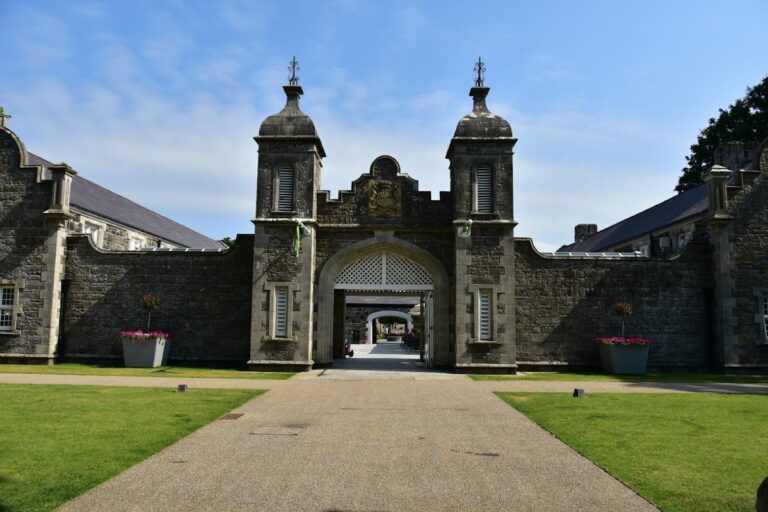
The present building is a large Palladian-style country house rather than a medieval fortress. Palladian architecture is a European classical style based on symmetry, columns, balanced proportions, and formal composition. Glenarm Castle has a series of columns terminating in pavilions that contain dining rooms on either side. Towers and cupolas also characterize the house, with cupolas forming small domes above the roof or central parts of the building. A lime-tree avenue leads to the main entrance.
The walled garden and former castle site
The walled garden dates from 1820 and was created to provide fresh produce for the castle’s inhabitants. It forms part of the estate associated with the present house and remains a distinct surviving feature of Glenarm’s planned grounds.
Remains of the original castle are incorporated into the old village courthouse on the opposite riverbank. During the 1970s, a skeleton that had been enclosed within the building’s structure was discovered there. The former castle complex occupied the riverbank and included a garden, orchard, mill, woods, and meadows, linking the early Bisset residence with the wider landscape of the estate.