Carrickabraghy Castle: A Gaelic Fortification in County Donegal


Site at a Glance
- Rating
- 4.6
- Popularity
- Low
- Country
- Ireland
- Primary era
- Early Modern
- External website
- Open
- Eras represented
- Early Modern
- Civilizations
- Irish
- Site type
- Military
- Remains
- Castle
On this page8 sections
History
Carrickabraghy Castle is a ruined fortification in County Donegal, Ireland, whose surviving remains date principally from around 1600 and occupy earlier defensive works. Built as a lowland-type stronghold on the north-western end of the Isle of Doagh, it stood at the head of Pollan Bay in western Inishowen. The site formed part of the territory historically known as Carraig Bhrachaí, and later became involved in the political and military struggles surrounding the Ó Dochartaigh lordship of Inishowen.
Carraig Bhrachaí and the McFalls
The name Carraig Bhrachaí is partly uncertain. Carraig means “rock,” while Bhrachaí may derive from a personal name found in the pre-Norman genealogy of Cineál Fhearghasa and possibly linked to the ancestry of the McFall sept. A sept was a kin-based branch of a larger Gaelic family or clan. Historian Mactochair instead interpreted the name as “Friars’ Rock.”
From the ninth to the thirteenth century, Inishowen was divided into three tuatha, or territorial districts: Aileach in the south, Bredach in the east, and Carraig Bhrachaí in the west. The Ó Maolfabhail family, later known in English as the McFalls, ruled Carraig Bhrachaí from the area around the castle. They descended from Cineál Fhearghasa, itself a branch of Cineál Eoghain, and ranked among the leading families of Inishowen. Their rulers styled themselves kings or lords of the territory.
Medieval rulers of Carraig Bhrachaí
The earliest historical reference to Carraig Bhrachaí appears in the Annals of the Four Masters, a major compilation of Irish annals recording rulers, deaths, battles, and other events. The annals state that Fearghas, son of Badhbhchadh and lord of Carraig Bhrachaí, was killed by men from Munster during Niall Caille’s campaign in Leinster in 834. Sechonnan, son of Conaing and king of Carraig Bhrachaí, died in 857, followed by Maolfabhail, son of Loingseach and lord of the territory, in 878.
The record continues with the deaths of Ruarc, son of Maolfabhail, in 907, and the chief of Carraig Bhrachaí in an Irish-Norse battle in 915. Tiarnach, son of Ruarc, died in 965, while Cú Dubh, son of Maolfabhail, fell in battle against the people of Tadhg Breagha in 1014. Flaitheartach Ó Maolfabhail died in 1053, Muireartach Ó Maolfabhail was killed by the Uí Meith of Menna Tire in 1065, and Giolla Chríost Ó Maolfabhail died in 1082.
In 1102, Sitric Ó Maolfabhail, king of Carraig Bhrachaí, was killed when Ulidian forces attacked a camp at night during a campaign led by Cineál Eoghain. Aodh Ó Maolfabhail was treacherously killed by Muireartach, son of Niall Mac Lochlainn, in 1166. In 1199, Cathalan Ó Maolfabhail was killed by O Dearain, who was immediately killed in revenge by Cathalan’s supporters. In 1215, Trad Ó Maolfabhail, chief of Cineál Fhearghasa, his brothers, and many others were killed in Dumbartonshire, Scotland, by Muireadach, chief steward of Lennox. References to the kings or lords of Carraig Bhrachaí cease after this event.
Ó Dochartaigh power and the battle of 1601
Carraig Bhrachaí then disappears from the historical record until around 1600, by which time the Ó Dochartaigh clan had become the dominant power in Inishowen. Seán Óg Ó Dochartaigh, Lord of Inishowen, used the defensible Isle of Doagh to protect livestock and supplies from English raids during the English invasion of Ireland. His kinsman Feilim Brasleach Ó Dochartaigh held the lordship associated with Carraig Bhrachaí.
After Seán Óg died unexpectedly in 1601, a succession struggle divided the territory. Aodh Rua Ó Donnell, lord of Tír Chonaill, supported Feilim Óg, Seán Óg’s experienced half-brother. Sir Henry Dowcra, the English commander in Derry, sought the submission of the territory to the English queen, while Aodh Buí Mac Daibheid supported Seán Óg’s fourteen-year-old son, Cathaoir Rua. Feilim Óg was installed in February 1601, but negotiations led by Aodh Buí resulted in Cathaoir Rua’s installation as Lord of Inishowen in May.
That same month, Aodh Rua Ó Donnell mobilised an army against Aodh Buí Mac Daibheid, who was allied with the English. The battle took place on the sandy plain of Pollan near Carrickabraghy Castle. Ó Donnell’s forces were defeated in a bloody engagement that caused terrible losses, although the reasons for his attack remain unclear.
Cathaoir Rua and the end of the Gaelic lordships
Cathaoir Rua held the lordship from 1601 but did not take full control until he reached the age of eighteen in 1605. His rule remained peaceful until the Flight of the Earls in 1607, when leading Gaelic aristocrats left Ireland for continental Europe, particularly Spain. English authorities feared that the exiles might return with foreign military support.
In autumn 1607, English spies misinterpreted Cathaoir Rua’s cutting of timber at Kilmacrennan. They believed it was preparation for rebellion. Cathaoir Rua later hid at Carrickabraghy Castle and planned an uprising, but it ended with his death in 1608. He was the last of the great Irish lords.
Abandonment and conservation
Carrickabraghy Castle was abandoned around 1665 and declined for several centuries. The first phase of modern conservation was completed in 2013. The castle is regarded as a site of local historical importance.
Remains
Fortification on the Isle of Doagh
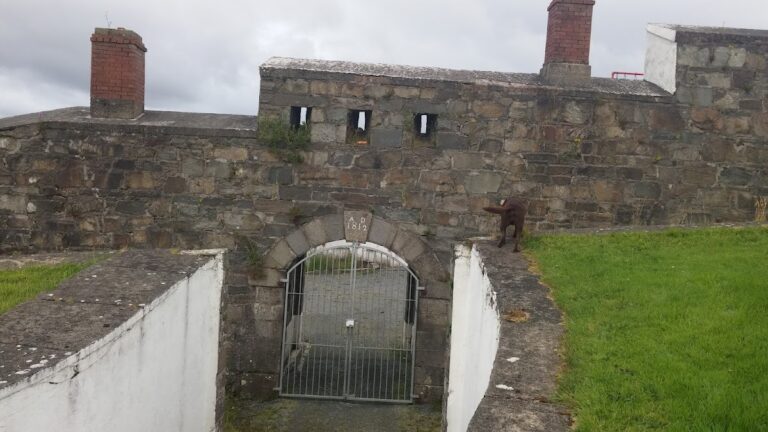
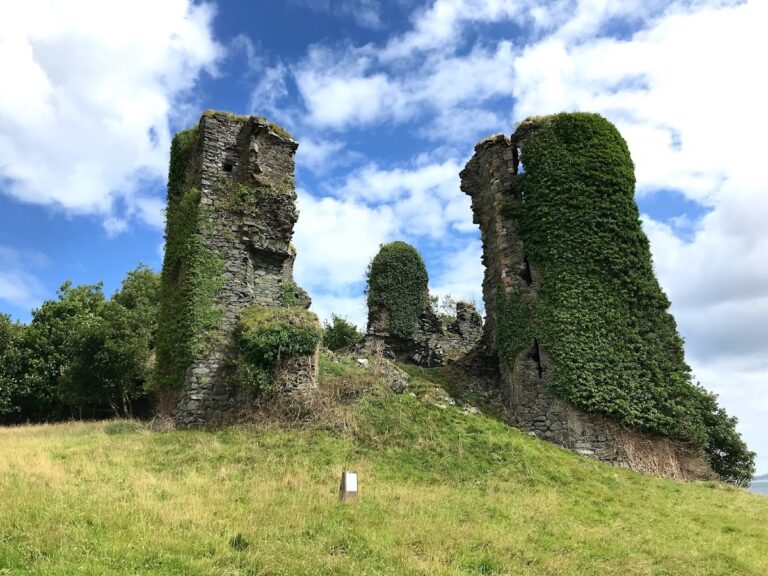
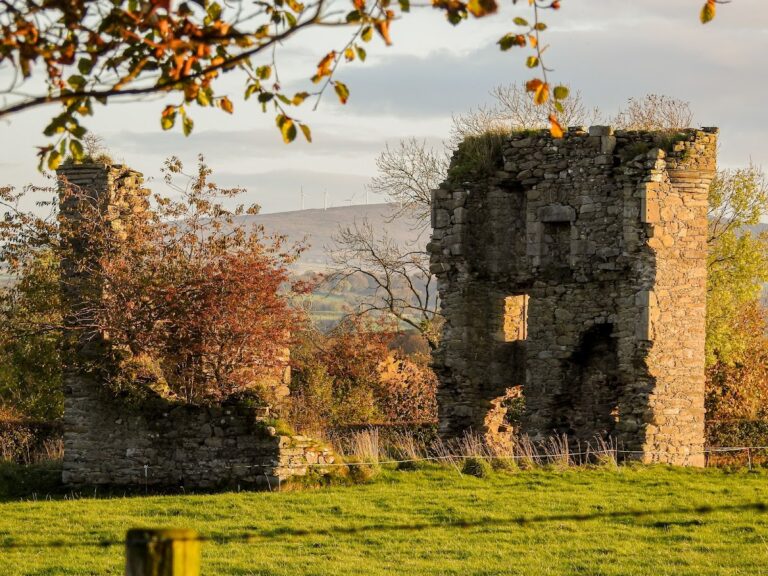
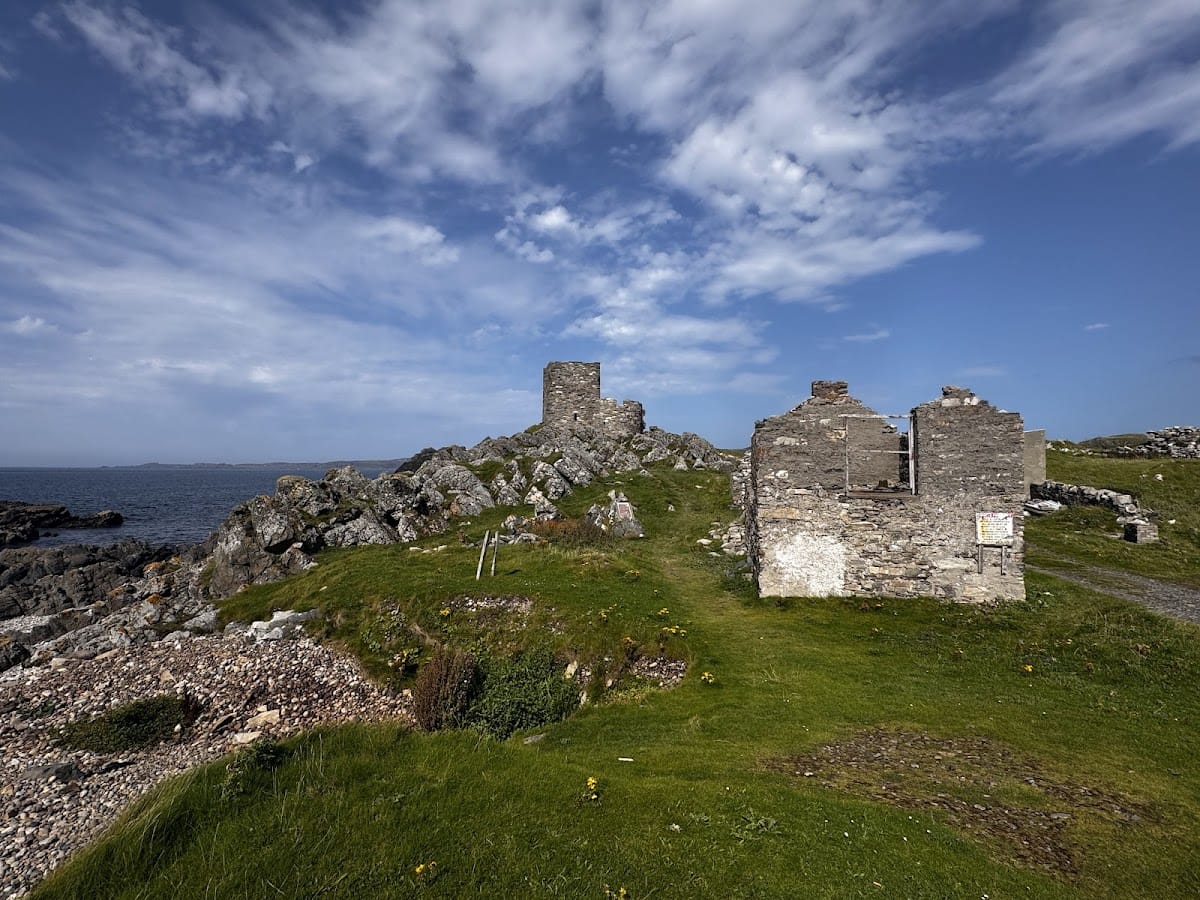
The surviving castle is a lowland-type fortification built of rubble stone on a rocky outcrop at the north-western extremity of the Isle of Doagh, at the head of Pollan Bay. Its remains date principally from around 1600 and occupy the position of earlier defensive structures. The island was considered easy to defend because it could be reached from the mainland only at low tide. The castle’s setting also places it beside the sandy plain of Pollan, where the battle of 1601 took place.