Pieskowa Skała: A Medieval Castle of Poland’s Eagle Nests
Site at a Glance
- Rating
- 4.6
- Popularity
- High
- Country
- Poland
- Primary era
- Medieval
- External website
- Open
- Eras represented
- Medieval, Early Modern, Modern
- Civilizations
- Habsburg, Kingdom of Poland, Polish–Lithuanian Commonwealth
- Site type
- Military
- Remains
- Castle
On this page14 sections
History
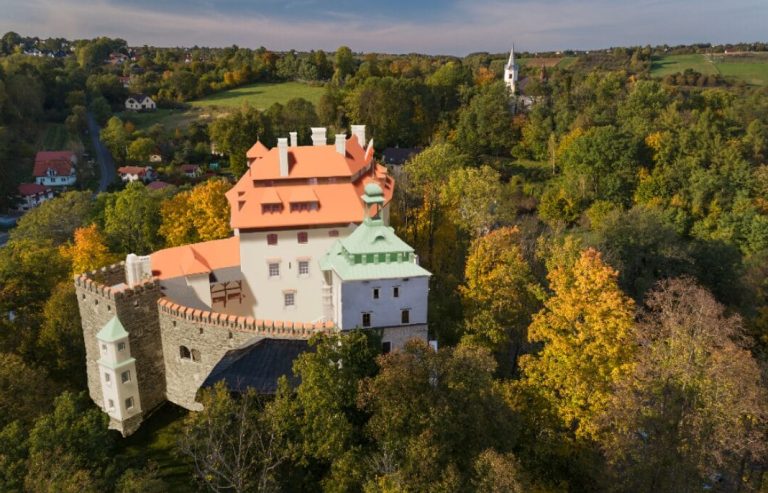
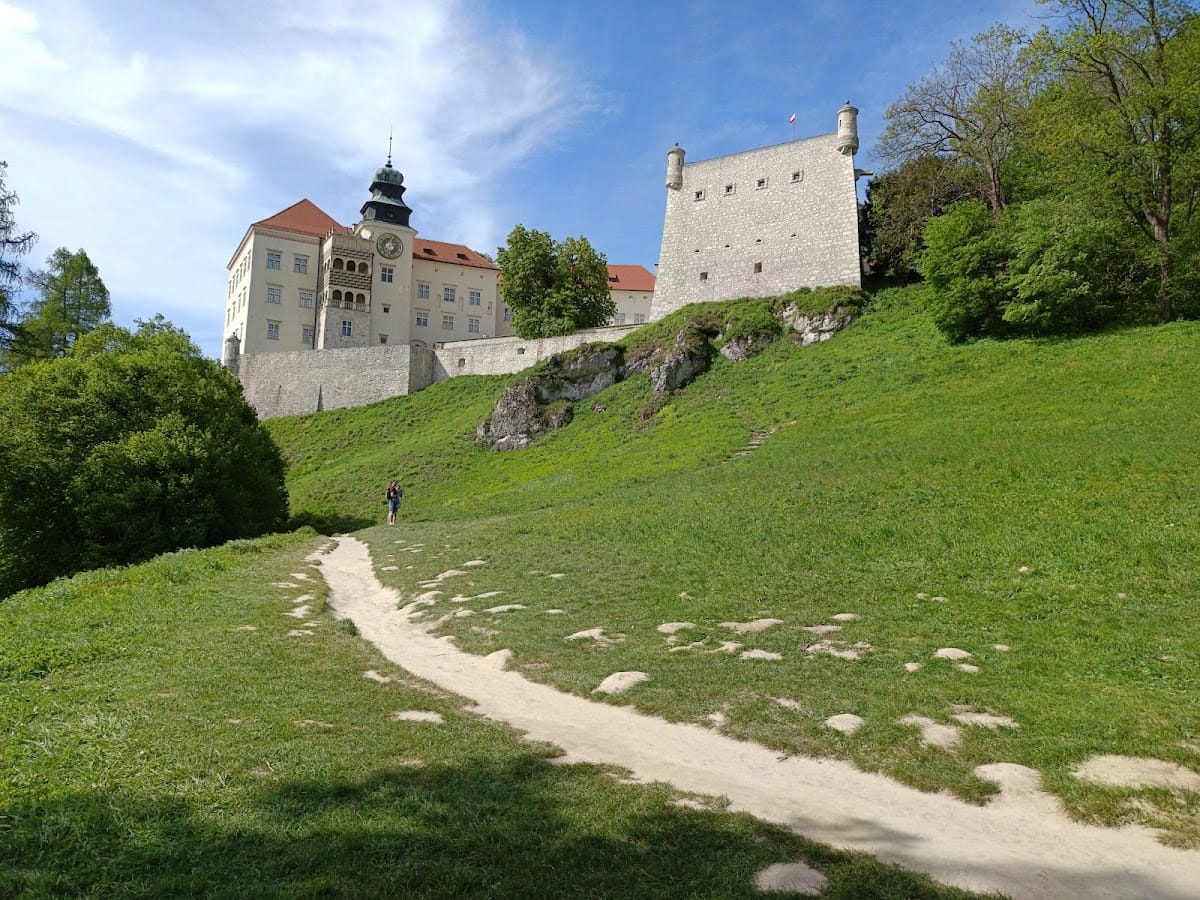
Pieskowa Skała is a medieval castle in Poland, located in the Prądnik Valley near Sułoszowa, about 27 kilometres north of Krakow. King Casimir III the Great built its masonry stronghold during the first half of the fourteenth century in the Gothic period. The castle formed part of the Eagle Nests, a chain of medieval castles and fortified sites along the limestone uplands between Krakow and Częstochowa, and guarded an important route between Silesia and Krakow.
Royal Foundation and the Szafraniec Estate
A document issued by King Władysław I the Elbow-high in 1315 names the castle as Peskenstein. An earlier document from 1306 mentions Peskonis in connection with a knight of that name. The name probably derives from Piotr, whose medieval diminutive was Peszek. A wooden fortification preceded the stone castle. Earthworks and a defensive ditch survive nearby, although it is uncertain whether they belonged to a fortification on exactly the same site.
Casimir III’s castle was divided into upper and lower sections. The upper stronghold occupied the difficult limestone outcrop known as Dorotka. In 1377, King Louis I of Hungary renovated Pieskowa Skała and granted it to Piotr Szafraniec. The Szafraniec family held the castle until 1608 and obtained full ownership in 1422 from King Władysław Jagiełło. The fifteenth-century chronicler Jan Długosz associated this grant with Piotr Szafraniec’s service at the Battle of Grunwald.
Some later Szafraniecs used the castle as a base for attacks on merchants travelling through the Prądnik Valley. Krzysztof Szafraniec was executed at Wawel in 1484 for banditry. Between 1542 and 1580, the Gothic stronghold was transformed into a Renaissance residence, a style that revived classical architectural forms. The main rebuilding of 1542–1544 was carried out by Niccolò Castiglione with Gabriel Słoński of Krakow and paid for by Stanisław Szafraniec, a Calvinist, or Protestant, voivode of Sandomierz.
Fortification, Destruction, and Rebuilding
After Jędrzej Szafraniec died without children in 1608, the estate passed first to Maciej Łubnicki and later to the Zebrzydowski family. During the seventeenth century, particularly under Michał Zebrzydowski, the castle acquired bastion fortifications. Bastions were projecting defensive earthwork or masonry forms intended to protect walls against artillery. Around 1640, the complex also received a Baroque gateway and a chapel.
The Swedish Deluge, the Swedish invasion of the Polish–Lithuanian Commonwealth in the seventeenth century, destroyed the castle in 1655. A major fire followed in 1718. The Wielopolski family rebuilt Pieskowa Skała as a residence in 1768, and King Stanisław August Poniatowski stayed there in 1787. Another fire in 1850 destroyed the oldest section, the high castle.
From Private Residence to State Museum
Count Jan Chrzciciel Mieroszewski bought Pieskowa Skała from the Wielopolskis in 1842. A Krakow politician and collector, he kept his library and collection of antique gems at the castle. On 4 and 5 March 1863, during the January Uprising, the Polish insurrection against Russian rule that began that year, battles took place at Pieskowa Skała and nearby Skała. Polish insurgents commanded by Marian Langiewicz fought Russian forces. Andrij Potebnia, a Ukrainian revolutionary and Russian army colonel who fought on the Polish side, was killed, while Aleksander Zdanowicz commanded the castle’s defence. Russian forces occupied and looted the castle after the insurgents withdrew.
During the 1880s, Sobiesław Mieroszewski repaired the castle and added Neo-Gothic elements. His extravagant spending dispersed the family fortune, and the property was sold to Dr. Serafin Chmurski. Chmurski built villas below the castle and tried to develop Pieskowa Skała as a summer resort. His debts led to the transfer of the property to the Pilawitz, Wilczyński and Company banking house in 1902, followed by an auction. After Adolf Dygasiński publicly appealed for its preservation, the Pieskowa Skała Joint-Stock Society was formed and bought the castle for 60,000 rubles. The property later passed to the Polish state.
During the Second World War, rooms in the castle served as an orphanage housing mainly children from Poland’s eastern borderlands. After the war, the state assumed control and a general restoration carried out from 1950 to 1963 prepared the castle for its role as a branch of the Wawel Royal Castle State Art Collections. It now houses the permanent exhibition “Stylistic Transformations in European Art from the Middle Ages to the Mid-Nineteenth Century.” Pieskowa Skała is a protected immovable monument in Poland and appears in the monument register under entry A-478, dated 25 April 1983.
Remains
Gateway and Courtyard
Entrance Complex
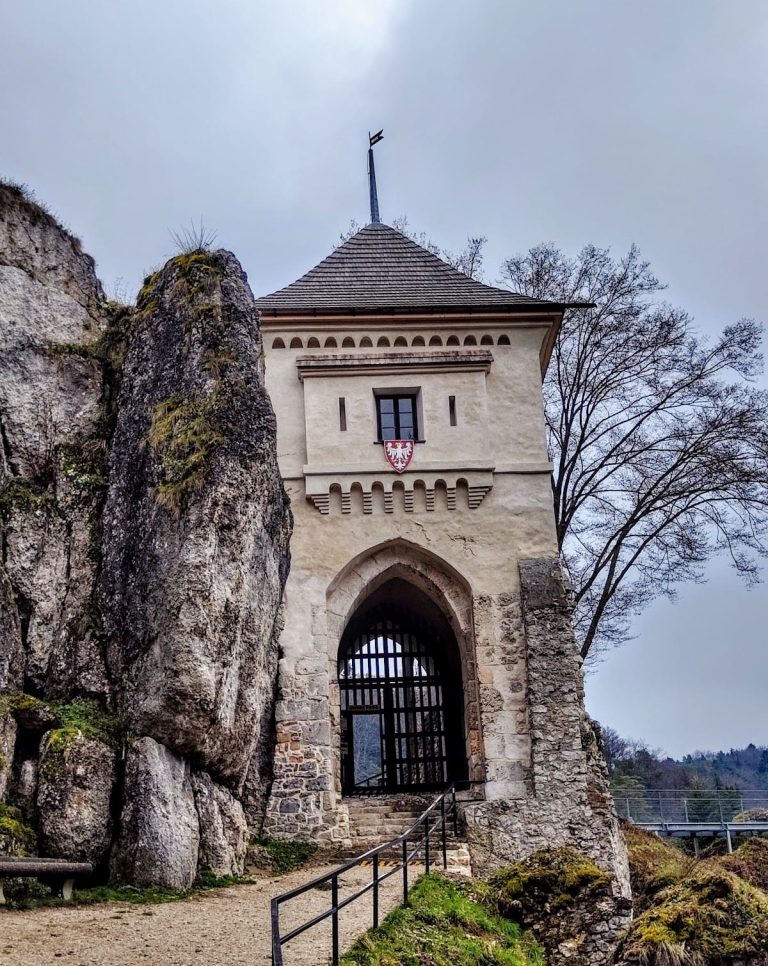
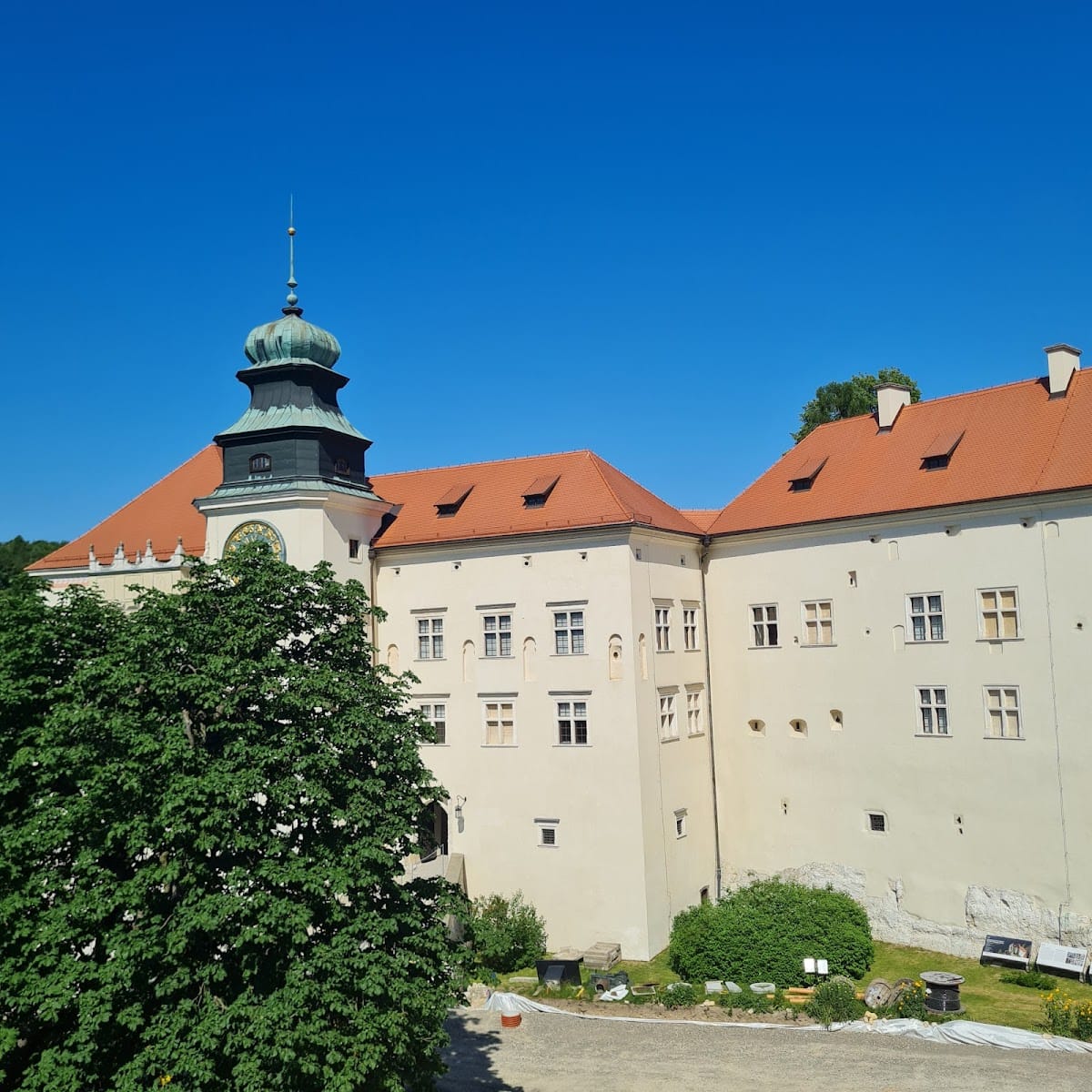
Pieskowa Skała stands on a limestone summit above the Prądnik Valley, with precipitous drops on three sides. The principal entrance is a triumphal-arch-shaped gateway set within a curtain-wall building. A cartouche, an ornamental framed panel, above the portal carries the Radwan arms of the Zebrzydowski family. Beneath the bartizan, a projecting defensive turret or gallery, is Michał Zebrzydowski’s genealogical heraldic composition.
The first entrance tower, now fitted with a clock, was built in the twentieth century to replace a medieval tower that collapsed. A second medieval tower survives beside a two-storey seventeenth-century wing, although its entrance is closed to visitors. Beside the entrance tower is a loggia, an open, often arcaded gallery, described as the only example of its architectural type in Poland. The arcade risalit, or projecting section of a building, above the gate was added during the seventeenth century.
Inner Courtyard
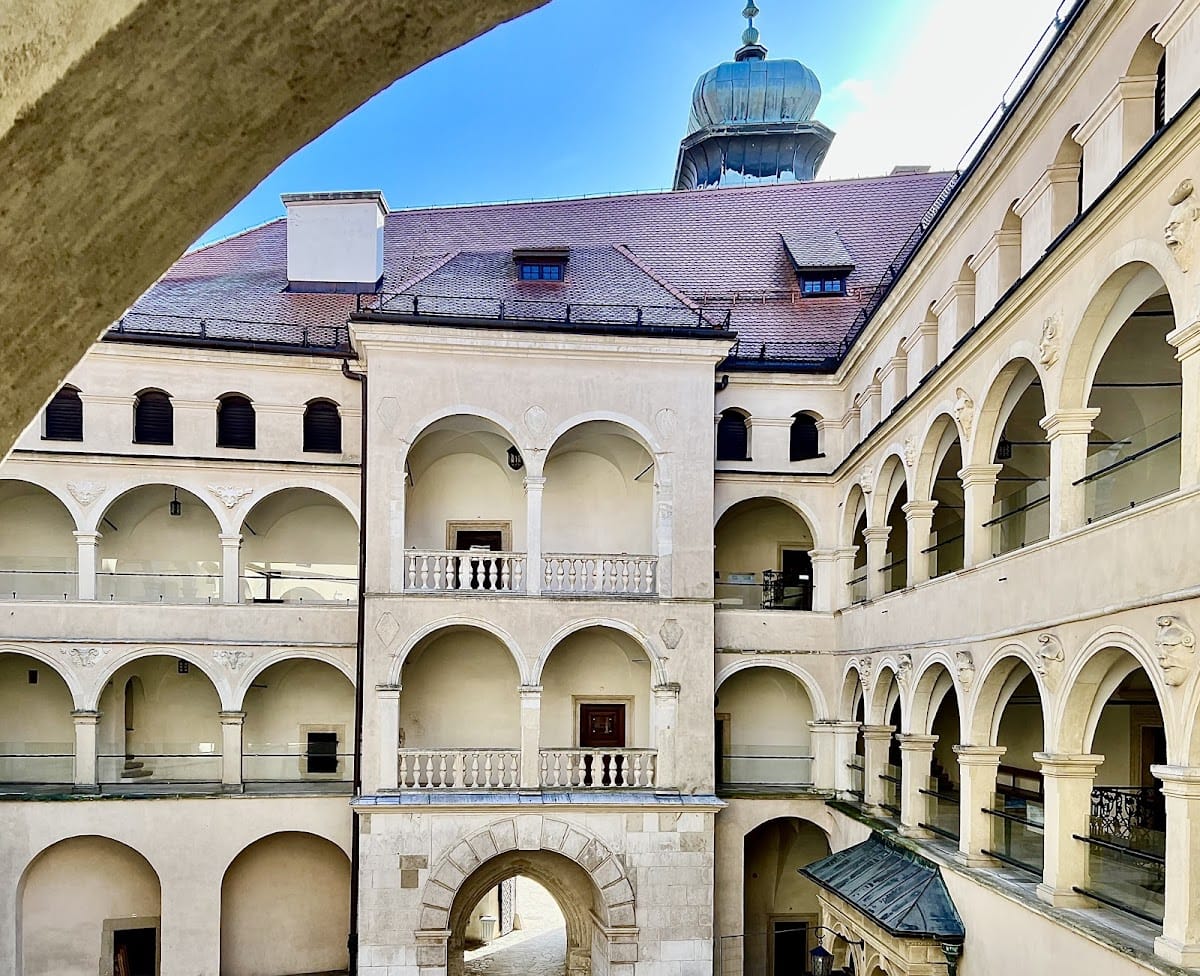
The inner courtyard has a trapezoidal plan. Arcades modeled on those of Wawel enclose it at the level of the two upper storeys. Twenty-one mascarons, sculpted ornamental faces and figures in animal and human forms, decorate the courtyard. A well descends approximately 40 metres below it.
Defensive Works and Grounds
Bastion Fortifications
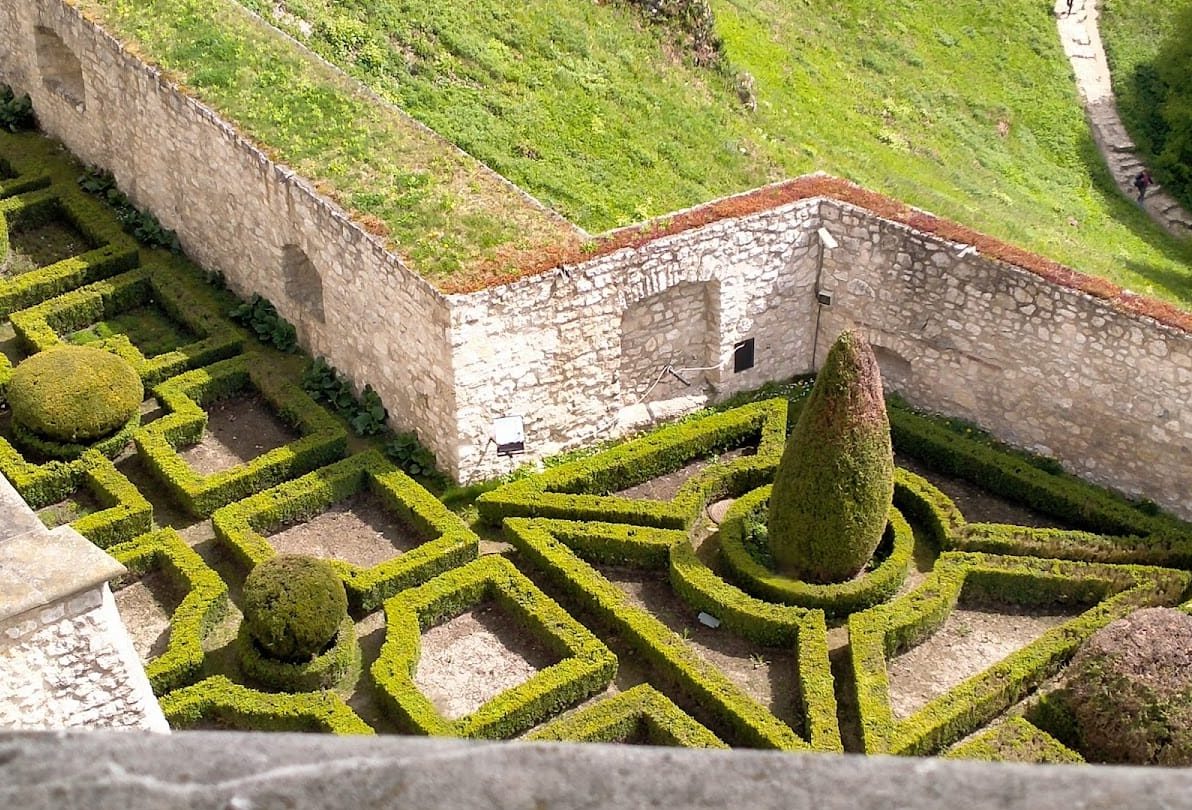
Baroque bastion fortifications form part of the defensive complex. The lowest, third bastion contains an Italian garden, while another bastion houses a restaurant. These projecting works belong to the seventeenth-century strengthening of the castle under Michał Zebrzydowski.
Hercules’ Club and the Ponds
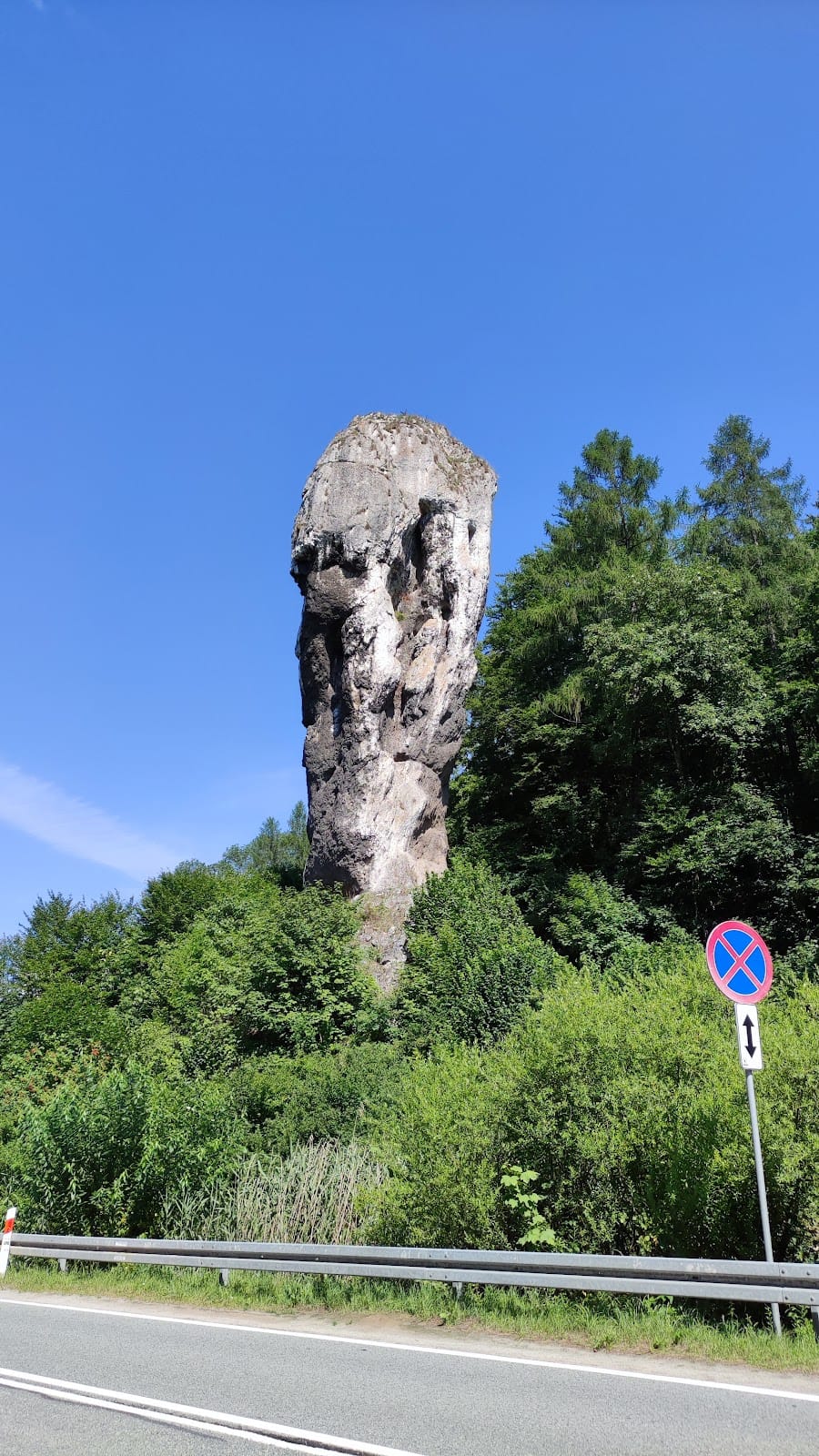
A landscape park adjoins the castle and includes the limestone monolith called Hercules’ Club, which rises to approximately 25 metres. A legend connects the rock with Krak, the mythical ruler said to have killed the Krakow dragon before leaving Hercules’ Club at the site.
At the foot of the castle hill, five flow-through ponds form a complex established in the sixteenth century. They were first used to raise carp, pike, and crucian carp, and later rainbow trout. Fish farming ended in 1993. The ponds now provide breeding habitat for amphibians in Ojców National Park, including smooth newts, crested newts, common toads, green toads, grass frogs, European tree frogs, and fire-bellied toads. During seasonal migrations from wintering sites sometimes as far as 3 kilometres away, volunteers and park staff carry amphibians across the adjacent road.
Museum Interiors and Funerary Sculpture
Castle Halls
Four large halls contain the permanent museum exhibition. Its paintings, sculptures, and furniture date from the fourteenth to the nineteenth centuries, presenting artistic changes across European history within the castle’s surviving residential spaces.
Sieniawski Sarcophagi
The castle crypts contain four seventeenth-century Mannerist sarcophagi belonging to members of the Sieniawski family. Mannerism developed elongated, complex, and theatrically ornamental forms within and beyond the Renaissance tradition. Sculpted representations of the deceased appear on the lids. The Wrocław sculptor Jan Pfister made the sarcophagi for the Sieniawski mausoleum in the castle chapel at Brzeżany in Podolia.
The sarcophagi were moved to Krakow in 1920 before the Bolshevik advance. After 1945, extensive devastation affected the church and chapel at Brzeżany Castle, while the sarcophagi remained preserved at Pieskowa Skała. Staff of the castle, as a Wawel branch, have carried out their restoration.