Olsztyn Castle: A Medieval Border Fortress in Poland
Site at a Glance
- Rating
- 4.7
- Popularity
- High
- Country
- Poland
- Primary era
- Medieval
- External website
- Open
- Eras represented
- Medieval, Early Modern
- Civilizations
- Kingdom of Poland, Polish–Lithuanian Commonwealth
- Site type
- Military
- Remains
- Castle
On this page13 sections
History
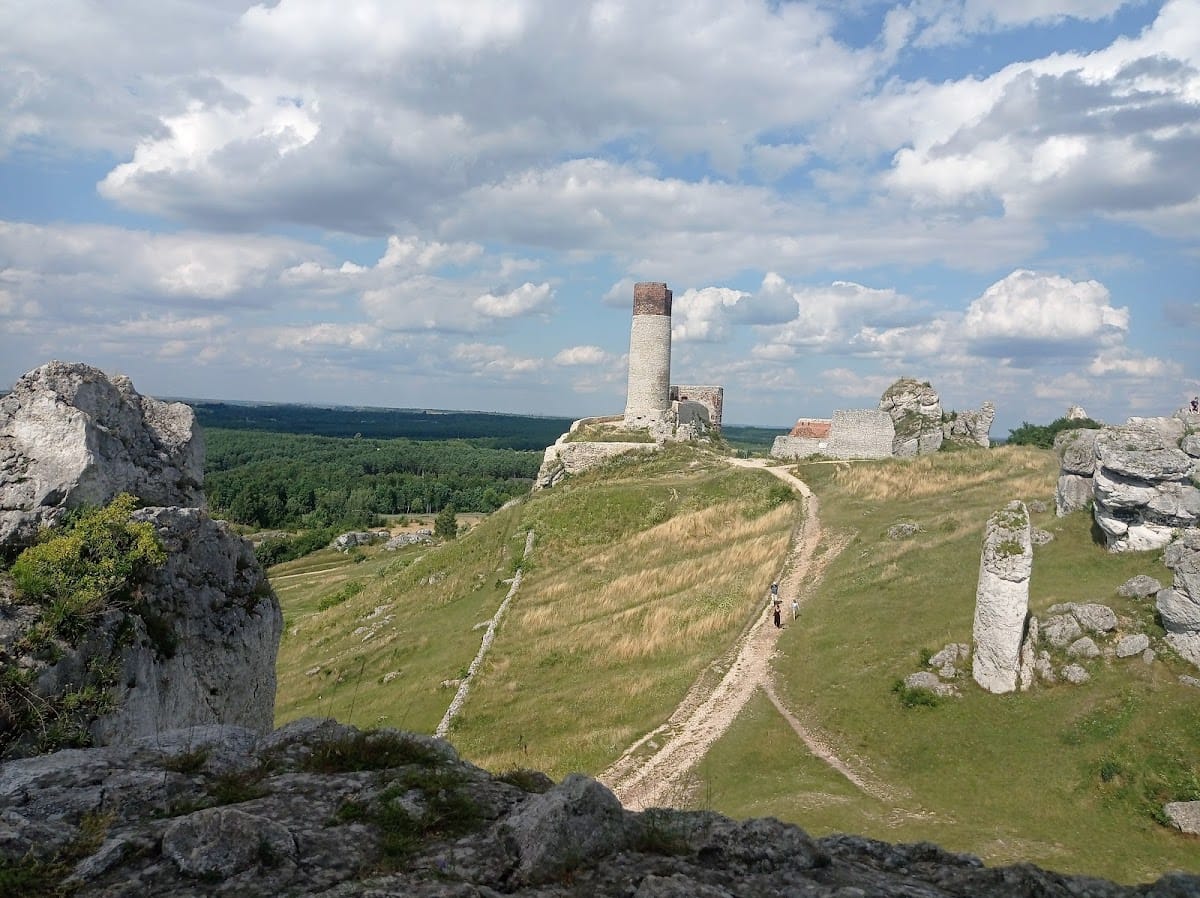
Olsztyn Castle is a ruined medieval fortress in Olsztyn, Poland, in the Kraków–Częstochowa Upland. It formed part of the Eagles’ Nests, a chain of castles and fortified sites built on prominent limestone formations between Kraków and Częstochowa, and guarded the Silesian–Lesser Polish frontier. The castle probably originated in the thirteenth century and became one of the strongest fortresses in the border region after royal expansion in the fourteenth century.
Early fortress and royal expansion
The castle first appears in written records in 1306, under the name Przemiłowice. The reference occurs in documents concerning events in 1294, during the second trial of Kraków Bishop Jan Muskata by Gniezno Archbishop Jakub Świnka. Archaeological research conducted in 2010 supported the existence of thirteenth-century origins, suggesting that the recorded fortress had developed from an earlier stronghold.
A watch post had existed on the site from the second half of the thirteenth century. In the following century, King Casimir the Great, whose reign included a major program of royal construction and fortification, expanded it into a powerful frontier castle. A burgrave named Zbyszek, the officer responsible for a castle’s administration or defense, is recorded at Olsztyn in 1349.
Tradition holds that Maćko Borkowic, the voivode of Poznań, was imprisoned at Olsztyn during Casimir the Great’s reign after plotting against the king. He was said to have been condemned to die of starvation. Local legends later connected the castle with the voivode’s ghost, the sound of chains, and lamentation.
Changes of allegiance and administrative growth
In 1370, Louis I, king of Hungary and Poland, granted Olsztyn and the Wieluń Land as a fief to his cousin, Duke Władysław of Opole. The grant followed the duke’s support for Louis’s dynastic plans. In 1391, on the orders of King Władysław Jagiełło, the Polish nobleman Spytek of Melsztyn captured the castle after a siege and returned it to the Polish Crown.
The settlement below the fortress, then called Olsztynek, became the seat of a starosty in 1406. A starosty was a royal administrative district, governed by a starost. Jan Służka of Mirów held the office of burgrave in 1439. In 1488, King Casimir IV Jagiellon granted the settlement town rights, followed by privileges for markets and fairs in 1552. Its growth remained limited because of infertile sandy soil and its distance from major trade routes. During the second half of the sixteenth century, the royal castle lay within Lelów County in the Kraków Voivodeship.
The lower castle was established in the fifteenth century and probably enlarged during the next century. The fortress helped repel attacks by Silesian dukes during the fifteenth century, although rockslides repeatedly damaged its walls and led to successive rebuilding. King Sigismund Augustus stayed at Olsztyn in 1545.
Sixteenth- and seventeenth-century attacks
In 1587, Austrian forces commanded by Archduke Maximilian, a claimant to the Polish throne, attacked Olsztyn. Starost Kasper Karliński led the garrison. According to the tradition surrounding the defense, the attackers placed Karliński’s kidnapped young son and the boy’s nurse in their line of fire. The castle was successfully defended, but the child was killed. The episode later appeared in works by the Polish poet Władysław Syrokomla and the playwright and poet Aleksander Fredro.
The assault severely damaged the fortress. Reconstruction was directed by the succeeding starost, Joachim Ocieski. After Ocieski’s death, Starost Mikołaj Wolski, who took office in 1613, neglected Olsztyn while concentrating on his residence at Krzepice. An inspection in 1631 found the castle already heavily damaged.
During the Swedish Deluge, the mid-seventeenth-century Swedish invasion and occupation of much of the Polish–Lithuanian Commonwealth, Swedish forces advancing toward Częstochowa attacked Olsztyn in October 1655. After a short siege, they captured and ruined the castle and burned the town. The spread of effective artillery had also reduced the defensive value of older fortresses, and Olsztyn became an unusable ruin.
Decline and archaeological investigation
Royal fortifier Krzysztof Mieroszewski carried out work at the castle after the Swedish attack, but the results were limited. Reconstruction was eventually abandoned because of its cost. Between 1722 and 1726, substantial sections of the lower castle were dismantled during construction of the parish church. The Olsztyn starosty continued until the end of the eighteenth century.
During the nineteenth century, local peasants progressively removed stone from the castle for building material, leaving the complex in its present ruined condition. The site is protected as a historic monument and forms part of Poland’s cultural heritage. Its seven-hundredth anniversary was commemorated in 2006.
Archaeological work continued to clarify the fortress’s development. Investigations in 2015 established parts of the previously uncertain arrangement of the lower castle, including the gate tower and three bridge piers leading toward the upper section. In 2019, several hundred Neanderthal flint tools were found in a cave on the lower-castle site that had later been used as a storeroom. In the following year, another previously unknown cave and a complex network of tunnels and fissures were identified and described.
International pyrotechnic and laser shows took place at the castle in 1992–1993 and 1995–1998. After part of the castle wall collapsed, the heritage conservator prohibited such events, reflecting the vulnerability of the surviving masonry.
Remains
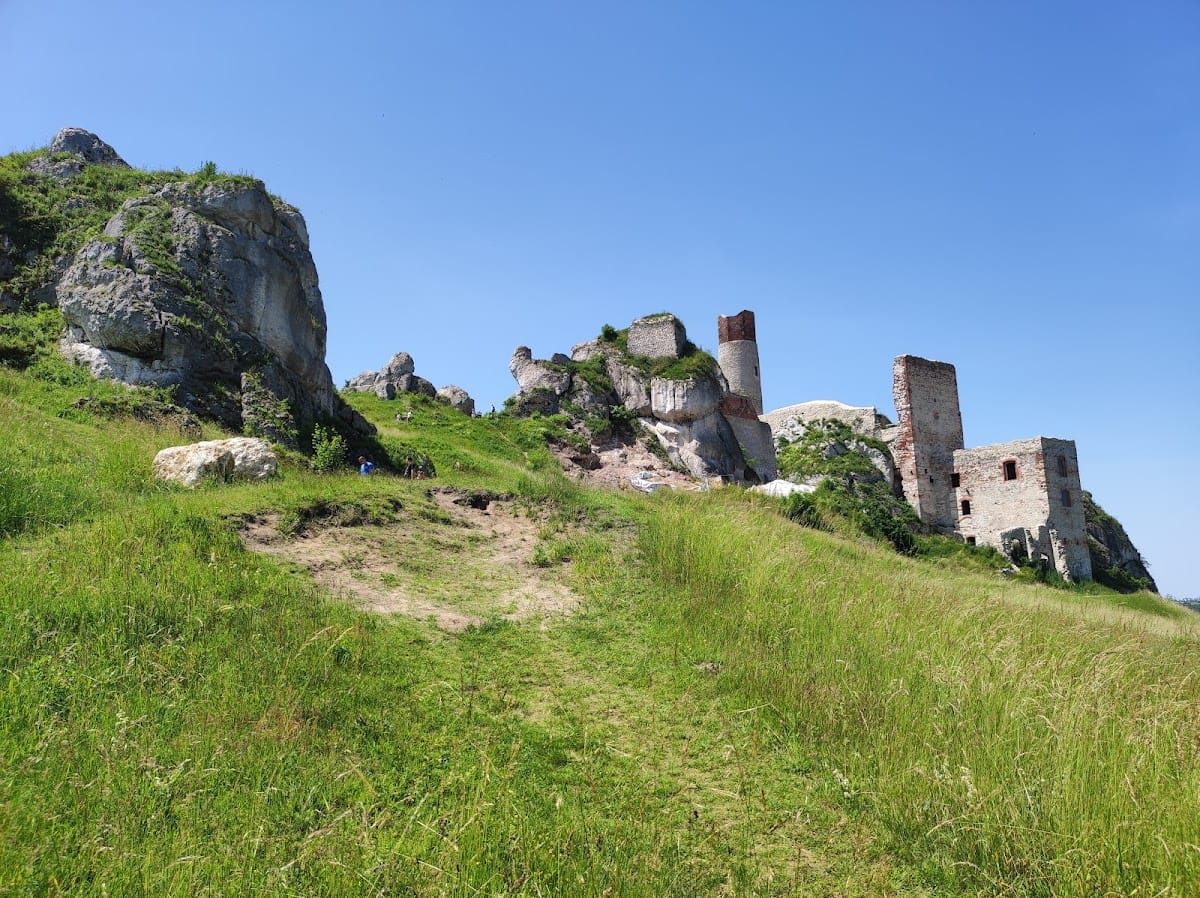
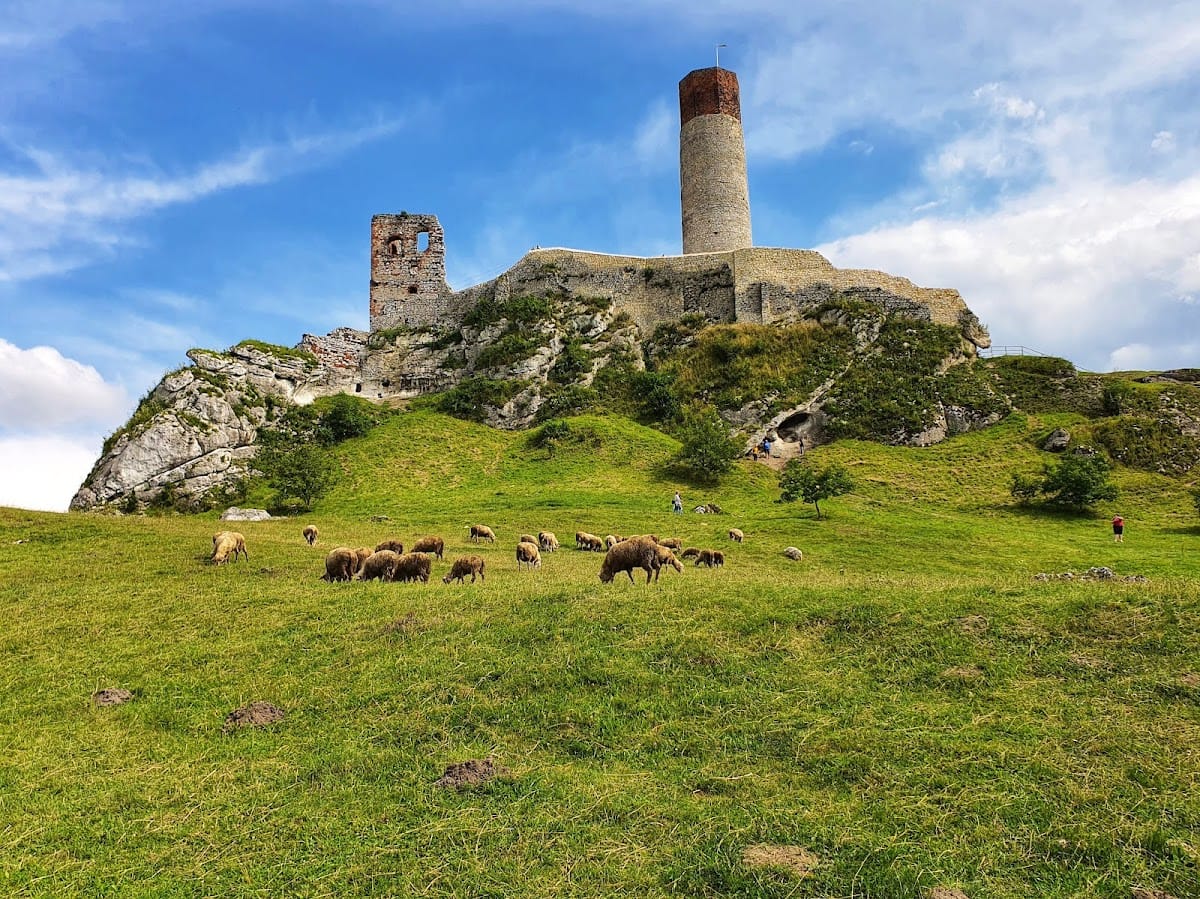
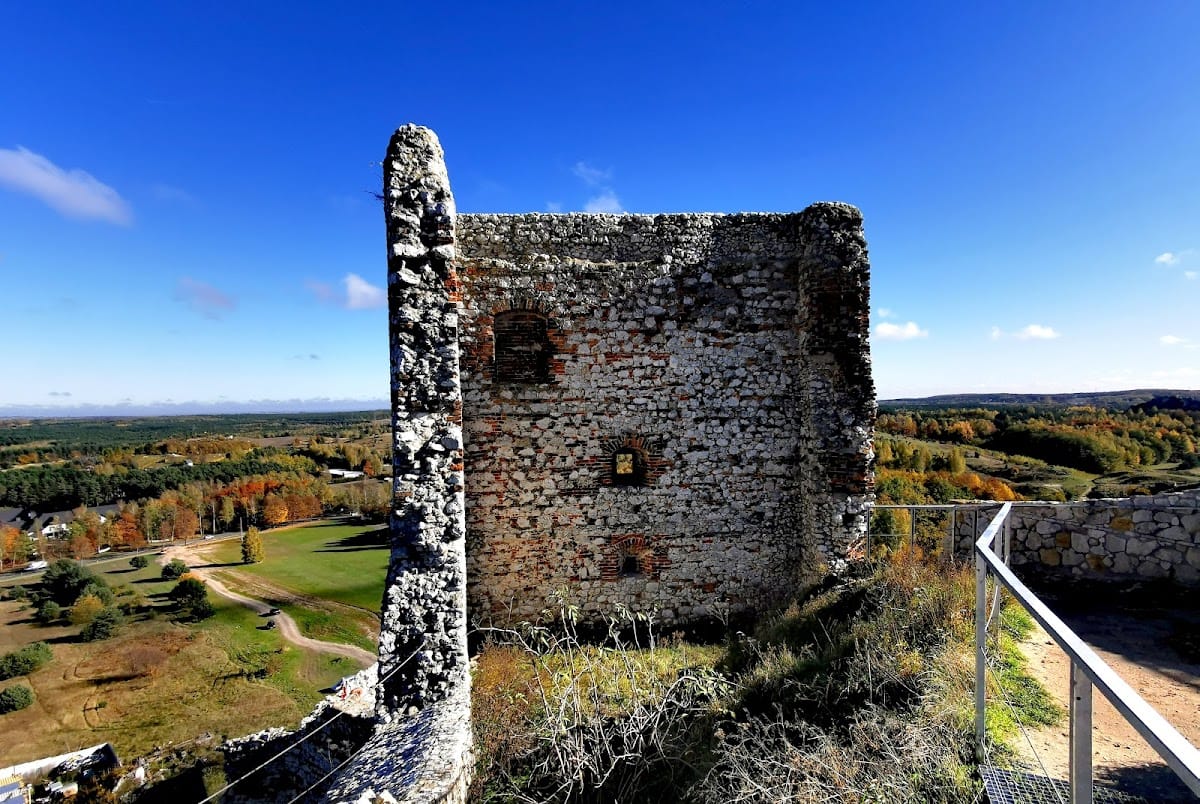
The surviving complex is a substantial rocky ruin divided into upper and lower sections. Its remains include walls belonging to the residential area, the cylindrical Stołp tower, the square Starost’s Tower, fragments of service buildings, and parts of the cellars. Rockslides affected the walls during the castle’s occupation, while later military destruction, dismantling for the parish church, and nineteenth-century removal of building material shaped the ruin that survives today.
Upper castle structures
Residential section
Walls of the residential section survive within the upper castle, together with fragments of service buildings and parts of the cellars. These remains belonged to the inhabited and working areas of the fortress. Their present fragmentary condition reflects the damage caused by rockslides, the destruction of 1655, later dismantling, and the removal of masonry for construction.
Stołp and Starost’s Tower
The upper section retains a cylindrical defensive tower known as the Stołp. The name refers to a medieval tower that could serve as a stronghold or keep. A square tower called the Starost’s Tower also survives. Together with the residential walls, these towers express the principal defensive and administrative elements of the upper castle, although both form part of a heavily ruined complex.
Lower castle and connecting works
Gate tower and bridge piers
The lower castle was created in the fifteenth century and probably expanded during the sixteenth. Its arrangement was previously uncertain, but archaeological investigation located the gate tower and three piers of the bridge that led from the gate tower toward the upper castle. These foundations clarify how the two sections were connected within the fortified site.
Forge and ironworking remains
Excavation in the lower castle exposed the foundations of a forge and traces of bloomery furnaces. A bloomery furnace produced iron directly from ore, creating a spongy mass of iron and slag. The remains add evidence of working activity within the lower section alongside its defensive and storage functions.
Caves and archaeological finds
A cave within the lower-castle area was later used as a storeroom. It contained several hundred flint tools made by Neanderthals, linking the rocky setting to human activity long before the medieval fortress was built. Further investigation identified another previously unknown cave and a complex system of tunnels and fissures in the same area.
A painting depicting the 1587 defense of Olsztyn is held in the National Museum in Warsaw. It preserves a visual representation of one of the castle’s best-known military episodes, while the surviving towers, walls, foundations, and subterranean features preserve the physical record of its development and decline.