Bydlin Castle: A Medieval Fortified Site and Former Church in Poland


Site at a Glance
- Rating
- 4.3
- Popularity
- Medium
- Country
- Poland
- Primary era
- Medieval
- External website
- Open
- Eras represented
- Medieval
- Civilizations
- Kingdom of Poland
- Site type
- Military
- Remains
- Castle
On this page7 sections
History
Bydlin Castle is a medieval fortified site in Poland, first referenced in the late fourteenth century. A defensive tower was built on a high, rocky hill, where it retained its military purpose for about two centuries. The first owner was the son of Niemierza of Gołcza, who is often credited with constructing the fortification.
From Fortification to Church
By the sixteenth century, the property had passed through the Boner and Firlej families and had approximately twenty owners. At the beginning of that century, the Firlejs transformed the fortified building into a church. Around 1570, during the Reformation, Jan Firlej temporarily made it an Arian congregation, a Christian assembly associated with a non-Trinitarian movement. In 1594, his son Mikołaj restored the building as the Catholic Church of the Holy Cross. The name was later applied to the entire hill.
Destruction, Rebuilding, and Ruin
In 1655, Swedish forces commanded by General Müller destroyed the church while advancing toward Częstochowa. The Męciński family rebuilt it several decades later. Continuing threats from robber raids led to the building’s abandonment toward the end of the eighteenth century, after which it gradually fell into ruin.
During the second half of the nineteenth century, stone from the walls was reused for various purposes, including the construction of a cemetery chapel at the foot of the hill. A galena mine, extracting lead-bearing ore, operated on the slopes toward the end of that century.
First World War and Archaeological Reassessment
In November during the early stages of the First World War, the front between Austro-Hungarian and Russian forces ran through the area. Polish Legion soldiers, Polish military formations serving on the Austro-Hungarian side, occupied defensive positions on the castle hill under Commander Trojanowski, opposite Russian troops at Załęże. The Battle of Krzywopłoty took place there from 17 to 19 November.
Archaeological research led by Błażej Muzolf in 1989 exposed foundations of previously unknown buildings, including a gate tower. These discoveries supported classifying the structure as a castle rather than solely as a religious building. A denar of Louis of Hungary, a small medieval coin dating to approximately 1370, further supported dating the wall construction to the Angevin period, the rule of the Angevin dynasty in the medieval Kingdom of Poland, including Louis’s reign.
Some scholars have proposed that the building was never a castle and served a religious function from the beginning. The site was registered as a protected cultural heritage monument in Poland under designation A-77/M on 2 March 2007. The southern wall of the residential building collapsed in 2009, and repair work followed in 2012. Bydlin Castle lies on the Eagles’ Nests Trail, a historic route linking fortified sites on prominent limestone elevations in the Kraków-Częstochowa Upland.
Remains
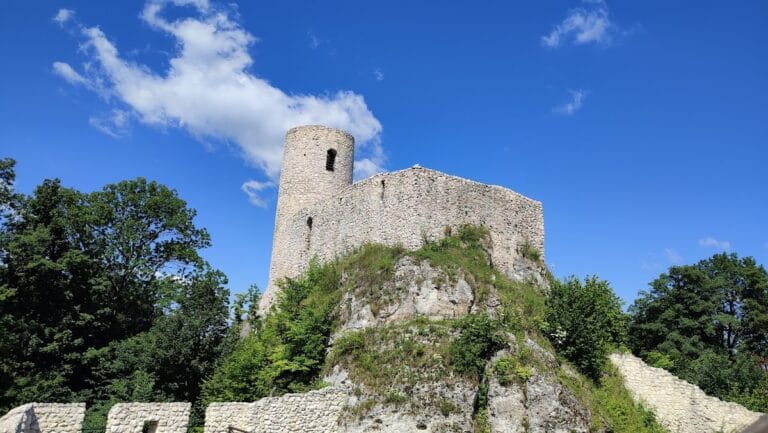
The surviving remains occupy a high, rocky hill and consist of fragments of limestone walls and a moat. The ruins form a rectangle approximately 24 metres long and 11 metres wide. The structure’s walls averaged slightly more than 2 metres in thickness and stood about 7 metres high. Buttressed corners strengthened the building, while traces of former loopholes or firing openings remain visible.
Fortified Structure
Local limestone forms the surviving wall fabric. The rectangular plan, substantial wall thickness, buttressed corners, moat, and firing openings reflect the building’s earlier defensive function. The southern wall that collapsed in 2009 belonged to the residential building and was repaired in 2012.
Excavated Buildings and Finds
The 1989 excavations revealed foundations of previously unknown structures, including a gate tower, clarifying the layout of the fortified site. Excavated material included substantial quantities of vessel pottery, stove tiles with figural and heraldic decoration, and both bowl-shaped and pot-shaped stove tiles. A denar of Louis of Hungary dating to approximately 1370 provided archaeological evidence for placing the wall construction in the Angevin period.