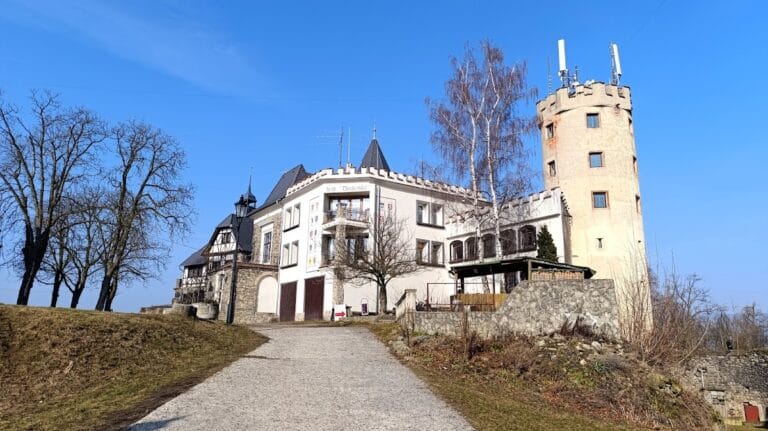
Hněvín Castle in Most: A Historic Landmark in the Czech Republic
Visitor Information
Google Rating: 4.6
Popularity: Medium
Country: Czechia
Civilization: Medieval European, Modern
Site type: Military
Remains: Castle
History
Hněvín Castle stands on a hill of the same name in the town of Most, located in the modern Czech Republic. The site has a long history of human settlement, with archaeological findings tracing back to the 9th century and even earlier periods including the Eneolithic, Bronze Age, and Hallstatt culture. The castle itself was built by the Hrabišic noble family during the 12th century, coinciding with Most’s emergence as a royal city under King Wenceslaus I. At that time, the castle served as the administrative center for the district, playing an important role in local governance.
Throughout the 13th to 15th centuries, ownership of Hněvín Castle shifted frequently in response to political changes. Wenceslaus II pledged the castle to the Brandenburg margraves, who controlled it alongside Meissen rulers for a period. In 1406, authority over the castle returned to the Bohemian crown. Later, the castle came under the control of George of Poděbrady, a notable Bohemian king, following the treaty signed in Cheb in 1459. By 1480, the castle was sold to the Veitmile brothers, prominent local landowners.
Ownership changed again in 1595 when Emperor Rudolf II sold the castle to the city of Most itself. Under Rudolf’s reign, the castle gained a fascinating association with alchemy, as Edward Kelley and Marek Mamugny, two well-known alchemists, took residence there. Kelley’s story ended tragically within its walls; he died as a prisoner in 1597. The castle remained strategically significant for decades, particularly during the turmoil of the Thirty Years’ War in the 17th century. Between 1646 and 1649, it endured occupation by Swedish troops, reflecting its military importance in the region.
Following the war, residents of Most petitioned Emperor Ferdinand III to have the castle demolished to discourage future military use. This led to the systematic dismantling of Hněvín between 1651 and 1653. For over two hundred years afterward, the site lay largely unused. A revival began in the late 19th century when locals constructed a restaurant on the hill in 1879 and a wooden lookout tower in 1889, though the tower was soon destroyed by strong winds.
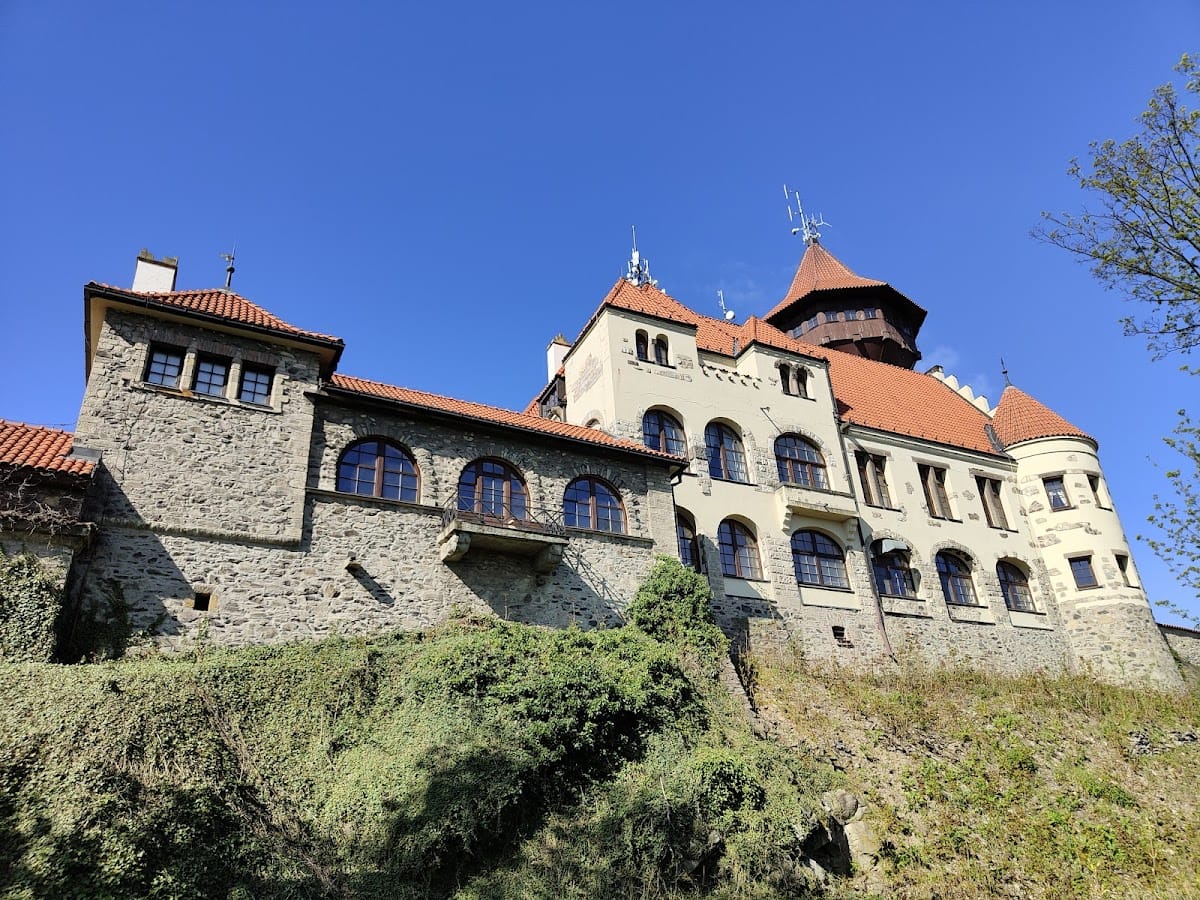
Renewed interest in restoring the castle grounds culminated in 1896 with the founding of a German association dedicated to this cause. By 1900, a solid stone lookout tower was completed, and in 1906 a neo-Gothic style restaurant was built, designed by Adolf Schwarzer. Additional features included a chapel tower built shortly before World War I and a veranda added in 1927. During the Second World War, the castle was repurposed as a base for German anti-aircraft defense, and a cave shelter was constructed beneath the lookout tower for protection against air raids.
After 1945, the site briefly maintained military functions before falling into decline. Restoration work in the late 1960s and early 1970s reopened the area to the public, including the establishment of a small observatory within the former chapel tower in 1972. The city of Most regained ownership following political changes in 1989 and conducted major renovations at the turn of the millennium. Today, Hněvín Castle and the adjacent Zahražany district stand as the only parts of the original town preserved through the extensive urban redevelopments of the 20th century.
Remains
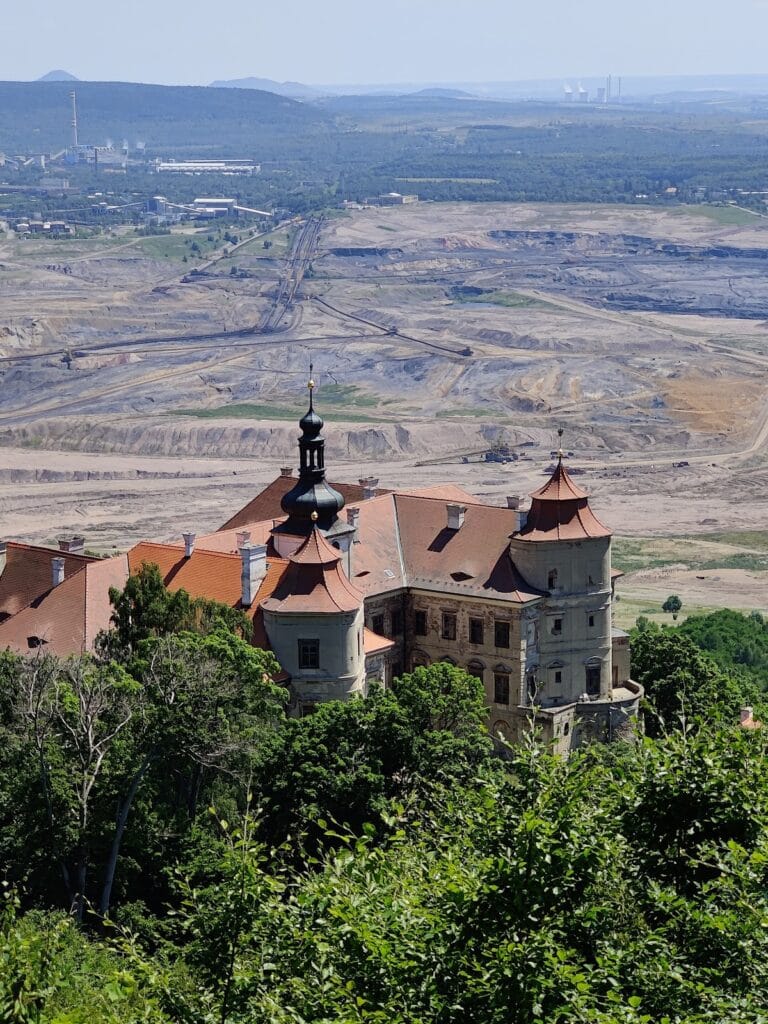
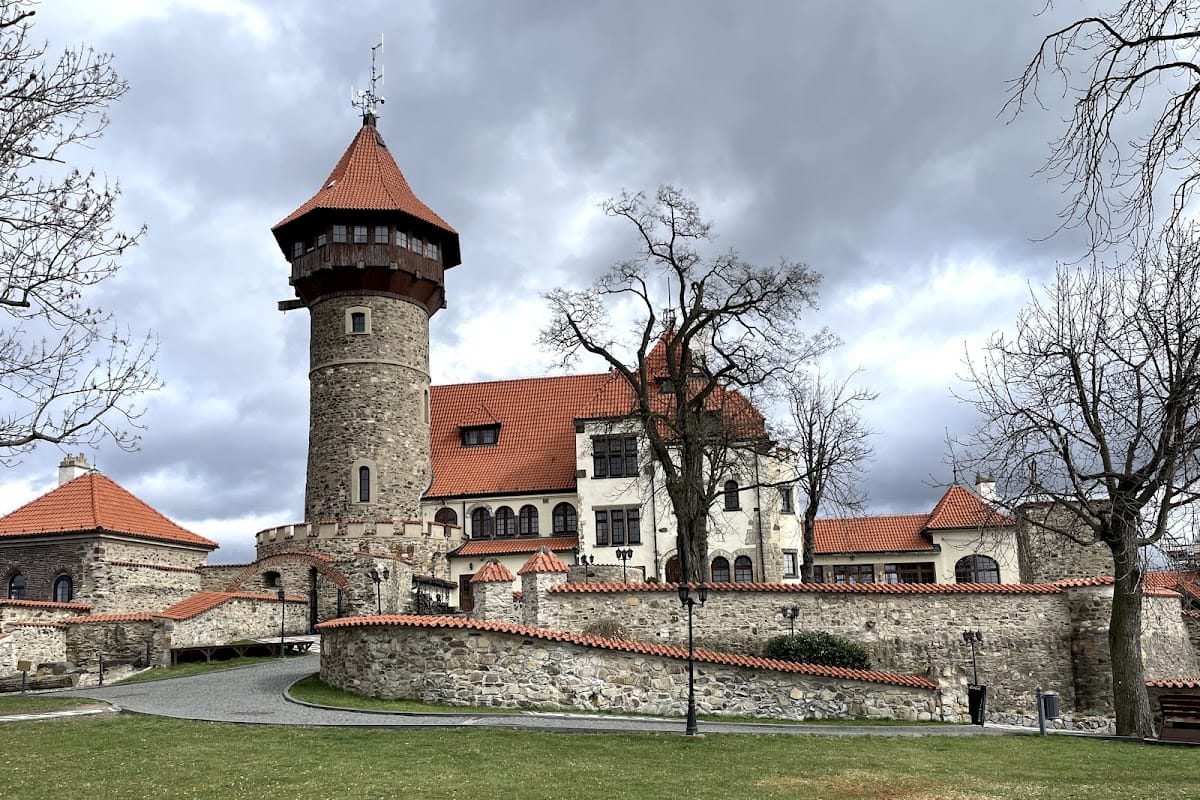
Hněvín Castle was originally designed with a roughly triangular shape featuring a rounded front side and a two-part interior arrangement. The northeastern corner comprised the castle’s core, where the main living spaces and noble quarters stood. This included a palace equipped with its own chapel and a spacious hall, alongside a second palace that contained a vaulted hall and another chapel, positioned along the northwest wall. A significant rectangular tower and a large circular bergfried, or main tower, approximately 14 meters in diameter, also formed part of this core.
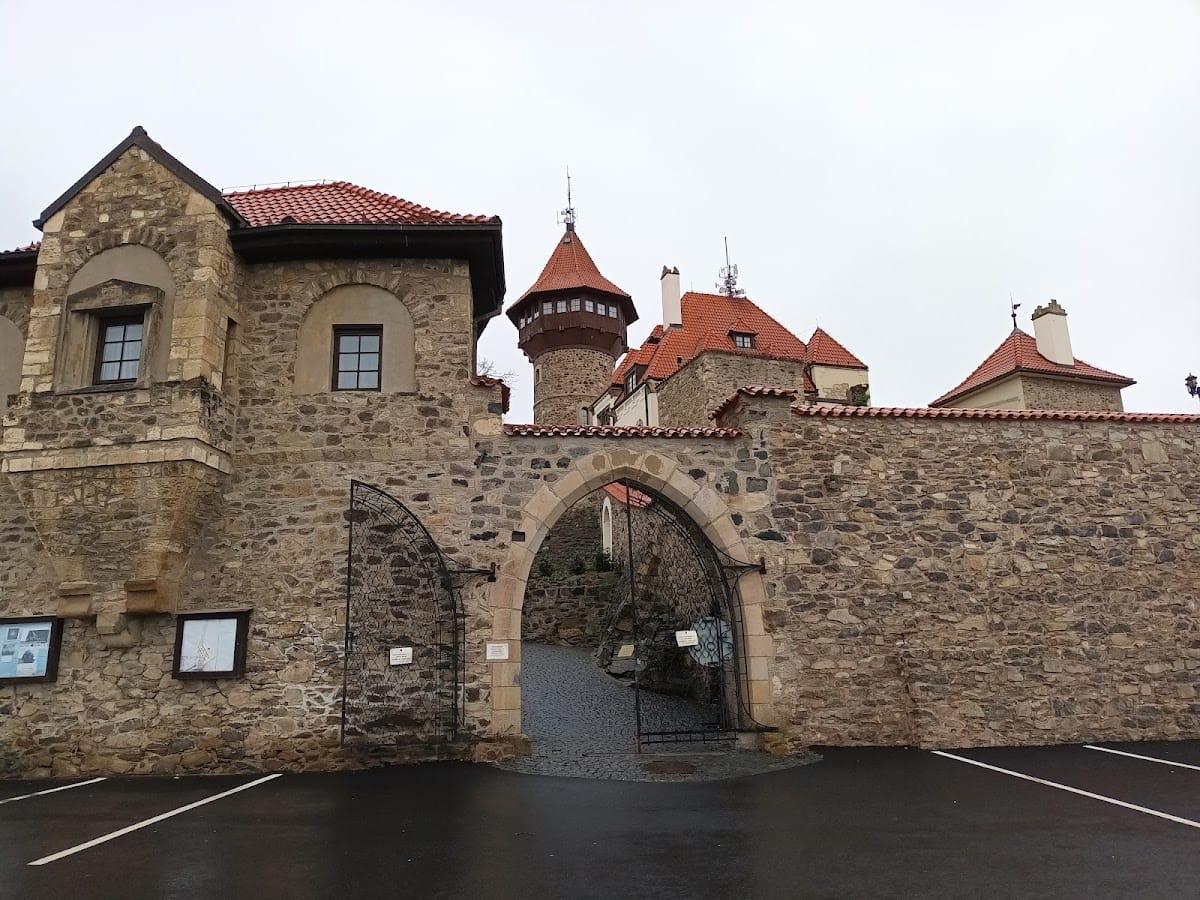
Separating the core from the outer bailey was a transverse wall, which helped define the castle’s internal zones. The primary entrance was originally located on the northern side near the western palace, with a second gate added later on the southern side during the 15th century to improve access. Surrounding the entire complex was a defensive wall fortified by five towers—two rectangular and three round. Some of these towers date back to late Gothic times, while others were part of romantic-era restorations in the 19th century.
During the 1800s, the terrain of the castle hill was raised by several meters, and the old defensive wall was largely dismantled down to the moat. A new perimeter wall was likely built along the original line, and the front moat was reinforced by an earthen embankment to enhance protection. The stone lookout tower erected in 1900 was distinctively topped with glazed bricks sourced from a local chamotte brickworks in nearby Braňany, showcasing attention to regional materials.
The neo-Gothic restaurant built in 1906 featured modern amenities for its time, including electricity and a telephone, reflecting the building’s use as a leisure site. Between 1913 and 1914, a smaller tower was constructed to function as a chapel, adding a religious element to the site. During World War II, a cave shelter was excavated beneath the lookout tower to serve as an air raid refuge, a feature that remains accessible to this day.
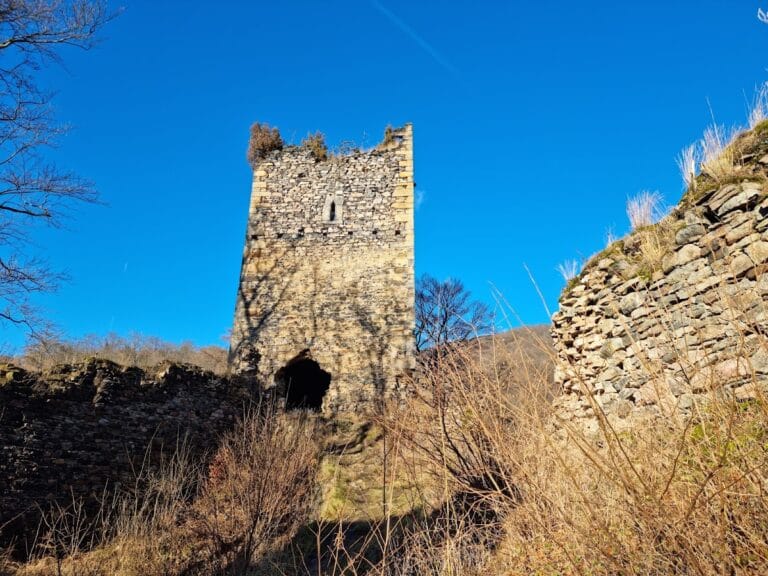
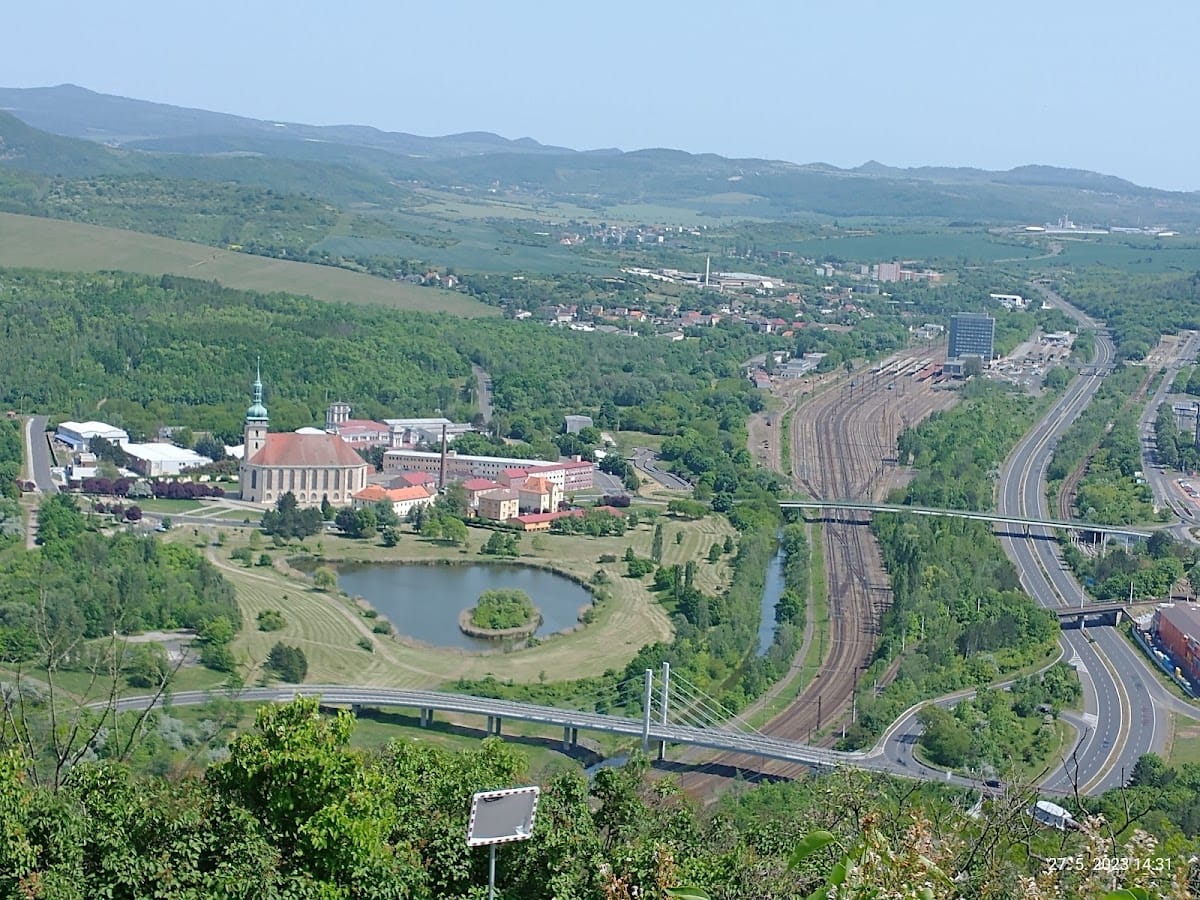
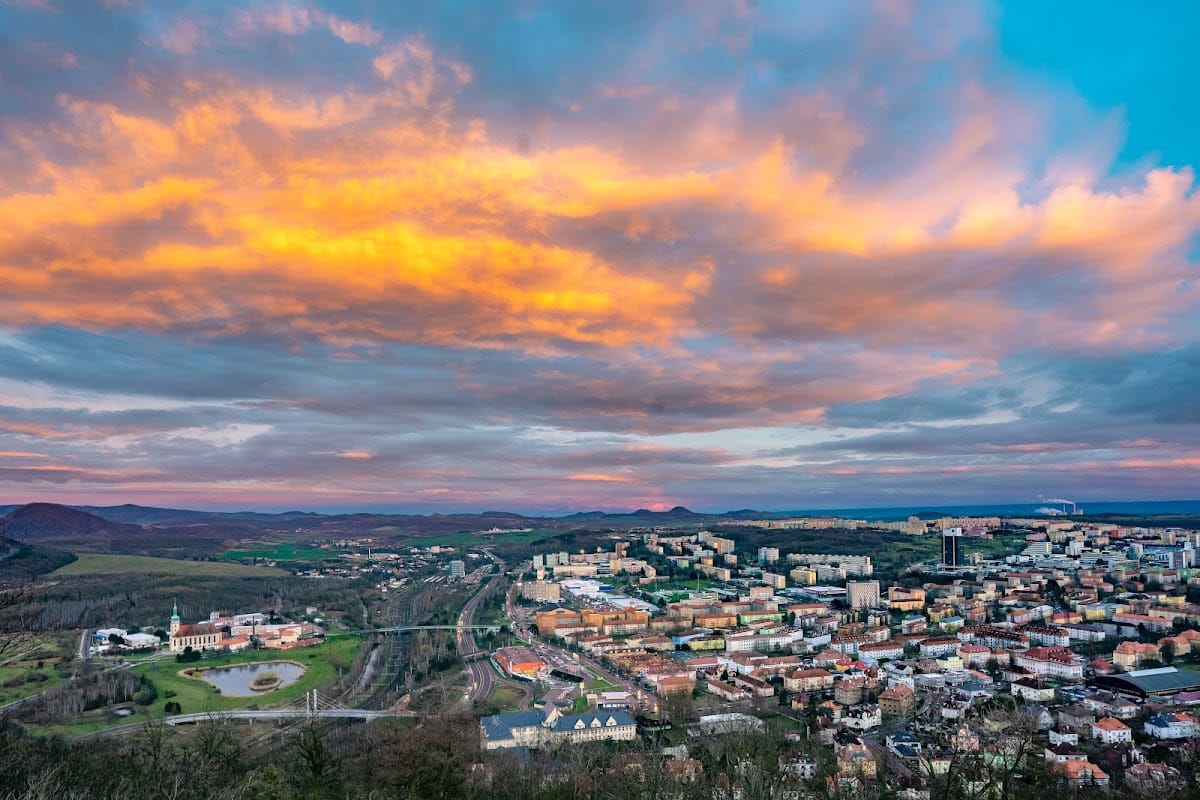
In the eastern tower, which formerly housed the chapel, a public observatory was established in 1972. This vantage point provides expansive views over the town of Most, the Ore Mountains, the Bohemian Central Highlands, and the North Bohemian Basin. Present-day visitors can see restored portions of the inner bailey, including round cannon bastions of Romanesque design. Foundations remain visible for the original palaces, bergfried, and the rectangular tower, while the later 19th and 20th-century reconstructions like the lookout tower and restaurant stand as enduring parts of the castle’s landscape.
Nearby sites