Jezeří Castle: A Czech Gothic Fortress and Baroque Château


Site at a Glance
- Rating
- 4.5
- Popularity
- Medium
- Country
- Czechia
- Primary era
- Early Modern
- External website
- Open
- Eras represented
- Medieval, Early Modern
- Civilizations
- Holy Roman Empire, Kingdom of Bohemia
- Site type
- Domestic
- Remains
- Castle
On this page14 sections
History
Jezeří Castle is a historic castle and château in Czechia, founded by Bohemian nobles as a Gothic castle between 1355 and 1365. Originally known as Eisenberg or Eisenberk, meaning “Iron Mountain,” it took its name from local iron-ore extraction. The name Jezeří, adopted in the nineteenth century, referred to the former Komořany Lake below the castle. The site later became a Lobkowicz residence, a cultural center, and a monument threatened by the expansion of brown-coal mining.
Medieval origins and noble ownership
Construction is attributed to Nevlas of Rvenice and his family, who had previously held a fortress at Albrechtice. Nevlas’s sons Bušek and Nevlas sold the castle before 1407 to Petr of Perče. Albrecht of Kolovrat held it from 1410 to 1413, and Jan Smolík of Slavice was recorded as its owner from 1416. Zikmund of Slavice still lived at Jezeří in 1451.
In the middle of the fifteenth century, Jezeří was held by Kunz of Kauffungen, a German knight known for abducting the sons of Saxon elector Frederick II from Altenburg in 1455. After Kunz was executed for violating the peace and making a treacherous attack, King George of Poděbrady occupied Jezeří to protect Kunz’s wife and children from a possible Saxon attack. Zikmund of Slavice regained the castle in 1459. After the probable death of his son Petr before 1493, the estate was administered for Petr’s underage heirs. Zikmund later bequeathed Jezeří in 1513 to his brother-in-law Mikuláš Hochhauser of Hochhaus.
Renaissance and Baroque transformation
Mikuláš Hochhauser converted the old castle into a Renaissance château in 1549. Around 1565, his sons divided their inheritance, and Jezeří passed to Petr of Hochhaus. Around 1588 it went to Václav of Hochhaus, who sold it to his brother Mikuláš after family disagreements. Mikuláš later sold the property to their uncle Jiří of Hochhaus. Jiří’s son Jan Mikuláš inherited the estate and was recorded at Jezeří in 1605.
Jan Mikuláš Hochhauser lost the Jezeří and Hliňany estates in 1623 after taking part in the Bohemian Estates uprising, a revolt by Bohemian nobles against Habsburg rule. The emperor gave the estates to William the Younger Popel of Lobkowicz as security for a loan of 10,000 florins. William expanded the holdings to include Nové Sedlo nad Bílinou and had Jezeří converted into a Baroque château in 1627.
A major fire in February 1646 destroyed every building at Jezeří except the servants’ quarters and stables. This occurred during the Thirty Years’ War, the European conflict of 1618 to 1648, amid fighting involving Swedish and imperial forces. Temporary repairs followed, but the lord’s administration moved to the château at Nové Sedlo. Ferdinand William of Lobkowicz rebuilt Jezeří in Baroque form between 1690 and 1696. Another fire on 25 September 1713, during the ownership of Ulrich Felix Popel of Lobkowicz, led to further restoration in the Baroque style.
The Lobkowicz estate and cultural center
After Oldřich Felix’s death in 1722, Jezeří entered a family entail, a legal arrangement that restricted the transfer of an inherited estate outside a designated family line. Jiří Kristián Lobkowicz, founder of the Mělník branch of the Lobkowicz family, acquired the château and used it mainly as a hunting residence. He sold it in 1752 to Prince Ferdinand Philip of Lobkowicz. The château’s cultural importance grew again under Ferdinand Philip’s son, Joseph Franz Maximilian of Lobkowicz, a Bohemian prince and patron of music.
During the late eighteenth and early nineteenth centuries, Jezeří became a cultural center for the surrounding region. A château theatre operated from 1802, while the estate supported a hunting-music ensemble, the Eisenberg choir, a vocal quartet, and a musical octet. Concerts were also held in the park. Johann Wolfgang von Goethe visited in 1810 and 1812. Other figures associated with Jezeří included Ludwig van Beethoven, Christoph Willibald Gluck, Paul and Anton Wranitzky, Antonio Brizzi, Antonio Casimir Cartellieri, Joseph Cartellieri, and the painter Carl Robert Croll.
Beethoven was a close friend of Joseph Franz Maximilian of Lobkowicz. His Third Symphony, the Eroica, was performed in the château theatre, as was Joseph Haydn’s oratorio The Creation. The estate itself included agricultural and industrial enterprises. By 1848, the wider Eisenberg estate comprised the towns of Ervěnice and Strupčice and 21 villages. Agriculture and forestry remained important, alongside a brewery, limekilns, brickworks, and brown-coal mining at Pohlody and near Chomutov.
War, confiscation, and mining threats
The land reform introduced after the foundation of Czechoslovakia reduced the estate, although the Lobkowicz family retained five farmyards. During the Second World War, German authorities administered the property because its last owner, Max Lobkowicz, was ambassador of the Czechoslovak government in London.
Jezeří then housed a special detention camp for prominent prisoners administered by the Reich Security Main Office, the central Nazi security and intelligence authority, as well as a satellite camp of Flossenbürg concentration camp. Between August 1943 and May 1945, the special camp held 241 high-ranking prisoners, including Allied officers and French hostages such as René Altmayer, Michel Clemenceau, Pierre de Gaulle, Colonel de La Rocque, and Maxime Germain. Around 20 April 1945, the prisoners came under the care of the Swiss Red Cross and were transported by train to Switzerland.
The Flossenbürg labor detachment used the castle stables and a former ground-floor storage area. It held 30 prisoners in June 1943, initially assigning them to erect barbed-wire fencing, build six watchtowers, and adapt the buildings for the special camp. Later prisoners worked in the kitchen. From January 1944 until the end of the war, their number generally ranged from three to eight. They were forbidden to enter the upper floors or contact the prominent prisoners, and left Jezeří on 27 April 1945 after the guards fled.
After the war, the château remained with the Lobkowicz family until the communist state confiscated it in 1948. In September 1950 it passed to the Ministry of National Defence and was used to house the Czechoslovak army. Military alterations damaged or destroyed interiors, and remaining furnishings were looted. The Ministry of the Interior took control in 1955, followed by the Ministry of Education and Culture in 1958.
Preservation and national protection
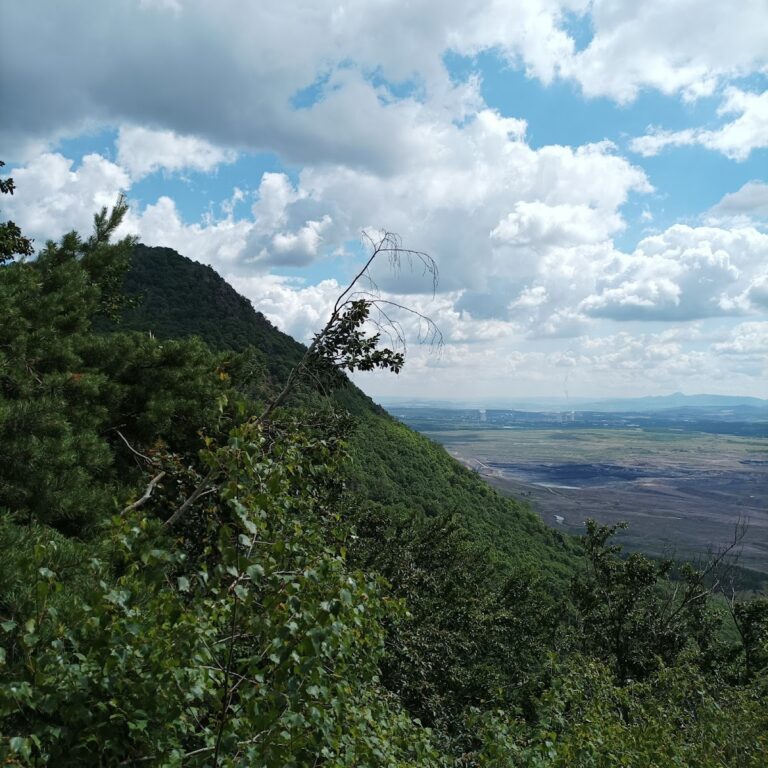
Jezeří came under the regional heritage-preservation and nature-conservation administration in Ústí nad Labem in 1972. The expansion of the ČSA open-pit brown-coal mine placed the château at risk. Demolition was considered in the 1980s, while the village of Jezeří and other settlements below the castle disappeared or were destroyed as mining expanded.
Geological investigations in the 1970s and 1980s found that the château stands on a relatively intact block of crystalline rock separated from the main Ore Mountains massif by major fault zones. Concern that mining beneath the castle might destabilize this block led to revised mining plans and the creation in 1991 of a protective zone defining a pillar of unmined coal beneath the slope.
Restoration planning began in 1986. A citizens’ initiative helped prevent demolition, and essential repairs to the roof and park retaining wall were completed between 1988 and 1991. The Lobkowicz family regained the château through restitution in 1991 but transferred it to the state in 1996 because reconstruction costs were too high. The Czech National Heritage Institute has administered Jezeří since 1996, and gradual restoration has continued. Jezeří was protected as a cultural monument from 1963. In 2022, the Czech government approved its designation, together with the nearby arboretum, as a national cultural monument effective from 1 July 2023. In 2020, it became the first Czech monument placed on Europa Nostra’s list of Europe’s most endangered heritage sites.
Remains
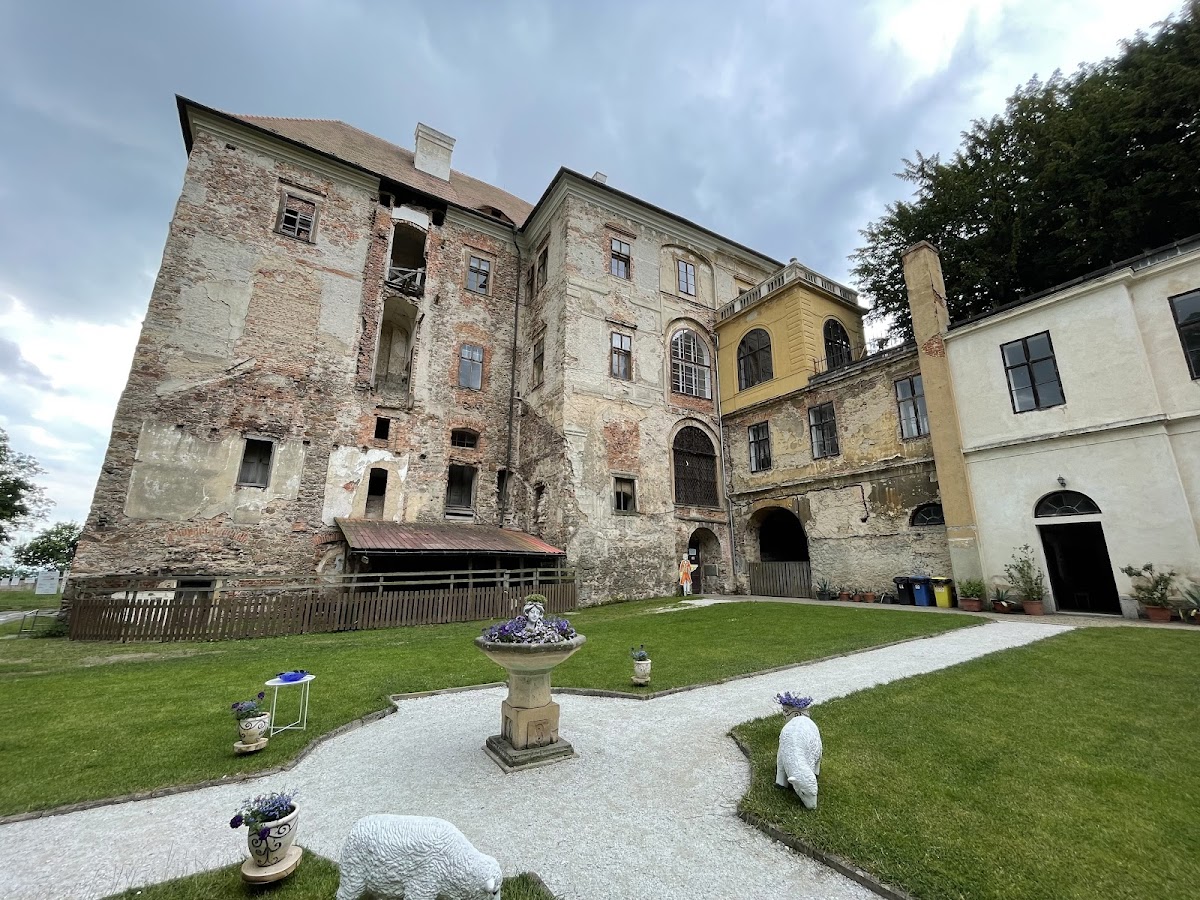
Jezeří occupies a rocky formation on the southeastern slope of the Kateřina Dome in the Ore Mountains, at the edge of the Most Basin. The area is formed mainly of orthogneiss, a metamorphic rock derived from igneous rock, created and altered during the Variscan orogeny, a major mountain-building period in Europe. The château stands directly above the ČSA open-pit brown-coal mine, less than 500 metres from its edge. Its present structure combines surviving elements of the medieval castle with Renaissance and Baroque rebuilding, while the surrounding park survives only in part.
Castle foundations and château structure
Medieval castle remains
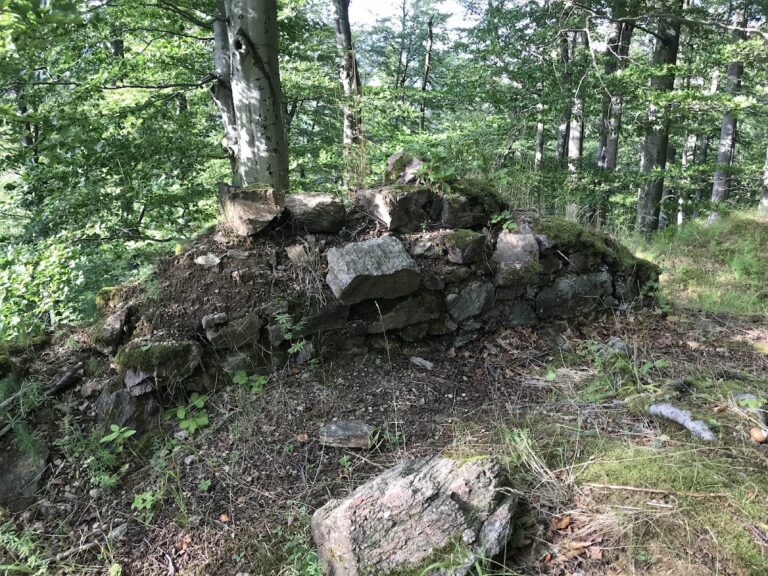
The medieval castle stood on the rocky mass that now partly occupies the basement of the main château and both western wings. The two eastern wings lie outside the area of the original castle. Fragments of medieval buildings remain within the later masonry, although their precise interpretation and the sequence of later medieval building phases remain uncertain. Only the position of one defensive ditch is known with certainty. A three-quarter-circular feature on the southern side and a building at the southwestern edge of the terrace may represent reworked remains of artillery bastions.
Main château
The principal building is two storeys high and follows an H-shaped, double-cross plan. Its four wings enclose two courtyards that open toward the surrounding landscape. Rounded towers rise at the western ends of the side wings. A powerful southern risalit, meaning a section projecting from the main façade, extends from the central building. On the western main façade, a shallow risalit continues into a square tower, while the tallest central tower rises above the entrance portal.
Portal and interior spaces
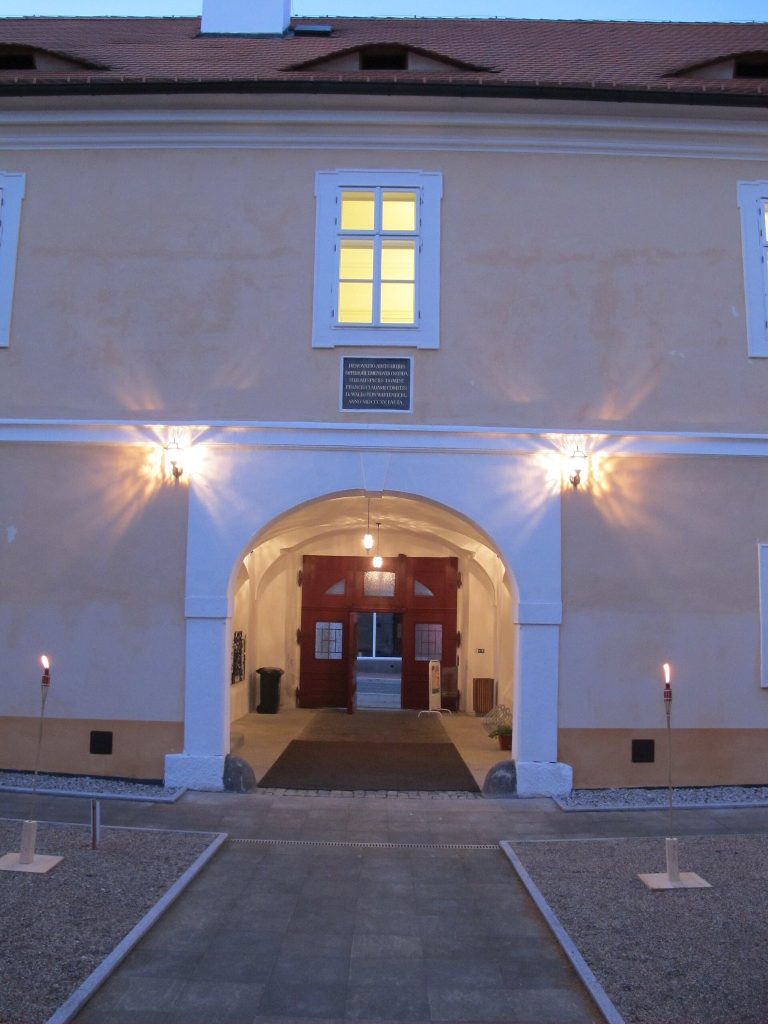
Access from the courtyard is through a monumental portal flanked by two atlas sculptures, male figures used as architectural supports. Their authorship has been attributed, with some uncertainty, to Johann Adam Dietz. An internal staircase leads from the portal to a large polygonal hall. The southern risalit contains a large domed hall, where massive consoles support the dome and its upper gallery. The château theatre was installed in this space at the beginning of the nineteenth century. Other rooms have cross vaults with stucco mirrors, and observation terraces occupy the eastern and western sides of the building.
The former interior included a gilded cabinet, an audience chamber, a Hall of Mirrors, a large banqueting hall, a collection of antlers, a princely chamber, a library, and the theatre. Some rooms are furnished to illustrate aristocratic life in the seventeenth and eighteenth centuries.
Gardens, park, and associated buildings
Terraced garden and landscape park
Limited space near the château led to the creation of a flower garden with a formal parterre on an elevated terrace. Below the castle hill, an English landscape park was laid out in the 1820s. This type of park was designed to imitate a natural landscape through lawns, trees, water, and irregular views. By 1838, the park covered about 50 hectares. Its surviving lower section is known as the Eisenberg Arboretum and contains old oaks, linden trees, beeches, and other valuable trees. Mining expansion damaged the arboretum and transformed the settlements and landscape below the château.
Mausoleum and chapel
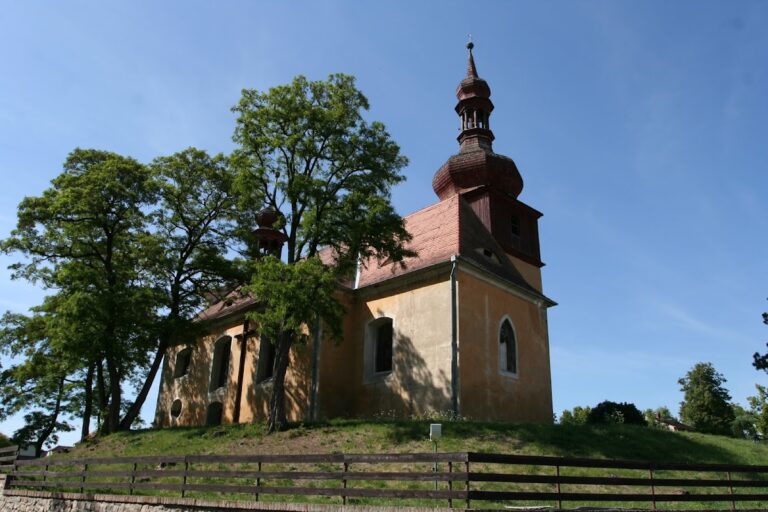
The remains of a Lobkowicz family mausoleum stand in the former park. It was built after 1753, probably by Andreas Altomonte. The park also contains the château chapel dedicated to Our Lady of Sorrows, built in 1805. Above the château, the former park area changes into natural woodland, while an enclosed hunting ground once occupied the higher ground.