Dunrobin Castle: Historic Seat of the Earls of Sutherland in Scotland
Visitor Information
Google Rating: 4.7
Popularity: Medium
Official Website: www.dunrobincastle.co.uk
Country: United Kingdom
Civilization: Early Modern, Medieval European, Modern
Site type: Domestic
Remains: Palace
History
Dunrobin Castle is situated in Golspie, Scotland, and was established by the medieval Scottish nobility. It has been the seat of the Earls of Sutherland and chiefs of Clan Sutherland since the 13th century. The lands were initially acquired before 1211 by Hugh, Lord of Duffus, descended from the Flemish noble Freskin. Around 1235, Hugh’s son William became the first Earl of Sutherland, marking the formal creation of the earldom. The castle likely occupies the site of an earlier fortification from the medieval period, with the earliest surviving structures dating back to the early 15th century.
During the 15th century, the castle was probably named in honor of Robert Sutherland, the 6th Earl, who died between 1427 and 1444. The original fortress was a strong square keep. The region experienced complex social influences, as Norse and Gaelic cultures mixed, and during the 16th century, through marriage, the earldom passed from the Sutherland family to the Gordon family. Political tensions marked this era: in 1518 Alexander Sutherland, the lawful heir, briefly took control of the castle during Adam Gordon’s absence but was quickly defeated and executed, his head displayed as a grim warning. His son John later attempted to reclaim Dunrobin in 1550 but died in the castle’s garden.
The 18th century saw Dunrobin involved in the Jacobite uprisings. In 1745, Jacobite forces led by Charles Edward Stuart seized the castle without warning, as Clan Sutherland had allied with the British government. The then 17th Earl escaped and joined the Duke of Cumberland’s army. After the 18th Earl’s death in 1766, the estate passed to his daughter Elizabeth, who married George Leveson-Gower, later the 1st Duke of Sutherland. The house was expanded and altered in the late 18th century.
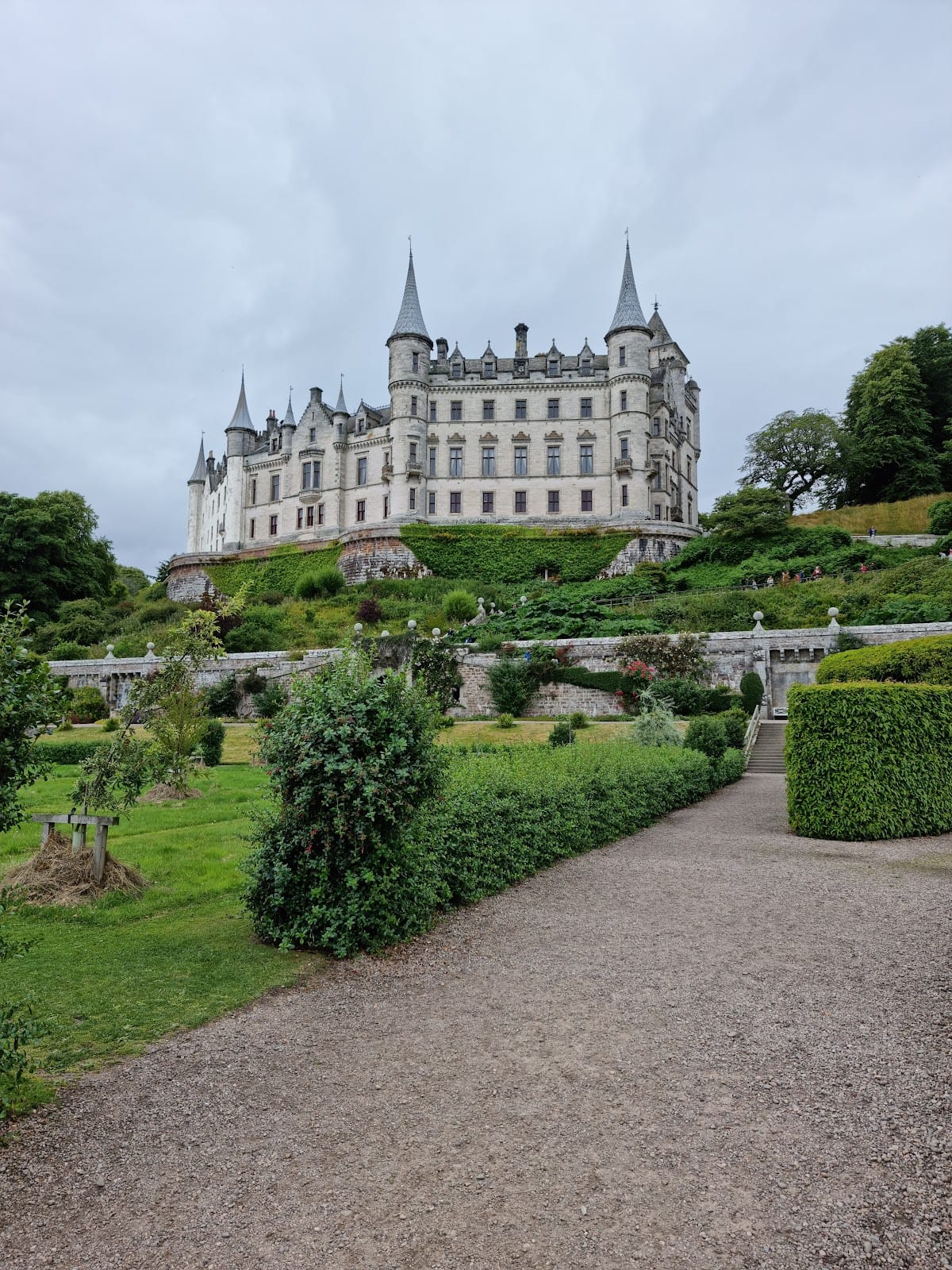
Between 1835 and 1850, the castle underwent major remodelling under Sir Charles Barry, a leading architect of the time. He redesigned Dunrobin in the Scottish Baronial style popular then, while preserving important medieval and early modern building elements. During World War I, the castle served as a naval hospital, but a fire in 1915 damaged much of its roof and interior additions by Barry. The celebrated Scottish architect Sir Robert Lorimer was engaged for restoration work after the war. Lorimer conserved many of the 17th- and 18th-century interiors, including intricate woodcarvings by Grinling Gibbons. The castle operated as a boys’ boarding school between 1965 and 1972. Since 1973, it has been partially open to the public, while still serving as a family home. Dunrobin Castle is recognized today as a Category A listed building, with its gardens protected within Scotland’s Inventory of Gardens and Designed Landscapes.
Remains
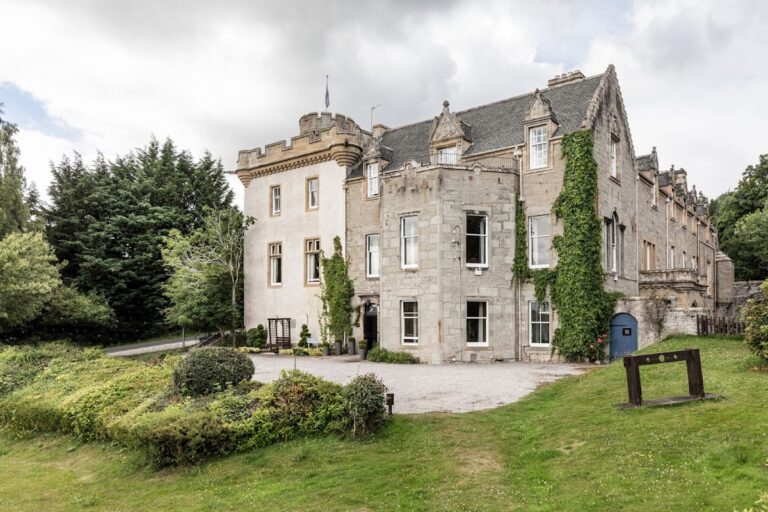
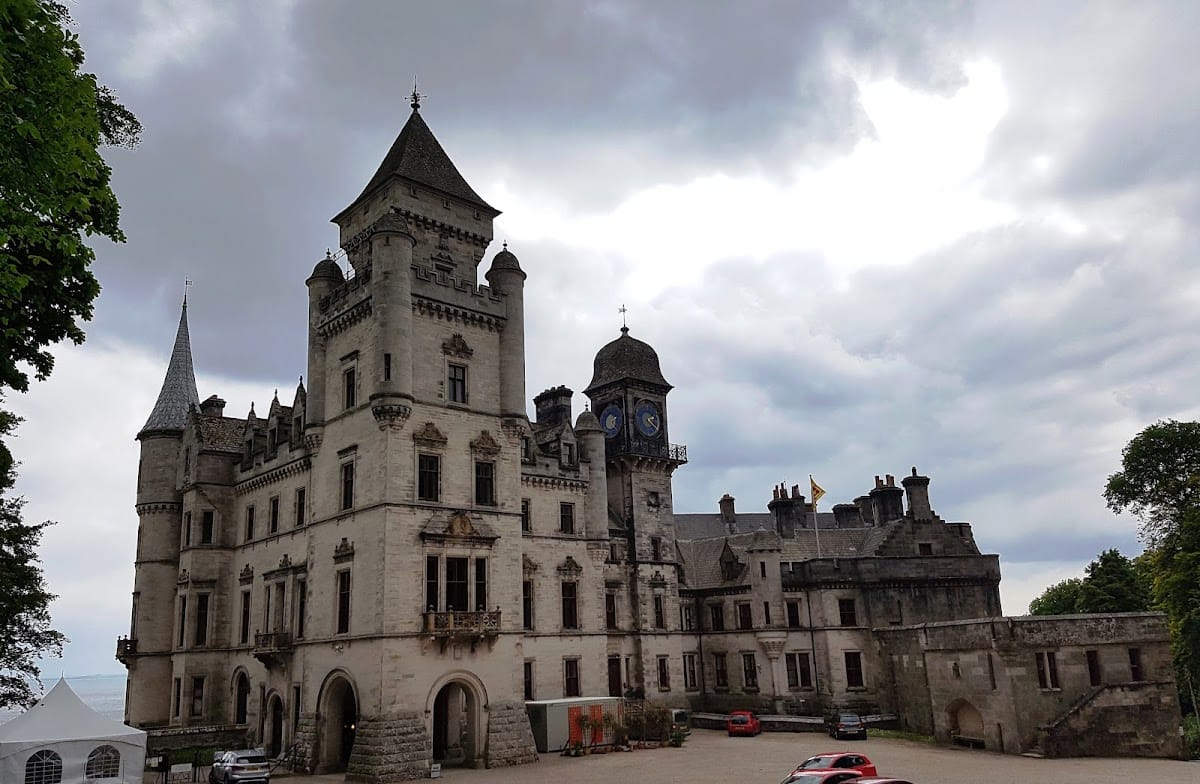
Dunrobin Castle is a vast quadrangular structure, standing four stories tall with towers flanking each corner. The castle contains 189 rooms, making it the largest residence in the northern Highlands. The tallest tower, which houses the main entrance, rises 135 feet (41 meters), with smaller round towers reaching 115 feet (35 meters) and a clock tower standing 125 feet (38 meters) high. The oldest part of the castle, visible in the interior courtyard, includes a square keep with massive walls exceeding six feet (1.8 meters) in thickness and stone-vaulted ceilings on every floor. An original iron yett, a type of iron gate, remains intact from at least 1401.
The section of the castle remodeled in the 19th century by Sir Charles Barry blends freestone construction with stylistic elements reminiscent of 16th- and 17th-century turreted architecture. Barry incorporated château-style features, such as a pyramidal roof over the main entrance, inspired by the French architect Viollet-le-Duc. Within the oldest courtyard lies St. John’s Well, a draw well renowned as one of the deepest in Scotland at 92 feet (28 meters).
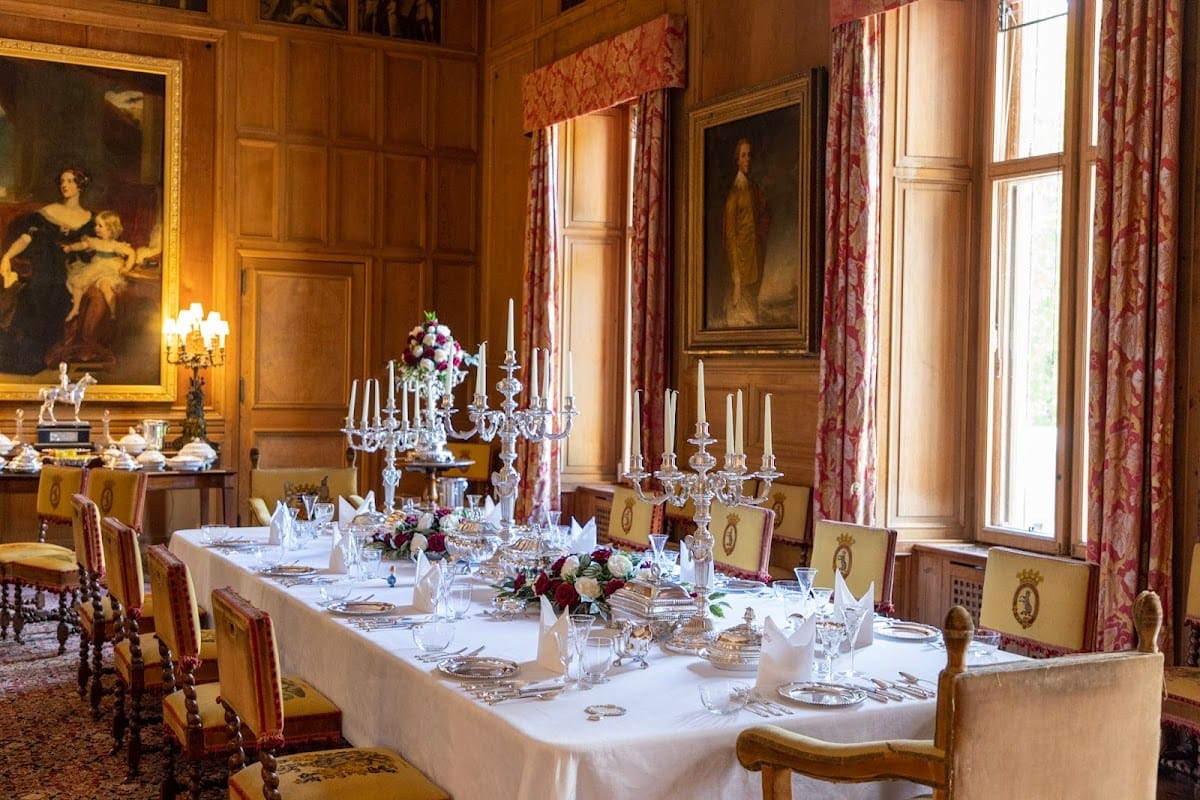
Inside, the castle preserves several notable historic interiors. The entrance hall is decorated with a frieze displaying the armorial bearings of former Earls of Sutherland. The grand main staircase spans approximately 30 feet (9 meters) in width and rises to 50 feet (15 meters) in height, adorned with portraits of the Leveson-Gower family. The panelled dining room measures 40 feet (12 meters) long by 22 feet (6.7 meters) wide and features an Italian Grisaille frieze—an artistic style of mural painting in shades of grey—a Khorassan carpet, and chairs embroidered by the wife of the fifth Duke of Sutherland. The drawing room, created by merging two smaller rooms during Lorimer’s postwar restoration, overlooks both the gardens and the sea. It contains large paintings by Canaletto, 18th-century tapestries, and portraits by notable artists Hoppner and Reynolds.
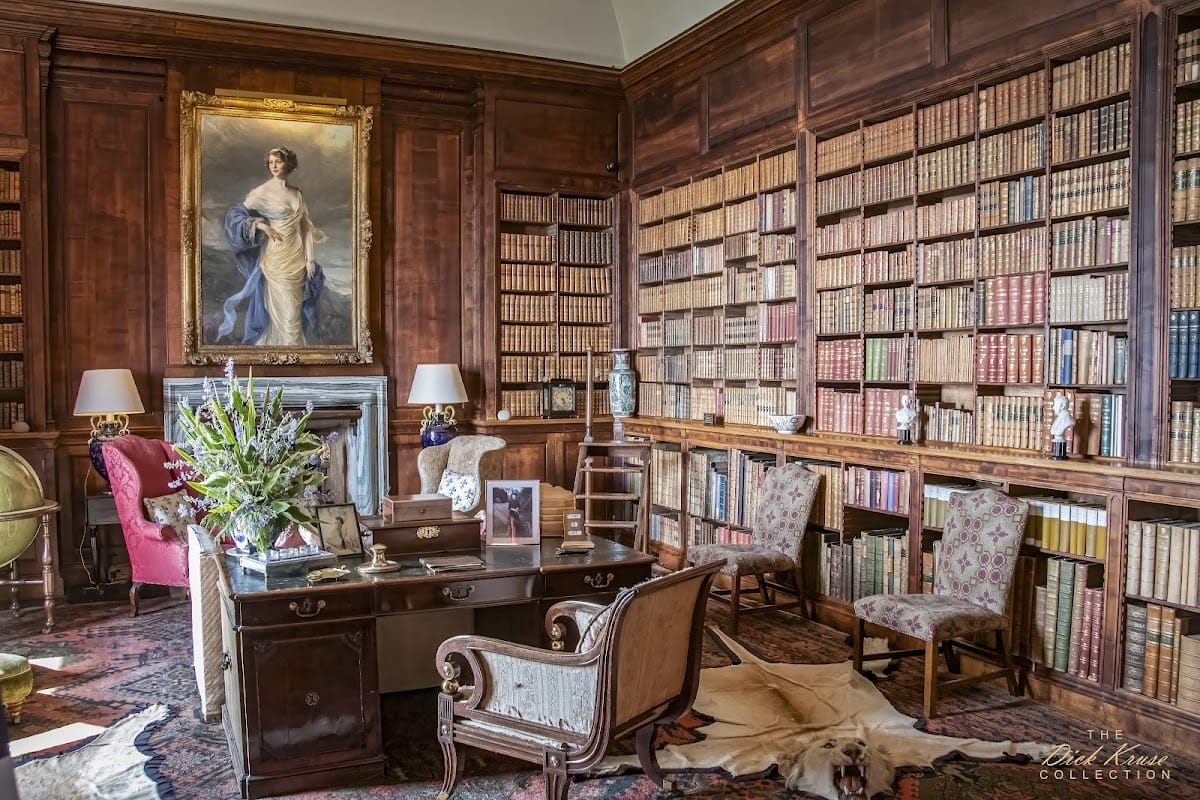
The library holds a collection exceeding 10,000 books, alongside a portrait of Duchess Eileen by Philip de László, and a mahogany table crafted by Thomas Chippendale, a celebrated furniture maker. A unique musical instrument, an aeolian orchestrelle—a pressure-operated harmonium reed organ—is installed in one of the hallways, reflecting the castle’s rich history of cultural patronage.
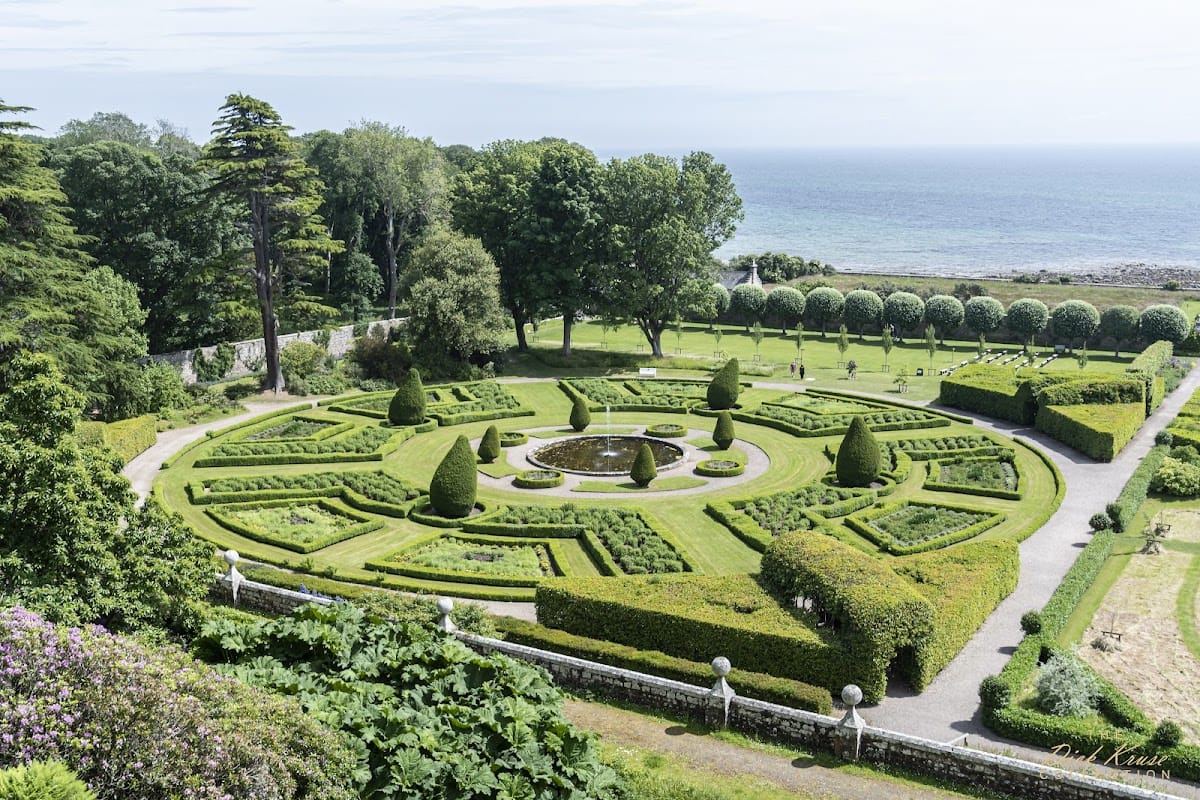
The extensive gardens surrounding the castle were completed in 1850, devised in the French formal style inspired by the gardens of Versailles. Spanning 1,379 acres (558 hectares), each parterre—a level garden area—centers on a circular pool with a fountain designed as an optical illusion to make the area appear larger when viewed from above. Adjacent to the formal gardens stands an 18th-century summerhouse that functions as a museum. This museum retains its Victorian-Edwardian layout and houses collections including trophy heads of animals hunted by the family, ethnographic items gathered worldwide, and archaeological artifacts, reflecting the diverse interests of the castle’s owners.
Nearby, Dunrobin Castle railway station, established in 1870 as a private station for the estate, includes a waiting room constructed in 1902. This building holds its own heritage designation as a Category B listed structure.
Nearby sites