Skelbo Castle: A Medieval Keep Guarding Loch Fleet


Site at a Glance
- Rating
- 4.2
- Popularity
- Very Low
- Country
- United Kingdom
- Primary era
- Medieval
- Eras represented
- Medieval, Early Modern
- Civilizations
- Kingdom of Scotland
- Site type
- Military
- Remains
- Castle
On this page10 sections
History
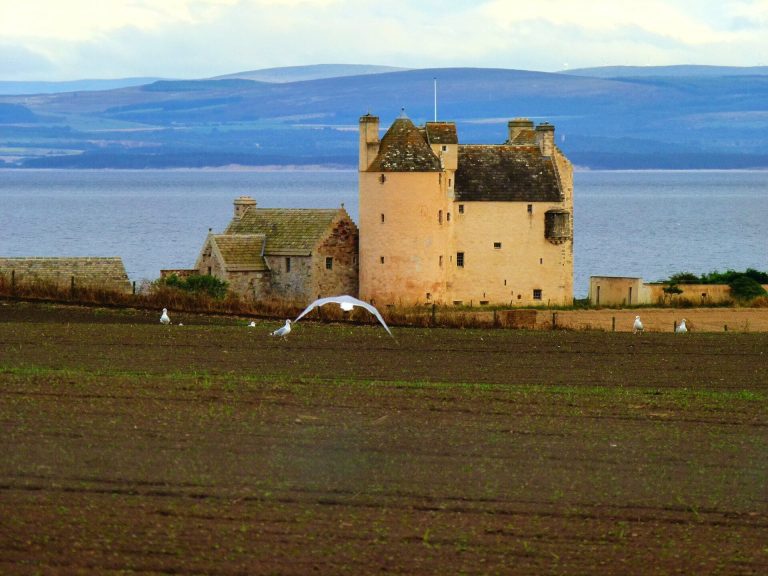
Skelbo Castle is a ruined fourteenth-century keep near Dornoch in Scotland, United Kingdom. Built during the medieval period, it stood above the former Little Ferry crossing and secured the approaches to Loch Fleet. At times, its position led it to be regarded as the region’s second most important fortress after Dunrobin Castle.
Medieval foundations and the Scottish succession
Hugh de Moravia granted Skelbo in 1211 to Gilbert de Moravia, Bishop of Caithness. In 1235, Gilbert transferred the castle to his brother Richard de Moravia. An earlier castle on the site belonged to the Sutherlands until Robert the Bruce captured it in 1308. Robert the Bruce, also known as Robert I of Scotland, was the king who led the struggle that secured Scotland’s independence from English rule in the early fourteenth century.
Skelbo also entered the crisis surrounding the Scottish succession in 1290. Commissioners of Edward I of England were waiting there for Margaret, Maid of Norway, when they learned that she had died in Orkney at the age of seven during her voyage from Norway to take up the Scottish throne. Margaret was the Norwegian-born child designated to inherit the crown, but she died before she could be crowned. Edward I, king of England from 1272 to 1307, was seeking authority over Scotland during this period.
Ownership disputes and the sixteenth century
Ownership was contested in 1494. Marjory Mowat, the widow of John of Kinnaird, disputed the property with Thomas of Kinnaird, and a court ordered a lawyer to question witnesses about a charter. The Murrays of Aberscross also challenged the Kinnaird family’s claim. The castle eventually passed to the Kinnairds, who, like the Murrays, traced their descent to Richard de Moravia.
William Sutherland, sixth of Duffus, acquired Skelbo in 1529 through an agreement with John Kinnaird of that Ilk. The contract required Sutherland to pay 2,300 merks in installments. In return, he received specified lands, including Skelbo, to be held from the Earl of Sutherland as overlord. A merk was a Scottish monetary unit used in medieval and early-modern land transactions. The transfer was completed on 15 September 1529.
A house was built beside the castle during the sixteenth century. The site continued as a residence until it was abandoned in the twentieth century.
Changing transport links and later ownership
Until the early nineteenth century, Little Ferry was the principal north-south coastal connection in the area. In 1816, Thomas Telford built the Mound dam to carry a new road across the marshy end of Loch Fleet. Telford was a British civil engineer known for roads, bridges, canals, and other infrastructure.
The last owner was Mikhail de Buar, who died without leaving a will in 2009. His estate subsequently became the subject of major litigation in Russia. The remains have been legally protected as a scheduled monument under designation SM6225 since 1995. A scheduled monument is a structure or archaeological site given statutory protection because of its national historical or archaeological importance.
Remains
Skelbo Castle occupies elevated ground above the road along the shore of Loch Fleet, at 16 metres above sea level. Its position provided broad views across the narrow loch and toward the hills beyond. The surviving complex consists of the broken walls of a massive keep, parts of a surrounding curtain wall, and an inner courtyard. Rubble from collapsed buildings now obstructs the courtyard, while the northern side preserves the remaining wall most fully.
Castle structures
The keep and curtain wall
The massive keep forms the central surviving element of the castle. Its walls are broken and fragmentary, with the best-preserved section on the northern side. Parts of the curtain wall, the enclosing defensive wall, remain around it and help define the former castle boundary.
The inner courtyard
An inner courtyard lies within the castle enclosure. Collapsed buildings have filled the space with rubble, preserving the evidence of the complex’s former internal arrangement while making the courtyard physically obstructed.
Sixteenth-century manor house
The old manor house
An old manor house stands behind the castle ruins. Its crow-stepped gables have stepped rather than straight sloping edges, creating a serrated outline at the ends of the building. The house represents the later residential phase that developed beside the medieval keep.