Duffus Castle: A Medieval Motte-and-Bailey Castle near Elgin



Site at a Glance
- Rating
- 4.6
- Popularity
- Medium
- Country
- United Kingdom
- Primary era
- Medieval
- External website
- Open
- Eras represented
- Medieval
- Civilizations
- Kingdom of Scotland
- Site type
- Military
- Remains
- Castle
On this page12 sections
History
Duffus Castle is a ruined medieval castle near Elgin in Scotland, United Kingdom, built by Scottish nobility from around 1140 and occupied until 1705. It began as a motte-and-bailey fortress and later became a stone residence and stronghold for families whose influence extended across northern Scotland.
Foundation under David I
After the suppression of the 1130 rebellion led by Angus, Mormaer of Moray, King David I placed trusted nobles in the province. A Mormaer was a high-ranking regional ruler in medieval Scotland, broadly comparable to an earl. Freskin, a nobleman probably of Flemish origin, received land at Duffus and probably established the first castle there. The site was certainly in existence when David I visited Moray in 1151.
The earliest fortress was an earthwork and timber castle set on boggy ground in the Laich of Moray. Its raised mound and enclosed lower area created a defensible centre for Freskin’s local authority. The castle remained broadly within his family’s succession as his descendants expanded their position in northern Scotland.
The de Moravia and Sutherland successions
From the thirteenth century, Freskin’s descendants adopted the name de Moravia and became one of the most powerful families in northern Scotland. The castle continued through their family line, although marriage transferred it when particular male lines ended.
In 1270, Duffus passed to Sir Reginald le Chen through his marriage to Mary de Moravia, Freskin’s heiress and descendant. After Reginald died in 1345, the castle went to his daughter Mariot, who was married to Nicholas, the second son of the fourth Earl of Sutherland. The Sutherlands, who were themselves descended from Freskin, retained Duffus until 1705.
Rebuilding and medieval conflict
A major rebuilding project was under way by 1305. In that year, King Edward I of England granted Reginald le Chen 200 oak trees from the royal forests of Longmorn and Darnaway for construction at his manor of Duffus. The stone castle dates from the early fourteenth century, although its precise builder is uncertain.
The castle may have been destroyed during the 1297 rebellion against English rule and may have suffered further damage during Robert the Bruce’s campaign in Moray in 1306. Robert the Bruce, later King Robert I of Scotland, led the Scottish struggle against English rule in the early fourteenth century. These possible episodes belong to a period when control of Moray was affected by the wider conflict between Scottish and English forces.
Decline and later status
The stone tower later suffered serious subsidence, and residential functions shifted to a newer hall. The castle’s decline may therefore have begun before its formal abandonment. In 1689, John Graham, first Viscount of Dundee, stayed with Lord Duffus shortly before the Battle of Killiecrankie. Graham was a Scottish military commander and leading Jacobite figure who fought at that battle, making his visit one of the last important events associated with the occupied castle.
By 1705, after the death of the second Lord Duffus, the castle had become unsuitable as a residence and was abandoned. It became government property in 1926 and is managed by Historic Environment Scotland. Duffus Castle is a Scheduled Monument, with the designation recorded on 27 September 1996.
Remains
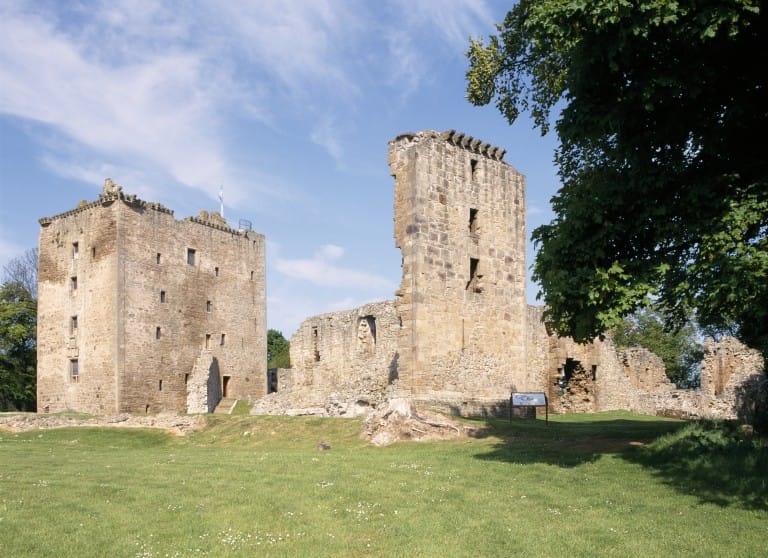
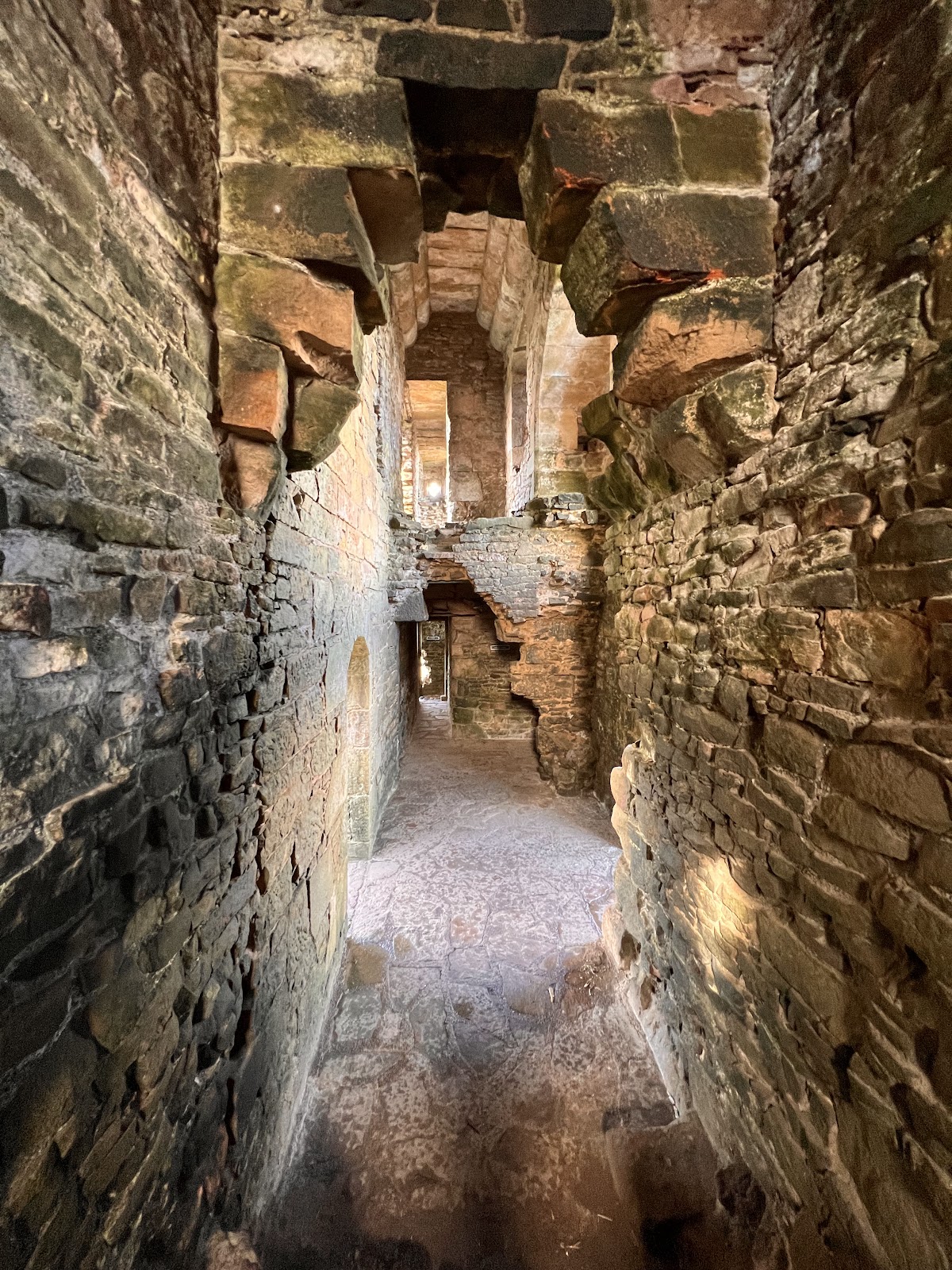
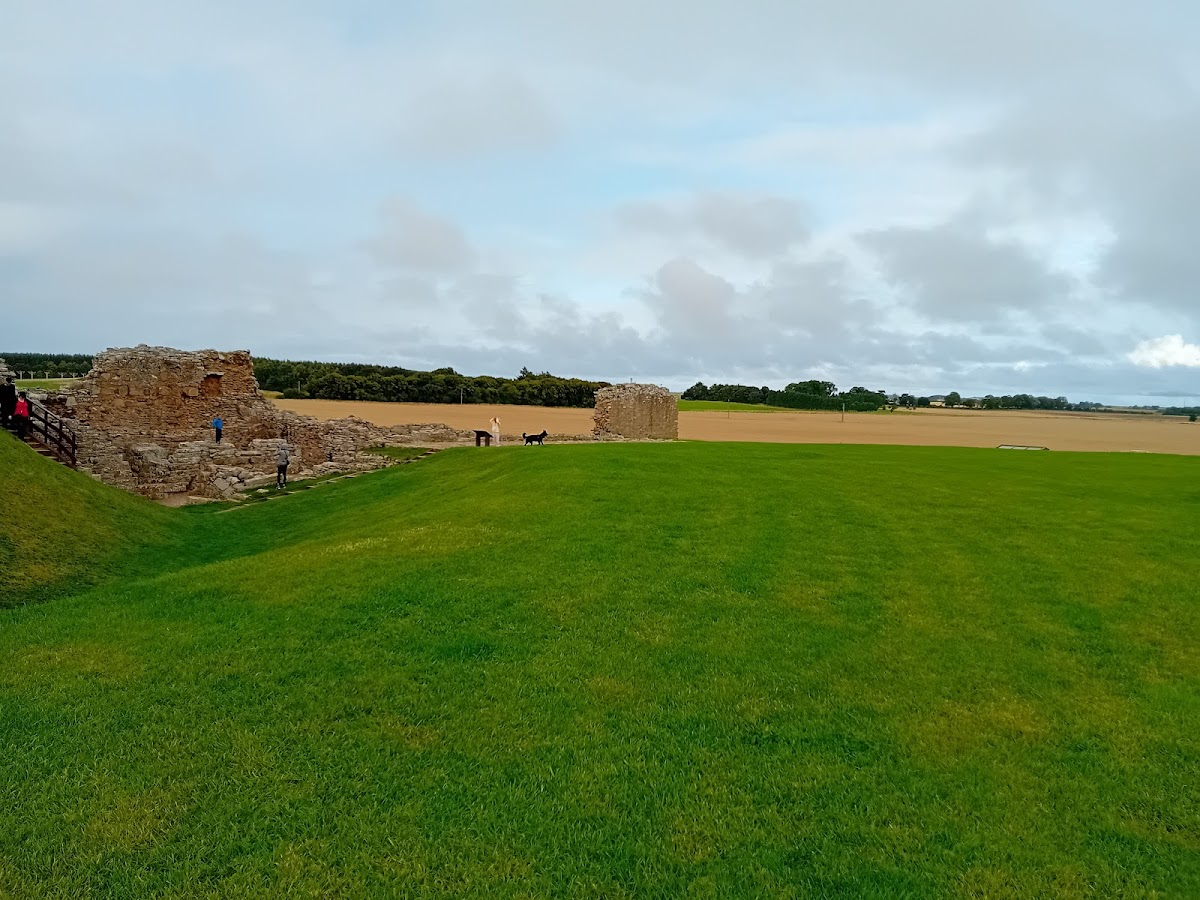
The surviving castle combines an artificial defensive mound, a lower enclosed courtyard, and later stone buildings. The complex has an irregular plan that is roughly beehive-shaped. Its north wall is straight, while the east and west walls initially run at right angles to it before curving toward one another and joining at the south. The original motte occupies the north-west corner, and the bailey extends around it within the enclosing wall.
The motte-and-bailey earthwork
The motte
The original motte is an artificial mound with steep sides, a flat summit, and a wide, deep ditch around its base. Timber buildings stood on the summit, protected by a wooden palisade along its edge. Steps set into the mound connected the motte with the bailey. The later stone tower was erected on this earthwork, whose unstable construction eventually contributed to the tower’s collapse.
The bailey
The bailey was a broad, artificially raised area lower than the motte. It held the castle’s accommodation and service buildings, including brew and bake houses, workshops, and stables. A curtain wall enclosed the entire bailey and crossed the ditch that separated it from the motte. Putlog holes, sockets in masonry for the ends of temporary wooden scaffolding or building supports, show that additional buildings once stood against this wall.
The stone castle
The tower
The principal stone building was a two-storey rectangular tower constructed from local stone, including sandstone. Its first floor contained the lord’s hall, a latrine, and sleeping chambers, while the ground floor served chiefly for storage and also accommodated the lord’s household. The tower had a strongly defensive arrangement, with few narrow windows and one ground-floor entrance secured by a portcullis, a vertically sliding fortified gate. Two upper-level doors opened onto the walkway of the curtain wall.
Repairs were made to the tower before part of it broke away and slid down the motte. The surviving structure is now ruined, with the collapse reflecting the instability of the artificial mound beneath it.
The later hall
A later building along the north side contained a kitchen, a great hall with a reception room, and a principal bedchamber. It may have been built by the Sutherlands and became the main residence after subsidence affected the tower. The hall retains evidence of continued alterations, reflecting the changing residential needs of the families who occupied Duffus.