Tulloch Castle: A Historic Tower House in Dingwall, Scotland


Site at a Glance
- Rating
- 4.2
- Popularity
- Low
- Country
- United Kingdom
- Primary era
- Early Modern
- External website
- Open
- Eras represented
- Medieval, Early Modern, Modern
- Civilizations
- British, Kingdom of Scotland
- Site type
- Domestic
- Remains
- Castle
On this page13 sections
History
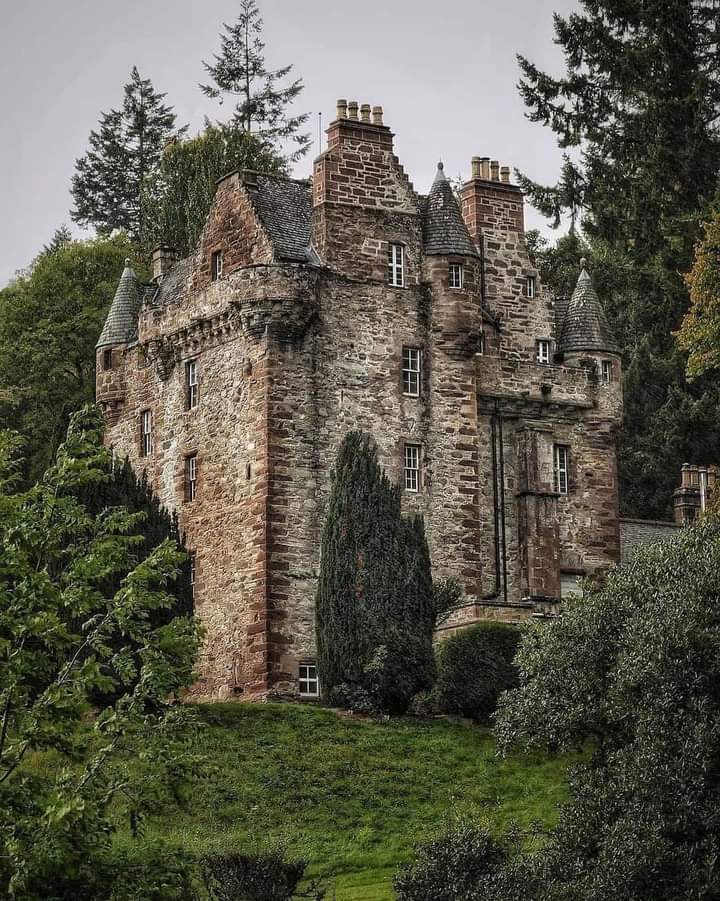
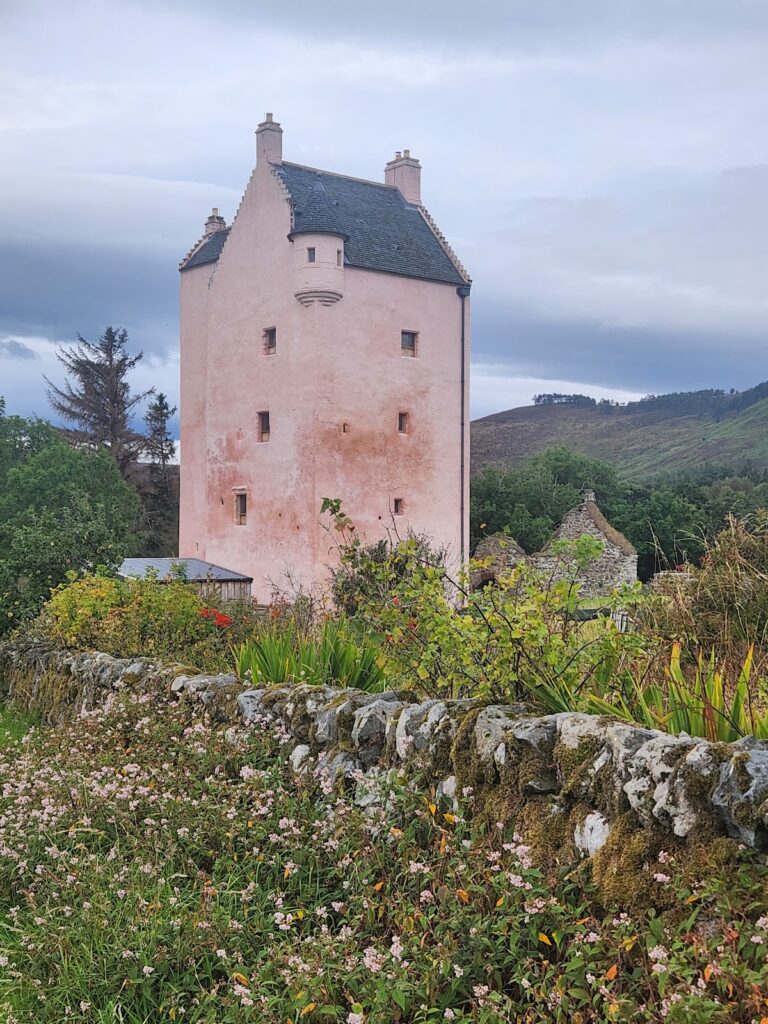
Tulloch Castle is a historic tower house in Dingwall, Scotland, United Kingdom, whose origins are placed either as early as the late fourteenth century or in the mid-sixteenth century. The castle is associated with the medieval Scottish earldom of Ross and later became the seat of the Bain, Bayne, Davidson, and Vickers families. Its history reflects the changing ownership, domestic use, and institutional roles of a Highland estate.
Medieval associations and the Bain barony
Tulloch Castle is associated with Mariota Leslie, who was born there. She was the daughter of Euphemia I, Countess of Ross, and later married Donald Macdonald, Lord of the Isles, the ruler of the Macdonald lordship based in the western Scottish islands and mainland territories. Several of Euphemia’s children by Walter Leslie were also born at Tulloch Castle.
In 1542, Duncan Bane, whose name also appears as Bain or Bayne, received a charter for the Tulloch lands. In 1678, King Charles II established the lands as a free barony for Sir Donald Bain of Tulloch. A free barony was a Scottish territorial jurisdiction held under a baron and recognized by the Crown.
The Davidson estate
Kenneth Bayne, the eighth laird and fifth baron of Tulloch, sold the estate to his cousin Henry Davidson in 1762. A crown charter confirming Henry Davidson as the sixth baron of Tulloch was issued by King George III on 23 February 1763. After Henry Davidson died in 1781, ownership passed to his younger brother Duncan Davidson, who represented Cromartyshire in Parliament from 1790 to 1796.
The succession then continued through Henry Davidson (1771–1827), Duncan Davidson (1800–1881), Duncan Henry Caithness Reay Davidson (1836–1889), and Duncan Davidson (1865–1917). During these generations, Tulloch Castle remained a family residence and continued to be connected with the management of the surrounding estate.
Vickers ownership and twentieth-century changes
The castle passed out of Davidson ownership in 1917, after the death of Duncan Davidson, eleventh baron of Tulloch. He left the castle and barony to his daughter and her son, Colonel Angus Vickers of the Vickers aircraft company. Sir Robert Lorimer designed alterations carried out in the early 1920s. Lorimer was a Scottish architect known for historicist and Arts and Crafts work.
After serving as the Vickers family home, Tulloch Castle was used as a hospital in 1940 following the evacuation of Dunkirk, the 1940 wartime withdrawal of Allied forces from northern France. The local education authority purchased the building in 1957. Until 1976, it served as a hostel for students from the west coast of Scotland studying at Dingwall Academy.
Following its period as a student hostel, the castle fell into disrepair. The local MacAulay family renovated it and converted it into a hotel in 1996. It remains a hotel and conference centre, and in October 2007 it hosted the official Clan Davidson Gathering. Tulloch Castle is a Category B listed building, a protected designation for a building of regional or national architectural or historic interest.
The barony and reported apparitions
After Colonel Angus Vickers died in 1990, the barony passed to his niece, Lady Phyllis Vickers. In 2016, the previous baron, Sir Francis Henry Mackay of Tulloch, transferred it by deed of disposition to Dr David Willien, the current baron. Dr Willien owns both the caput baroneum, the principal place associated with a barony, also called the Brick House Land, and the separate titular barony of Tulloch.
Tulloch Castle is also associated with reports of a green lady and other apparitions, including a young girl and a middle-aged woman. Grampian Television’s Beyond Explanation investigated the reports in 2005 without reaching a conclusive result. On 28 May 2008, fourteen-year-old Connor Bond reportedly photographed a hand gripping a stair railing with a floating apparition behind it. Film and paranormal-phenomena experts later examined the photographs.
Remains
Castle grounds and circulation
The surviving castle is identified as a tower house, while its surrounding grounds preserve traces of the wider estate layout. A former tunnel ran from the basement beneath Dingwall toward the site of the old Dingwall Castle. The passage has collapsed, and an air vent associated with it lies on the front lawn in a closed-off condition.
Davidson cemetery
A Davidson cemetery occupies part of the grounds. Family members and pets were buried there, and the enclosure is surrounded by a metal fence. The cemetery has become overgrown, but some headstones remain visible among the vegetation.
Walled gardens
Two walled gardens originally stood on either side of the castle. Their grounds are now overgrown. Parts of the former garden area have become woodland, while other parts have been occupied by houses, preserving fragments of the estate’s earlier landscape within the modern surroundings.
Gatehouses and entrance ways
West gatehouse
The former west gatehouse stood at the foot of what is now Maggie’s Drive. Its appearance and position are known from old Dingwall postcards and from Ordnance Survey maps dating from the late nineteenth and early twentieth centuries.
East gatehouse
The east gatehouse survives as a privately owned house. It was built in 1876, and the path that once linked it with the castle has become a public road that remains the main entrance to Tulloch Castle.
Caisteal Gorach
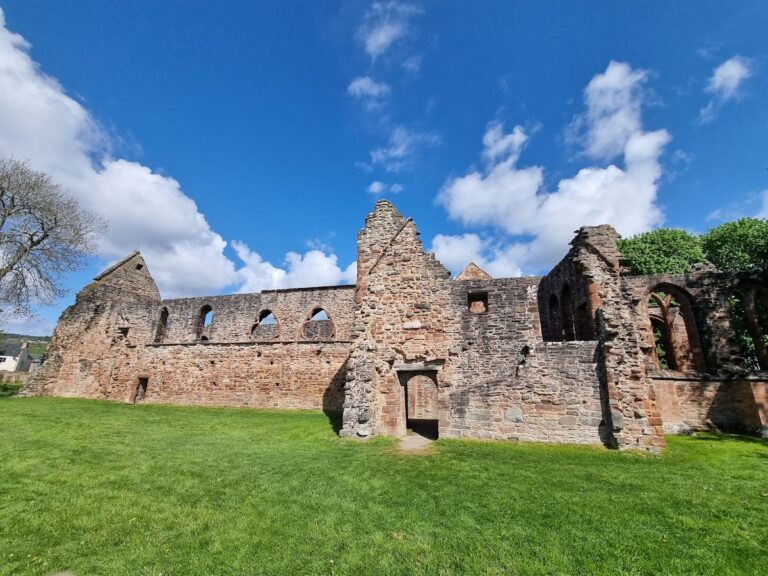
On a hill north of the castle stands Caisteal Gorach, a late-eighteenth-century folly designed by Robert Adam for Duncan Davidson of Tulloch. A folly is a decorative building constructed chiefly as a landscape ornament rather than for an essential practical purpose. Caisteal Gorach consists of a ruined round tower with flanking walls and is designated a Category A listed building, the highest level of protection for Scotland’s historic buildings.