Castle of Serpa: A Historic Fortress in Portugal
Visitor Information
Google Rating: 4.5
Popularity: Medium
Country: Portugal
Civilization: Early Modern, Medieval European, Medieval Islamic
Site type: Military
Remains: Castle
History
The Castle of Serpa is located in the municipality of Serpa, in modern-day Portugal. Its origins trace back to prehistoric occupation, later transformed during Roman times into a fortified position guarding the important route between Beja and southern Hispania.
Following the collapse of Roman authority, Serpa saw occupation by several groups including the Alans, Vandals, Suebi, and Visigoths. From the 8th century onward, Muslim forces controlled the region and strengthened the fortifications, establishing the site as a key defensive point. During the Christian Reconquista, forces under either King Afonso Henriques or the knight Geraldo Sem-Pavor captured Serpa around 1166, though it was later retaken by Muslim Almohads led by Yaqub al-Mansur in 1191. The castle returned to Christian control in 1232 under King Sancho II, who granted it to his brother Fernando.
In the latter half of the 13th century, control of Serpa was disputed between Portugal and Castile. The town was ceded to Castile in 1271 but restored to Portuguese rule in 1283 by Queen Beatriz. A significant milestone occurred in 1295 when Serpa was awarded its first charter, which initiated the rebuilding of the old Muslim fortifications. These efforts relied on the existing rammed earth walls and were financially supported by revenues from local churches donated by the military Order of Avis in 1320.
During the 1383–1385 crisis over the Portuguese succession, the castle sided with the Master of Avis, serving as a strategic base for Portuguese attacks into Castilian lands. After periods of warfare and plagues, King Afonso V granted tax and military exemptions in 1455 to encourage repopulation of the area, though this measure was temporary and limited to foreigners.
Under the reign of King Manuel I between 1495 and 1521, the castle’s fortifications were well-documented in Duarte de Armas’s “Book of Fortresses” around 1509. At that time, it was depicted as a substantial stronghold featuring both cylindrical and square towers and a prominent keep, surrounded by a double perimeter wall protecting the town. A new municipal charter was issued in 1513, and the castle along with the town was handed to Manuel’s son, Infante Luís, Duke of Beja.
In the turbulent succession crisis of 1580, when the Portuguese crown was contested, the castle fell to Spanish forces under Sancho d’Ávila, partly due to insufficient garrisoning. Following Portugal’s Restoration War in the mid-17th century, King João IV granted the castle and town to Infante Pedro in 1641, integrating it into the House of the Infantado. At this time, architect Nicolau de Langres carried out modernization work, culminating in the Fort of São Pedro de Serpa’s completion in 1668.
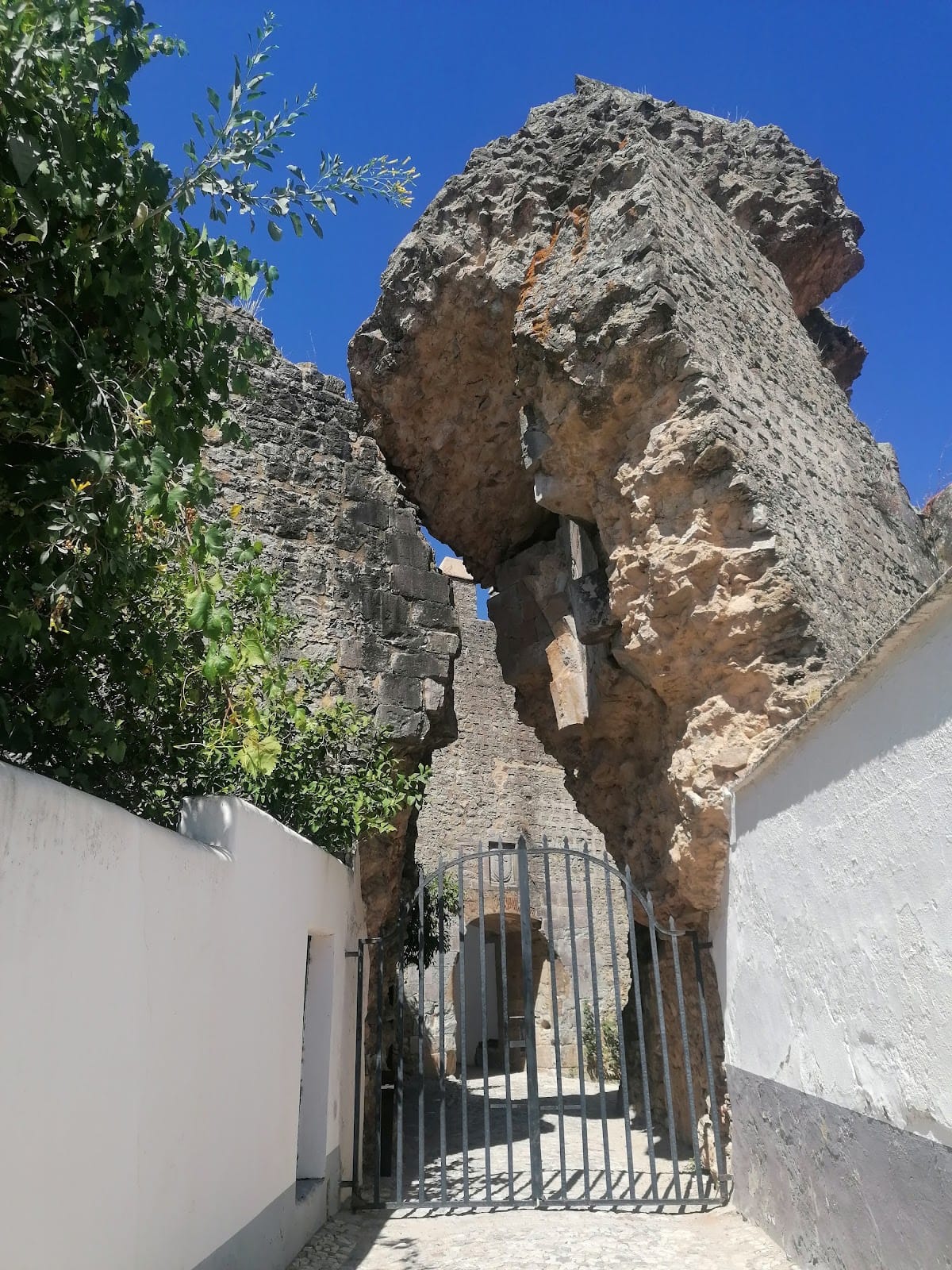
During the War of Spanish Succession, a retreating Spanish army caused an explosion in the castle’s gunpowder magazine in 1707, which destroyed one of the towers. By the late 19th century, the castle had fallen into ruin, with large portions of its masonry collapsed. Recognition of the site’s historical value led to its protection as a National Monument in 1954 and prompted restoration efforts beginning in 1958. These activities, including repairs to the aqueduct and clearance of walls, continued throughout the 20th century, although severe storms in 2000 caused the loss of part of the wall.
Remains
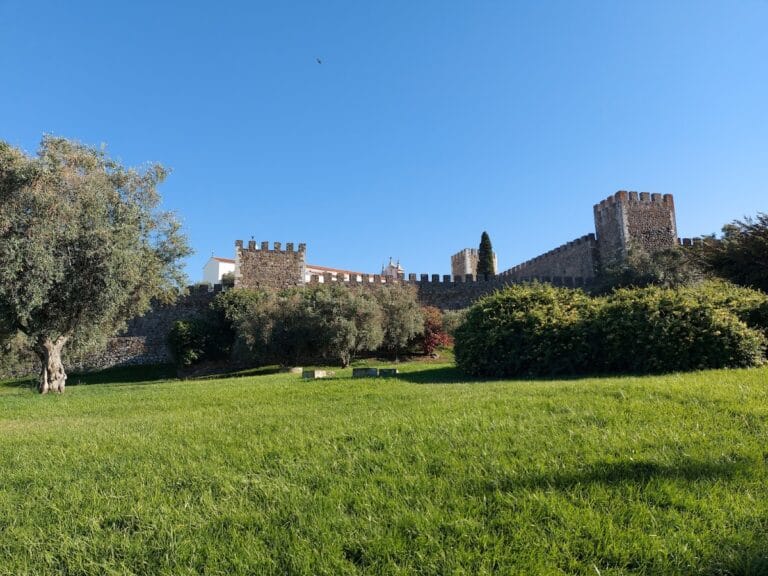
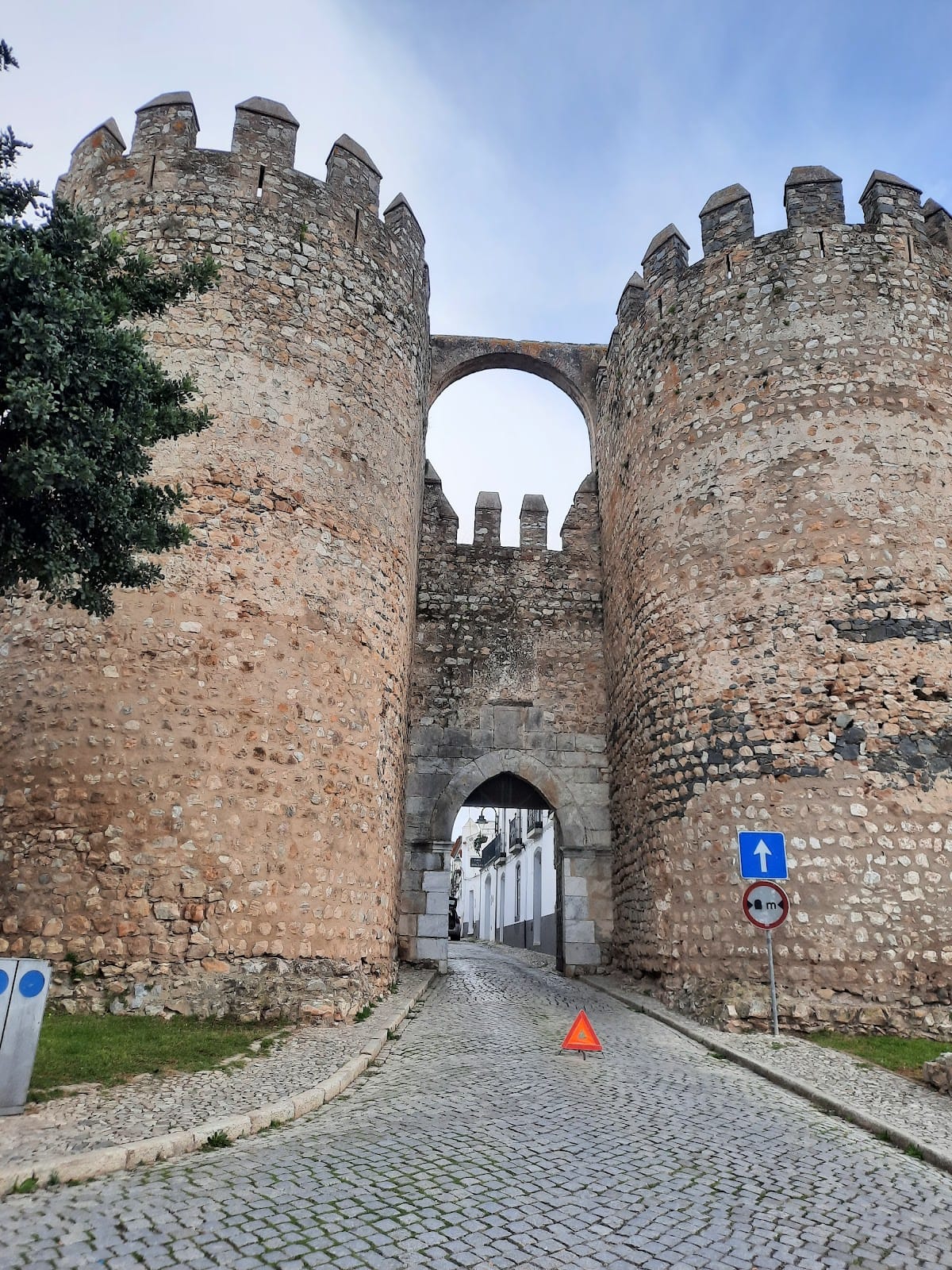
The Castle of Serpa is situated within the historic core of the town, positioned on elevated ground around 230 meters above sea level. Its defensive walls form an irregular oval shape, strengthened by rectangular and semicircular towers. These walls are crowned with prismatic battlements—solid, upright stone blocks designed to protect defenders. Originally, the town had three large main gates: Porta de Moura in the northeast, Porta de Beja to the northwest, and the now-lost Porta de Sevilha to the south. Each gate was flanked by two cylindrical towers with chamfered edges topped by distinctive five-sided merlons, which are the stone projections atop battlements.
Along the western curtain wall runs a unique aqueduct, built on rounded stone arches. This water channel connected the northern side of the fortifications to the Palace of the Counts of Ficalho, supplying water to the palace and nearby areas. At the southeast corner of the enclosure stands a large 17th-century water wheel known locally as a “nora,” which drew water from a well to aid the water supply system. This integration of fortifications and hydraulic infrastructure illustrates adaptations made over centuries to meet both defense and daily life needs.
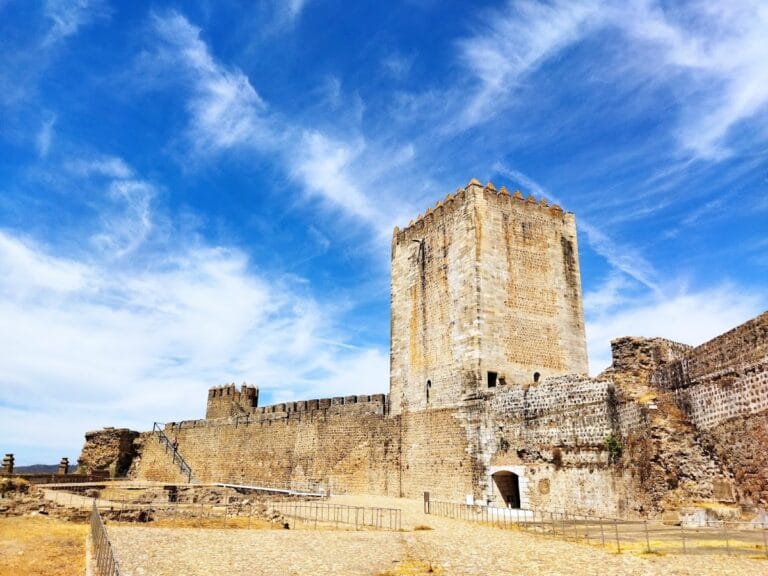
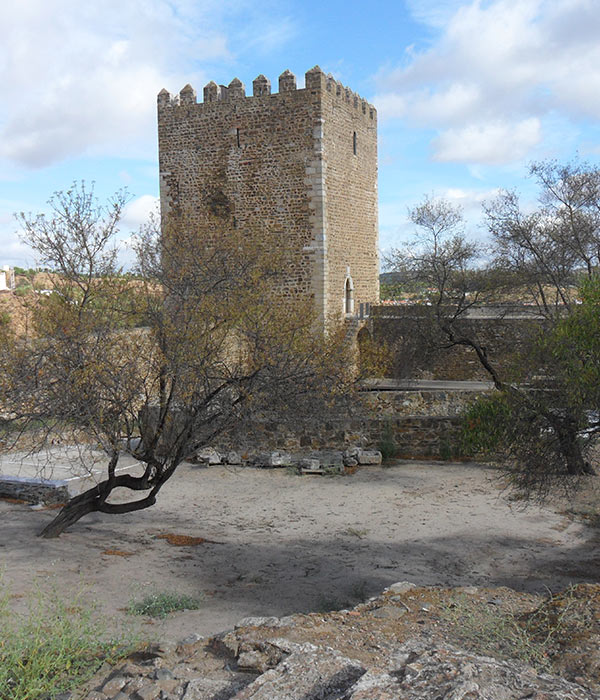
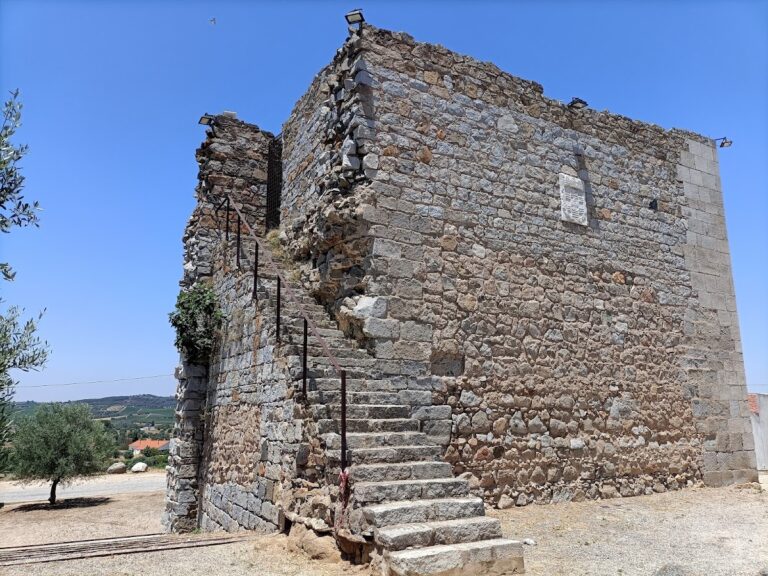
Inside the castle complex, the highest section is occupied by a quadrangular alcazaba, or citadel—a fortified area often serving as the last refuge during attacks. This citadel’s walls are reinforced by a large square keep tower on the southern wall, though only its lower portions remain intact. Nearby, a semicircular tower provides additional defensive strength, as does a rectangular tower situated at the southeast angle. Close to this tower, parts of the barbican—a fortified outwork positioned to defend the main gate—are still visible today.
Within the barbican area, the Archaeological Museum of Serpa is housed, showcasing artifacts from a wide span of history uncovered in the region. These range from tools and objects of the Paleolithic and Neolithic periods, through the Metal Ages and Roman occupation, providing a tangible connection to the site’s long human presence.
Near the Church of Santa Maria, itself a building with origins as a former Muslim mosque, stands the Torre do Relógio or Clock Tower. This square stone tower includes a belfry topped by conical pinnacles surrounded by chamfered merlons. Converted into a clock tower in 1440, it ranks as the third oldest clock tower in Portugal, indicating its longstanding civic importance.
Integrated into the walls is the Palace of the Counts of Ficalho, reflecting the architectural style known as Mannerism. Construction began under Francisco de Melo, who governed the castle in the late 16th century, and was continued by his sons Pedro de Melo, known for his role as governor of Rio de Janeiro between 1662 and 1666, and António Martim de Melo, Bishop of Guarda. This palace illustrates the evolving residential and administrative functions carried out within the fortified space across centuries.
Nearby sites