Kastell Holten: A Former Border-Defense Castle in Germany


Site at a Glance
- Rating
- 4.3
- Popularity
- Low
- Country
- Germany
- Primary era
- Early Modern
- External website
- Open
- Eras represented
- Medieval, Early Modern
- Civilizations
- Duchy of Cleves, Holy Roman Empire, Kingdom of Prussia
- Site type
- Military
- Remains
- Castle
On this page8 sections
History
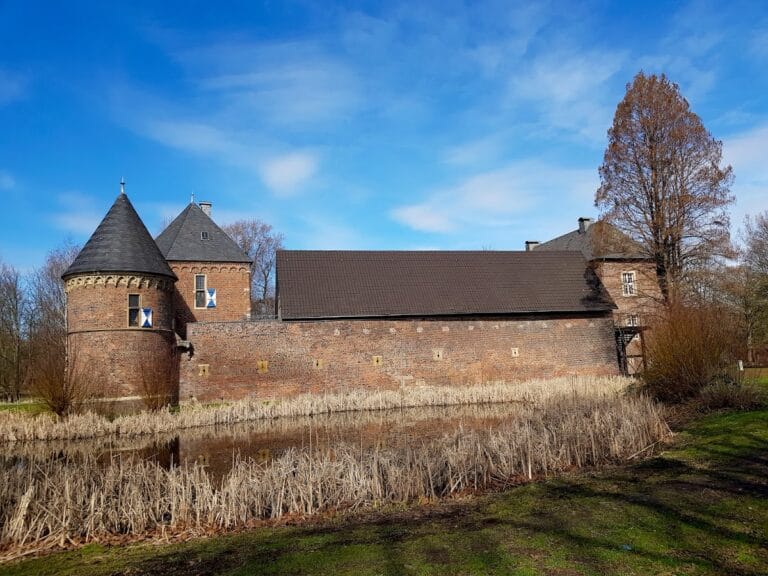
Kastell Holten is a former moated castle in Germany, located in Holten, now a district of Oberhausen. Its fortified form was established in 1307 as a medieval border-defense stronghold against the territory of the County of Cleves. Built in low-lying marshland on three sides and away from major roads, the castle helped shape the settlement that developed under its protection.
Medieval Origins and Border Defense
An earlier castle known as Burg Holte was mentioned in 1188, 1243, and 1250 in connection with the sale of property interests to the Archbishopric of Cologne. Around 1299, Count Engelbert II of the Mark acquired the Holten estate as part of his marriage settlement when he married Mechthild of Holte and Arberg of the House of Arenberg.
After Engelbert won a boundary dispute with the Duchy of Cleves, he strengthened the existing buildings and added new fortifications in 1307. The works turned the site into a defensive position along the border with Cleves. Holten grew under the castle’s protection and received town rights by 1310.
In 1355, the castle and town came under the authority of the Duchy of Cleves. From that time, the castle had less strategic value in comparison with the Cleves town of Dinslaken. Between 1445 and 1557, the castle and town were pledged to the von Loë family.
Military Occupation and Political Change
Kastell Holten was repeatedly drawn into the conflicts of the early modern period. Spanish troops occupied it in 1586 and 1598 during the Eighty Years’ War, the long conflict in which the Dutch revolt against Spanish rule developed. During the Thirty Years’ War, the major European conflict of 1618 to 1648, Ansbach and Anhalt troops occupied the castle in 1623, followed by Hessian troops in 1634.
The castle was seriously destroyed in 1640 and restored about sixty years later. French forces temporarily took Holten into military possession in 1672. The area was under Brandenburg rule from 1609 to 1701, then became part of the Kingdom of Prussia. It was temporarily governed by the Grand Duchy of Berg from 1806 to 1813 before returning to Prussia in 1815 through the Congress of Vienna, the diplomatic settlement that reorganized much of Europe after the Napoleonic Wars.
Civilian Reuse and Preservation
The complex passed into civilian ownership in 1818 and was converted into a school during the nineteenth century. After the Second World War, the buildings had deteriorated considerably. From 1968, the surviving building was used by a sports and shooting association. It now serves as the clubhouse and event venue of the Bürgerschützengilde Holten von 1308. Kastell Holten is protected as an architectural heritage monument in North Rhine-Westphalia.
Remains
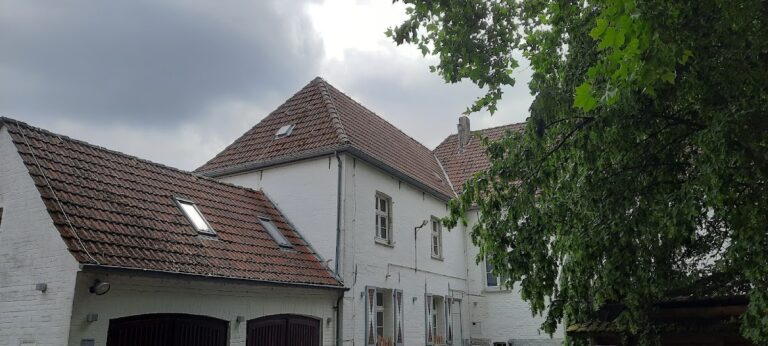
Kastell Holten was a lowland moated castle, meaning a fortified residence built on relatively flat terrain and surrounded by water-filled defenses. The complex consisted of a main castle and an outer bailey, enclosed by moats and a high earthwork rampart. Parts of the rampart remain visible, while a park with a children’s playground occupies the former outer-bailey area in front of the main-castle mound.
Main Castle Buildings
East Wing
The surviving east wing belongs to a sixteenth-century rebuilding of the main castle. It remains in good condition and is the surviving building of the former complex. The castle was remodelled during the sixteenth century and again in 1765, giving the present wing its later form.
Defensive and Residential Structures
The sixteenth-century alterations included casemates, covered or vaulted defensive chambers designed to house firearms while protecting their occupants. A stair tower formerly stood on the west side, and a four-storey residential or domestic tower occupied the north side. The south wing was demolished in 1961.
Nearby sites