Horst Palace: A Renaissance Palace Complex in Gelsenkirchen, Germany
Site at a Glance
- Rating
- 4.5
- Popularity
- Medium
- Country
- Germany
- Primary era
- Early Modern
- External website
- Open
- Eras represented
- Medieval, Early Modern
- Civilizations
- Holy Roman Empire
- Site type
- Domestic
- Remains
- Palace
On this page21 sections
History
Horst Palace is a sixteenth-century Renaissance palace in Gelsenkirchen, Germany, built by the Lords of Horst and shaped by the architectural tradition later called the Lippe Renaissance, or Horst School of Architecture. During its construction, it was among the largest four-winged palace complexes north of the Alps and became an influential example of Dutch-Mannerist design in Westphalia and the Weser region.
From farmstead to medieval castle
An island in the marshes between two branches of the Emscher contained a farmstead by the eleventh century. Its inhabitants may have captured the Emscherbruch horses associated with the surrounding area. The settlement later developed into a castle complex, which was destroyed by fire twice.
The Lords of Horst are known from the twelfth century and originated in the area of present-day Essen. From about 1200, members of the family held the marshalship of Essen Abbey. This office included responsibility for game in the Emscherbruch and the right to capture its horses. From 1363, the family was recorded as feudatories of the Counts of Cleves.
The Lords of Horst resisted the territorial ambitions of the Archbishopric of Cologne for many years. They had asserted jurisdiction over the parishes of Gladbeck and Buer, prompting Archbishop Friedrich of Saarwerden to begin legal proceedings against them in 1410 and 1411. In 1412, Rütger von der Horst swore allegiance to the archbishop. The formerly independent lordship then became part of the archiepiscopal Vest Recklinghausen while remaining a fief of the Electorate of Cologne.
The Counts of Mark and Berg had already tried to acquire Horst Castle, or at least the right to open it, in 1315 and 1349. These attempts failed after Horst entered the Cologne territory.
Rütger von der Horst and the Renaissance rebuilding
Rütger von der Horst inherited sole possession of the Horst estate on 21 May 1547. He served as marshal under six Cologne electors, and Archbishop Salentin von Isenburg appointed him governor of the Vest Recklinghausen shortly before resigning his office. Rütger’s position required a residence suited not only to domestic life but also to representation and ceremony.
After the castle was destroyed by fire in spring 1554, Rütger demolished the remaining structures and commissioned a new moated palace. His mother-in-law, Elisabeth von Palandt, provided the initial financing through her inheritance. From 1571, income from Rütger’s investment in a profitable West Frisian salt and peat company helped pay for the elaborate interiors.
The building process is unusually well documented by two account books and 47 building contracts written in Low German and covering the years 1554 to 1567. The interior work continued until 1573, while the new palace was completed in 1578. Rütger died four years later.
Arnt Johannsen to Boecop, the town architect of Arnhem, was the leading master builder by 1558. Rütger had met him in Arnhem, where Johannsen had worked for the Geldrian military commander Maarten van Rossum. Disagreements led Johannsen to leave the building site in 1567. Laurenz von Brachum, who had joined the project as a stonemason on 23 September 1558, assumed part of Johannsen’s responsibilities in 1563 and 1564. He directed the final design of the courtyard façades and the ornamental gable of the northeast wing.
Heinrich Vernukken and his son Wilhelm worked on the sculptural decoration, inscriptions, coats of arms, and interiors. The French painter Joist de la Cour was responsible for painting work from 1563. The building records, however, do not support the earlier attribution of the later wings to him.
Inheritance and transfer of ownership
Rütger’s only son, Johann, died young. His daughter Margarethe brought the palace into the von Loë family through her marriage to Bertram von Loë in 1582. Bertram also died without a male heir. Their daughter Sibylla inherited Horst and brought it as her dowry into her marriage to Dietrich von der Recke in 1607.
On 9 June 1706, Hermann Dietrich von der Recke sold Horst Palace and its lordship to Ferdinand von Fürstenberg for approximately 100,000 Reichstaler. A legal challenge to the transaction continued before the Imperial Chamber Court until 1802. The Fürstenberg family then paid 76,000 thalers in compensation to the Count of Westerholt-Gysenberg, who had acquired the claims.
The Fürstenbergs did not use Horst as a permanent residence. Christian von Fürstenberg dissolved the household in 1730. After that, the outer bailey was leased for agriculture, while a rent master managed the palace.
Deterioration and nineteenth-century demolition
The palace stood on structurally unsuitable ground in the former moat, and its inadequate foundations caused early deterioration. The Fürstenbergs undertook extensive repairs between 1706 and 1721. These included partial rebuilding of the manor-house courtyard façade in 1711 and 1712, repairs to the foundations in 1716, and partial rebuilding of the northern corner tower in 1721.
The gatehouse was demolished in 1828. Heinrich Johann Freyse carried out repairs in 1828 and 1829 and proposed converting the palace into a three-winged Classicist building. His plan would have removed much of the Renaissance decoration, but it was not implemented. The west tower collapsed shortly before 1830, the north tower fell in spring 1833, and the south tower collapsed on Christmas Eve 1843. Prussian regional authorities ordered the demolition of the eastern tower and adjoining residential wing in 1853 and 1854.
During the nineteenth-century demolition, the Fürstenbergs salvaged much of the façade sculpture and ornament. This material became known as the Stone Treasure and was kept in a purpose-built shed until 1925. Negotiations held between 1848 and 1851 to sell the decoration to King Frederick William IV of Prussia failed. The inventory drawings prepared for the proposed sale by Karl Gustav Greiß later became known as the Potsdamer Blätter.
Public use, excavation, and restoration
Between 1924 and 1930, the surviving sections were converted into a public recreation center. The filled-in basement was excavated, a restaurant was installed in the vaulted cellars, and the former kitchen became a small museum for the Stone Treasure. From 1925, the palace park was opened to the public, and its pond was reshaped into a geometric moat around three sides of the building.
The restaurant was replaced by a discotheque in 1976. Poor maintenance by successive users accelerated the building’s deterioration. Restoration of the entrance wing’s street façade between 1962 and 1967 replaced most of its Baumberg sandstone decoration with reconstructions in Wrexen sandstone. The courtyard façade received conservation treatment in 1984.
A citizens’ initiative founded in 1985 campaigned to prevent the palace from becoming a final ruin and to secure a new use for it. Gelsenkirchen purchased the ruins in 1988 with financial assistance from North Rhine-Westphalia. Plans for municipal offices, a training center, a hotel, or a dance-sports center were not carried out.
Systematic archaeological excavations began in spring 1990 under the Westphalian Museum of Archaeology and the archaeological-monument authorities of the Landschaftsverband Westfalen-Lippe. The work revealed earlier building phases, numerous finds, and a water and waste-management system comprising a cistern, a well, and numerous latrine shafts and chutes.
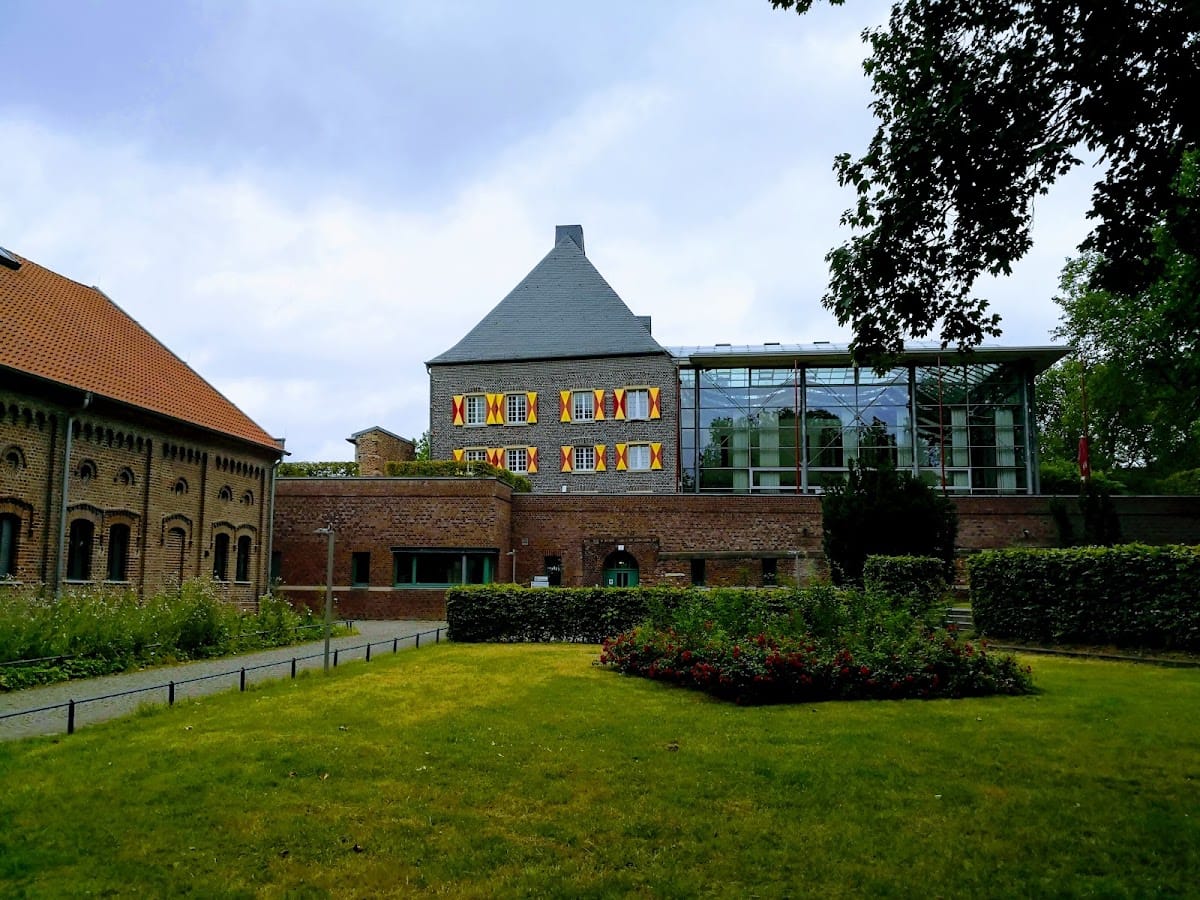
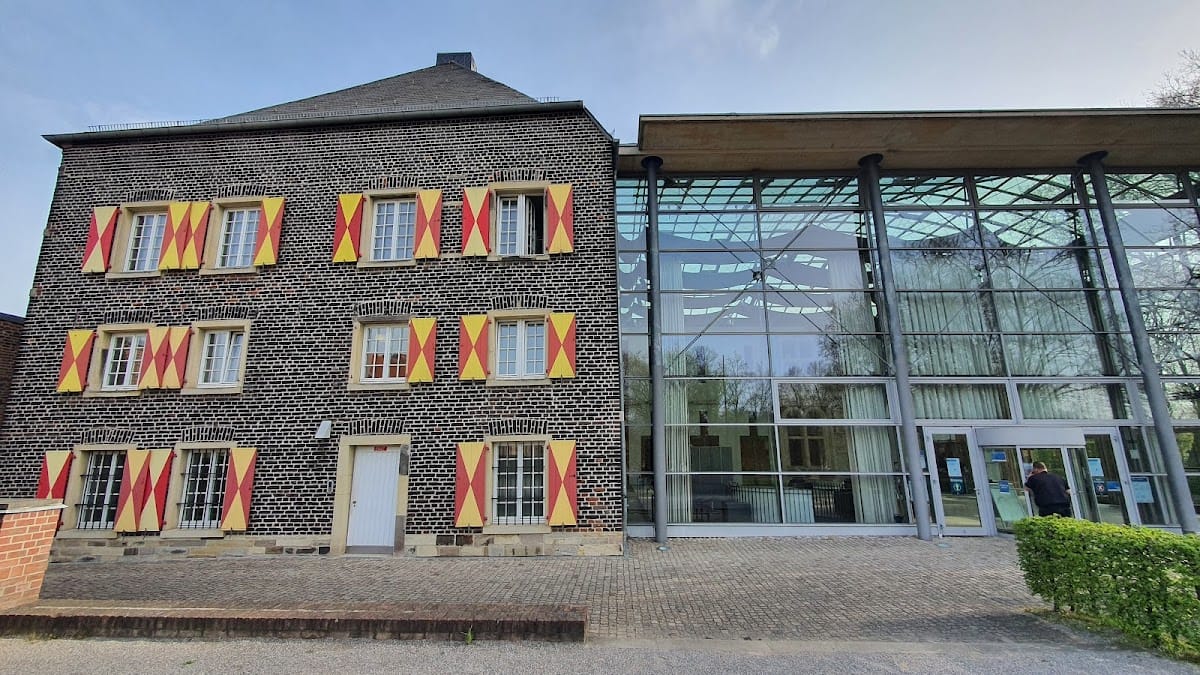
An architectural competition held in 1992 was won by Jochem Jourdan. His design guided restoration and partial reconstruction between 1994 and 1999. Surviving historical elements were incorporated, twentieth-century additions were removed, and the foundations of lost towers and wings were conserved. Horst Palace has been protected as a listed monument since 15 December 1983. It now serves as a cultural center and registry office of Gelsenkirchen, and it has housed the Gelsenkirchen-West district administration since 1995.
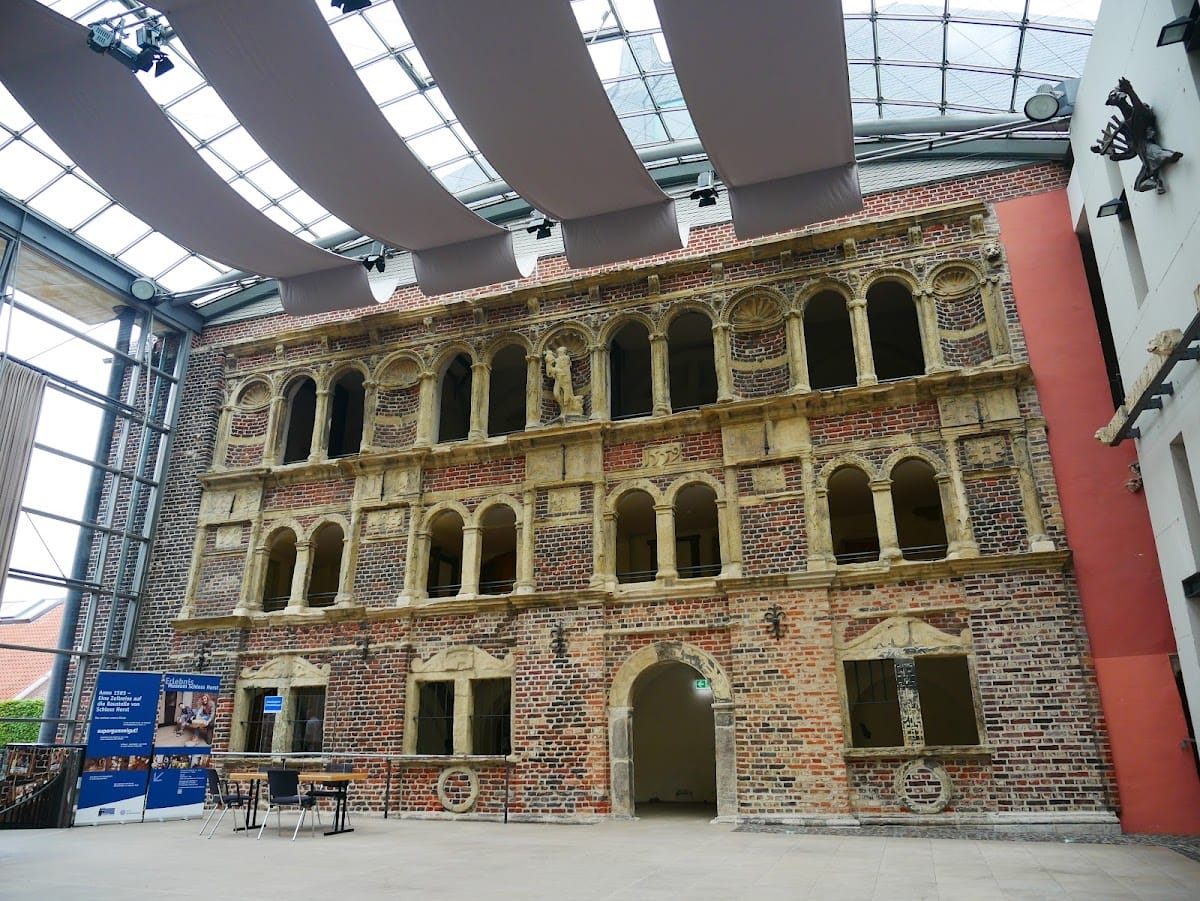
The museum presents the Stone Treasure, architectural fragments, excavation finds, and the history of Renaissance construction, with particular attention to the operation of the palace’s large building site. The basement contains a restaurant, the restored fireplace room is used as a wedding hall, and the covered courtyard accommodates temporary exhibitions and events. Museum displays occupy parts of the corridors, the basement level of the south tower, and the reconstructed upper floor of the manor-house wing. The outer-bailey buildings dating from 1856 became a community center and district library after four years of renovation, and both have operated there since 2013. The complex also contains a small printing museum.
Remains
Layout and construction
The Renaissance palace originally formed a four-winged complex measuring approximately 53 meters on each side. Slightly projecting square pavilion towers marked the four corners. A broad, shallow moat surrounded the complex, with a berm, or level strip beside a defensive ditch, measuring approximately 3.5 meters wide on at least the eastern side. The Emscher fed the moat, with its main channel flowing north and west of the site until the nineteenth century.
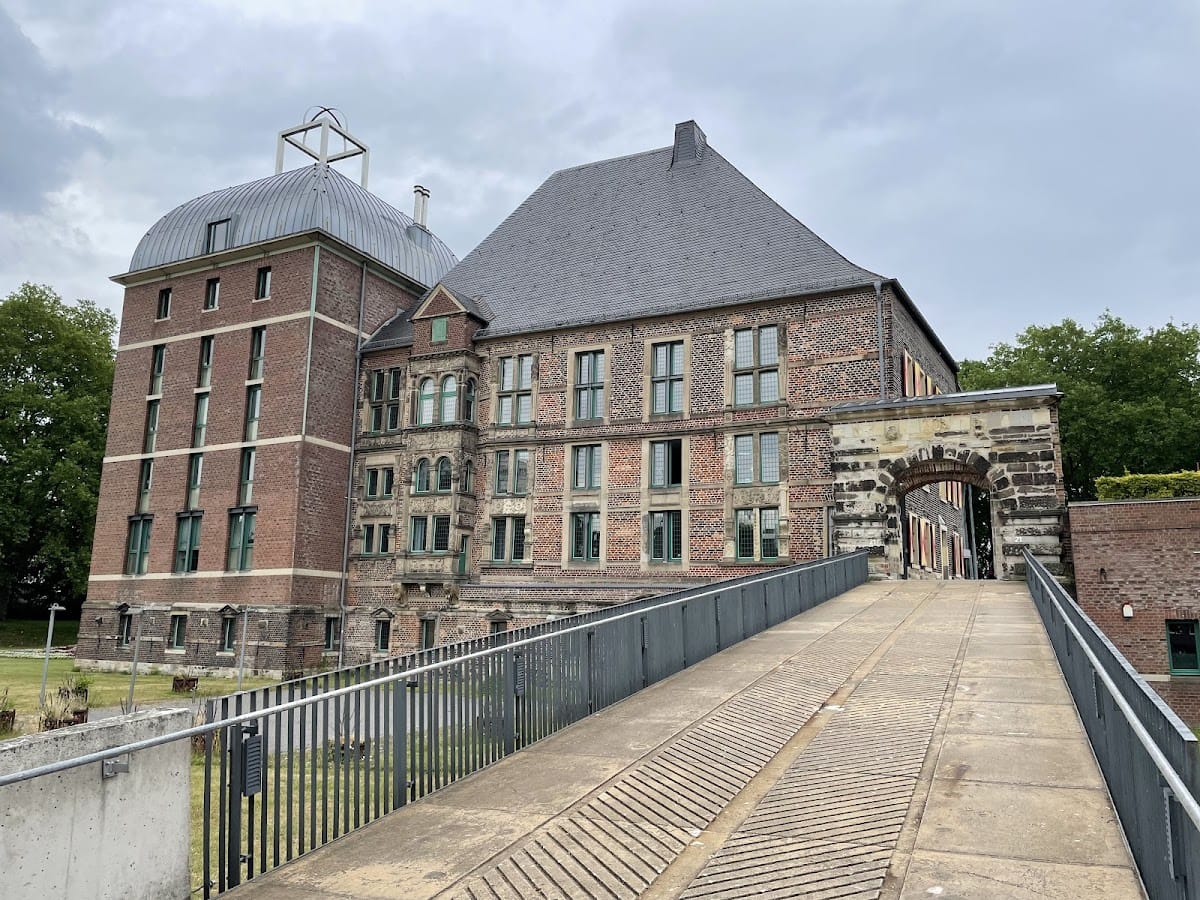
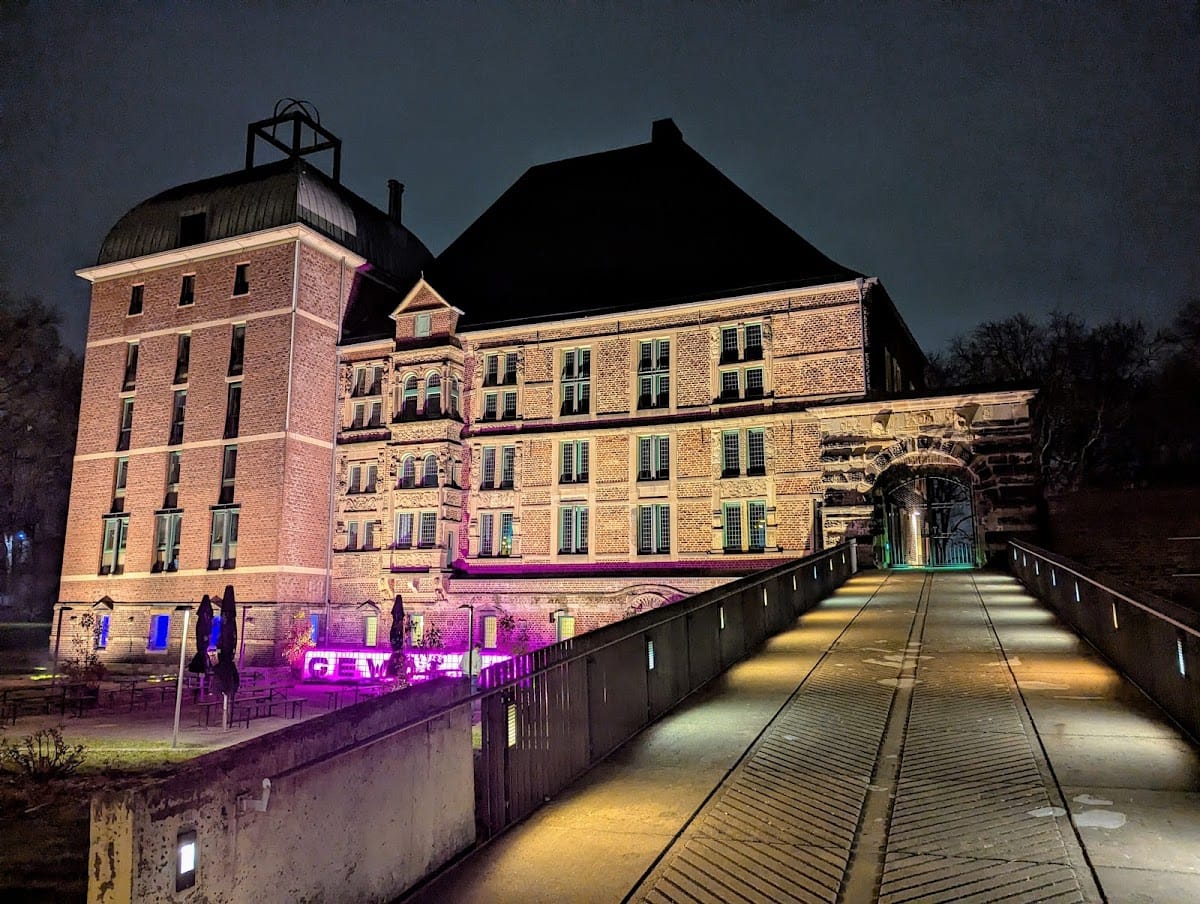
The main palace stood on an island, while the outer bailey, the adjoining enclosed area for buildings and working spaces, occupied a separate island to the northeast. A three-arched stone bridge connected the two islands. Access from outside passed through a drawbridge at the outer-bailey gatehouse. A modern ramp now leads to the entrance. Beneath it, remnants of the former bridge pillars and part of the outer-bailey fortification wall were exposed during twentieth-century excavations. A freestanding arch of rusticated ashlar beside the entrance is the last surviving element of the former gatehouse.
The palace was built from red brick and light-colored sandstone from the Baumberge hills. Sandstone formed the door and window surrounds, friezes, cornices, and other decorative elements. The exterior was originally covered with white plaster. The stone decoration was largely gilded, the cornices were painted black, and the surrounds were painted green. Some courtyard pilasters and columns were painted to imitate marble.
The medieval settlement and castle
Early farmstead and wooden fortification
The earlier farmstead in the outer-bailey area consisted of a two-room post-and-beam house about 6 to 7 meters wide and 11 to 12 meters long. Traces of posts and sill beams, remains of tiled stoves, and fragments of blue glass with white thread decoration indicate a household of relatively high social status.
In the late twelfth century, probably at the initiative of Essen Abbey, the farmstead was converted into a wooden motte-and-bailey fortification. A motte is a fortified medieval mound, usually supporting a tower or principal building. The artificial mound measured nearly 40 meters in diameter and nearly 2 meters high. A polygonal tower 6 to 6.5 meters in diameter, a principal building, and two wooden outbuildings stood within a parapet and walkway. An additional palisade protected the moat. The outer bailey lay west of the castle core and was linked to it by a bridge.
Stone castle and medieval expansion
After the wooden fortification burned, a stone residential building or tower was erected. It measured 11 by 7.5 meters and had walls 1.2 meters thick. A curtain wall, the enclosing defensive wall of a castle, surrounded it, while the castle mound had previously been raised by at least 1.5 meters.
The medieval complex was expanded within the curtain wall with brick buildings, probably in the fifteenth or early sixteenth century. Excavations identified a residential tower enlarged to 19 by 11 meters, a two-story brick building measuring 16 by 10 meters, a round tower, and additional structures near the gate. Some buildings stood on pile grates over the moat, and their roofs were covered with clay and slate shingles.
Outer-bailey chapel
A chapel stood in the outer-bailey area by the twelfth century. Its foundations were approximately 1.5 meters thick, and the original hall measured about 13 by 15 meters. It had an apsidal choir and a nave with a clear width of 6.6 by 4.2 meters. Beneath the choir, a crypt-like structure contained four burial chambers, probably intended for members of the castle lords’ family.
In the late Middle Ages, the chapel received a vault, a larger polygonal choir, and additions on its northeast side. Its patron was Saint Hippolytus. Around 1590, it probably became a parish church and remained in the outer bailey until 1753, when it was replaced by the present Church of Saint Hippolytus.
Renaissance wings and façades
Entrance wing
Johannsen’s original design called for a closed four-wing complex with projecting square corner towers and two- or three-story wings on three sides. A low single-story wing on the fourth side was intended to admit more light into the courtyard. The completed arrangement consisted principally of the three-story northwest entrance wing, the two-story northeast residential wing, and low wings on the remaining sides.
The northwest entrance wing, including its courtyard gallery, was completed in 1559. Its elaborately decorated portal and multistory bay window dominate the entrance façade. The bay window rests on trestle brackets and is enriched with caryatids, sculpted female figures serving as architectural supports, together with cartouches and scrollwork. Most of these elements are reconstructions from the first half of the 1960s, made because Baumberg sandstone was highly vulnerable to weathering. A few well-preserved originals were retained or renewed.
The wing is approximately 24 meters high including the basement, with about 12 meters occupied by the roof structure. Two profiled stone cornices divide the façade horizontally, although they do not correspond exactly to the building’s three stories. The top floor contained the manorial bedrooms, the lower mezzanine was reserved for servants, and the ground floor included the kitchen.
The basement-level portal and windows on the street side were opened during the conversion to a restaurant and are not original elements. The former courtyard galleries have cross-vaulted ceilings. The ground-floor gallery has a groined vault, while the first-floor gallery has a ribbed vault with original black, beige, and gray ornamental and figural paintings. One restored section is visible, while the remaining decoration lies beneath plasterboard awaiting restoration.
Manor-house wing
The adjoining northeast manor-house wing had two stories but reached the same overall height as the entrance wing. Work began in 1554, its structural shell was complete by 1563, façade work began in 1564, and it received its roof in the same year. The courtyard façade was demolished in the mid-nineteenth century, but two sections were reconstructed from salvaged fragments.
The reconstruction includes a round-arched main portal, the coats of arms of Rütger von der Horst and Anna von Palandt, Corinthian columns, and a triangular pediment with a lion’s head. Herms, pillar-like supports ending in heads or busts, and satyrs wrapped in scrollwork decorate the composition. Ionic pilasters and upper-story Corinthian columns resting on sculptural supports complete the surviving arrangement.
A stone band beneath the cornice carries an inscription combining an Old Testament passage with a New Testament addition about love of God and one’s neighbor. The Knights’ Hall, with its Renaissance cross-frame windows, is the only room of the former manor-house wing to have escaped nineteenth-century demolition. Its main portal bears the date 1566. A servants’ staircase connects the hall with the floor below and formerly led toward the palace kitchen. Its double-flight arrangement follows models from Italian palazzo architecture, an urban palace tradition that also influenced Horst’s galleries, circulation system, and interiors.
Remaining wings and towers
The southeast and southwest sides were formed by low single-story wings. The southeast wing was an open courtyard walkway with a slate roof, while the southwest wing contained the palace chapel. The planned third wing was reduced to a three-axis risalit, a section projecting outward from the main wall. The corner towers were intended to have unusual Welsh bonnets, and the completed complex showed variations in the height and execution of its wings and towers.
The north tower connecting the two surviving wings was rebuilt in the 1990s to the dimensions of its predecessor. Its plain sandstone cornice echoes the horizontal division of the adjoining wings. The other corner towers were rebuilt only to courtyard level, indicating the original plan and dimensions. The present dry moat dates from the twentieth century.
The original foundations were once thought to have rested on pile grates. Excavations in the 1990s instead showed that the surviving palace rests on several layers of roughly hewn sandstone. The inadequate foundation contributed substantially to the loss of the original complex.
Interior decoration and fireplaces
Resurrection Fireplace
The fireplace room in the entrance wing contains the sixteenth-century Resurrection Fireplace, also called the kitchen fireplace because the room served as the palace kitchen from the seventeenth century. Its front lintel is 2.44 meters wide and carries a relief of Ezekiel’s vision of the resurrection of the dead at the Last Judgment. Three additional fields depict the interior of a three-nave church. The imagery was once painted in color and is explained by inscriptions.
Heinrich Vernukken created the fireplace around 1565 to 1570, using a 1564 Luther Bible with woodcuts by Jost Amman as a model. It is the only palace fireplace that remains intact and in its original position.
Historical and Diana fireplaces
The Historical Fireplace in the Knights’ Hall is a partial reconstruction made from fragments. Its principal relief depicts the Battle of the Milvian Bridge after Raphael’s monumental painting in the Vatican. Other sections draw on Livy’s account of the Horatii and Curiatii and on a relief of Marcus Aurelius’s triumph in Rome.
The Diana Fireplace in the oriel room above the fireplace room is assembled from preserved fragments, and it is uncertain whether all the pieces belonged to one original fireplace. An oriel is a projecting windowed structure supported by brackets or corbels. The front relief shows Diana punishing the pregnant nymph Callisto and bears an inscription dating it to 1575. The scene follows a print by Cornelis Cort after a painting from Titian’s workshop. The upper section depicts the sleeping Venus with Cupid, while the side reliefs may show related subjects with quotations from Ovid’s Metamorphoses.
Stone Treasure
The Stone Treasure consists of fragmentary façade ornaments, figural decoration, putti and battle friezes, terracotta reliefs, medallions of emperors about 40 centimeters in diameter, and parts of portals and fireplaces. Some fragments were inserted into walls during twentieth-century alterations, while other sculptures were reused at Borbeck Palace.
At least nine richly decorated figural fireplaces originally stood at Horst. The Resurrection Fireplace is the only one remaining in place. Three were moved to Hugenpoet Palace in 1886, including the Cain and Abel Fireplace, the Lot Fireplace dated 1560, and the Troy Fireplace dated 1578. Another was moved to Rheinstein Castle and given Neo-Gothic additions. The surviving reliefs draw on classical history and mythology as well as the Old and New Testaments. The Troy Fireplace depicts the burning of Troy after Raphael’s Fire in the Borgo, using a print by Marcantonio Raimondi as its model.
Excavated objects and architectural influence
Excavations in the 1990s recovered fragments of façade ornament, medallions depicting Roman Caesars, and high-quality architectural tiles, including molding, cornice, wreath, and crowning tiles. Silver and ivory cutlery, vessels of cut stone, ceramics, and Venetian glass illustrate the former courtly household and its elevated table culture. A distinctive drinking vessel from the second half of the sixteenth century depicts a pipe-smoking man in Spanish court dress and may represent Rütger von der Horst.
The palace combined French architectural models with elements of Italian palazzo design. Its galleries separated public circulation routes from private rooms, while the integrated central staircase used an innovative double-flight arrangement with straight flights and a half-landing. This arrangement eliminated the need for a stair tower projecting from the façade.
Horst Palace is characterized by dense and varied architectural sculpture, reliefs, figural decoration, coats of arms, inscriptions, and friezes influenced by Dutch Mannerism. This sixteenth-century Northern European style favored elaborate ornament, complex figural compositions, and strongly decorative architectural treatment. The palace’s scale, regularity, and sculptural quality made it an influential model beyond Westphalia. Its decoration is regarded as a link between Dutch architecture and the architecture of the Weser region, and the building is considered a key work of the Lippe Renaissance.