Ragnit Castle: Teutonic Order Fortress in Russia
Site at a Glance
- Rating
- 4.4
- Popularity
- Medium
- Country
- Russia
- Primary era
- Medieval
- External website
- Open
- Eras represented
- Medieval, Modern
- Civilizations
- Crusader, Teutonic Order
- Site type
- Military
- Remains
- Castle
On this page12 sections
History
Ragnit Castle is a Teutonic Order fortress in Neman, Russia, founded in 1289 as part of the Order’s expansion in northern East Prussia. Built beside the Memel River, it functioned as an Ordensburg, a fortified administrative and military center, helping control the river and trade with Russia.
From Schalauer fortress to Teutonic stronghold
A wooden fortress called Raganita stood on a peninsula on the Memel and belonged to the Schalauer people. Teutonic forces captured and destroyed it in the 1270s. In 1289, Landmeister Meinhard von Querfurt, a senior regional leader of the Teutonic Order, established a timber-and-earth fortress on the former site. It was initially named Landeshut, but the older name Ragnit eventually prevailed.
That same year, the Order transferred the Komturei of Labiau to Ragnit. A Komturei was an administrative district governed by an Order commander. Ragnit then became an important staging point for military campaigns into Lithuania. Its defenses repelled a Lithuanian attack in 1295 and helped the Order inflict a major defeat on Lithuanian forces in 1338. From at least 1336, forces of the Order and associated crusaders departed once or twice a year from Königsberg, Tilsit, or Ragnit for campaigns into Lithuanian territory.
Rebuilding in the fourteenth and fifteenth centuries
In the mid-fourteenth century, the fortress was rebuilt under Winrich von Kniprode, a grand master of the Teutonic Order, and a moat was dug around it. Lithuanian forces of the Grand Duchy of Lithuania burned the fortress again in 1365.
Konrad Zöllner von Rotenstein, another grand master, later rebuilt the stronghold and moved it to its present location. A new brick castle was constructed west of the earlier fortress between 1397 and 1409 under the direction of the Rhenish master builder Nikolaus Fellenstein. Further alterations followed a fire in 1445.
Courts, prison, and wartime destruction
Between 1825 and 1838, the fortress was converted into a court and prison complex. It housed the East Prussian prison until 1945. The town and district courts operated there from 1839, a military tribunal from 1849, and a court again from 1879. A fire in the late 1820s caused severe damage, but complete repairs were achieved by 1840.
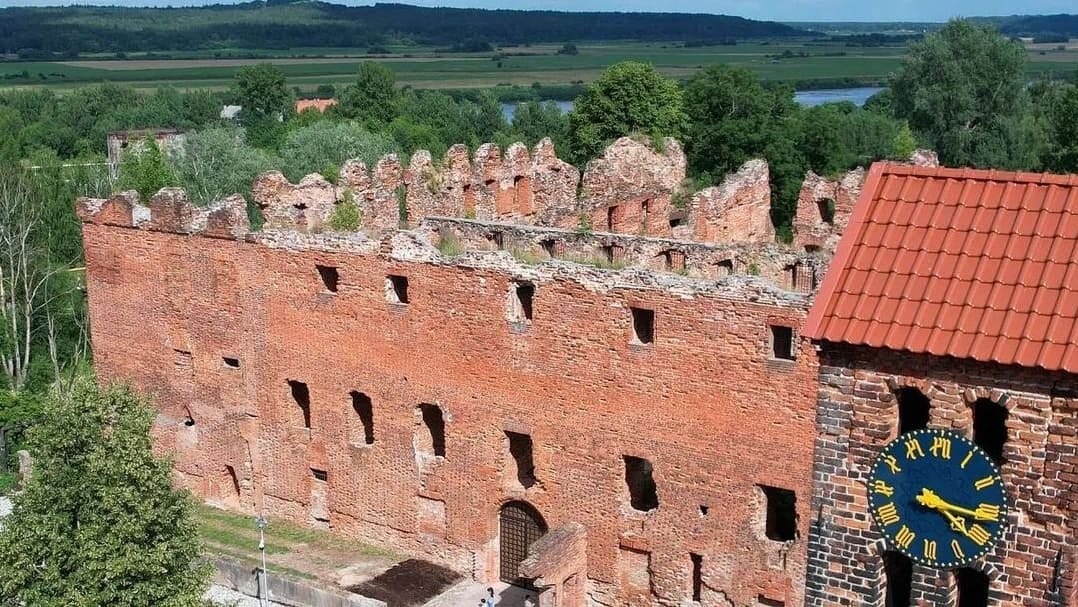
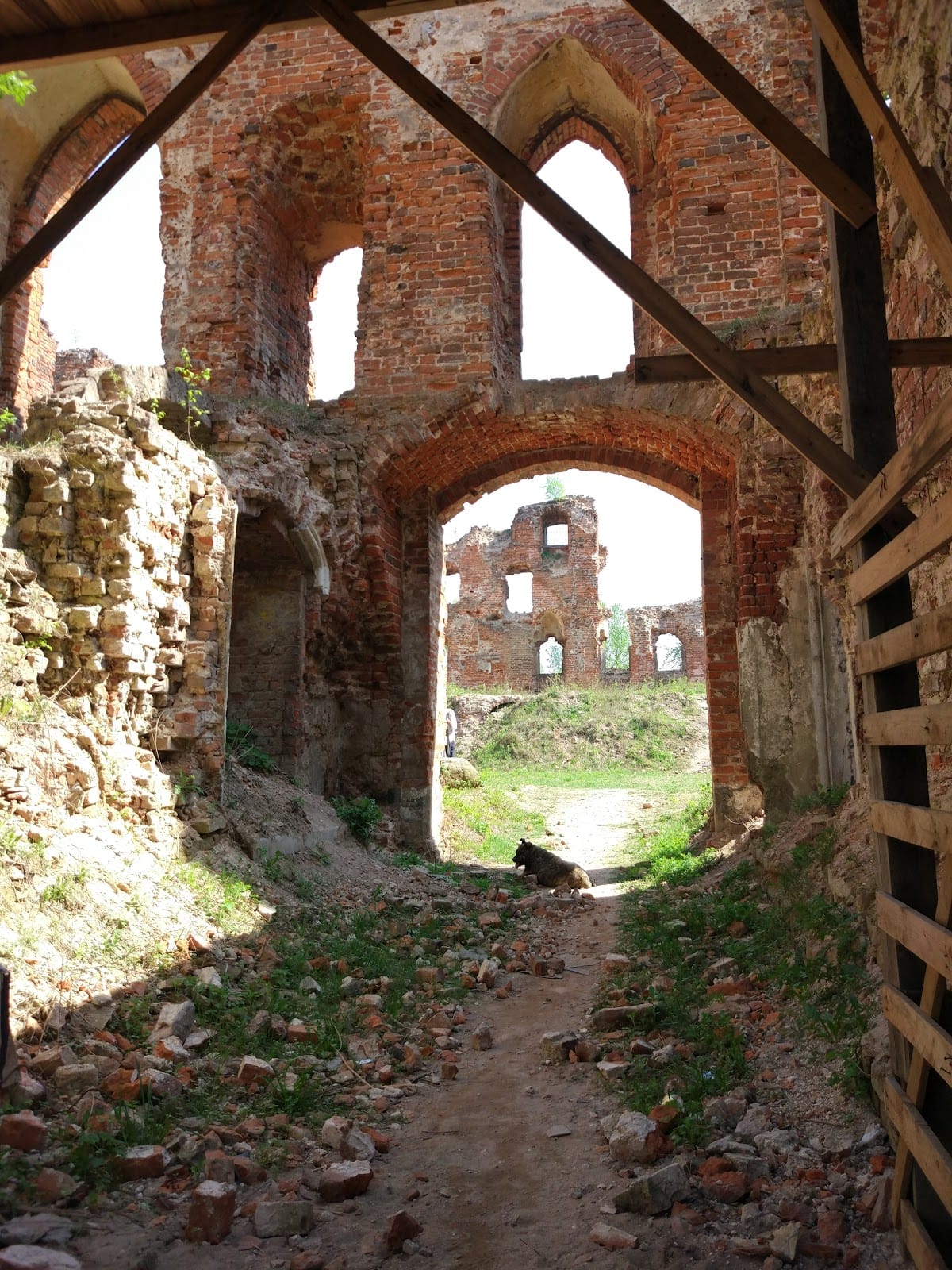
After the Nazi seizure of power in 1933, the prison was used extensively, and many anti-fascist prisoners spent their final years there. The castle burned out during the Second World War in 1944 and 1945 and subsequently became a ruin. Parts of the outer walls were blown up during the Soviet period, although much of the masonry survived to the lower edge of the defensive storey. Photographs preserve evidence of the fortress’s condition in 1957.
Later interventions and preservation
Ragnit’s ruins were used as a film location for Twenty Days Without War in 1976. During production, Lenfilm specialists under director Alexei German detonated part of an interior wall. The destroyed section measured 30 metres in length, 10 metres in height, and up to 2 metres in thickness. Local garrison troops cordoned off the area during the explosion.
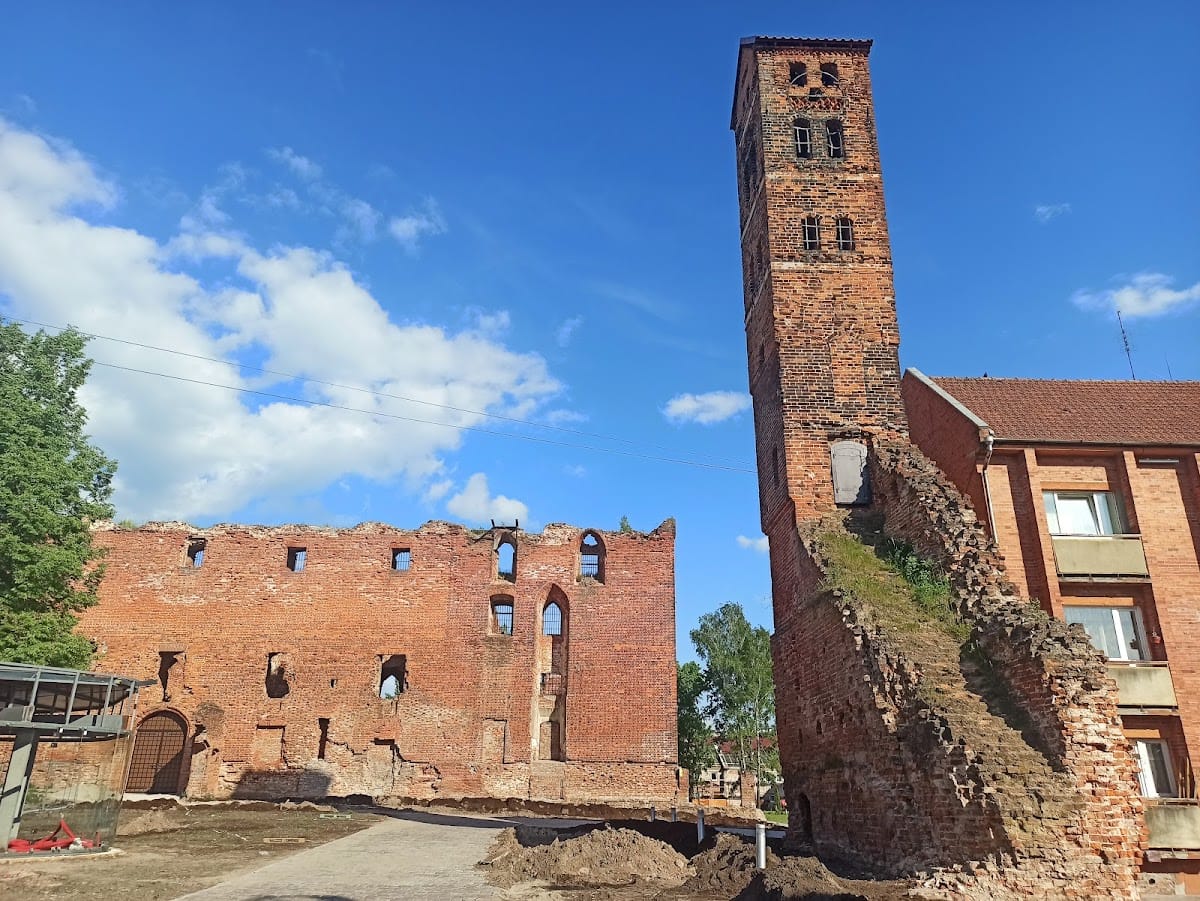
The ruins were used again for The Soldier and the Elephant in 1977 and I Am a Russian Soldier in 1995. Further explosions were carried out in the courtyard during the latter production. The clock tower was repaired in 1992 by the Neman–Plön Friendship Society, which repaired its staircase, restored its roof, and installed window grilles.
The ruins and their associated land plot were transferred by the Kaliningrad Duma to the Russian Orthodox Church in November 2010. Since 2019, the castle has been leased by Ivan Artyukh, a Kaliningrad-based entrepreneur involved in later preservation efforts. Volunteer and municipal support has contributed to conservation and public-use measures, while emergency-prevention and conservation works have been carried out in three stages since 2021. The ruins entered the Russian register of regional cultural-heritage objects in 2007 and retain regional cultural-heritage status.
Remains
Fortress layout and construction
Main castle
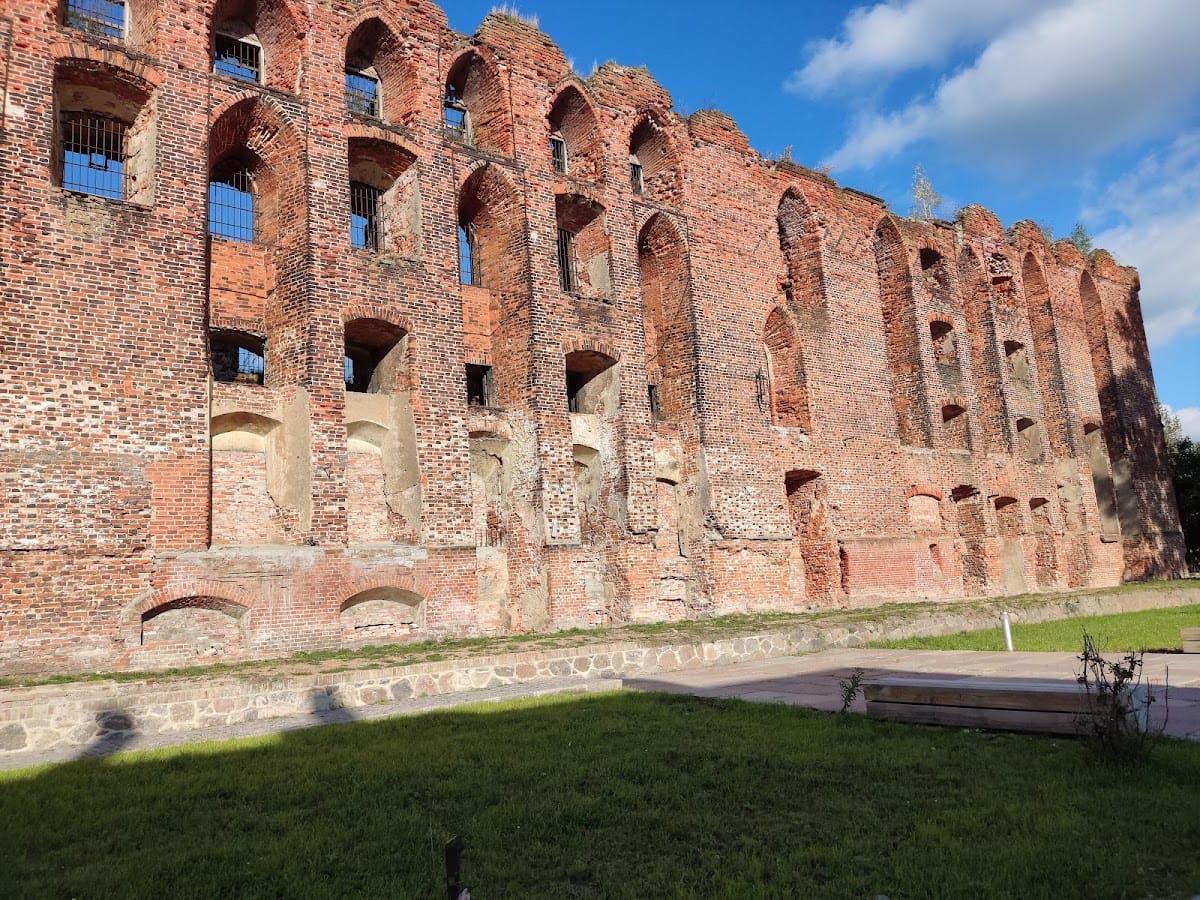
The present castle is a nearly square brick fortress measuring approximately 59 by 58 metres. Its inner courtyard measures 31 by 31 metres. Massive granite slabs form the foundation, which lies about 5 metres below ground level. The four-storey building contained 11 large halls and numerous smaller service rooms, while its above-ground and basement spaces were repeatedly altered and rebuilt over the centuries.
Elaborate openwork gates, windows, and portals formed part of the castle’s design, along with ancillary wings. Secret underground tunnels were also present. The surviving complex is now ruined. Much of the external masonry remains up to the lower edge of the defensive storey, while other sections were destroyed or blown up during the Soviet period and later film production.
Clock tower
A slender square clock tower, approximately 25 metres high, formed part of the castle complex. Its staircase and roof were repaired in 1992, and window grilles were installed during the same intervention.
Altered interiors and surviving evidence
Court rooms and paintings
The nineteenth-century conversion changed the medieval structure substantially. Vaults above the ground floor were removed, walls were pierced or altered, and the former gables were replaced with a hipped roof. The principal massive walls and the slender square tower of the outer bailey remained substantially intact after this conversion. Valuable wall paintings dating to around 1408 were uncovered in one of the court rooms in 1906.
Knightly armor
Knightly armor found at Ragnit Castle before the Second World War was preserved for many years by the German scholar Gerhard Scherraik. In 2001, it was presented to Neman district head Sergei Ledenev in Fallingbostel as a donation to the Neman district local-history museum, now located in Ulyanovo.