Waldsteinburg: A Ruined Summit Castle in Germany
Site at a Glance
- Rating
- 4.7
- Popularity
- Low
- Country
- Germany
- Primary era
- Medieval
- Eras represented
- Medieval
- Civilizations
- Holy Roman Empire
- Site type
- Military
- Remains
- Castle
On this page8 sections
History
Waldsteinburg is a ruined medieval summit castle in Germany, near Zell in the Fichtel Mountains. Built by the knights and lords of Sparneck, it was first recorded in 1350 and replaced the older Ostburg on the Großer Waldstein because that earlier fortification no longer met defensive requirements. The castle formed part of the Sparneck territorial estate, whose lands roughly corresponded to the former district of Münchberg.
The Sparneck stronghold
The family’s most prominent representative associated with Waldstein was Rüdiger von Sparneck, who was recorded in 1336 as Count Palatine of Eger. After Charles IV, King of Bohemia and later Holy Roman Emperor, gained the imperial crown, Waldstein occupied an important position within the political structure of the western Egerland and neighbouring regions. On 13 July 1364, Rüdiger granted Münchberg the Nuremberg town rights, a legal status that provided the town with the privileges of a Nuremberg-style municipality.
Rüdiger’s son Hans I von Sparneck joined the Bamberg cathedral chapter on 28 April 1352. He pledged Waldstein to Konrad von Neuberg, but later secured it as an imperial fief together with his brothers Erhard, Frederick I, and Pabo II. An imperial fief was a lordship held from the emperor in return for formal allegiance and service. The Sparnecks were a medieval ministerial and knightly family whose authority was rooted around Sparneck, Münchberg, and Waldstein.
Destruction in 1523
Waldstein became involved in the violent activities of Hans Thomas von Absberg, who held prisoners there in 1521 after a series of kidnappings and attacks in Franconia. Among the captives were Hans Lamparter of Greiffenstein, an imperial spokesman, and Johann Lucas, a financial agent for the emperor. The prisoners escaped in January 1523 after one year and 38 days in captivity, then accused the Sparnecks of helping Absberg.
The Swabian League responded with an army of 10,000 infantry and 1,000 cavalry. The league was an association of imperial territories and cities in southwestern Germany that organized military action against opponents of the imperial order. Its force carried 100 firearms, 33 cannon, and 900 pounds of gunpowder. The troops reached Waldstein Castle on 11 July 1523 and destroyed it down to its foundations. Gunpowder blew up the prison, while the Sparnecks fled before the attack and removed what they could.
The family did not rebuild the castle. The seizure of the Waldstein, Sparneck, and Stockerode fiefs, along with 22 taxable villages, marked the collapse of Sparneck power. The Bohemian Crown confiscated the fiefs and sold them to Christoph Haller von Hallerstein, an adviser to Emperor Charles V. The last member of the Sparneck line died at Wunsiedel in 1744.
Later use and preservation
After its destruction, Waldstein was largely forgotten. During the War of the Spanish Succession, the European conflict fought from 1701 to 1714 over the succession to the Spanish throne, the ruins were reused as a store. The gatehouse was roofed with red tiles and served as a watchtower. Those tiles inspired the name Red Castle, which the Hof school director Helfrecht used for the site in a work published in 1795.
Johann Christoph Stierlein completed a particularly precise map of the castle area and its surviving remains in 1816. The Fichtelgebirge Club at Münchberg staged the first Waldstein Festival in 1923, four centuries after the destruction. In 1995, the Felsenbühne Waldstein theatre association was founded. It has about 150 members and has presented four historical plays at the stage below the castle, three written within the association.
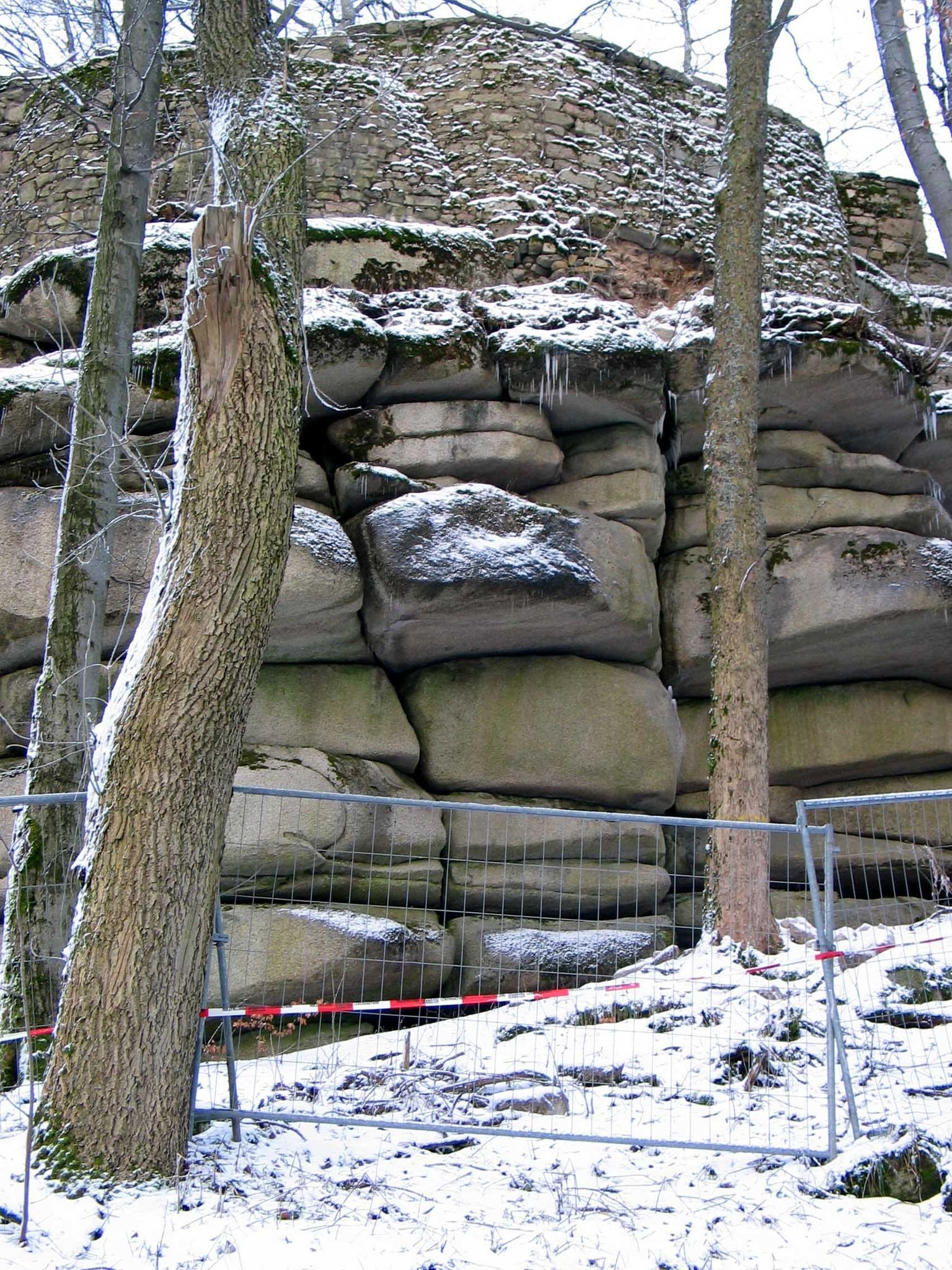
Waldsteinburg is protected as a Bavarian architectural monument. After part of the wall collapsed in 2007, the Bavarian State Office for Monument Conservation considered measures to preserve the ruins. A major granite-conservation project took place from 1 August 2023 to 13 October 2024.
Remains
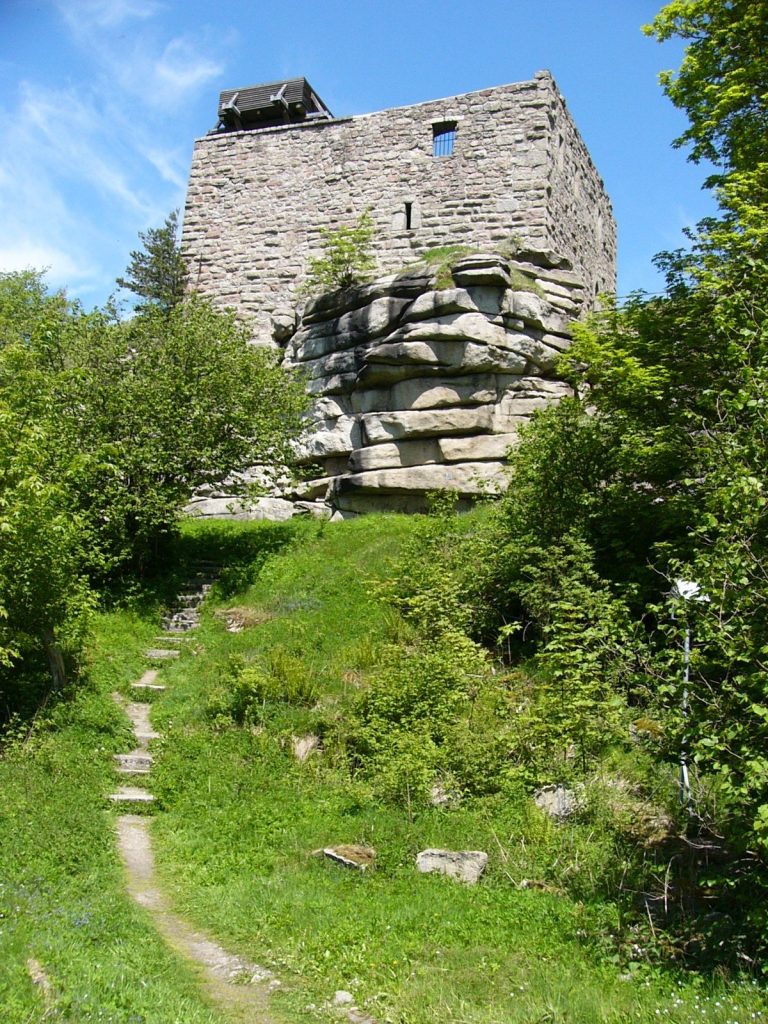
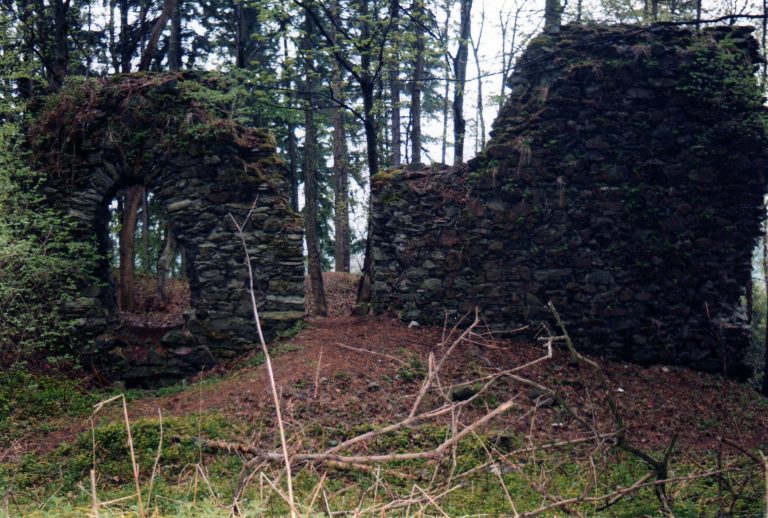
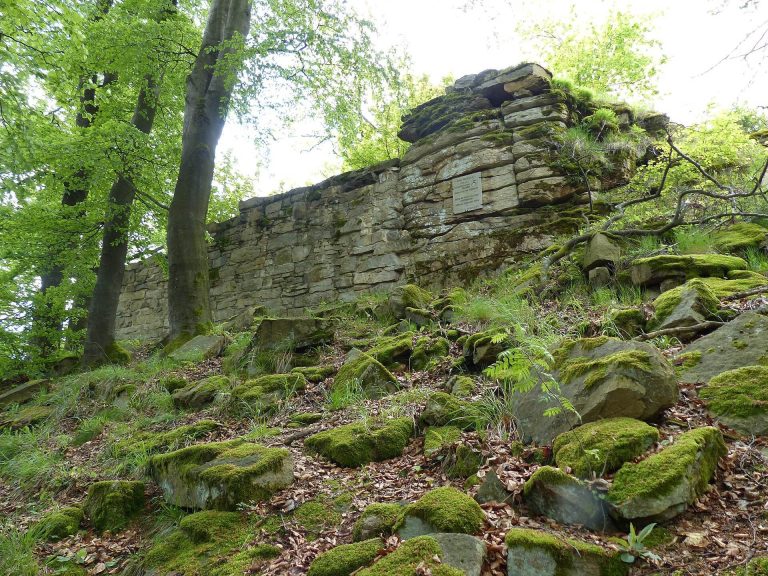
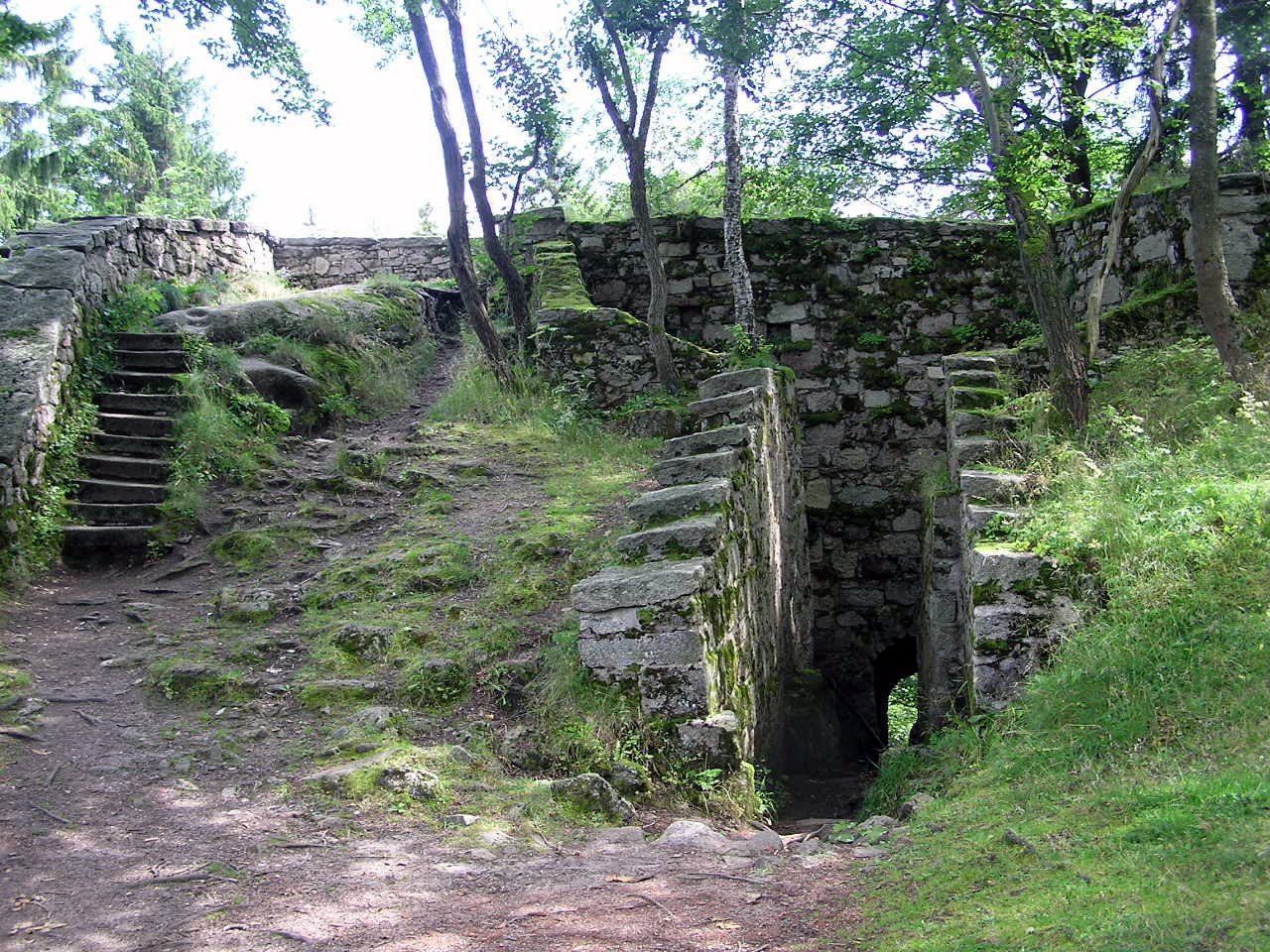
Waldsteinburg stands at approximately 877 metres above sea level on the summit of the Großer Waldstein in the Fichtel Mountains. The ruined complex occupies a rocky plateau and now survives largely as foundation walls. Individual blocks of rusticated ashlar, stone cut with roughly finished projecting faces, remain among the visible construction features. A 1523 woodcut by Hans Wandereisen shows the castle rising above a cleared rocky spur. Although the image exaggerates the number of storeys, it preserves evidence for the castle’s position and general arrangement.
Outer ward
The approach shown in the woodcut climbs towards an outer ward. One side of the outer gate survives, while a simple palisade protected the rear of the ward by making use of the natural rock formation. A wooden building near the cleared spur has been identified with a recorded sheep shed. A stone cottage in the left part of the outer ward was interpreted by Steffen Schwarz as a storehouse.
Inner ward
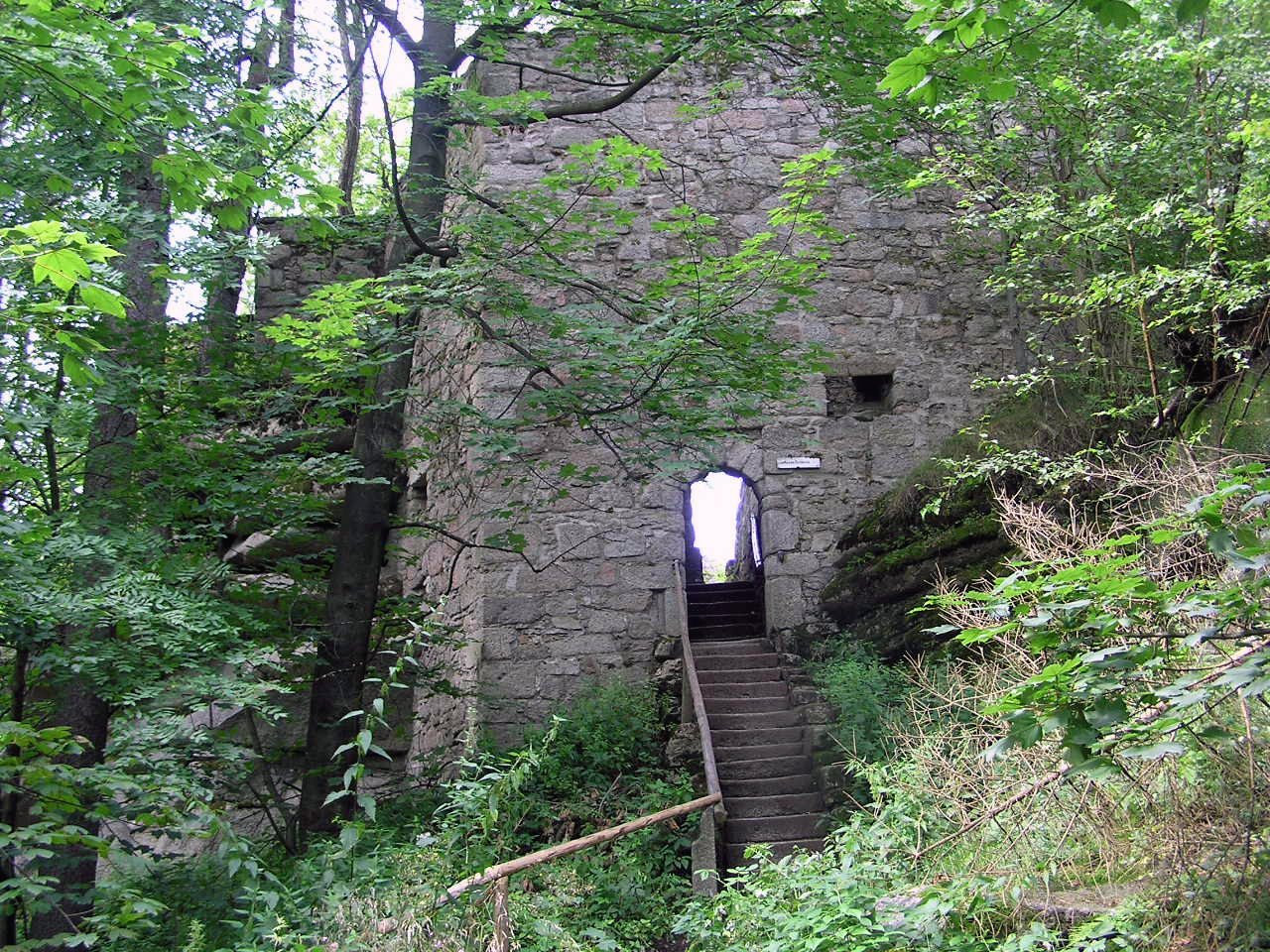
The inner ward contained the palace, the gatehouse, a battlement with small projecting watch turrets, and a square keep. The palace was the principal residential hall of the castle, while the keep served as its main fortified tower. Access to this part of the complex was protected by a drawbridge. The bridge is not visible in Wandereisen’s woodcut, but investigations including those of Karl Dietel support its former presence.
Gatehouse reuse
The gatehouse later received a red-tiled roof when the ruins were reused during the War of the Spanish Succession. Its conversion into a watchtower altered the surviving structure and formed part of the site’s later physical history.