Libá Chateau: A Medieval Castle and Baroque Château in Czechia
Site at a Glance
- Rating
- 4.3
- Popularity
- Low
- Country
- Czechia
- Primary era
- Early Modern
- External website
- Open
- Eras represented
- Medieval, Early Modern
- Civilizations
- Holy Roman Empire, Kingdom of Bohemia
- Site type
- Domestic
- Remains
- Castle
On this page10 sections
History
Libá Chateau is a historic castle and château complex in Czechia, first documented as a fortress in the mid-thirteenth century and later shaped by Gothic, Baroque, and Rococo phases. Formerly also known as Liebenstein, it became the center of the Liebenstein lordship and was influenced by its proximity to the urban area of Eger.
Thirteenth- and fourteenth-century origins
A fortress on the château hill and its associated settlement had developed by about the middle of the thirteenth century. The castle is specifically recorded in 1264 in connection with Ruprecht of New Liebenstein. After the Liebenstein family died out near the end of the century, the castle was destroyed. Franz Goßwein acquired the lordship and the ruined castle in 1346, and a new castle complex was built between 1346 and 1349. A further restoration was recorded in 1355 with the permission of Charles IV, the fourteenth-century King of Bohemia and Holy Roman Emperor.
The castle was enlarged repeatedly during the following centuries. Repeated raids led Wenceslas IV, Charles IV’s son and successor as King of Bohemia and King of the Romans, to confiscate it from the Goßwein family. In 1381 he granted Libá to Johann I of Leuchtenberg, who sold it in 1400 to the Eger burgher Erhard Rudisch. After Rudisch died in 1406, the Sparneck knights inherited Libá. The Zedtwitz family acquired the lordship after 1425 or in 1426.
The Zedtwitz period
Jörg von Zedtwitz used the castle as a base for raids against Eger and the owners of neighboring castles, including Seeberg and Haslau. The resulting feud began around 1492 and lasted almost twenty years. Troops from Eger eventually destroyed the castle, while Jörg von Zedtwitz narrowly escaped with his life. In 1553, Christoph von Zedtwitz served as the defending captain during the siege of Hof. The first pictorial representation of the already substantial castle complex dates from 1560.
The castle and lordship remained with the Zedtwitz counts, known from 1879 as the Zedtwitz-Liebenstein counts, until November 1915. Benno Count von Zedtwitz-Liebenstein then sold the château, the family’s remaining estates, and its commercial enterprises for 4.2 million crowns to a consortium associated with the Viennese businessman Leopold Hauser.
Twentieth-century decline and restoration
In March 1927, engineer Fritz Kaeßmann acquired the château and an estate of 1,420 hectares for his own management. He died in 1938, and his son Gustav was killed in the Second World War in 1944. After the war ended in 1945, the estate was confiscated, and the women and children of the Kaeßmann family were forced to leave the land in 1946.
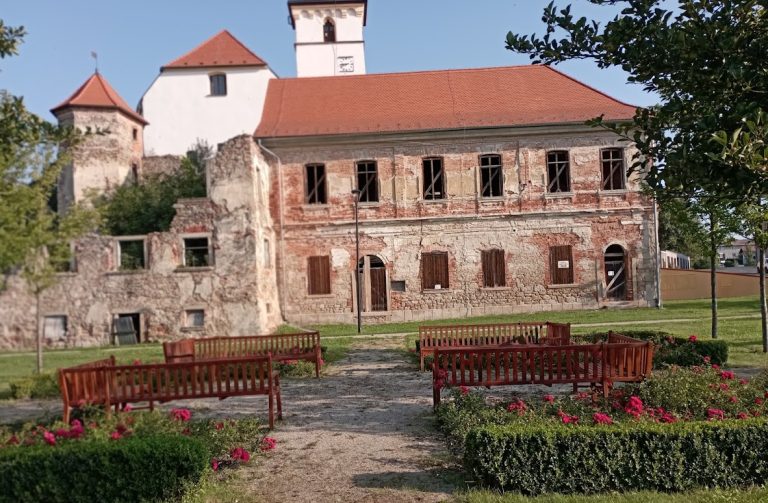
The château first provided accommodation for the forestry administration, but it stood empty from 1951. Its furnishings were stolen, and the buildings were used as a source of stone and other construction material. The tower received a new copper cap in 1976. A later fire severely damaged part of the mansard roof, after which the château deteriorated into a ruin.
A Czech art historian acquired the estate in 1991 for a symbolic price and planned to rebuild the château as a spa hotel. Initial preservation work halted the advanced deterioration, but the project ended when the investor’s funds were exhausted. Wladimir Grinêv and Zuzana Grinêvova acquired the château in 2006 and resumed restoration. As of October 2025, the work was continuing, while archaeological excavation in the basement had produced new evidence about the earliest castle complex. Libá Chateau has been protected as a cultural monument of the Czech Republic since 1963. Part of the monument has been open to the public since 2014, and some reconstructed rooms are used for art exhibitions.
Remains
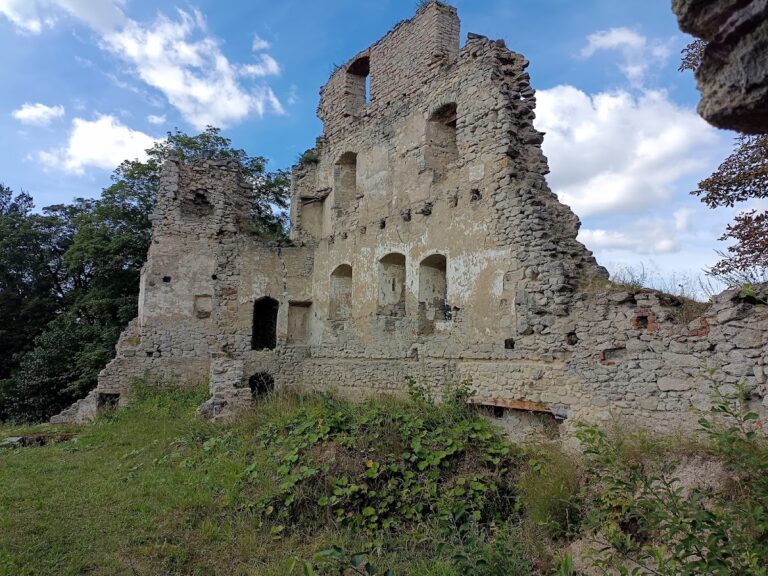
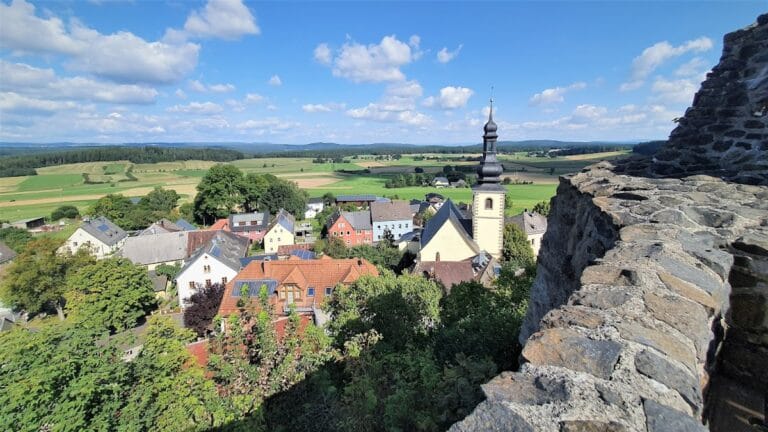
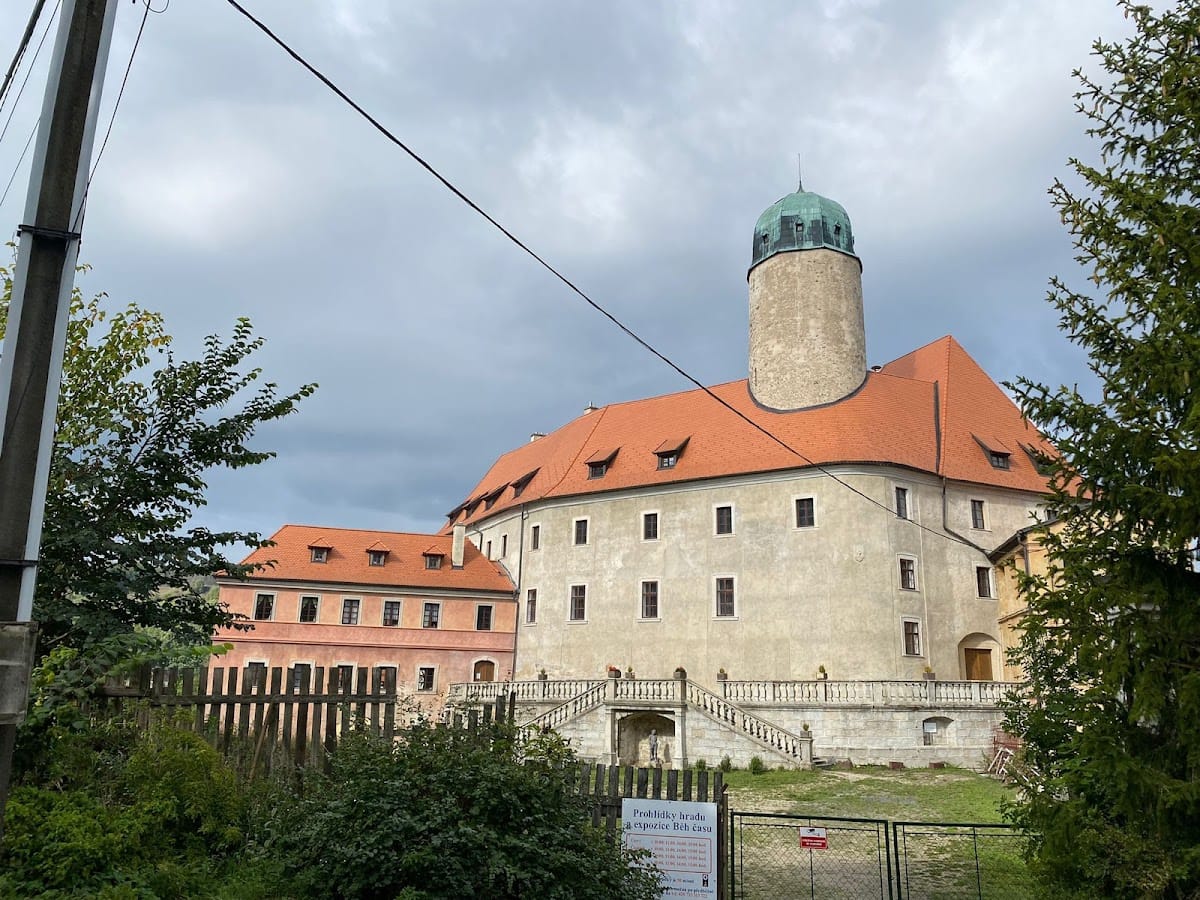
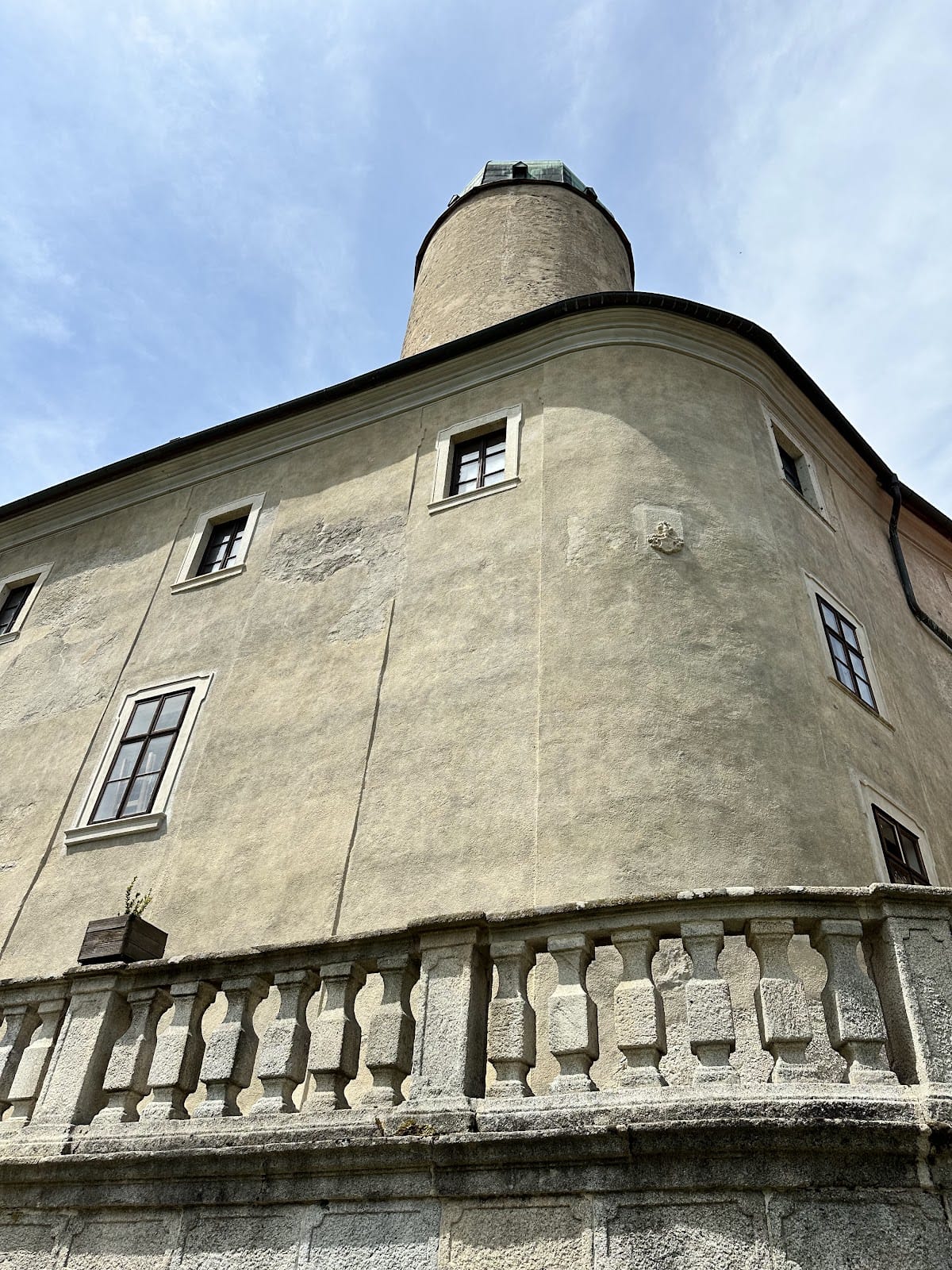
Libá Chateau stands on an elevation above the Libá Brook in the southeastern part of Libá, in the Cheb District of western Bohemia. The surviving complex brings together the remains of a medieval fortress with a later château whose architectural character combines Gothic and Baroque forms and is also described as Rococo. The medieval castle consisted of a bailey, an enclosed outer part containing supporting buildings and additional defenses, and a cramped inner castle.
Medieval fortifications
Inner castle
The original small castle was a bergfried-type fortress. Its principal defensive tower, the bergfried, would have served as a strong refuge and lookout rather than as a permanent residence, although it remains uncertain whether the circular tower belonged to the earliest construction phase. A small, possibly tower-like palace stood on the southwestern side of the inner castle. It was built with ashlar masonry, formed from dressed stone blocks laid in comparatively orderly courses. During the fourteenth century, a more elaborate palace was added to improve residential facilities, and the circulation system within the castle was probably modified.
Bailey and castle church
Square towers or bastions strengthened the defenses of the bailey. From 1406, the outer part of the castle also included a church, probably occupying the position where the Baroque Church of Saint Catherine now stands. A representation from the mid-eighteenth century shows a circular corner tower at the later church’s position, although the church had not yet been built at that time.
Baroque and Rococo château
After wartime devastation, the castle was repaired and later transformed into a Baroque or Rococo château around 1770. This conversion altered the earlier defensive landscape: the former ditches were filled and the ramparts were removed. Restoration in the modern period has included complete roof repairs, new windows, and work on the exterior facades. Ceilings and walls have been reconstructed, while destroyed rooms have received stucco decoration based on historical photographs.
Archaeological evidence
Excavations in the basement have revealed evidence relating to the first castle complex on the site. These investigations have added new information about the earliest phases of Libá’s medieval development while restoration continues across the later château.
Nearby sites