Burg Hohenberg an der Eger: A Hilltop Fortress in Germany


Site at a Glance
- Rating
- 4.2
- Popularity
- Low
- Country
- Germany
- Primary era
- Medieval
- External website
- Open
- Eras represented
- Medieval, Early Modern
- Civilizations
- Holy Roman Empire
- Site type
- Military
- Remains
- Castle
On this page11 sections
History
Burg Hohenberg an der Eger is a hilltop fortress in Germany, built during the Staufen period between 1170 and 1220 to help secure the imperial castle of Eger. The Staufen period was the era when the Hohenstaufen dynasty supplied several German kings and Holy Roman Emperors, especially during the twelfth and thirteenth centuries. The place-name first appears in 1222, when Berchtoldus de honberg of the Hohenberg noble family witnessed a document.
From noble castle to Hohenzollern fortress
Around 1300, Hohenberg passed to the burgraves of Nuremberg. They incorporated their oldest acquisitions in the Egerland into the Wunsiedel-Hohenberg administrative district. Rüdiger von Sparneck became the first recorded official appointed by the burgraves at Hohenberg in 1341.
The castle later became the second most important fortress in the Hohenzollern margraviate of Brandenburg-Kulmbach-Bayreuth, after Plassenburg near Kulmbach. The Hohenzollerns were a German ruling dynasty whose burgraves of Nuremberg later became margraves of Brandenburg-Ansbach and Brandenburg-Bayreuth. Hohenberg guarded the Schirnding Pass, a strategically important route linking the Fichtelgebirge uplands with the Eger Basin and the road to Bohemia.
Hans von Kotzau defended Hohenberg against the Hussites in 1433. The Hussites were followers of the religious reformer Jan Hus, whose movement became a major military and religious force in Bohemia during the early fifteenth century. During the Bavarian War in 1462, when Bohemian troops invaded, a man from Eger named Haußner set fire to one of the castle towers.
Late medieval rebuilding and seventeenth-century defenses
The essential fortifications of the present castle were constructed around 1480. The outer bailey, a fortified area outside the main enclosure, was reported in 1499 and 1504. In 1621 and 1622, Margrave Christian ordered large earthworks with seven bastions around the castle. A bastion was a projecting defensive earthwork designed to support fire along the adjoining walls, and the new defenses were strengthened with palisades, barriers made from closely set wooden stakes.
These measures had limited effect during the Thirty Years’ War, the European conflict of 1618 to 1648 involving religious, dynastic, and territorial struggles. In June 1632, imperial troops captured the Schirnding Pass, seized the Hohenberg border house, and occupied it for three years.
Administrative, educational, and modern use
After the Thirty Years’ War, Hohenberg lost its strategic importance. In 1666, Margrave Christian Ernst built the Fürstenhaus as an administrative office and hunting lodge, with an attached kitchen wing and a residence for the local official. An administrative official of this kind managed an office or district on behalf of a territorial ruler, while a hunting lodge served as a residence during organized hunting and related stays.
Hohenberg and the castle held the privilege of an imperial place of asylum until 1799. This was an area protected by the emperor where a person who reached a marked boundary was temporarily shielded from arrest or pursuit. Four stone columns at the approaches to the town marked the protected area.
The Margraviate of Ansbach-Bayreuth became part of the Kingdom of Prussia in 1791. Following a four-year French occupation, Hohenberg and the castle became part of the Kingdom of Bavaria in 1810. From 1936, the castle belonged to the National Socialist Teachers’ League and operated as a rural boarding school.
In April 1945, during the defense of the town by SS troops, American artillery destroyed several defensive towers, the outer bailey, and about one-third of Hohenberg. Reconstruction by the Bavarian state began in 1951. In 1955, the Sudeten German Social and Educational Foundation, working with the Free State of Bavaria, established a youth hostel and rural boarding school at the castle. The complex later became a border-region educational center. The youth hostel was named after Guido Rotter from 1960 and operated until the end of 2014. Since April 2015, VEZ e.V./Learning Campus has operated Burg Hohenberg, while extensive renovation work has continued since 2017.
Remains
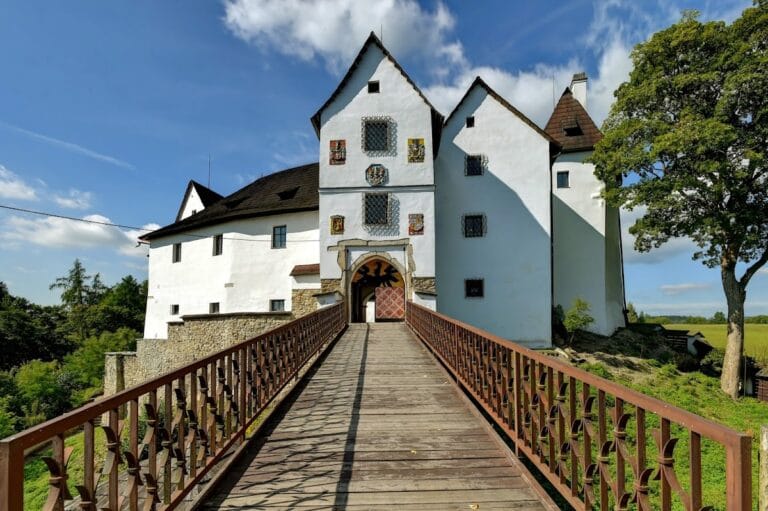
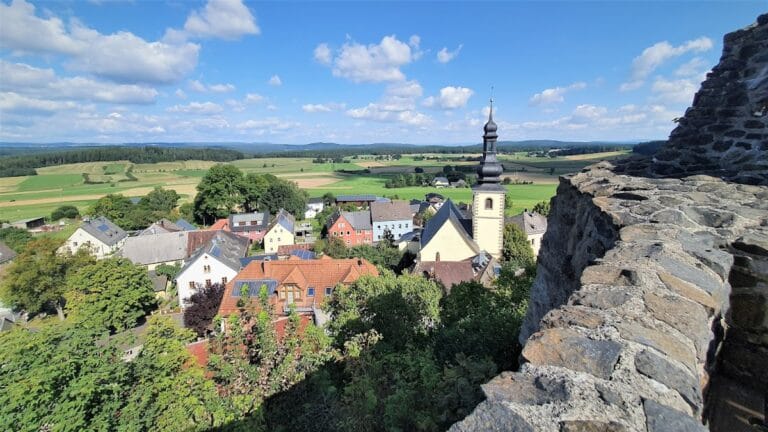
Burg Hohenberg occupies a rocky spur at the edge of Hohenberg an der Eger’s town center, rising 125 meters above the Eger River. The hilltop fortress is described as well preserved and inhabited. Its spacious courtyard is enclosed by a ring wall on an irregular hexagonal plan, while surviving towers, the Fürstenhaus, and remnants of the later earthworks reveal the castle’s changing defensive and administrative functions.
Ring wall and defensive structures
Ring wall and towers
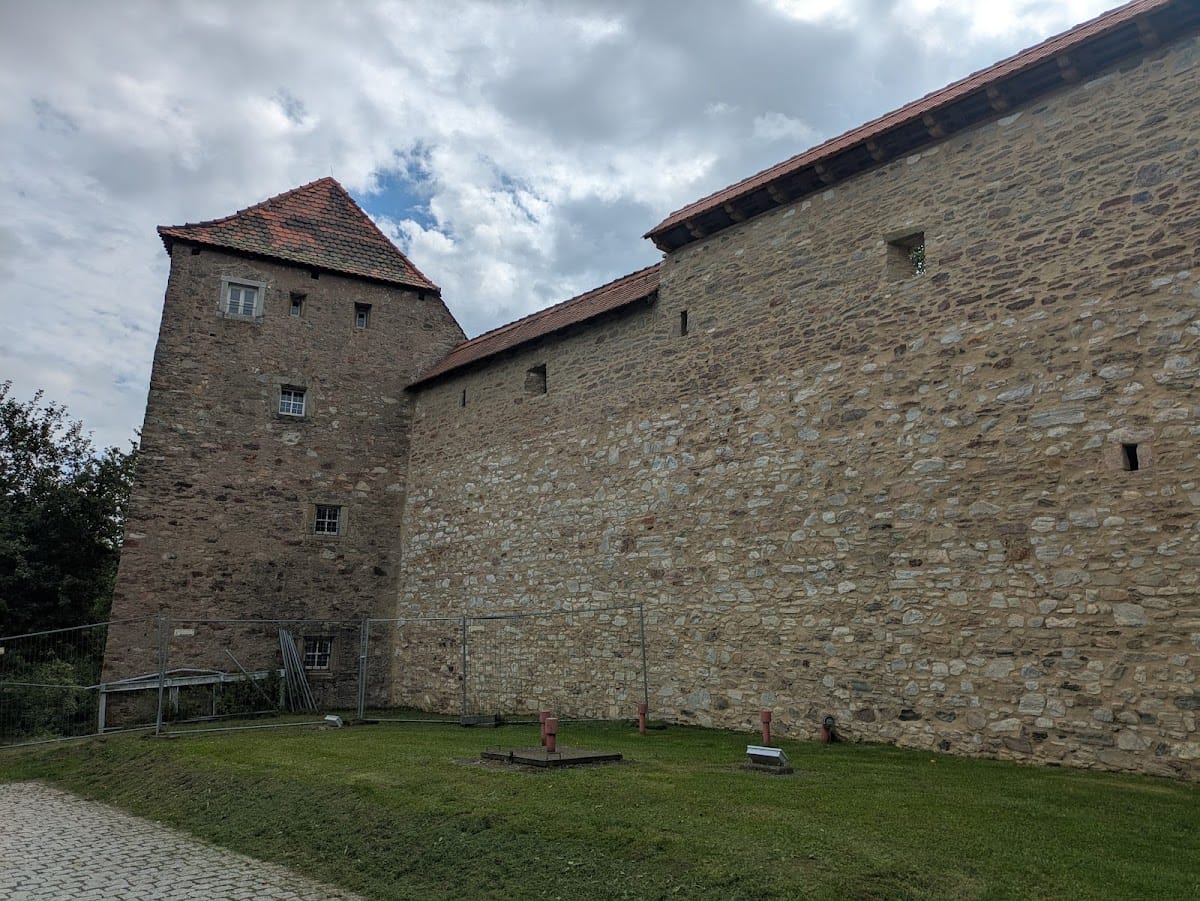
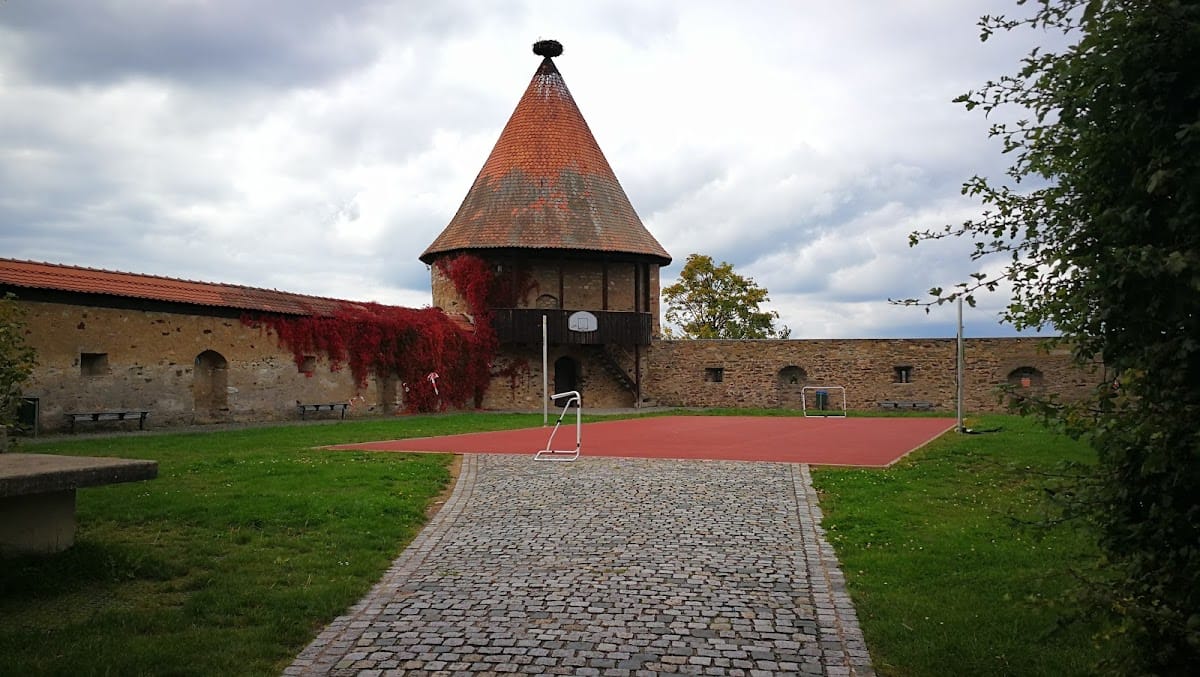
The ring wall was built around 1480 and encloses the castle courtyard in an irregular six-sided layout. Its corners are reinforced by a gatehouse, three round gun towers, and a square prison tower. A fourth round tower disappeared during the nineteenth century. The outer bailey and several defensive towers, including the gate tower and Storchenturm, were destroyed by American artillery in 1945. The subsequent rebuilding began in 1951, and the surviving complex is protected as an architectural heritage monument in Bavaria.
Fürstenhaus
The Fürstenhaus was constructed in 1666 as an administrative office and hunting lodge. Its attached kitchen wing and former residence for the local official remain part of the castle’s internal building group. Other buildings once inside the enclosure, including a granary and a cattle house, were demolished during the nineteenth century.
Southern earthworks and pavilion site
Earth bastion
A remnant of the earthwork raised in 1621 and 1622 survives in front of the southern ring wall. The former southeastern earth bastion formed part of the defensive system ordered by Margrave Christian. Its earth construction represents the later strengthening of the medieval fortress with projecting positions and wooden palisades.
Königsruhe pavilion site
A wooden pavilion called Königsruhe stood on the southeastern earth bastion from 1853 until 1959. It commemorated Queen Therese of Bavaria’s visit in 1847, when she stayed on the earthwork and enjoyed the view over the Egerland. The former pavilion site is now used as a campfire area connected with the youth hostel, and the area has become completely overgrown.
Nearby sites