Burg Delmenhorst: A Former Water Castle in Germany
Site at a Glance
- Rating
- 4.5
- Popularity
- Low
- Country
- Germany
- Primary era
- Medieval
- External website
- Open
- Eras represented
- Medieval, Early Modern
- Civilizations
- Holy Roman Empire
- Site type
- Military
- Remains
- Castle
On this page11 sections
History
Burg Delmenhorst, also called Delmenhorst Castle, is a former lowland water castle in Germany, founded by the Counts of Oldenburg after the Stedinger Wars. Construction began in 1247 in the marshy Delme lowlands, where the castle secured territory conquered from the Stedingers and developed from a small farm known as “De Horst.” For almost five centuries, it stood at the center of the town and the County of Delmenhorst.
Foundation and county seat
The Stedinger Wars were thirteenth-century conflicts involving the Stedinger population of the lower Weser region and the forces of the Archbishopric of Bremen and its allies. The Oldenburg counts established Delmenhorst after these conflicts as part of their effort to secure the newly acquired territory. The castle was first recorded on 27 July 1259, when Count John I of Oldenburg sealed a land sale at “in castro nostro Delmenhorst,” meaning “in our castle at Delmenhorst.”
From 1281 to 1436, the castle and its surrounding territory were held by the elder line of the Counts of Delmenhorst. In 1436, Delmenhorst returned to the County of Oldenburg. A fire in 1424 led to an expansion of the castle, and the enlarged complex was surrounded by a pentagonal moat by 1434.
Military stronghold and Renaissance palace
Between 1440 and 1482, Delmenhorst served Count Gerd the Bold as a base for raiding expeditions. Gerd the Bold was a fifteenth-century Count of Oldenburg-Delmenhorst whose military campaigns brought repeated attacks against the castle. Delmenhorst resisted sieges in 1462 and 1471, but it was captured in 1482. Count Anton I of Oldenburg did not recover the lordship and county until 1547.
During the 1520s, the castle was converted into a fortress with an octagonal perimeter, rounded artillery fortifications called roundels, and projecting defensive platforms known as bastions. A third surrounding moat was also added, although it was later filled in. Another fortification expansion planned in 1647 was only partly completed.
During the sixteenth century, the fortified complex also became a prominent Renaissance palace with a pleasure garden, a formally designed garden intended for leisure and representation. The counties of Oldenburg and Delmenhorst came under Danish rule in 1667, and the palace began to decay during the seventeenth century.
Demolition and later history
After the county was pledged to the Electorate of Brunswick-Lüneburg in 1711, the palace was sold for demolition. The remaining part of the castle tower known as the Blue Tower was demolished in 1787. Its stones were reused in the construction of the new town church, while the tower later became a heraldic symbol of Delmenhorst.
A Peter-Elisabeth Hospital was built on the vacant castle site at the end of the nineteenth century. In the early twentieth century, the hospital was converted into a vocational school, which was demolished in 1972. The former castle grounds were redesigned as a park in 1906. The site is now an archaeological monument, with the buried remains and some architectural fragments helping to preserve the history of the former castle complex.
Remains
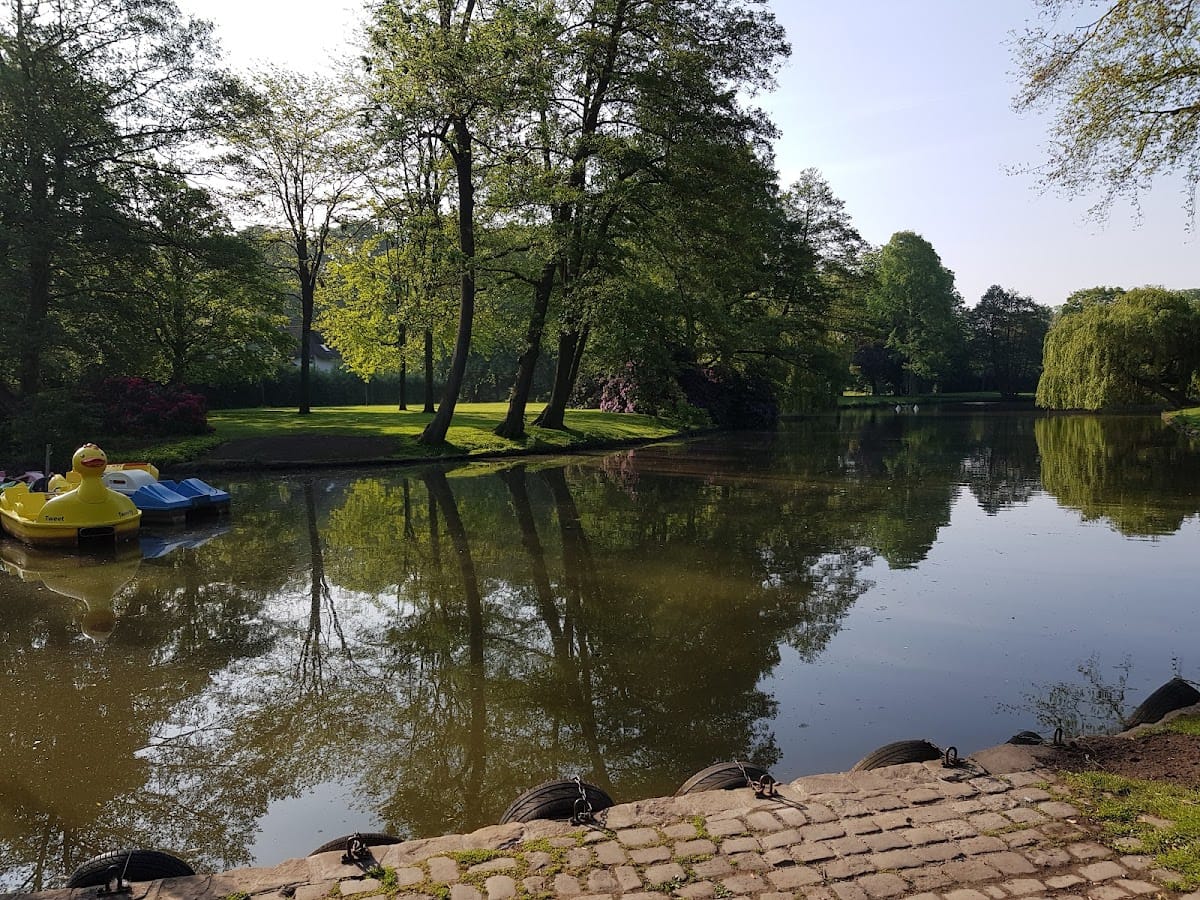
The castle occupied a castle island at the southern edge of central Delmenhorst, in the Delme floodplain of the Oldenburg region in Lower Saxony. The former castle area forms a roughly circular site with a maximum diameter of about 160 metres. Only a few foundation walls and markings in the ground reveal the plan above the surface, while the main remains lie about four metres below ground. The park is crossed by the former inner and outer moats, and fragments from the demolished complex are displayed in the Delmenhorst City Museum.
Fortifications and water defences
The original form of the lowland castle is unknown. By 1434, the enlarged complex was enclosed by a pentagonal moat. The early modern fortress had an octagonal perimeter with roundels and bastions, together with inner and outer moats. The third moat added during the sixteenth-century fortification works has been filled in, while the inner and outer moats remain visible as elements of the present park.
Entrance complex
Blue Tower
The entrance route approached from the north by a bridge that led through a bastion and toward the principal residential building, or palas. The Blue Tower stood on the left side of this route. It measured 11.75 metres in diameter and had walls four metres thick. The tower was demolished in 1787, and its stones were reused in the new town church.
Chapel wing and arsenal
The chapel wing stood on the right side of the entrance route. Beyond it, at an obtuse angle, was the arsenal. The remains of another round tower stood behind the arsenal, forming part of the fortified arrangement around the entrance area.
Commissary House and Red Tower
The Commissary House occupied the space between the arsenal and the Red Tower. The Red Tower was almost square, measuring approximately 13 metres across, with walls about 2.8 metres thick. These structures formed part of the surviving plan known through foundation remains and ground markings on the castle island.
Garden house
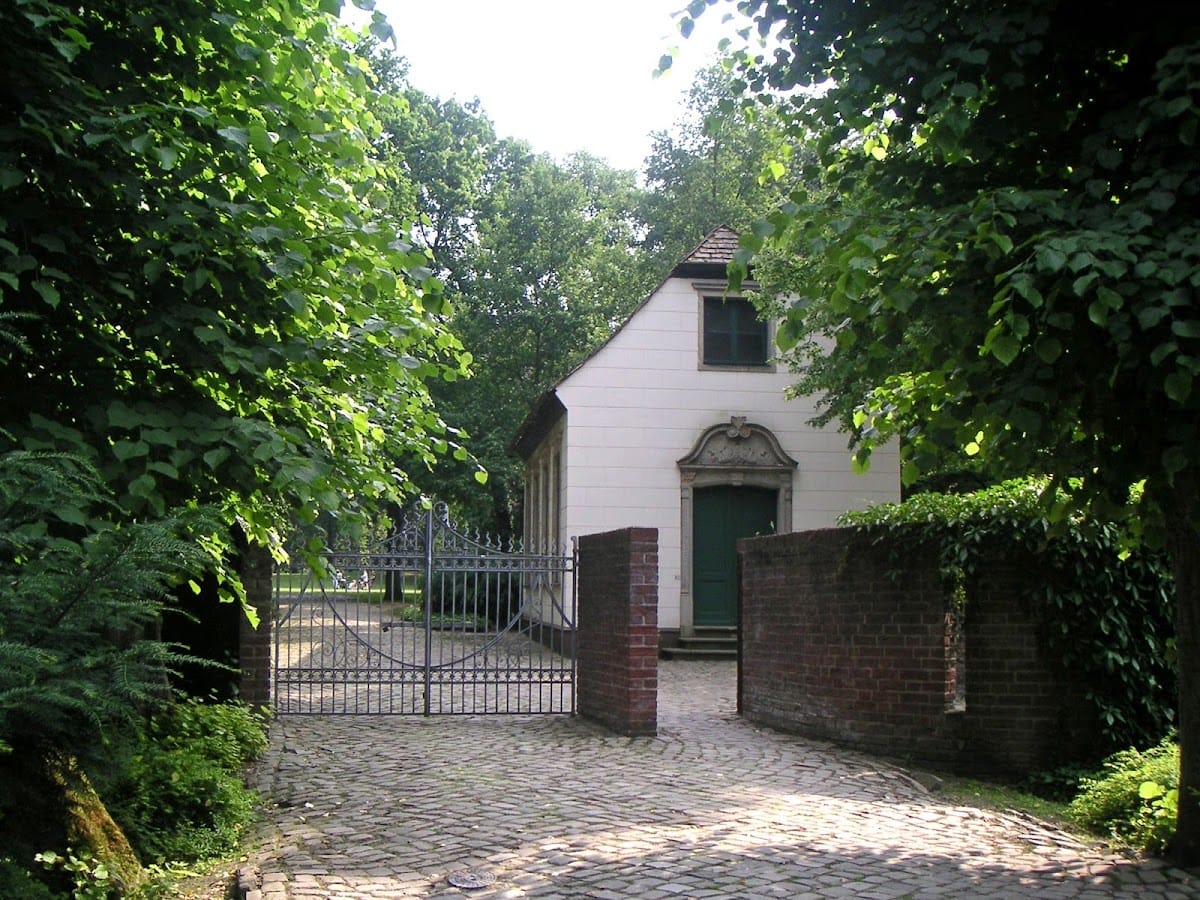
A former count’s garden house stands at the entrance to the castle island. Anton I of Oldenburg and Delmenhorst erected it in 1564 at the Weyhausen estate on the Ochtum. The building was remodeled in the Baroque style in 1723 and reconstructed at its present location in 1979.
Nearby sites