Wasserburg Hopen: A Lowland Castle in Lohne, Germany


Site at a Glance
- Rating
- 4.3
- Popularity
- Very Low
- Country
- Germany
- Primary era
- Early Modern
- Eras represented
- Medieval, Early Modern
- Civilizations
- Holy Roman Empire
- Site type
- Domestic
- Remains
- Castle
On this page9 sections
History
Wasserburg Hopen is a lowland castle in Lohne, Germany, built by the lower nobleman Herbord von Dinklage in 1517 near the Hopener Mill Stream. Its setting in relatively level terrain used surrounding water as part of the castle’s defensive character. The von Dinklage family retained Hopen until 1587, establishing the estate as a possession of local German nobility.
Noble ownership and estate development
After a short period under the von Langen family, Hopen passed to the von Haren family, who held it until 1793. The estate then passed through a member of the von Oeynhausen family of Merrelsheim before the von Galen family purchased it in 1805. Its activities extended beyond the castle itself and included agriculture, forestry, and fishponds.
In 1703, Herbord von Haren laid out the avenues that run through Hopen Castle Forest. These avenues remain an associated landscape feature of the estate and reflect the deliberate organization of its wooded grounds.
War, changing uses, and preservation
During the Thirty Years’ War, the European conflict fought chiefly between 1618 and 1648, marauding Swedish and Hessian soldiers burned Hopen’s outer bailey in 1637 while Vechta was under siege. The outer bailey was the enclosed area adjoining the main fortified structure, usually containing supporting buildings.
Refugees were housed in the manor house in 1948, the same year that Count Korff, known as Schmiesing-Kerssenbrock, became the owner. From 1954, the property served for a period as a youth hostel, but it returned to private use in 1964. Extensive renovation took place in 2014. Wasserburg Hopen is recognized as an architectural heritage monument in Lower Saxony.
Remains
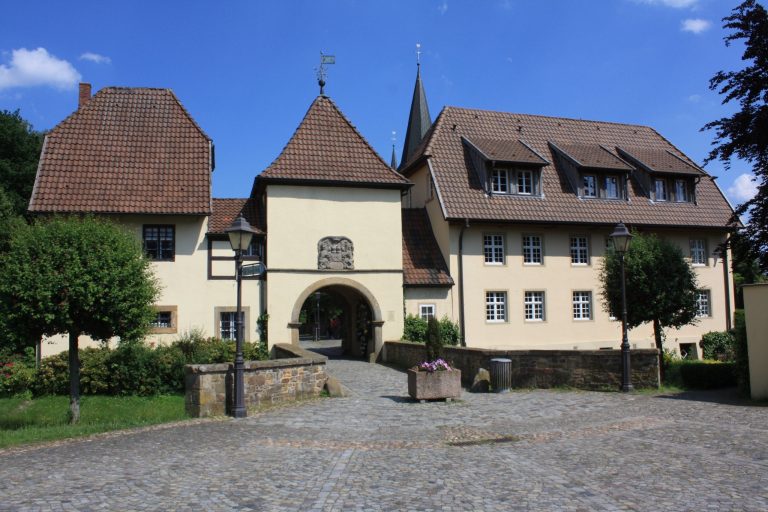
Wasserburg Hopen stands in Hopener Forest beside the Hopener Mill Stream. The castle is enclosed by a Gräfte, a surrounding water-filled moat or ditch. Parts of this moat had previously been filled in, but Count Kerssenbrock had them excavated and restored to their original condition. Substantial parts of the castle complex survive.
Castle structures
Main house
The original complex included a main building, a castle tower, and a drawbridge. The date of the main house remains uncertain, with construction attributed either to 1479 or 1566. Around 1700, a second half-timbered storey was added. Half-timbered construction uses a structural timber frame whose spaces are filled with another material.
Former tower and drawbridge
The castle tower later collapsed into the moat in 1825. The drawbridge was demolished in 1880, while a two-storey half-timbered extension added around 1780 was removed around 1900. That extension had almost doubled the length of the castle.
Entrance canopy
Above the entrance is a sandstone canopy bearing the coats of arms of the von Haren and Löw von und zu Steinfurth families.
Forest avenues and artistic record
The avenues laid out through Hopen Castle Forest in 1703 form part of the site’s associated landscape. The castle was also depicted in Wasserburg Hopen bei Lohne, a painting made by the German painter Luzie Uptmoor in the 1970s.