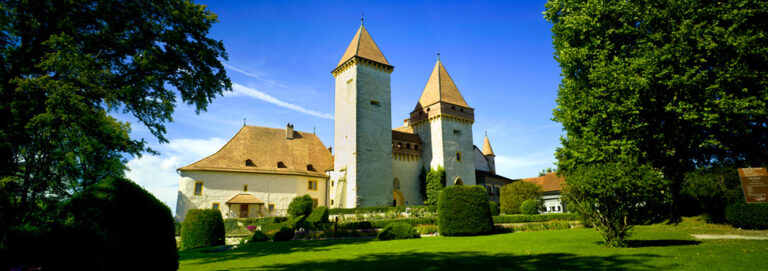
Yverdon-les-Bains Castle: A Medieval Fortress and Cultural Landmark in Switzerland
Visitor Information
Google Rating: 4.4
Popularity: Low
Official Website: chateau.yverdon.ch
Country: Switzerland
Civilization: Early Modern, Medieval European
Site type: Military
Remains: Castle
History
Yverdon-les-Bains Castle is located in the municipality of Yverdon-les-Bains, Switzerland. It was originally built by medieval European builders during the 13th century.
The earliest known construction at the site dates to around 1235 when Amédée III of Montfaucon-Montbéliard, who ruled over Orbe, established a large circular tower there. This initial fortress element marked the beginning of what would become a prominent medieval stronghold. In 1260, Amédée III sold the territory of Yverdon to Peter II, Count of Savoy. Shortly afterward, between 1260 and 1265, the Count ordered the construction of a quadrangular castle embodying the “Savoyard square” architectural style. The castle’s design and building work were carried out by masons John and James of Saint-Georges, who were father and son craftsmen at the time, bringing expertise that linked this fortress to others of the same period in the region.
Following its completion, Yverdon Castle served as the residence for the castellans appointed by the Counts of Savoy. This role lasted until 1536 when administrative control shifted and the castle became the official headquarters for the bailiffs representing the city of Bern. Bern’s jurisdiction continued here until 1798, a period that included various political changes in the region.
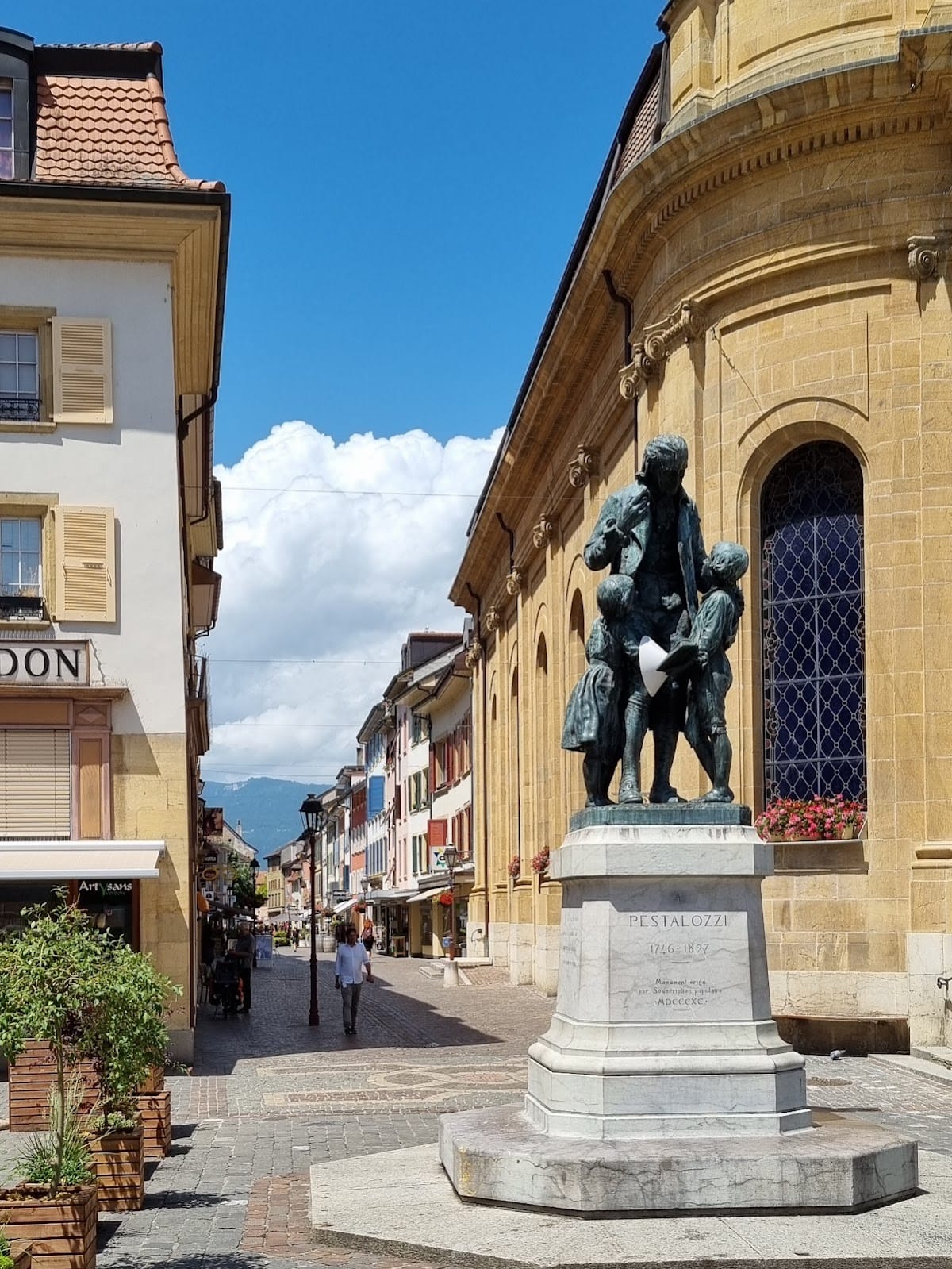
The year 1798 marked a significant shift as ownership passed to the Département du Léman during the brief existence of the Helvetic Republic. Soon after, the city of Yverdon took possession of the castle and entrusted it to Johann Heinrich Pestalozzi, a noted Swiss educator. Pestalozzi used the castle to run his institute from 1805 to 1825, making it an important site for educational reform and innovation.
From 1838 until 1974, parts of the castle were adapted to serve as classrooms for the public school system. Over time, modifications such as interior walls and additional windows were introduced to accommodate this new function. After educational use ceased, efforts were made to restore the castle to its medieval appearance. Since 1830, the castle has housed the local museum dedicated to Yverdon and its region, becoming a cultural center that also includes a theater, conference spaces, and the oldest public library in the French-speaking part of Switzerland.
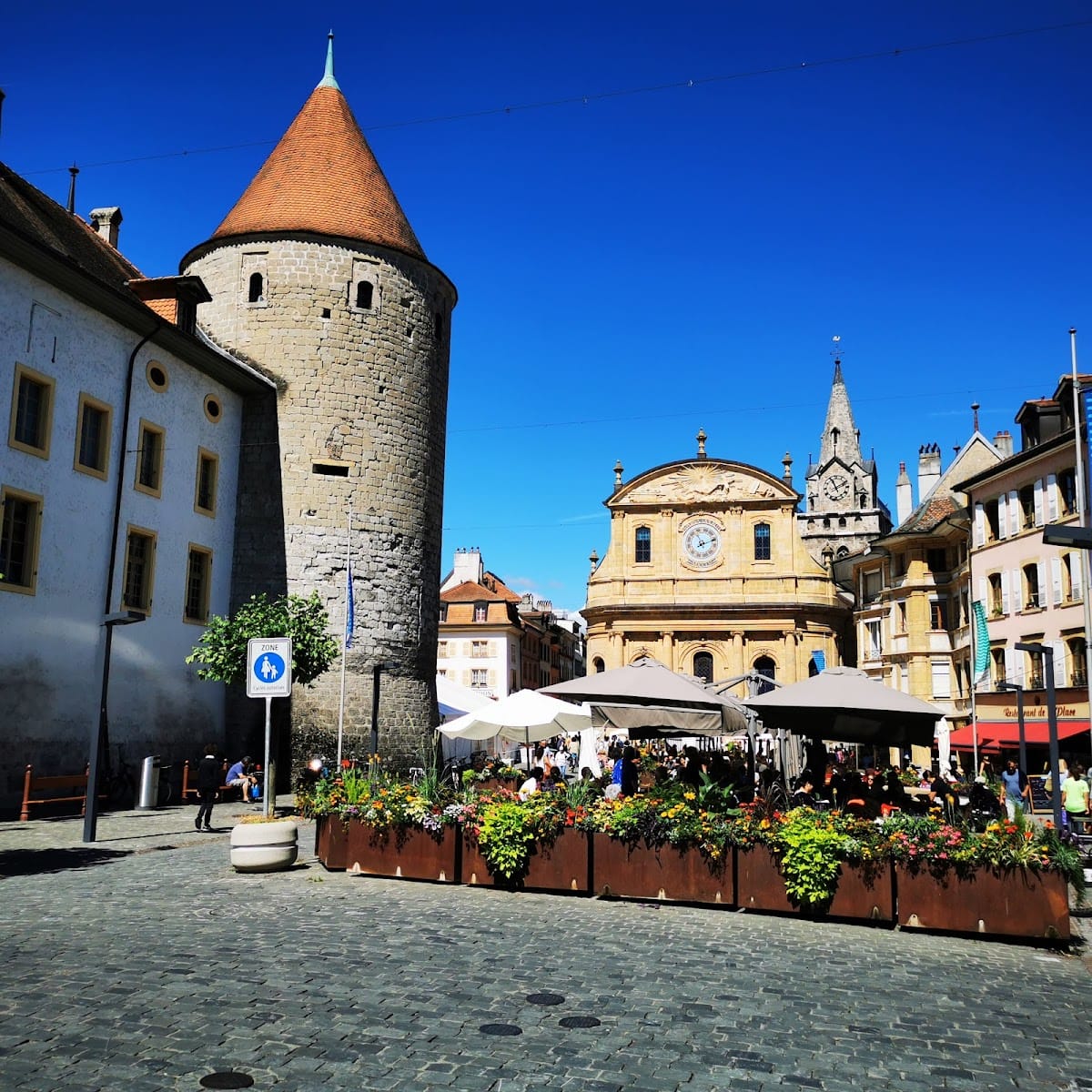
One notable historical episode is linked to the southwest tower, later called the “Jewish Tower.” This name originates from an event in 1702 when two Jewish merchants made a dramatic escape from this tower. The tower itself was rebuilt after suffering a collapse in 1605, reflecting ongoing maintenance and restoration through its history. The castle’s historical and cultural importance has led to its recognition as a Swiss heritage site of national significance, with restoration projects carried out in the early 20th century under Otto Schmid and again beginning in 1956 led by Pierre Margot.
Remains
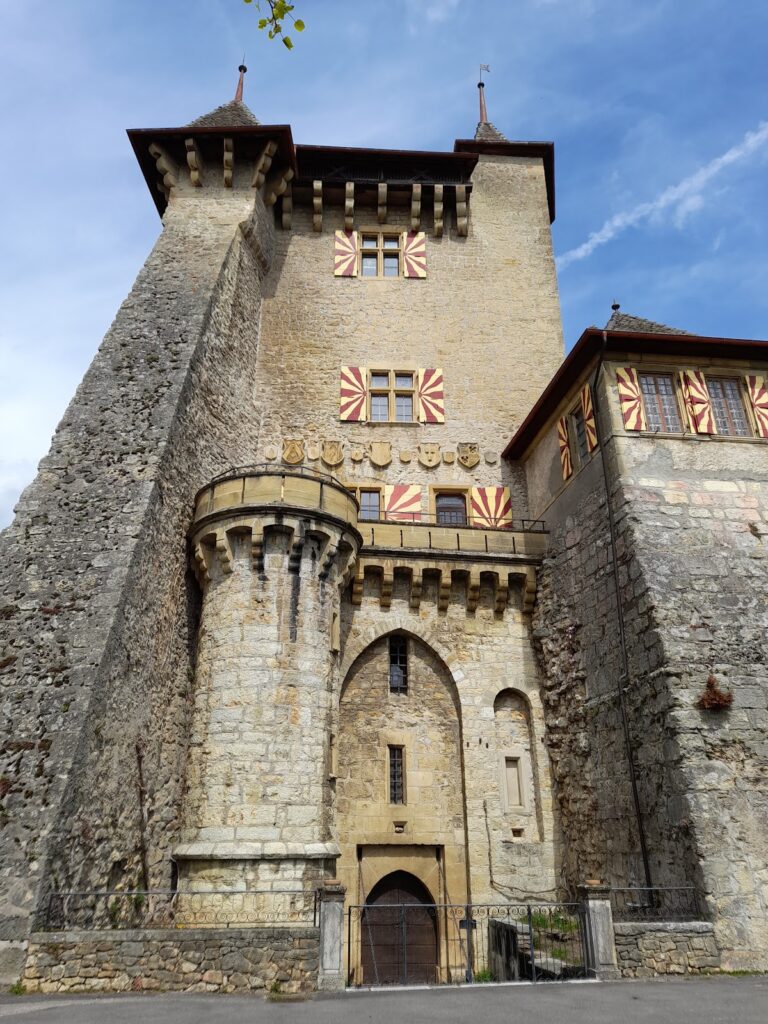
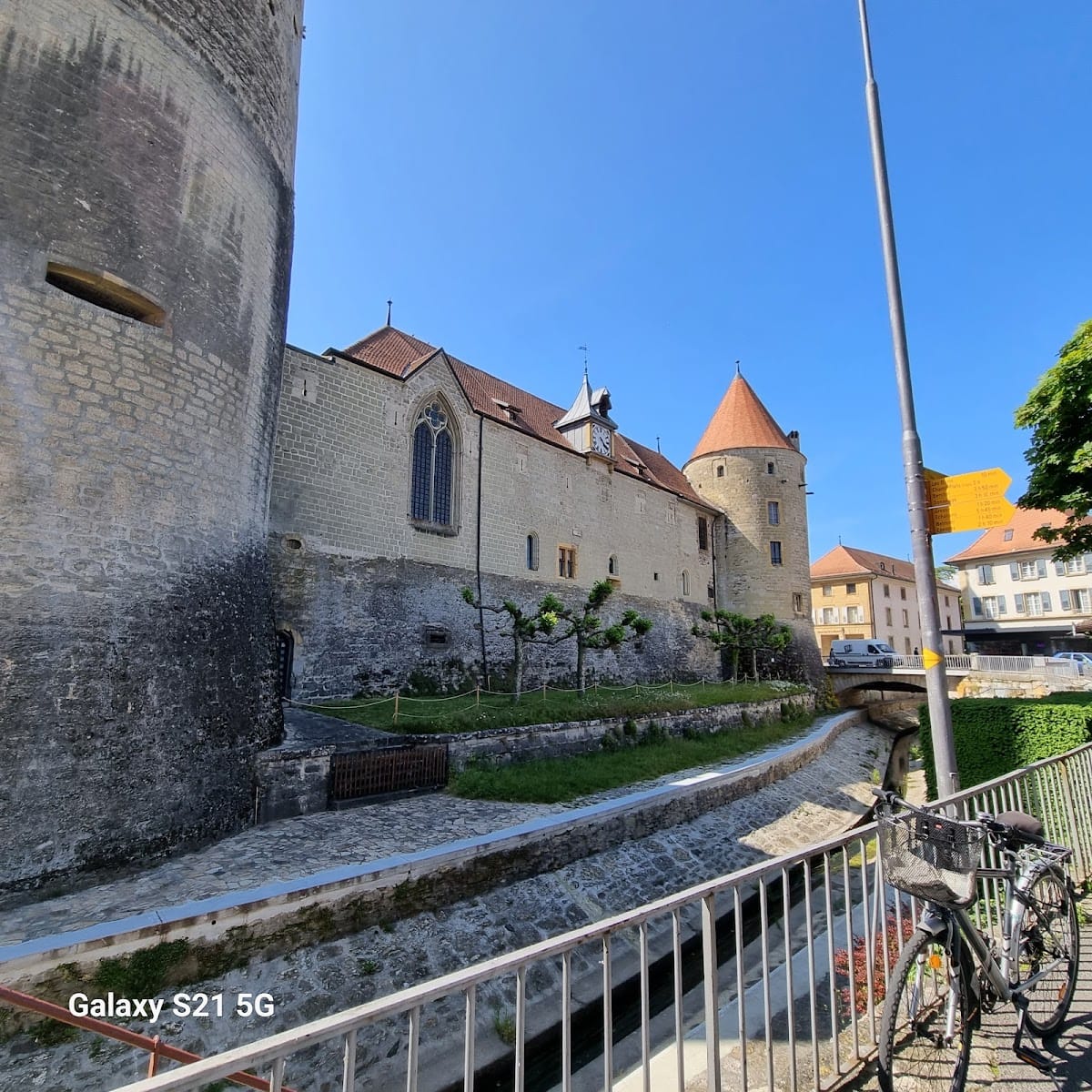
Yverdon-les-Bains Castle presents a roughly rectangular footprint measuring about 40 by 48 meters, constructed in a style known as the “Savoyard square,” characterized by quadrangular walls and circular towers at each corner. This layout reflects medieval military architecture popularized in the 13th century and is closely related to the design of the donjon at Semur-en-Auxois, corresponding to the work of the masons John and James of Saint-Georges who built the castle.
The castle was built upon fluvio-lacustrine alluvial deposits—sediments deposited by rivers and lakes—providing a naturally firm foundation. Its defensive location takes advantage of the nearby Thièle river, which once separated the castle from the town with a drawbridge connecting the eastern gate to the town walls. This natural barrier enhanced the castle’s protection against attacks.
Architectural details reveal defensive features typical of medieval fortifications. Machicolations, which are openings between supporting corbels that allowed defenders to drop objects on attackers below, are topped by bay-crenellations. These battlements are closed by wooden shutters and supported by corbels, suggesting that the tower roofs were originally covered to provide shelter while enabling defense. Additional protection came from wooden hoardings—temporary balconies supported by retractable beams—installed along the towers and curtain walls. These wooden structures allowed defenders to extend their vantage points and repulse enemies during sieges.
The roofs currently visible date from the late 15th century, replacing earlier, more substantial medieval roofing systems. Surrounding the main castle walls were originally strong outer walls called braies, serving as an additional layer of defense. These were considered innovative when introduced around 1260, although they no longer survive.
Throughout the 19th and 20th centuries, the castle underwent several adaptations to serve evolving functions, including the addition of internal partitions and extra windows to accommodate school classrooms. Later restorations removed these alterations to revive the castle’s medieval aesthetic. Today, the castle retains its restored medieval form, showcasing key elements from its original design and highlighting its long historical evolution through multiple uses and periods.
Nearby sites