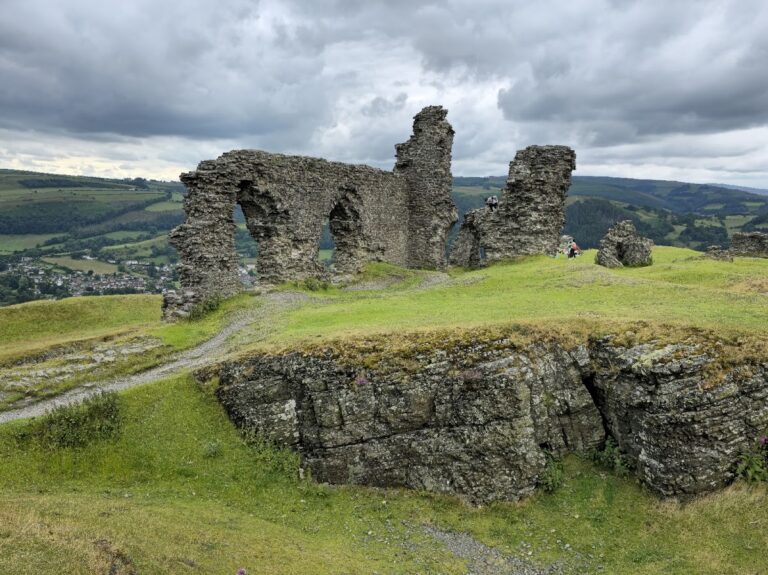
Tomen yr Allt: A Norman Motte and Bailey Castle in Wales
Visitor Information
Google Rating: 5
Popularity: Very Low
Country: United Kingdom
Civilization: Medieval European
Site type: Military
Remains: Castle
History
Tomen yr Allt is a medieval motte and bailey castle situated near Llanfyllin in Wales, built by the Normans during their expansion into the region. Constructed likely in the late 11th or 12th century, the castle reflects the introduction of Norman military architecture into Wales, using the motte and bailey design brought from France.
During the 12th century, the area around Tomen yr Allt became part of the commote of Mechain Uwch Coed within the larger cantref of Mechain. In 1160, as the Kingdom of Powys split, Mechain was incorporated into the principality that later became known as Powys Wenwynwyn. Control of the region shifted to Llywelyn the Great by 1208, and following his death in 1241, the local lordship passed to Gruffydd ap Gwenwynwyn, who was allied with Henry III of England.
The castle played a strategic role in regional conflicts during the mid-13th century. In May 1257, records describe Llywelyn ap Gruffudd besieging a fortress called the “castle of Bodyddon.” Scholars identify this location as Tomen yr Allt due to its commanding view over the nearby settlement of Bodyddon. The siege likely led to the castle’s destruction. Subsequently, the nearby Bodfach Hall is thought to have been erected to replace the castle as the local administrative center on lands once part of the Bodfach estate.
Archaeological findings, including fragments of daub and evidence of burning, support the historical account of destruction, pointing to a timber-built keep that suffered fire damage. Today, the castle is recognized as an important medieval site protected under Welsh heritage laws.
Remains
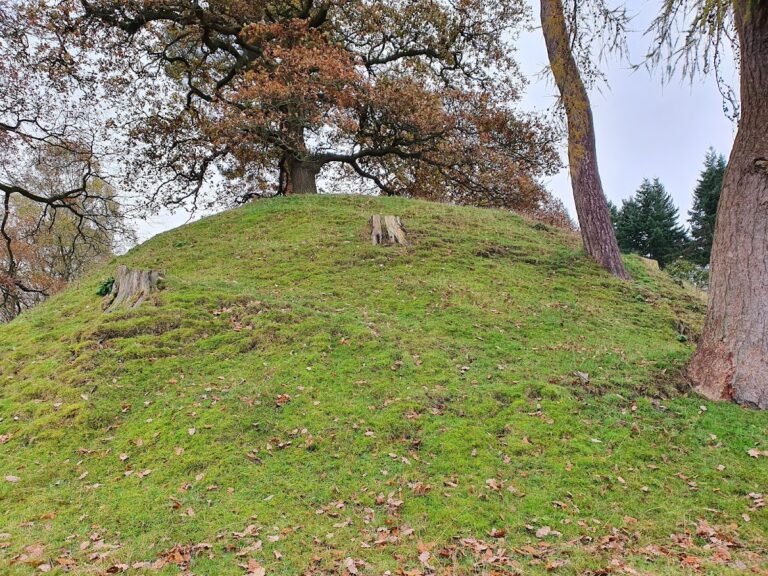
The surviving remains of Tomen yr Allt reveal the typical layout of a Norman motte and bailey fortification, marked by a large, man-made earth mound known as a motte. This mound measures approximately 13 by 10 meters at its base and rises to nearly 10 meters in height. It sits within a broader circular earthwork enclosure exceeding 40 meters in diameter, which would have formed the defensive perimeter around the motte.
Encircling the motte is a continuous stony ditch, a defensive feature that is reinforced by an additional ditch on the northeastern side. This doubling of the ditch on the side opposite the natural slope of the hill suggests focused efforts to strengthen the castle’s defenses where the terrain was less protective. On the southeast side, the earthwork bank is flattened where it connects with neighboring fields, indicating a transition from fortification to cultivated land.
Excavations carried out in 1978 uncovered traces of daub, a mixture of clay and straw used in timber construction, along with a burnt layer that confirms the keep was built from wood and destroyed by fire. The earthworks themselves have remained largely intact over the centuries, but no stone structures survive on the site. Positioned on a wooded hillside at an elevation of around 247 meters, the castle overlooks both Bodyddon to the west and Bodfach Hall to the southeast, emphasizing its strategic placement within the landscape. Today, the site is protected as a scheduled monument, ensuring the preservation of these earthwork ruins as tangible evidence of Norman military presence in medieval Wales.
Nearby sites