Sycharth Castle: A Norman Motte-and-Bailey Castle and Owain Glyndŵr’s Principal Mansion


Site at a Glance
- Rating
- 4.7
- Popularity
- Very Low
- Country
- United Kingdom
- Primary era
- Medieval
- External website
- Open
- Eras represented
- Medieval
- Civilizations
- Norman
- Site type
- Military
- Remains
- Castle
On this page8 sections
History
Sycharth Castle is a Norman-period motte-and-bailey castle in Wales, United Kingdom, near Llansilin in Powys. Probably built by the Normans before 1086, it stood in the valley of the River Cynllaith, within the former Welsh territory of Powys Fadog, which had belonged to the Kingdom of Powys.
Norman origins and Welsh administration
A motte-and-bailey castle combined a raised mound with an adjoining enclosed area, allowing early Norman builders to establish defensive and residential sites quickly, often using timber. The Domesday Book, a survey completed in 1086 for William I of England, indicates that Sycharth may already have existed by that time. After the Norman Conquest, the commotes of Cynllaith and Edeyrnion came under Norman control. Sycharth, also called Cynllaith Owain, served as the Norman castle for Cynllaith, while Rhug fulfilled that role for Edeyrnion.
The commotes later passed to Madog Crypl, Lord of Glyndyfrdwy and Lord of Cynllaith Owain, who held them from about 1275 to 1304. Gruffudd Fychan II, the father of Owain Glyndŵr, was probably Madog Crypl’s grandson. These transfers placed Sycharth within the inheritance that later shaped the career of Owain Glyndŵr.
Owain Glyndŵr’s residence
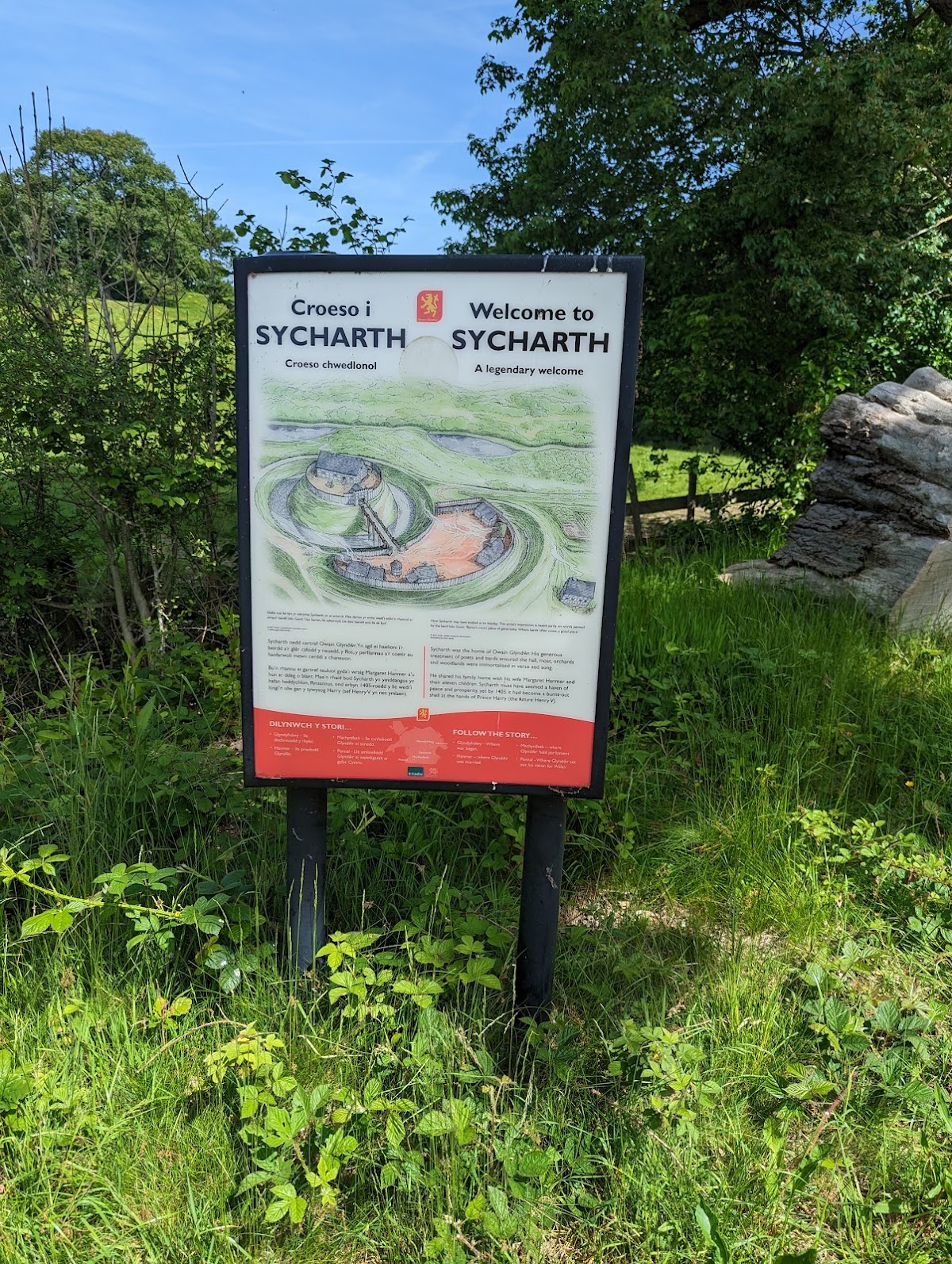
Owain Glyndŵr inherited Sycharth in 1369. He lived there with his wife, Margaret Hanmer, and their children, and the castle became his principal mansion. It is also identified as the place of his birth. Glyndŵr later led a major revolt against English rule between 1400 and 1409 and became the last native Welshman to hold the title of Prince of Wales.
The fourteenth-century Welsh poet Iolo Goch praised Sycharth as an aristocratic residence of considerable wealth. His description names nine substantial wooden buildings or halls, each with an associated wardrobe, meaning a service room connected with a great hall. The buildings had tiled roofs and chimneys, presenting Sycharth as an elaborate household centre rather than simply a military stronghold.
Destruction and archaeological investigation
During Glyndŵr’s revolt, Prince Henry, later King Henry V, oversaw the destruction of Sycharth in May 1403. A letter dated 15 May states that Henry found the mansion deserted and ordered the entire residence to be burned, together with nearby houses belonging to Glyndŵr’s tenants and a lodge in his park.
Excavations in the early 1960s investigated the castle and found evidence of burning, consistent with the destruction ordered in 1403. Sycharth is now in the guardianship of Cadw, the Welsh Government’s historic-environment service responsible for protecting and managing nationally important monuments.
Remains
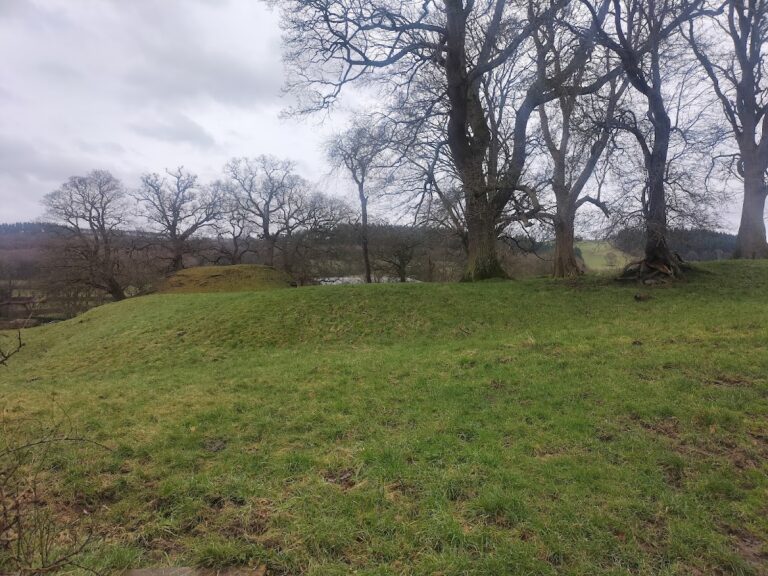
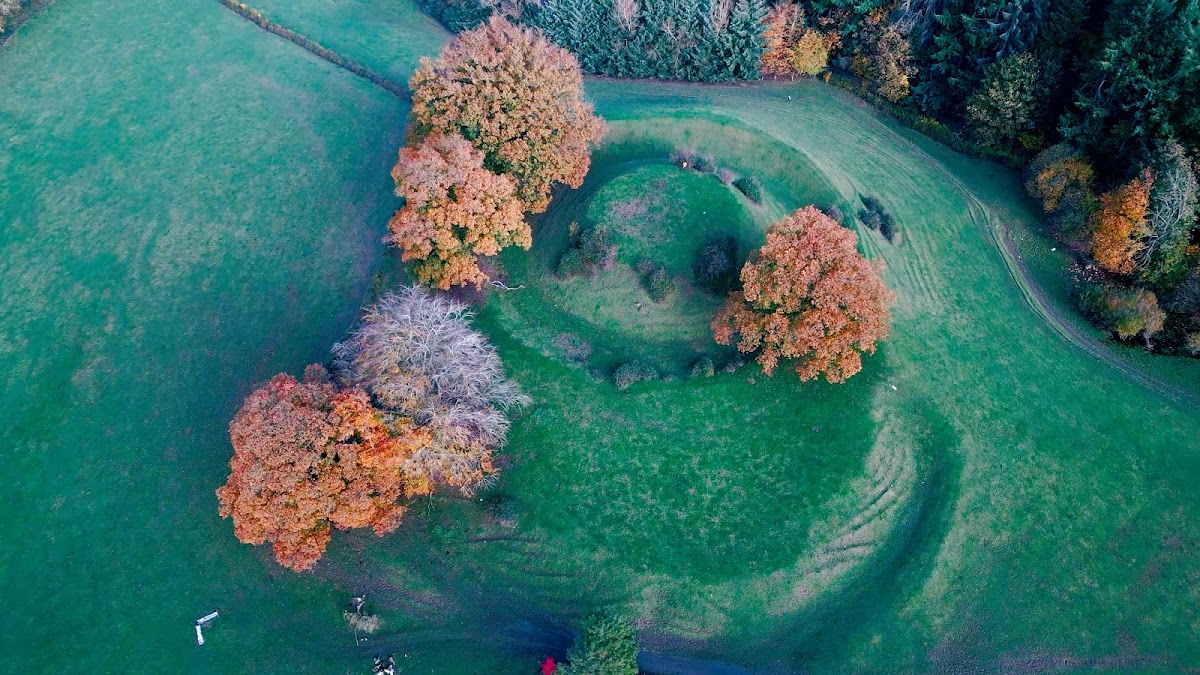
Sycharth survives as a grass-covered Norman motte-and-bailey set at approximately 143 metres above sea level in the Cynllaith valley. The site includes a flat-topped motte, surrounding banks, and an outer bailey. Higher ground and a belt of woodland known as Parc Sycharth lie to the east, while a medieval fishpond is adjacent to the castle. A farm immediately west of the site served as the township courthouse until the nineteenth century.
Castle earthworks and residential buildings
The motte and timber halls
The motte forms the central raised element of the castle and has a level summit. Excavations revealed two timber halls on this flat surface, one measuring 43 metres in length. Their scale helps explain the residential character of the site and relates to Iolo Goch’s description of a larger group of wooden halls, tiled roofs, chimneys, and associated service rooms.
The banks and outer bailey
The banks and outer bailey complete the surviving castle earthworks. Together with the motte, they preserve the basic arrangement of the Norman fortification, while the grass-covered mound represents the principal visible remains of the site.