Strathaven Castle: A Historic Scottish Stronghold
Visitor Information
Google Rating: 3.4
Popularity: Very Low
Official Website: canmore.org.uk
Country: United Kingdom
Civilization: Early Modern, Medieval European
Site type: Military
Remains: Castle
History
Strathaven Castle, also known historically as Avondale Castle, stands near Strathaven in Scotland. The original fortress was constructed around the year 1350 by the Baird family, who established the stronghold close to the Powmillon Burn. Over time, ownership of the castle passed to the Sinclair family before coming under the control of the powerful Earls of Douglas.
In the mid-15th century, the castle experienced notable turmoil. In 1455, King James II moved to suppress the influence of the Earls of Douglas, leading to military action against their holdings. During this conflict, Strathaven Castle was attacked, resulting in significant damage and partial destruction. Following these events, little remained of the initial Baird and Douglas structures.
Two years later, in 1457, Sir Andrew Stewart, an illegitimate grandson of Murdoch Stewart, Duke of Albany, was granted the lands. Stewart either entirely rebuilt the castle or erected a new building on the same site, marking the beginning of a new chapter. Sir Andrew would later be ennobled as Lord Avondale, associating the estate closely with his lineage.
Later developments in the early 16th century saw the castle expanded under Sir James Hamilton of Finnart in 1534. Correspondence from 1559 also mentions Master Patrick Buchanan teaching the children of Regent Arran at the castle, indicating its use as a noble residence and place of education during this period.
Ownership passed into the hands of James, Marquis of Hamilton, in 1611. The castle continued as a noble residence until the early 18th century. Anne, Duchess of Hamilton, who lived from 1632 to 1716, was its last occupant but mainly resided at Hamilton Palace. By 1717 the castle had been abandoned, falling into ruin in the centuries that followed.
Today, the remains of Strathaven Castle stand as a protected monument. Although closed to the public for several years, a local organization formed in 2023 with the aim of promoting restoration efforts and reopening access to this historic site.
Remains
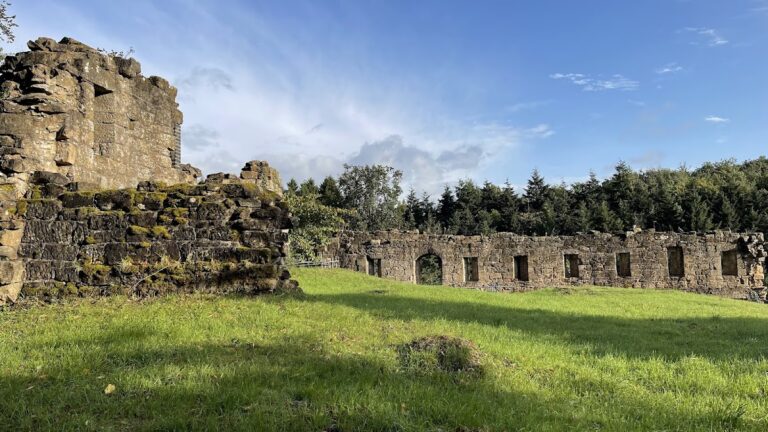
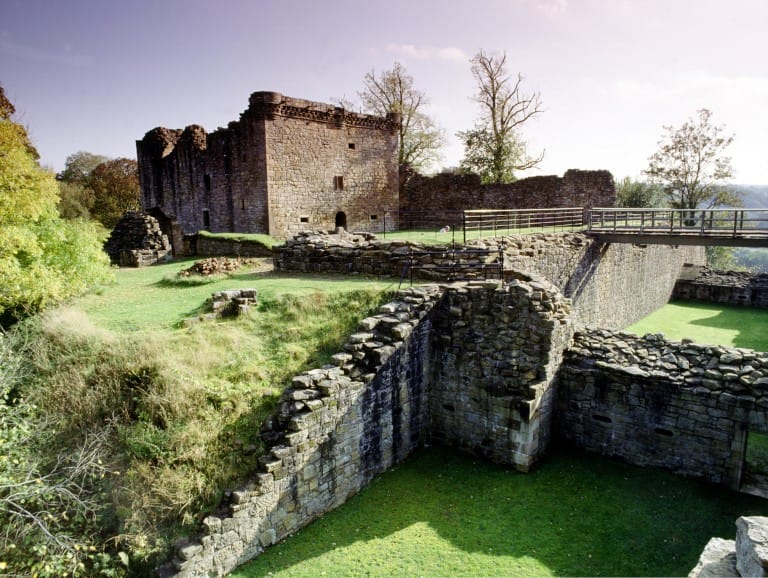
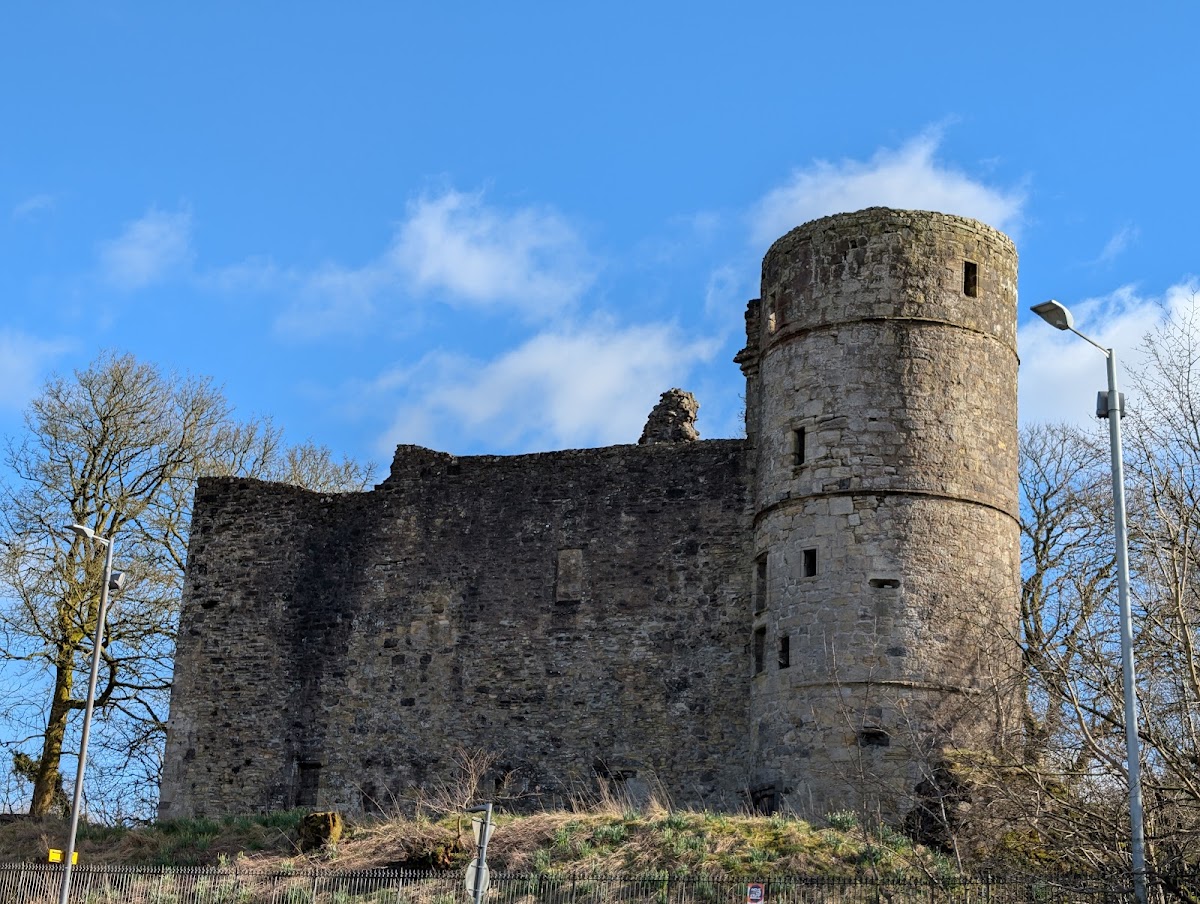
Strathaven Castle occupies the summit of a rugged hill partially shaped by human intervention, surrounded naturally on three sides by the steep slopes of the Powmillon Burn. The site was originally fortified with a barmkin, a defensive wall enclosing the top of the mound, fragments of which are still visible to the west of the main structure. This enclosure would have provided space for ancillary buildings and livestock protection during times of attack.
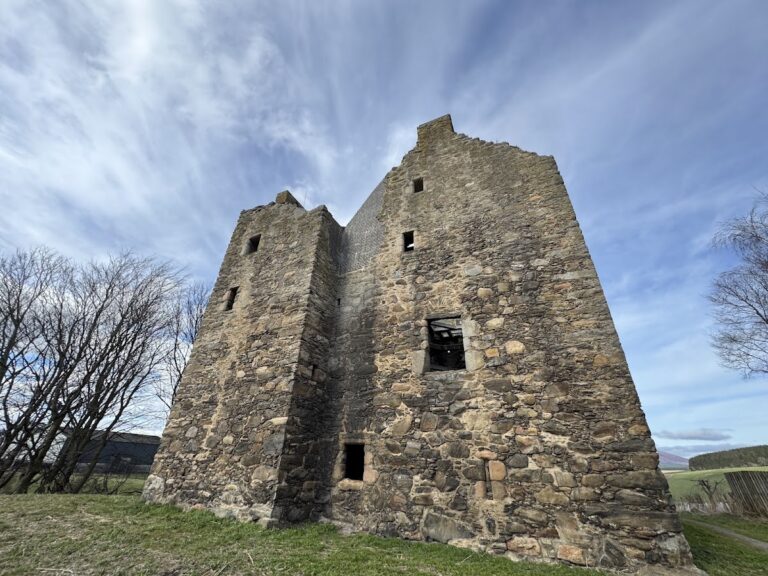
The main castle was a rectangular, three-storey building measuring roughly 11 by 21 meters. It featured a distinctive four-storey round tower positioned at the northwest corner, a feature likely added during the 16th century, and a smaller wing projecting from the southeast side. Today, the north wall and the round tower survive almost intact, while the other walls remain only in fragments. Inside, the collapsed vaulted basement can still be discerned among the rubble.
Some original architectural details have been obscured by later repairs using modern concrete, yet traces of 15th-century corbelling—stone projections supporting parapets or upper stories—can be observed, hinting at the craftsmanship of the medieval masons. The round tower itself contains several wide gunloops, narrow openings designed for firing guns or crossbows, reflecting military advancements of the time. The low placement of the tower’s entrance is unusual; studies suggest that although the doorway was originally wider, it did not have a traditional lower threshold, as a continuous stone plinth extends beneath it.
Local tradition, recorded on an information panel at the site, speaks of a human skeleton uncovered when sections of the castle’s walls collapsed or were dismantled. This find connects to a regional legend about a woman immured, or walled in alive, within the castle. The panel also recounts folklore about underground tunnels, known as ley tunnels, said to connect the castle to nearby landmarks such as Sweetie’s Brae and Mill Brae. However, excavations during road construction below the castle found no evidence to support the existence of such passageways.
Nearby sites