Bothwell Castle: A Medieval Scottish Stronghold on the River Clyde

Site at a Glance
- Rating
- 4.3
- Popularity
- Low
- Country
- United Kingdom
- Primary era
- Medieval
- External website
- Open
- Eras represented
- Medieval
- Civilizations
- Kingdom of Scotland
- Site type
- Military
- Remains
- Castle
On this page15 sections
History
Bothwell Castle is a large medieval castle in the United Kingdom, built in the thirteenth century by Walter de Moravia above a steep bend of the River Clyde between Bothwell and Uddingston. It was intended to guard a strategic crossing and became one of Scotland’s important military strongholds. Its history is closely tied to the Wars of Scottish Independence, the late-thirteenth- and early-fourteenth-century conflicts in which Scotland resisted English conquest.
Origins and the Wars of Scottish Independence
King David I granted the barony of Bothwell to David Olifard, or Olifant, in the mid-twelfth century. The barony passed through his descendants before coming to Walter de Moravia by 1252 through his marriage connection to the Olifard inheritance. Walter’s castle had begun by 1296, when the struggle between Scotland and England entered a decisive phase, but the work then extended only to the main donjon, the prison tower, and a short stretch of curtain wall. The remaining foundations were probably protected by a wooden palisade.
English forces seized Bothwell at the beginning of the wars and captured William Moray of Bothwell, whose family held the castle. A Scottish siege of the English garrison continued for fourteen months in 1298 and 1299 before the garrison surrendered. Edward I recaptured the stronghold in 1301 with an army of about 6,800 men and specially made siege engines. Bothwell then served as the headquarters of Aymer de Valence, 2nd Earl of Pembroke, Edward’s appointed Warden of Scotland, and remained under English control for several years.
After Robert the Bruce’s victory at Bannockburn in 1314, several English nobles took refuge at Bothwell. Sir Walter FitzGilbert, the constable, surrendered the castle to the advancing Scots and received the barony of Cadzow as his reward. His descendants became the Hamilton family. The Scots then slighted the fortress, meaning that they deliberately demolished parts of it to prevent its military reuse.
Recapture and Douglas rebuilding
Edward III restored English control in 1336 and ordered the castle repaired for use as his Scottish headquarters. The following year, Sir Andrew Murray, the great-nephew of Sir William Murray and the rightful owner of Bothwell, recaptured it with siege engines. He destroyed part of the donjon by throwing its western side into the Clyde, preventing the enemy from occupying the stronghold again. Bothwell remained derelict until the 1360s.
In 1362, Joan Moray, heiress of the Morays of Bothwell, married Archibald Douglas, known as “the Grim,” who later became Lord of Galloway and Earl of Douglas. He began rebuilding the castle, repairing the donjon and extending the walls. His son, Archibald, 4th Earl of Douglas, continued the work. By 1424, the reconstructed complex included the Great Hall, an adjacent chapel, corner towers, and connecting curtain walls.
Later medieval ownership
The Black Douglases, a powerful branch of the Douglas family, were forfeited by the Crown in 1455, and their lands returned to royal control. James III subsequently granted Bothwell to Lord Crichton and then to Sir John Ramsay, whose holdings were also forfeited. In 1488, Patrick Hepburn, 2nd Lord Hailes, received Bothwell and was made Earl of Bothwell. He soon exchanged the castle with Archibald Douglas, 5th Earl of Angus, known as “Bell-the-Cat,” for Hermitage Castle in Liddesdale.
James IV visited Bothwell in 1503 and 1504. The castle later passed through the Earls of Angus and the Marquesses of Douglas to the Earls of Forfar. Archibald Douglas, 1st Earl of Forfar, began a new mansion nearby and demolished the castle’s north-east tower for building stone. After the death of the 2nd Earl of Forfar at Sheriffmuir in 1715, Bothwell returned to the senior Douglas line, represented by the 1st Duke of Douglas and his heirs, and later passed to the Earls of Home. The castle was abandoned by the eighteenth century.
Modern preservation
Bothwell House, the nearby mansion, was demolished or collapsed in 1926 because of mining subsidence. In 1935, the 13th Earl of Home placed Bothwell Castle in state care. Historic Environment Scotland now manages it as a nationally important scheduled monument. The castle is regarded as one of the foremost secular structures of medieval Scotland and as one of the country’s important military strongholds. It also appears in Jane Porter’s 1810 novel The Scottish Chiefs.
Remains
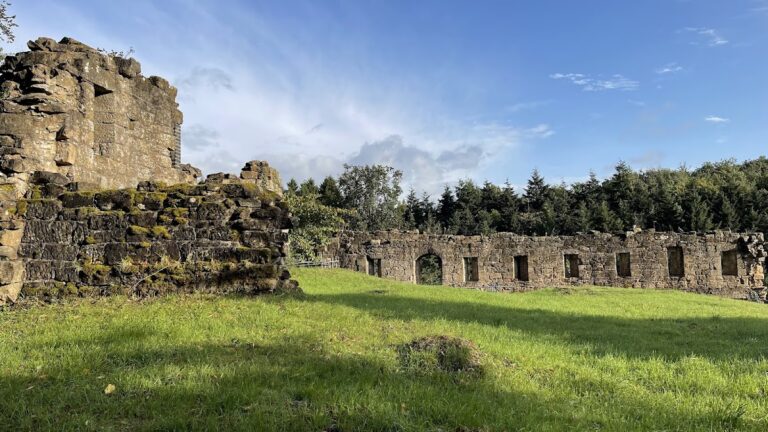
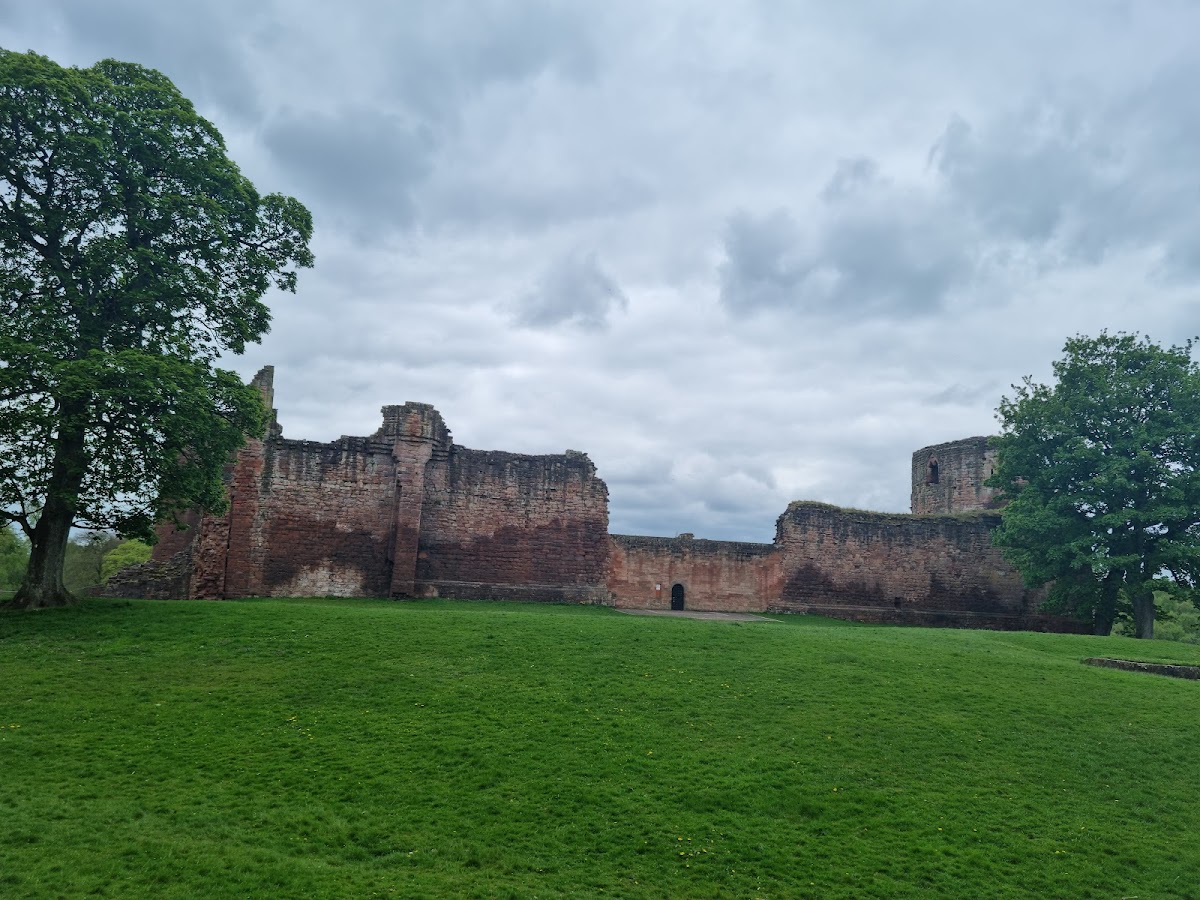
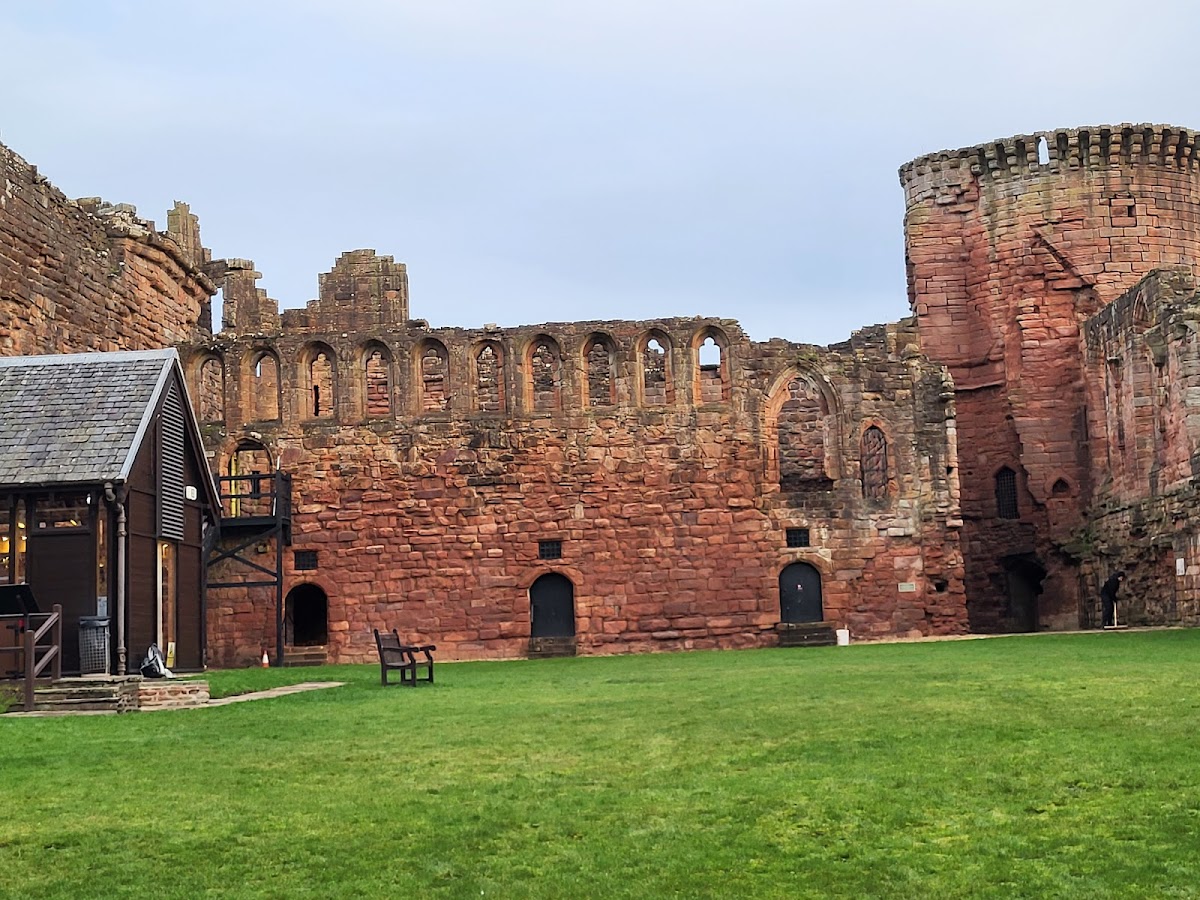
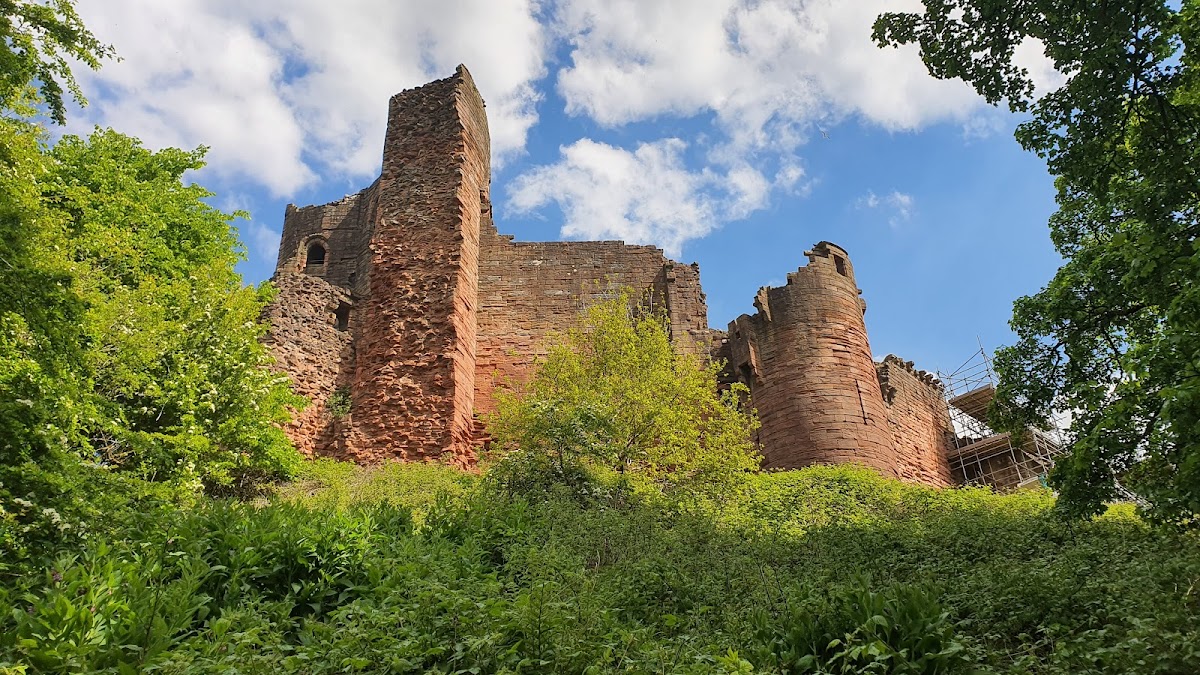
Bothwell is arranged around a broadly rectangular courtyard enclosed by long curtain walls, defensive walls that surround a castle’s interior space. The complex was built chiefly from coursed red-sandstone rubble. The thirteenth-century donjon occupies the west, while the later Great Hall forms the principal surviving element of the east wing. Round towers stand at the south-east and south-west corners, and later medieval rebuilding added further towers and walls.
Western and southern defenses
The donjon
The cylindrical donjon, the principal fortified tower of a medieval castle, combined defensive, residential, and administrative functions. It originally stood about 25 to 27.4 metres high, measured 19 to 20 metres across, and had walls approximately 4.6 metres thick. The four-storey tower had its own battlements and stood above a formerly water-filled moat with a sluice on the south side. A wooden drawbridge provided access, while a well about six metres deep occupied the basement. The western side was destroyed in 1337 when Sir Andrew Murray sought to prevent the castle’s military reoccupation, leaving the donjon in a ruined state.
The prison tower and rear gate
The prison tower stands in the south wall beside the donjon. It rises three storeys and contains a prison pit. East of it is a fourteenth-century rear gate with a Douglas coat of arms above the entrance. A fifteenth-century latrine tower adjoins the former south wing and forms part of the later medieval arrangement.
The south-east corner tower
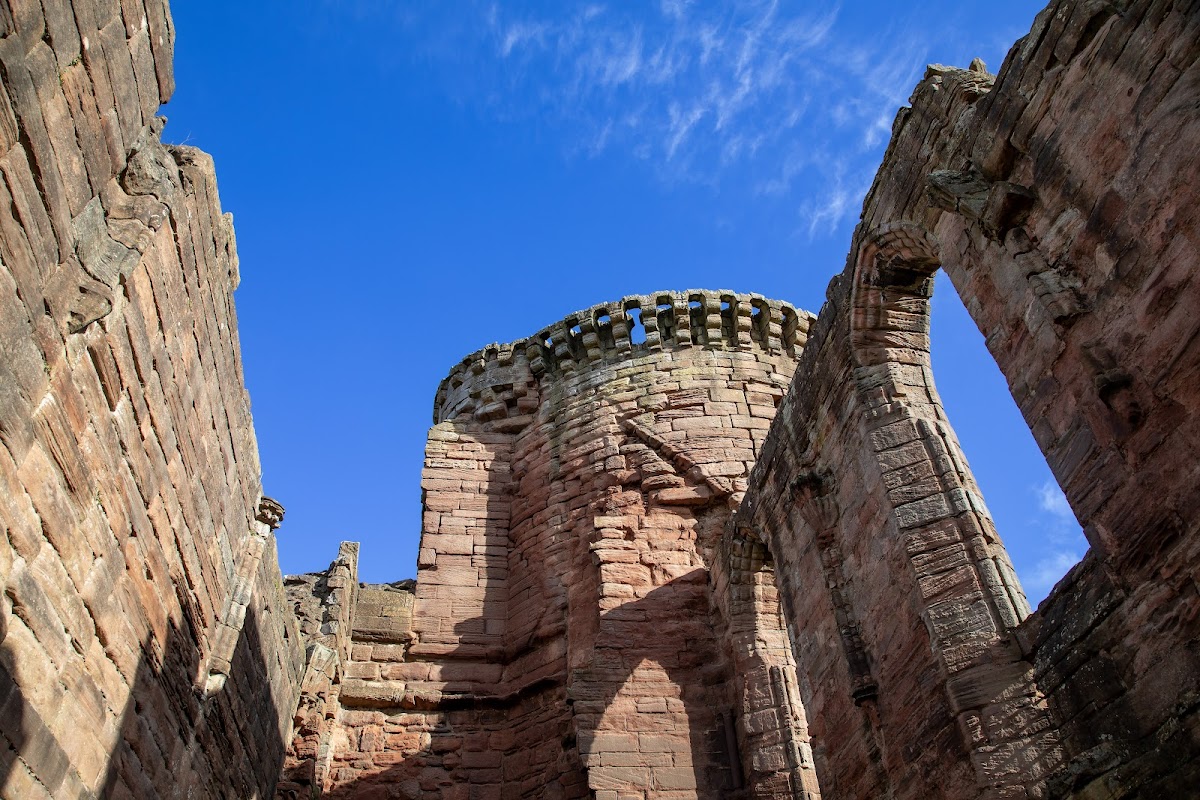
The south-east corner tower is a three-storey fifteenth-century structure. Its battlement is supported by corbels, projecting stone blocks that carry the weight of the upper defensive work.
Eastern residential range
The chapel
Remains of a fifteenth-century chapel survive at first-floor level in the eastern part of the former south wing. The chapel belongs to the rebuilding period that followed the Douglas acquisition of Bothwell and the completion of the principal curtain walls.
The Great Hall and kitchens
The fifteenth-century Great Hall occupies the first floor of the east wing. Three storage rooms lie beneath it. To the north, the kitchen survives through its fireplace and oven, while the north-east tower formed part of the Douglas family’s accommodation from the late fourteenth century.
The north-east tower and gatehouse
The north-east tower was largely destroyed around 1700, but its unusual drawbridge survives. The principal gatehouse, formerly positioned at the centre of the north side, was also demolished around that time. The wall now occupying that position dates from 1987.
Thirteenth-century foundations
Foundations north of the castle belong to the original thirteenth-century design, which remained incomplete. They probably represent a gatehouse flanked by two latrine towers and a round tower containing a well. The form of the surviving round donjon has been compared architecturally with the strongholds of Coucy, Kildrummy, and Dirleton.