Schloss Ebenfurth: A Historic Medieval Fortress in Austria
Visitor Information
Google Rating: 5
Popularity: Very Low
Official Website: schlossebenfurth.at
Country: Austria
Civilization: Early Modern, Medieval European
Site type: Military
Remains: Castle
History
Schloss Ebenfurth stands in the town of Ebenfurth in modern Austria, a stronghold originally established during the medieval period by the civilization of early Austrian nobility. Its earliest mentions date to around 1160 when the site was recorded as a fief under the control of the Diocese of Passau. Initially, the stronghold most likely consisted of a single defensive tower, placing it among the region’s oldest fortifications.
By the mid-13th century, ownership of the site had passed to prominent noble families: first to the Feldsberg or Seefelder lineage by 1250 and then to the Pottendorf family around 1270. Towards the end of the 13th century, after sustaining damage from local conflicts, Duke Albert I of Austria granted the Pottendorfs permission to rebuild and expand the fortress. This reconstruction resulted in a small castle featuring Romanesque design elements, notably surrounded by a protective moat.
In the late 15th century, Schloss Ebenfurth became the focus of military action during the struggles between Matthias Corvinus of Hungary and Frederick III of Habsburg. The castle was seized by Corvinus’s forces but was reclaimed by Austrian imperial troops following Matthias’s death. Over the following centuries, the castle experienced numerous changes in ownership and adaptations reflecting evolving architectural styles.
During the early 1600s, the fortress was given a Renaissance makeover, updating its appearance to reflect contemporary tastes. In the 18th century, it was further remodeled in the Baroque style, significantly transforming its look while retaining its historic character. From 1747 and well into the 20th century, the castle belonged to the Suttner family.
In the 20th century, particularly during the Second World War, Schloss Ebenfurth was repurposed as a shelter for displaced individuals. The war and its aftermath inflicted substantial damage to the structure, which then suffered neglect and vandalism in the following decades, leading it toward a state of ruin. The renewed interest in its preservation began in 2010 when the building was acquired by Serbian singer Dragana Mirković and her partner, who launched extensive restoration efforts.
During these restorations, the discovery of twenty-eight Jewish gravestones and fragments dating back to the 1600s was made within the castle’s defensive walls. This finding shed valuable light on the history of Jewish communities in the regions of Lower Austria and Burgenland, illustrating a historical connection between the fortress and the local cultural heritage.
Remains
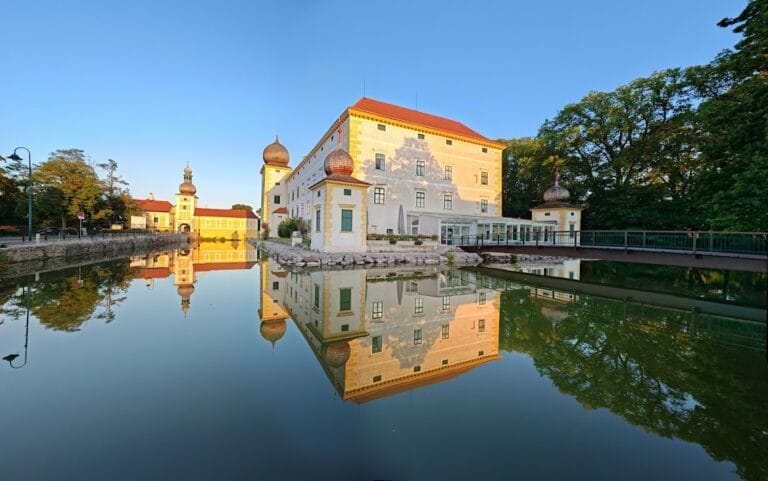
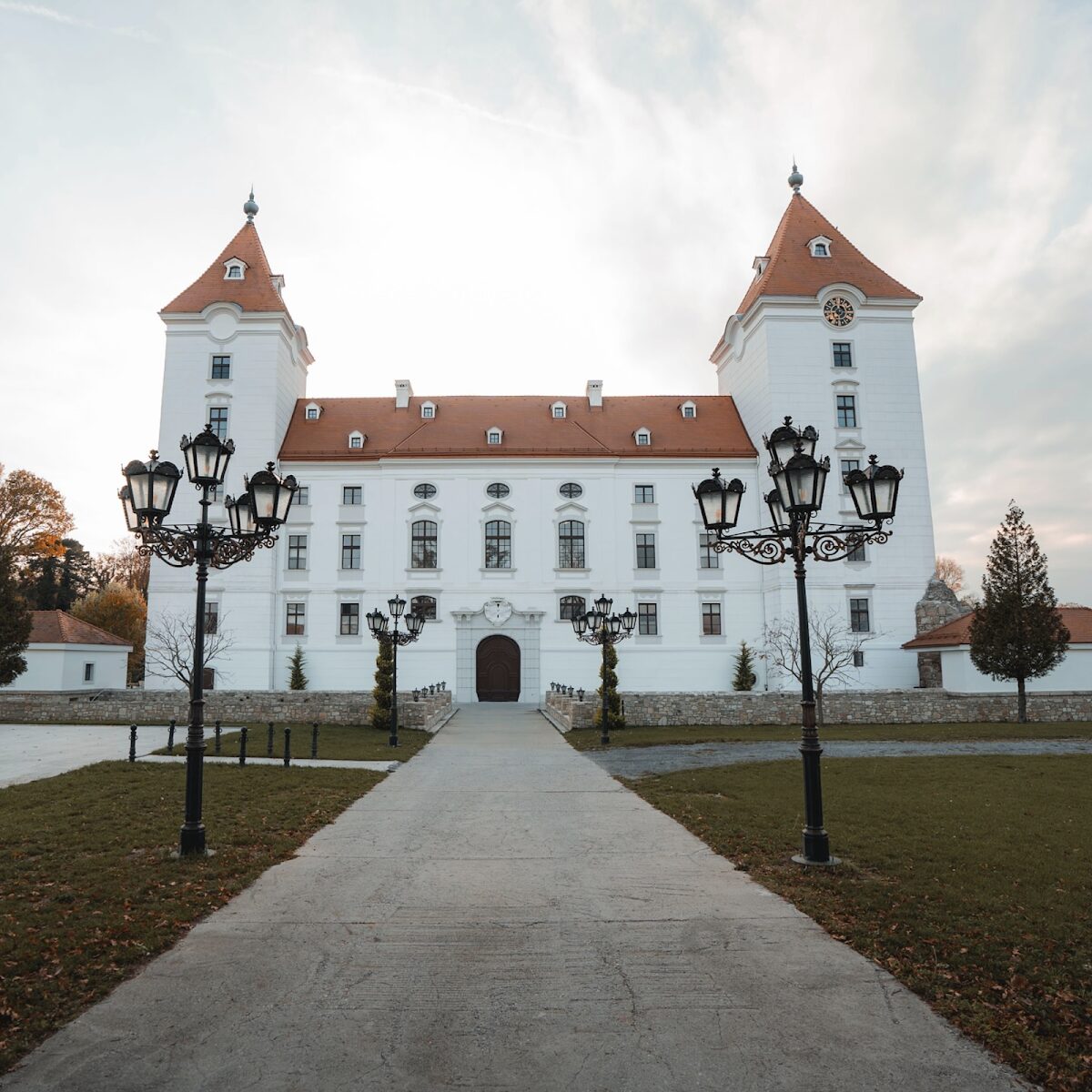
Schloss Ebenfurth is laid out as a large, nearly square complex originally designed as a medieval water fortress. The defensive structure was surrounded by a moat, a common feature intended to impede attackers by surrounding the castle with water. The overall construction demonstrates layers of architectural styles reflecting centuries of adaptation, with the predominant visible character drawn from the Baroque remodeling of the 18th century.
Two prominent towers flank the main façade, maintaining the fortress’s historic silhouette and offering reminders of its medieval origins. These towers served as defensive vantage points and symbolic guardians of the castle’s entrance. The building materials and construction techniques preserved in these towers reflect the building methods typical of their respective eras of construction and renovation.
Within the interior, significant artistic elements have been conserved, most notably 18th-century frescoes created by the painter Franz Anton Maulbertsch. These wall paintings contribute important insight into the cultural and aesthetic priorities during the later Baroque phase of the castle’s history, serving as both decoration and historical testimony.
The structure experienced serious damage during the Ottoman siege of 1529, an event that marks one of the key violent episodes in its history. Further deterioration occurred through later periods of conflict and relative neglect, including widespread vandalism through the 20th century.
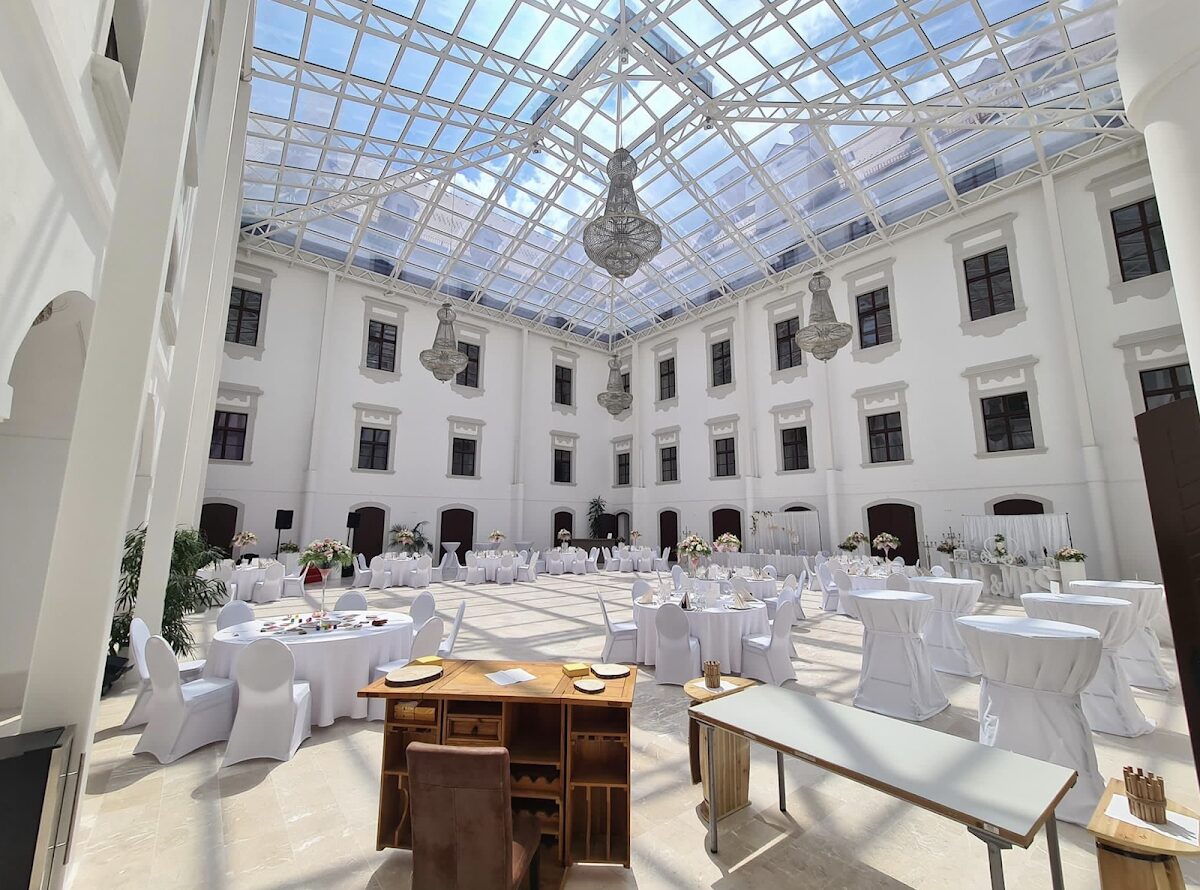
Restoration efforts initiated in the 21st century have focused on stabilizing and repairing critical elements, especially the roof, to protect the castle’s interior from further decay. By 2018, a comprehensive renovation was completed, addressing many structural issues and restoring the building’s external and internal conditions.
Perhaps the most remarkable archaeological discovery at the site during recent work was the unearthing of 17th-century Jewish gravestones embedded within the old fortification’s confines. These tombstones establish a direct physical link between the castle and the surrounding community’s historical Jewish population, underscoring the spatial relationship between the fortress and earlier burial grounds. Their preservation offers a rare glimpse into the religious and cultural history interwoven with the site’s evolution.
Nearby sites