Burg Scharfeneck: A Ruined Hill Castle in Austria


Site at a Glance
- Rating
- 4.3
- Popularity
- Very Low
- Country
- Austria
- Primary era
- Medieval
- Eras represented
- Medieval
- Civilizations
- Holy Roman Empire
- Site type
- Military
- Remains
- Castle
On this page11 sections
History
Early castle and abandonment
Burg Scharfeneck is a ruined hill castle in Baden, Austria, built during the medieval period above the former route through the Helenental near the Schwechat River. Archaeological investigations show that the castle was inhabited around 1100, while a wooden fortification may have occupied the hill as early as the beginning of the second millennium. The site was abandoned no later than the thirteenth century.
The castle may earlier have been known as Veste Wolfsberg, although that identification remains uncertain. Its economic base was limited, leaving it unable to compete with the more powerful neighbouring Rauheneck. This weakness helps explain its early decline and its eventual connection with the Rauhenstein estate complex.
Ownership and later changes
Ownership during the second half of the fifteenth century is unclear, and the periods when the castle was under Hungarian or Austrian control cannot be securely established. Around 1470, Ulrich Kamper separated the ruined castle from the Rauhenstein estate complex. He then entered the landed nobility as Ulrich Kamper of Scharfeneck. Although the ruin was no longer inhabited, it returned to Rauhenstein ownership in 1517, while the name Scharfeneck continued in use.
From the sixteenth century onward, the castle changed hands only as a pledged property. Lightning severely damaged the keep in 1555. Max von Polheim soon took over its administration and commissioned some enlargement work, but the castle had already lost much of its strategic value. It ceased to be inhabited and deteriorated into a ruin, with only a keeper remaining in the gatehouse. A breach several metres wide in a side wall indicates that the castle was deliberately demolished.
Protection and present condition
Since the late twentieth century, the ruins have belonged to the Austrian Federal Forests. Their deteriorated condition has not removed their legal protection as a listed monument in Austria, where Burg Scharfeneck is recorded under identification number 70944.
Remains
Defensive towers and walls
Northeastern bastioned tower
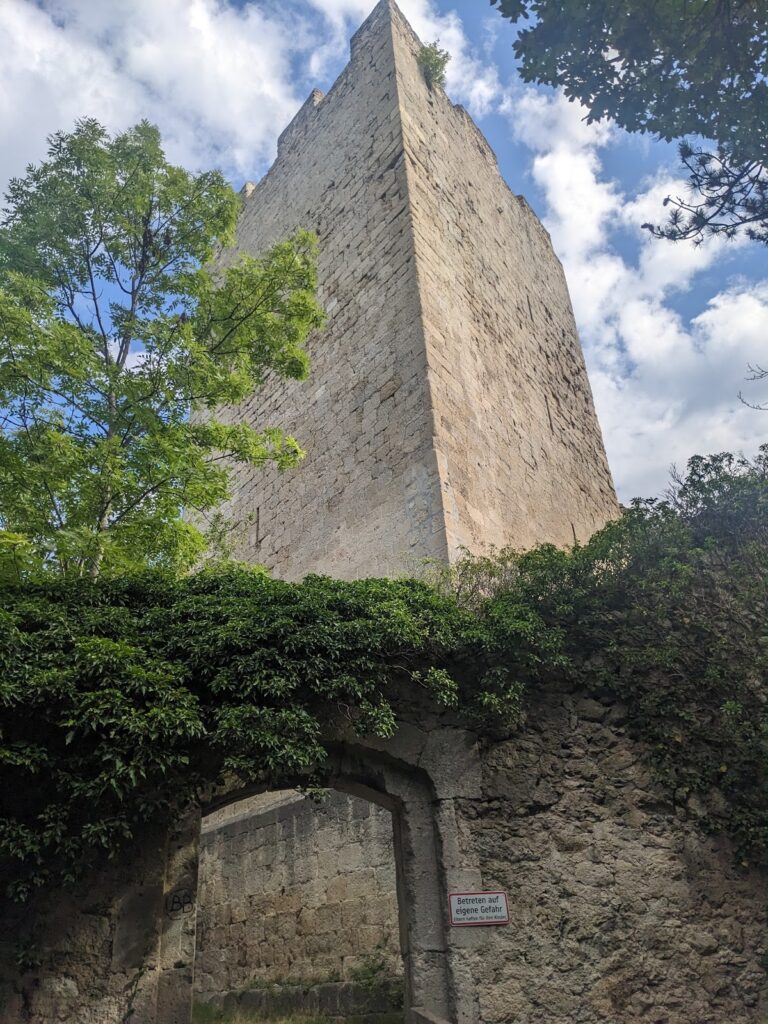
The most complete surviving area lies on the northeastern side of the hilltop enclosure. A projecting round bastioned tower, a tower designed to strengthen defensive fire and protect adjoining walls, rises from the ruins. Its lower section contains numerous narrow, notch-like openings. The tower was originally much taller, but its upper storeys collapsed long ago.
Southwestern elliptical tower
An imposing elliptical tower occupies the southwestern corner. Its walls are approximately 3 to 4 metres thick and were built to carry a defensive platform with parapets and loopholes, narrow openings through which defenders could observe or fire outward. The continuous walls also contain openings resembling notches, with vaulted firing chambers behind them. Window frames in the walls belong to the Late Gothic style and date from the fifteenth century.
Interior structures
Hall and cistern
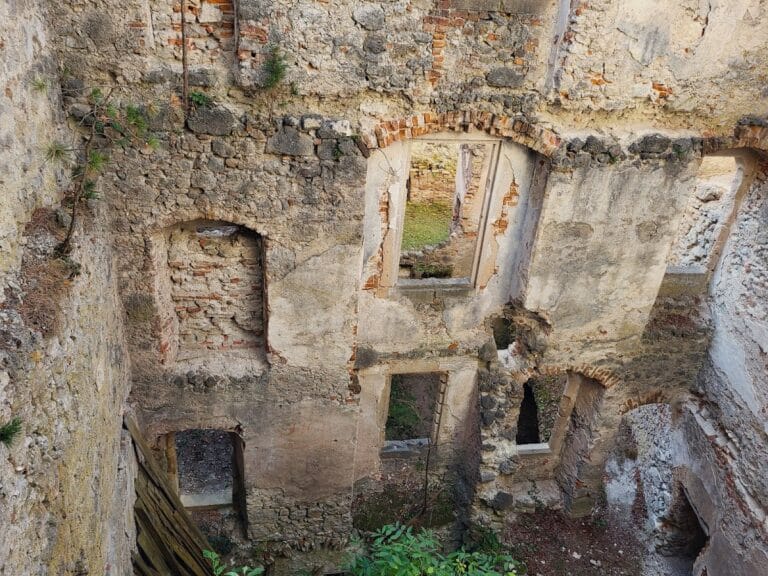
A large hall occupies the ground floor of the surviving complex. Its barrel vault has a substantial opening in its upper section, while a cistern remains below the hall. The inner courtyard is largely filled with rubble and debris from collapsed parts of the castle, making the surviving interior spaces fragmentary.
Spiral staircase and demolished wall
One tower retains parts of a stone spiral staircase. The multi-metre-wide breach in a side wall is another prominent feature of the ruin and is interpreted as the physical result of intentional demolition. Apart from these surviving elements, the other structures of the former fortress have been lost.