Laxenburg Castles: Habsburg Palaces and Historic Parkland in Austria
Site at a Glance
- Rating
- 4.7
- Popularity
- High
- Country
- Austria
- Primary era
- Early Modern
- Eras represented
- Medieval, Early Modern, Modern
- Civilizations
- Habsburg, Holy Roman Empire
- Site type
- Domestic
- Remains
- Palace
On this page23 sections
History
Laxenburg castles are a group of palaces and parkland in Austria, at Laxenburg near Vienna, developed by the Habsburg dynasty from a medieval hunting estate into an imperial residence. The complex includes the Old Castle, the Blue Court or New Castle, and Franzensburg, together with an extensive historic landscape.
Medieval estate and Habsburg expansion
The park began as a large hunting area in the thirteenth century, when it and the Old Castle belonged to the Lords of Lachsenburg. After the family died out in the fourteenth century, the estates passed to the Habsburgs, the dynasty that ruled the Austrian lands and later the Austro-Hungarian Empire.
Albrecht III remodelled and enlarged the hunting lodge. The building later deteriorated, until Emperor Leopold I commissioned Lodovico Burnacini to renovate and reshape it in the Baroque style. The Old Castle was destroyed during the Second Siege of Vienna, the 1683 Ottoman assault on the Habsburg capital, and was rebuilt in 1693 with an additional storey. Its original moats were filled during the eighteenth century.
Imperial residence
Laxenburg became an important Habsburg residence during the reign of Emperor Charles VI and remained a major place of residence until the end of the Austro-Hungarian Monarchy. The Laxenburg Alliance, a defensive military agreement formed in 1682 by several imperial powers in response to the expansionist policy of Louis XIV of France, was concluded here.
Under Maria Theresa, who ruled from 1740 to 1780, a long avenue connected Schönbrunn with Laxenburg along the route of today’s Schönbrunner Allee. The imperial court also had a railway built between Laxenburg and the Southern Railway at Mödling. Until the First World War, the Old Castle and the New Castle served as spring residences for the Habsburgs.
Emperor Franz Joseph I and Empress Elisabeth spent their honeymoon at Laxenburg in 1854. Their children Gisela and Crown Prince Rudolf were born there in 1856 and 1858. Emperor Franz II, later Emperor Franz I of Austria, gave his name to Franzensburg, which was built on an island in the castle pond.
War, court administration, and political change
Emperor Charles I lived at Laxenburg almost continuously in 1917 and 1918. Its closeness to the army high command at Baden, which he personally directed, kept him near military headquarters while allowing political contacts away from constant observation in Vienna. Petitions addressed to him were also processed at Laxenburg.
Several aristocratic families and senior officials, including the Esterházy, Daun, Auersperg, and Chotek families, built small palaces or villas near the imperial residence. Later expansion of the imperial estates removed most of them, although the Green House survived.
After the monarchy ended, administration passed from the Habsburg-Lorraine Family Fund to the War Victims Fund. A company formed in 1922 to develop the property commercially failed in 1924, and Laxenburg returned to the War Victims Fund. In 1938, Laxenburg and its castles became part of Greater Vienna as its twenty-fourth district.
The Blue Court and its ancillary buildings were then used by the Wehrmacht, the unified armed forces of Nazi Germany, as a military depot. Most furniture and works of art were transferred to museums in Vienna. The Soviet Army occupied the castles and large parts of the park in 1945.
Education, restoration, and present uses
From 1925, the Old Castle housed the Hellerau Laxenburg School for Rhythm, Music, and Physical Education. Established in 1919, the internationally influential school was particularly associated with modern dance in Vienna. Antisemitism forced it to close in 1938.
By 1955, the castle complex was in very poor condition. Representatives of Lower Austria and Vienna created Schloss Laxenburg Betriebsgesellschaft mbH in 1962 to manage the castles and park, while the City of Vienna retained administration of the agricultural estate. The Old Castle, including its chapel, underwent thorough renovation during the 1970s after wartime and postwar damage. Part of the Austrian Film Archive has been housed there since 1970, and the chapel is used for concerts, weddings, and other celebrations.
The Blue Court also experienced several distinct phases of ownership and use. First recorded as a free estate in 1544, it belonged at different times to Melchior Arguello, Friedrich Karl von Schönborn, Count Adolf Metsch, and members of the Daun family. Maria Theresa acquired it in 1762 and ordered further enlargement. At the beginning of the First World War, Franz Joseph converted it into a military hospital. Charles I moved the imperial court from Schönbrunn to the Blue Court on 15 March 1917, and it remained there until the court moved to the Imperial House in Baden on 6 February 1918. During the postwar Soviet occupation, the building served as a Red Army command post.
Remains
The complex occupies approximately 250 hectares. Its historic landscape contains three principal castles, a pond of about 25 hectares, wooded islands, winding paths, channels, ponds, and numerous garden structures. The park developed from a hunting domain into an English landscape garden after 1780. This style used irregular planting, winding paths, water, and naturalistic scenery rather than strict geometric formality. From the mid-1790s, Emperor Franz II/I created the Rittergau, a neo-medieval garden area designed for private pleasure and as a dynastic monument.
Castles and imperial buildings
Old Castle
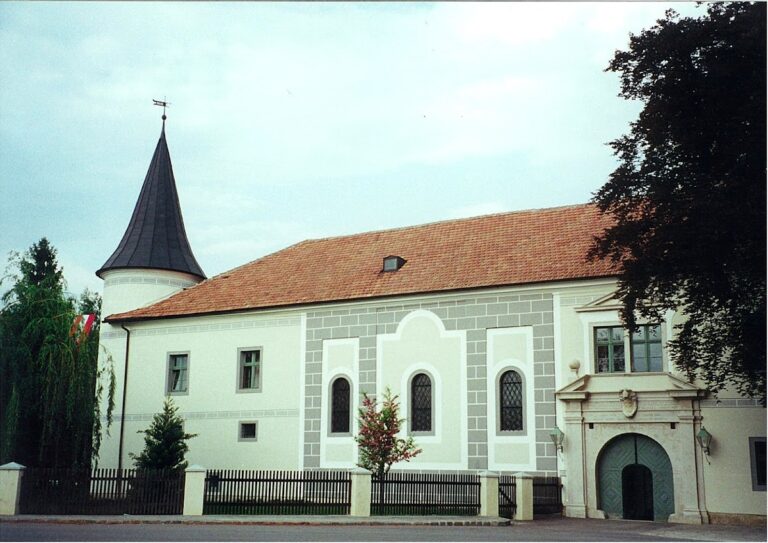
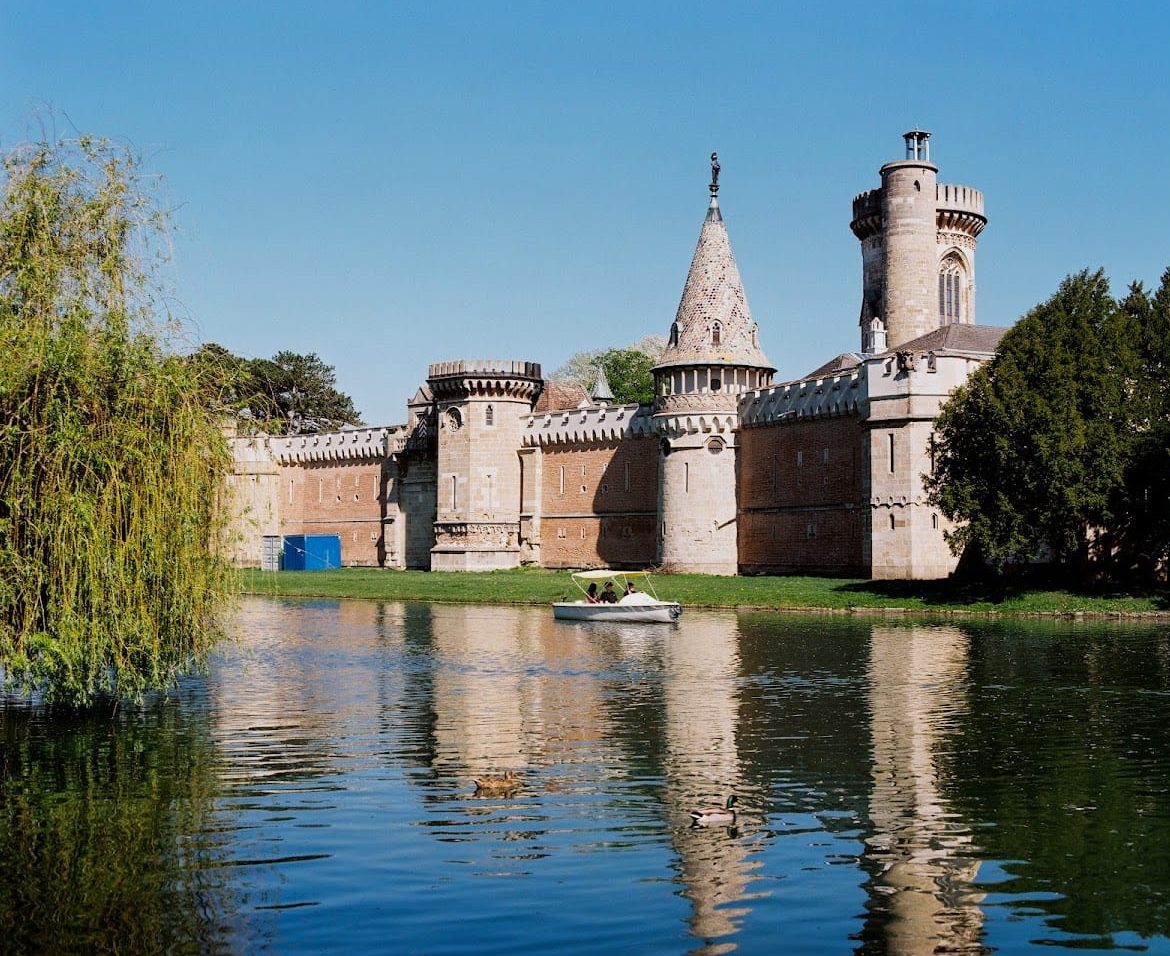
The Old Castle incorporates a tower chapel first mentioned in 1332. A new chapel was built in 1389, receiving statues from a chapel on Leopoldsberg and furnishings from Vienna’s Salesian Church of Saint Anne. The chapel was remodelled in the Baroque style in 1755. The castle itself was rebuilt after its destruction during the Second Siege of Vienna, raised by one storey, and later thoroughly renovated in the 1970s.
Blue Court
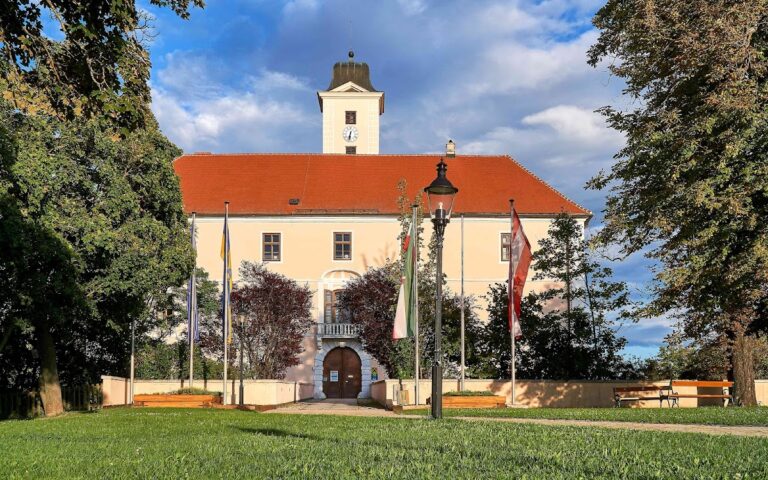
The Blue Court, also called the New Castle, was enlarged between 1710 and 1720 by Friedrich Karl von Schönborn, with work carried out by Lucas von Hildebrandt. Maria Theresa later commissioned extensive rebuilding by court architect Nikolaus Pacassi, including the dining-room wing and palace theatre. A Belvedere, an elevated pavilion designed to provide a view, was added to the east wing around 1774. Its interior contains illusionistic paintings, with Josef Pichler, Vinzenz Fischer, and Johann Wenzel proposed as possible artists. Kaiserstein, a hard architectural stone, appears in the staircase of the colonnaded hall and grand staircase.
The dining-room wing and palace theatre are administered by the International Institute for Applied Systems Analysis and serve as a conference centre. The complex also retains the former Green House, one of the small aristocratic villas that once stood around the imperial estate.
Franzensburg
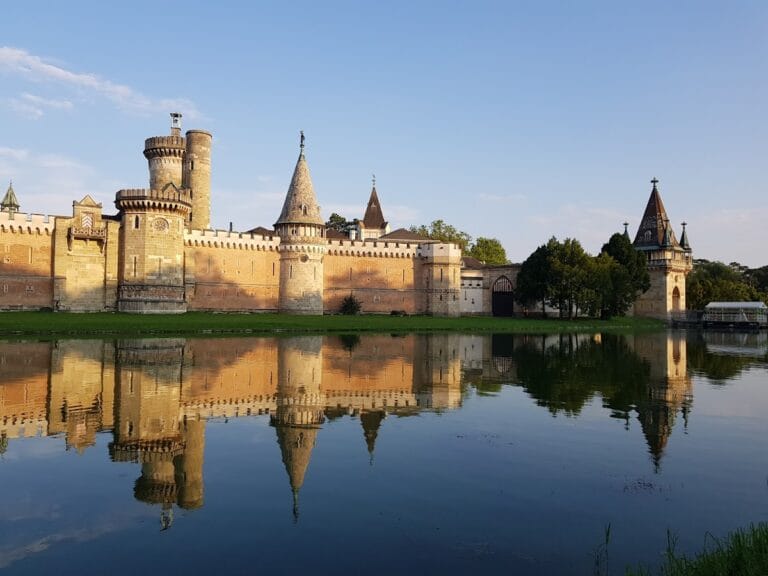
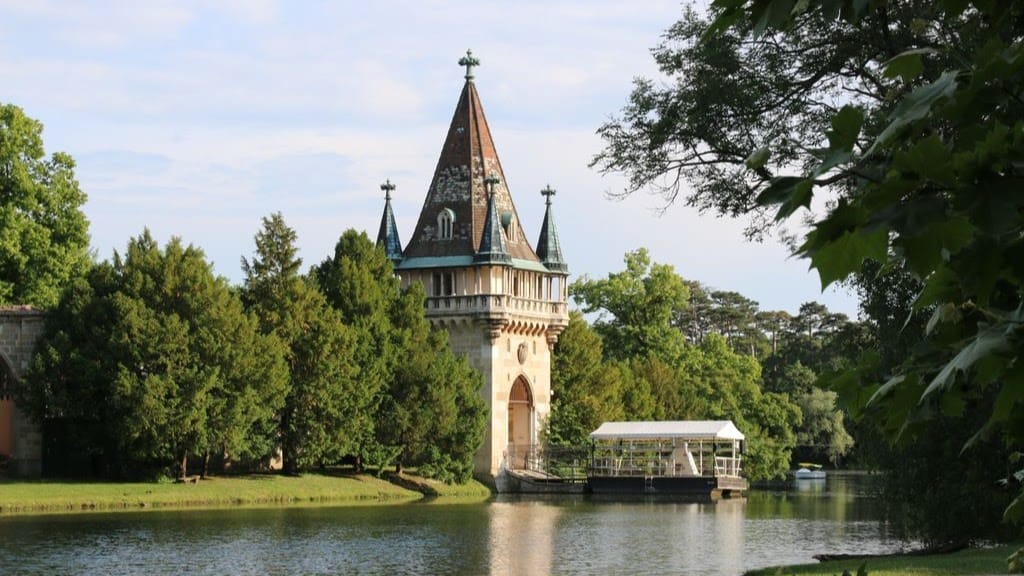
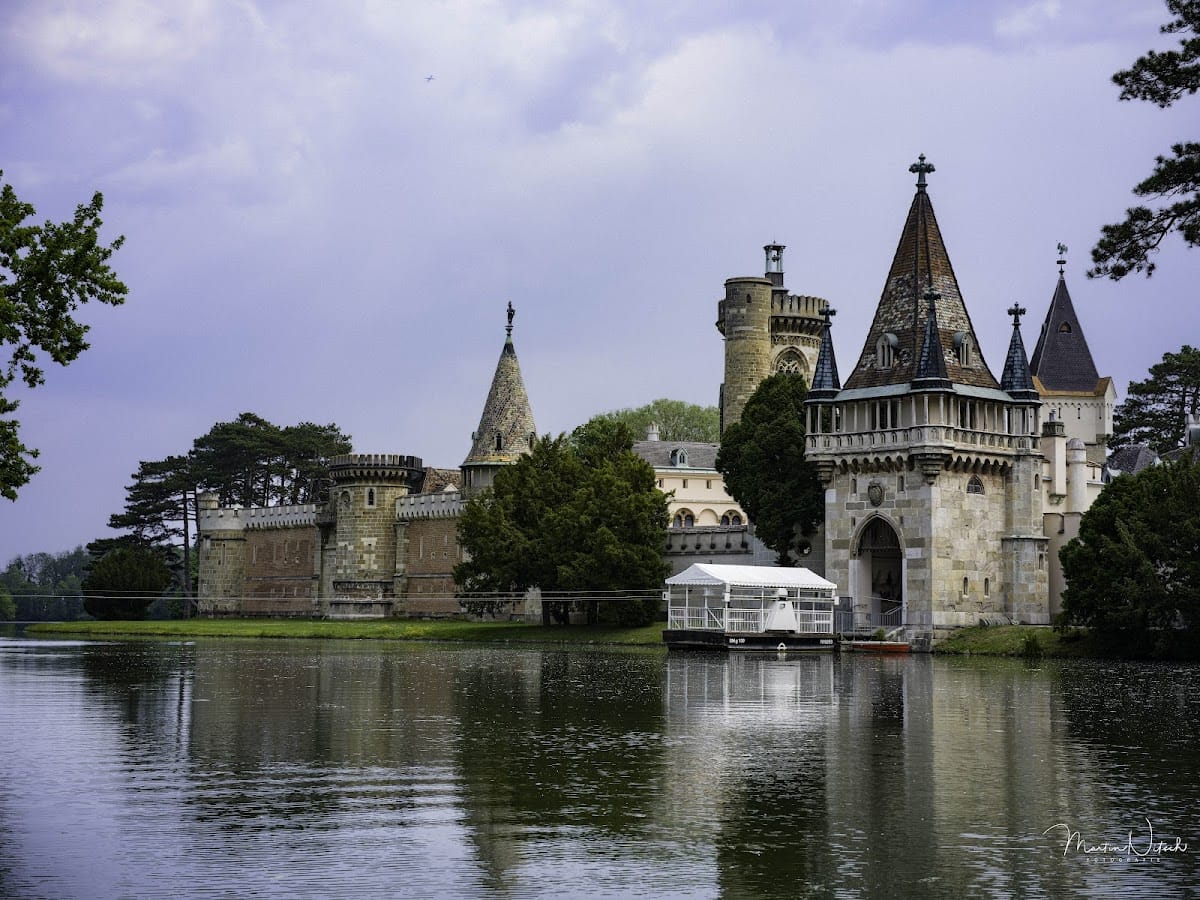
Franzensburg was built between 1801 and 1836 on an island in the castle pond in a historicist medieval style. An iron bridge links the island with the mainland to the south, while other wooded islands occupy the pond.
Water system and landscape
Castle pond and channels
The central pond covers approximately 25 hectares and is described as the largest of its kind in Austria. Emperors, kings, and members of the court rowed there. The park was originally crossed by the Schwechat, while the Triesting Canal, constructed in 1801, brought water from Münchendorf into the grounds. The Heidbach forms another inflow and receives the Badener Mühlbach.
Water leaves the pond through the Lobenbach and flows into the Mödlingbach before reaching the new Schwechat near the Triesting confluence. The Triesting Canal divides into several channels in the park. The Heidbach enters a northern channel, which joins the Forstmeister Canal and continues through channels historically called the Gross Loben, Loben Bach, and Triesting Canal. A former mill-channel branch remains identifiable, although it is dry. The Schwechat was relocated eastward during the 1920s.
Forstmeister Canal and Great Cascade
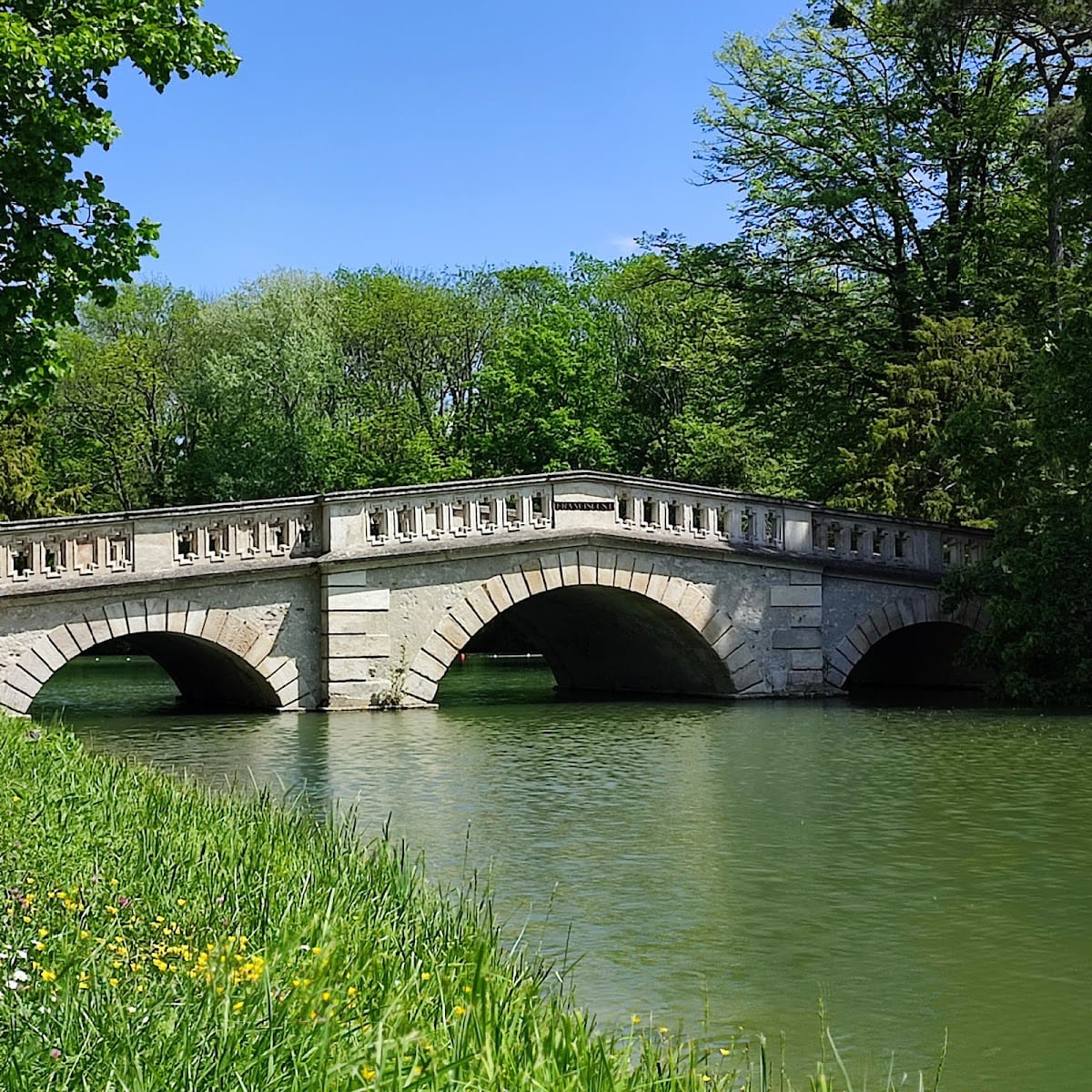
The Forstmeister Canal was laid out in the eighteenth century and crosses the Münchendorf axis. The Great Cascade marks its end. The former rural hamlet of Fischerdörfl has disappeared, but a bridge preserves its name. The former course of the Schwechat also places the park within the river’s floodplain landscape.
Garden structures and historic features
Green Pleasure House
The Green Pleasure House stands on the longitudinal axis of the Baroque forest star. Built around 1760 as an octagonal pavilion dedicated to Diana, the Roman goddess associated especially with hunting, it uses treillage, an open garden-lattice framework. Maria Theresa favoured the pavilion and reportedly played cards there.
Rittergau features
The Knight’s Crypt and Knight’s Column are historic features associated with the Rittergau. The Rock Grotto was intended to contain a model of Habsburg Castle, but the project was never completed. The Tournament Ground is another surviving historic area within the park.
Temples, bridges, and memorials
The Concordia Temple is a circular structure with Corinthian columns decorated with acanthus leaves. Emperor Ferdinand I erected another temple on Mariannen Island for his wife Maria Anna, and the structure survives as a ruin. Beside the Goldfish Pond, a Chinese bridge and pavilion designed by Johann Ferdinand Hetzendorf von Hohenberg once stood; only the stone base survives.
A colossal bust of Emperor Franz I, created by Giovanni Battista Comolli at the commission of the City of Milan, was installed in the park in 1836. Lombardy belonged to the Austrian Empire until 1859. The grounds also contain a dovecote approximately 200 years old, numerous oak trees, and a fallen oak estimated to be 200 to 300 years old. Some old oaks are protected by heritage authorities.
House of Laune
The House of Laune was built around 1798 by Hetzendorf von Hohenberg. Its original plan included an octagonal central building, four low wings, and numerous decorative elements. Military conflict in 1809 badly damaged it, and a 1814 renovation replaced its earlier character with a simple Early Neoclassical facade. Further wartime damage during the Second World War left the foundations and walls. The ruin was restored in 2019 and 2020, including a protective roof over the wall crest.
Ice cellars and horse installations
The Court Ice Cellars probably served to obtain ice from the castle pond. During the First World War, the stables were used to transfer Lipizzaners, the classical riding horses associated with the Habsburg court and the Spanish Riding School, from Slovenia to Vienna. The surviving Ross Schwemme at Johannesplatz was used to wash horses and vehicles, and remains associated with that service.
Associated infrastructure
Imperial railway station
The imperial railway station stands outside the main complex but was directly associated with the residence. It was the terminus of the former Laxenburg Railway and has been reconstructed to resemble its 1847 appearance. A former water route also connected Vienna with Laxenburg through the Wiener Neustädter Canal, where excursion boats travelled until the route lost popularity around 1830 because of the long journey.
Former service buildings
The park formerly included additional coach houses, pleasure houses, gardens, and service areas. One former coach house now contains the City of Vienna’s Bio Estate Laxenburg. Another former coach-house area connected with hunting administration houses the central depot of the Austrian Film Archive.
Kaunitz-Wittgenstein Palace
The nearby Kaunitz-Wittgenstein Palace became a monastery and provincial house for the Sisters of the Holy Cross in 1912, and the sisters operated schools there. Part of the building now houses the International Anti-Corruption Academy, described as the first training institution of its kind worldwide.