Schloss Aschhausen: A Historic Castle in Schöntal, Germany
Visitor Information
Google Rating: 4.7
Popularity: Very Low
Official Website: www.schloss-aschhausen.de
Country: Germany
Civilization: Early Modern, Medieval European, Modern
Site type: Military
Remains: Castle
History
Schloss Aschhausen is located in the municipality of Schöntal, Germany. The site originated as a medieval fortified residence built by local nobility during the Middle Ages.
The first mention of Aschhausen dates back to 1165 through Theoderich de Askehusen, indicating the existence of a lordly seat at that time. The earliest surviving structure, the bergfried or keep, was constructed sometime in the 13th or 14th century. By 1315, the castle had become a fiefdom under the authority of the Archbishopric of Mainz, linking it to the ecclesiastical power of the region.
In 1523, the castle suffered major destruction following military action by the Swabian League, led by Georg Truchsess von Waldburg. This campaign was a response to the support given by Hans Georg von Aschhausen to the outlaw knight Hans Thomas von Absberg. The castle’s conquest and ruin were chronicled in a woodcut by the artist Hans Wandereisen, a valuable contemporary record of this conflict.
Rebuilding efforts occupied much of the 16th century. The round tower was added in 1537, and the original bergfried was reshaped in 1568. Later, in 1579, a new structure was erected in the lower part of the castle complex. The family of Aschhausen produced notable figures such as Johann Gottfried von Aschhausen, who served as Prince-Bishop of Bamberg and Würzburg from 1575 to 1622. However, the noble line came to an end by the mid-1600s.
In 1671, ownership of the castle and associated land passed to the abbots and convent of Schöntal Abbey. Under the leadership of abbots including Christoph Haan, Benedikt Knittel, and Angelus Münch, the castle received substantial alterations early in the 18th century. Additions from this period include two towers and the elongated main building that define much of the castle’s current form. The castle chapel was consecrated in 1748 by the auxiliary bishop von Gebsattel, marking its religious significance within the monastic estate.
Following the secularization and dissolution of Schöntal Abbey in the early 19th century, the castle became a fief granted by Duke Friedrich II to Johann Friedrich Karl Count von Zeppelin in 1803. The Zeppelin family retained ownership, with descendants continuing to hold the property. A new residential wing was constructed between 1912 and 1914, designed by Ernst Haiger for Count Johann Friedrich Alexander Fürchtegott von Zeppelin. During World War II, in 1945, the round tower built in 1537 was destroyed by fire but later rebuilt.
From the 1950s onward, the estate transitioned from tenant farming to direct management by the Zeppelin family. Agricultural activities included the cultivation of grains, sugar beets, maize, and rapeseed, alongside raising pigs, cattle, and turkeys. The castle also established a museum displaying family heirlooms such as coins, tiled stoves, hunting weapons, and trophies, preserving its heritage and material culture.
Remains
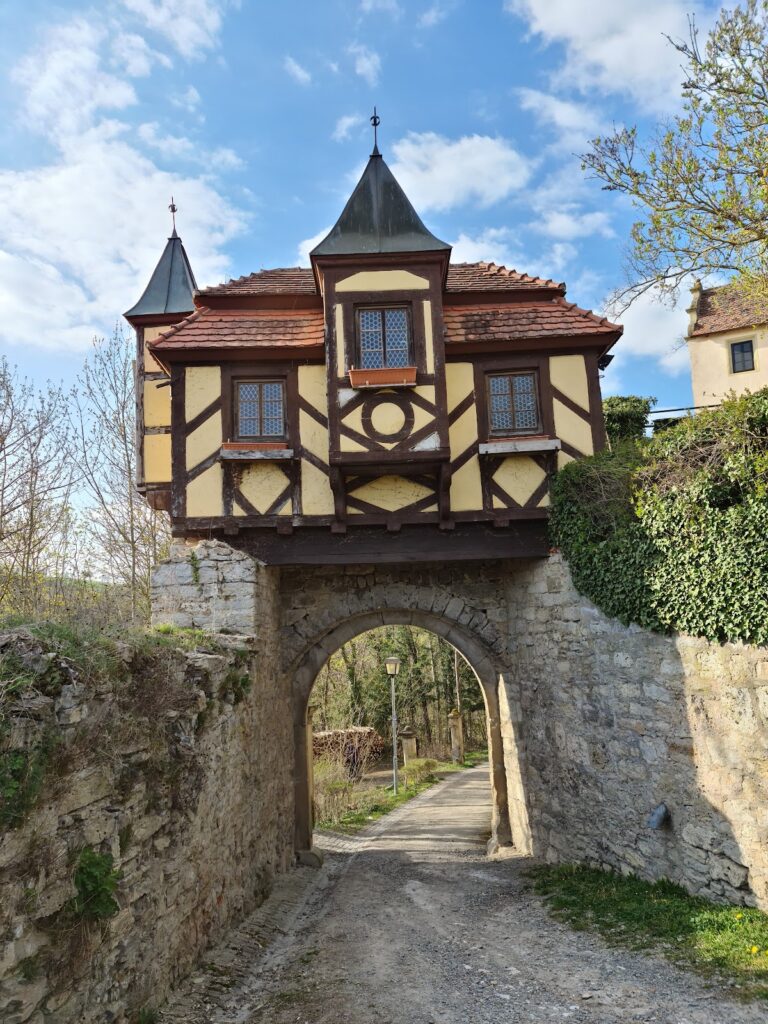
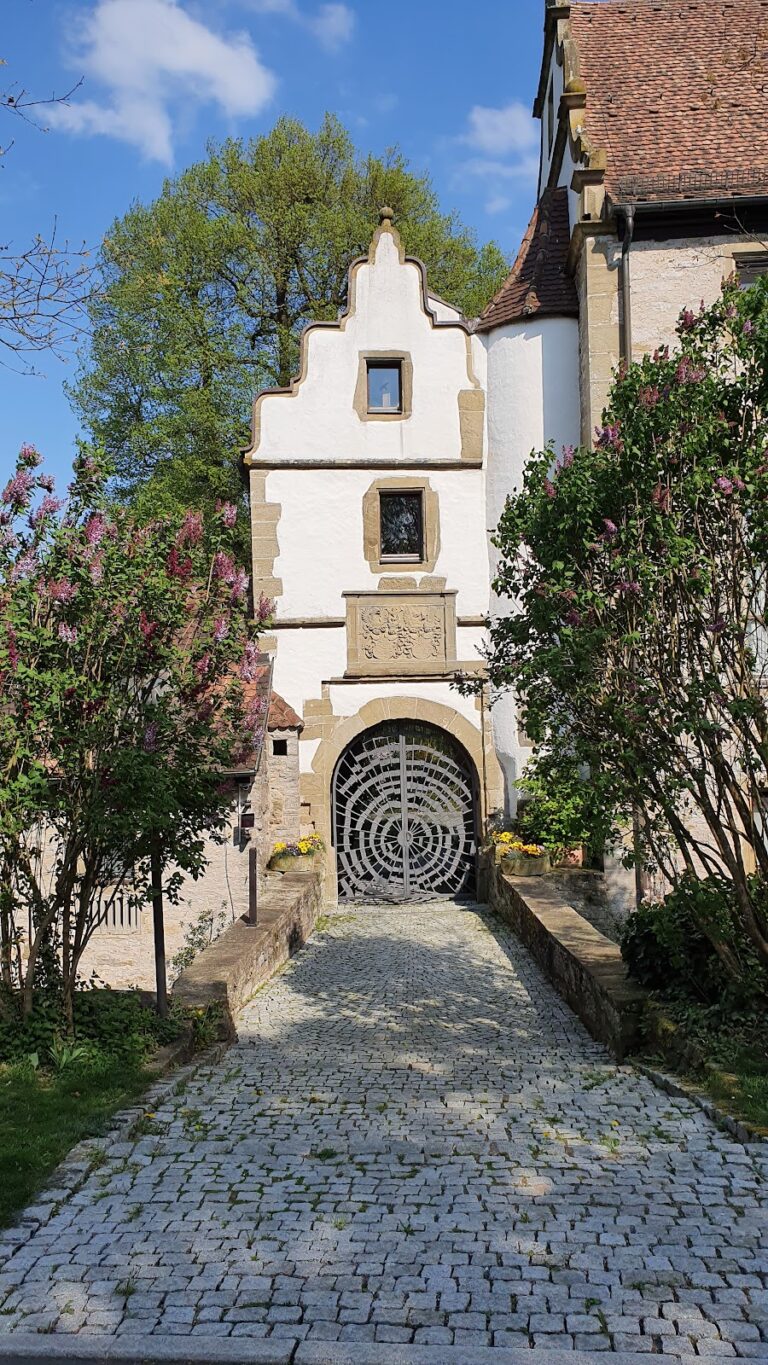
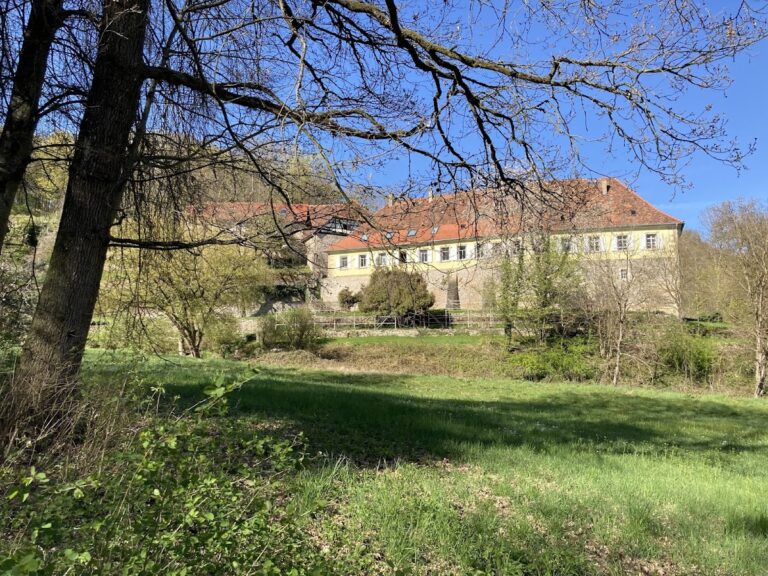
Schloss Aschhausen consists of a roughly rectangular group of buildings arranged around a central courtyard. The complex blends medieval and later construction styles, with masonry and timber framing present throughout. The north side houses the main entrance, where a long, older castle building with two towers serves as a gatehouse leading into the courtyard.
The eastern portion preserves the castle’s oldest elements. This includes the bergfried, a tall, fortified keep dating back to the 13th or 14th century, notable for its defensive purpose. Nearby stands the round tower constructed in 1537, which was connected to the courtyard by a bridge. Although this tower burned down during World War II, it has since been fully reconstructed. Alongside these features is a granary originally built in the 16th century, demonstrating the site’s agricultural role. This granary has been adaptively reused as a spacious banquet hall capable of accommodating around 200 guests, complemented by adjoining kitchen and sanitary facilities.
The southern section of the castle complex contains the estate’s administrative building known as the “Leutewohnung,” as well as a distillery, reflecting functional additions from later periods. To the west, a group of utility buildings encloses the courtyard, forming a stable and service area. Between these western facilities and the old castle building at the northwest corner, the most recent addition—a residential wing constructed between 1912 and 1914—is situated, marking a significant architectural expansion in the 20th century.
West of the castle lies a small former park, historically used for cultivating flowers and vegetables. While it has since been simplified to lawn areas, it currently includes a swimming pool, indicating ongoing adaptations of the grounds.
The castle chapel, originally dating to the 17th century and consecrated in 1748, stands as a significant religious feature within the estate. The old castle building also contains a hall used for concerts and seminars, accommodating about 60 people, and the malt cellar below serves similarly for events, illustrating the castle’s multifunctional use.
A noteworthy symbolic element is the coat of arms placed above the gatehouse entrance. This emblem was recorded in the 1523 woodcut by Hans Wandereisen that depicted the castle’s destruction, linking the castle’s physical presence with its historical legacy.
Throughout the complex, the combination of solid masonry walls and upper floors built with half-timbering reflects construction techniques visible in the 1523 illustration, showcasing continuity of style alongside various phases of expansion and restoration.
Nearby sites