Schloss Neuenstein: A Renaissance Palace and Museum in Germany


Site at a Glance
- Rating
- 4.5
- Popularity
- Low
- Country
- Germany
- Primary era
- Early Modern
- External website
- Open
- Eras represented
- Medieval, Early Modern, Modern
- Civilizations
- German, Holy Roman Empire
- Site type
- Domestic
- Remains
- Palace
On this page11 sections
History
Schloss Neuenstein is a Renaissance palace and museum in Neuenstein, Germany, developed from an early 13th-century Hohenstaufen moated castle. The Hohenstaufen were the medieval German ruling dynasty associated with emperors including Frederick II. The original fortress stood on a sandbank in a swampy landscape beside an old long-distance route linking the Rhine, Wimpfen, and the Danube.
From Hohenstaufen Castle to Hohenlohe Possession
Around 1230, the castle belonged to the Lords of Stein, whose descendants later took the name von Neuenstein. Around 1300, it passed to the House of Hohenlohe, a German noble family whose territories were later divided among several lines. The Hohenlohe family still owns the castle.
One early connection between Neuenstein and the Hohenlohe dynasty involved Gottfried I von Hohenlohe, who lived at Weikersheim Castle. He followed Emperor Frederick II and served as tutor to Frederick’s son, Conrad IV. After allegedly surviving a murder plot in Regensburg in 1250, Gottfried received fiefs from King Conrad in gratitude for his assistance. These grants included the bailiwick, an administrative and judicial office, of the canons’ monastery at Öhringen, founded in 1037, together with castles and manorial estates at Neuenstein and Waldenburg.
The Hohenlohe territories and castles were repeatedly divided between successive generations. In the principal division of 1551, Count Ludwig Casimir of Hohenlohe-Neuenstein founded the Neuenstein line. Its possessions included Langenburg, Ingelfingen, Öhringen, and Kirchberg. His half-brother Eberhard established the Waldenburg line, which held Waldenburg, Bartenstein, and Schillingsfürst. Neuenstein belonged to the Protestant branch of the family.
Renaissance Transformation
The complex was enlarged during the 15th century. Count Ludwig Casimir later commissioned Balthasar Wolff, a master builder from Heilbronn, to turn the medieval castle into a Renaissance palace. The Renaissance was a European cultural and artistic period that revived classical forms and shaped architecture and court culture from roughly the 15th through the 17th centuries. Building continued until the beginning of the 17th century, while the Eschelbacher Steige served as an important route for transporting construction materials and provisioning the enlarged residence.
Decline, Museum, and Modern Residence
When Wolfgang Julius von Hohenlohe-Neuenstein died in 1698, the family moved its residence to the former canons’ monastery at Öhringen, which was remodeled in the Baroque style. Neuenstein then stood empty and deteriorated. In later periods, parts of the complex were used as a penitentiary and workhouse, a retirement home, and an orphanage. Workshops also operated within the castle.
Renovation began in the Imperial Hall in 1870. An antiquities collection transferred from Kirchberg Castle became the foundation of a Hohenlohe family museum, one of the first private museums in Germany. It opened to the public in 1878. At the beginning of the 20th century, Prince Christian Kraft of Hohenlohe commissioned the architect and castle researcher Bodo Ebhardt to carry out a comprehensive restoration. The work lasted from 1906 to 1925 and included a new upper floor, which offered greater living comfort than the Renaissance floors.
Neuenstein became both a museum and the residence of the Hohenlohe-Oehringen owner after the family’s Silesian residence was expropriated in 1945. Kirchberg and Ingelfingen castles were sold in 1952, followed by Öhringen in 1961 and the Friedrichsruhe hunting lodge in 2005. The castle also houses the Hohenlohe Central Archives, the shared family archive of the House of Hohenlohe, overseen by the State of Baden-Württemberg. Its cultural role continues in the Knights’ Hall, which regularly hosts concerts associated with the Hohenloher Kultursommer, a regional summer cultural festival.
Remains
Castle Layout and Exterior
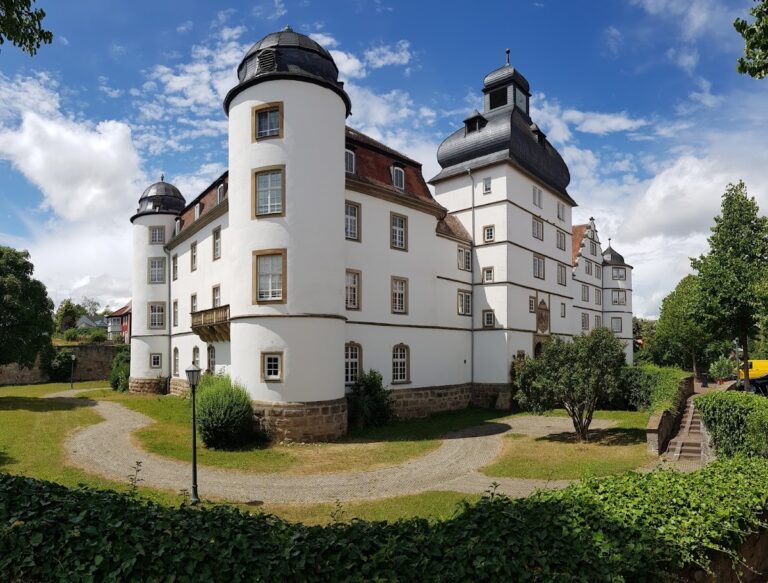
Schloss Neuenstein survives as a closed four-wing Renaissance complex rising six storeys. Its compact form encloses the castle interior, while the northwest corner incorporates the Romanesque keep of the earlier fortress. A keep is the principal fortified tower of a castle, and Romanesque architecture is characterized by massive masonry, round-headed openings, and strong, simple forms. Two other corners are marked by high round towers, preserving the defensive elements within the later palace design.
Entrance Bridge and Portal
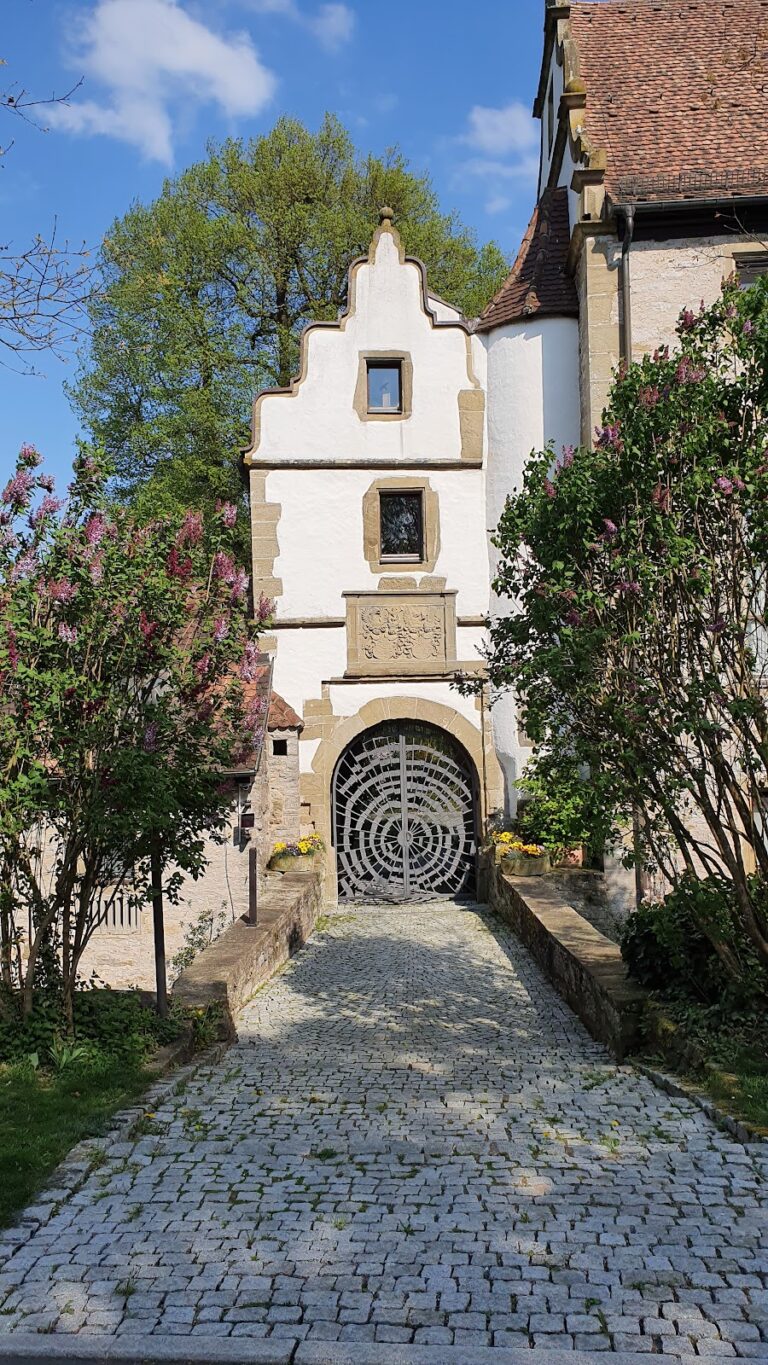
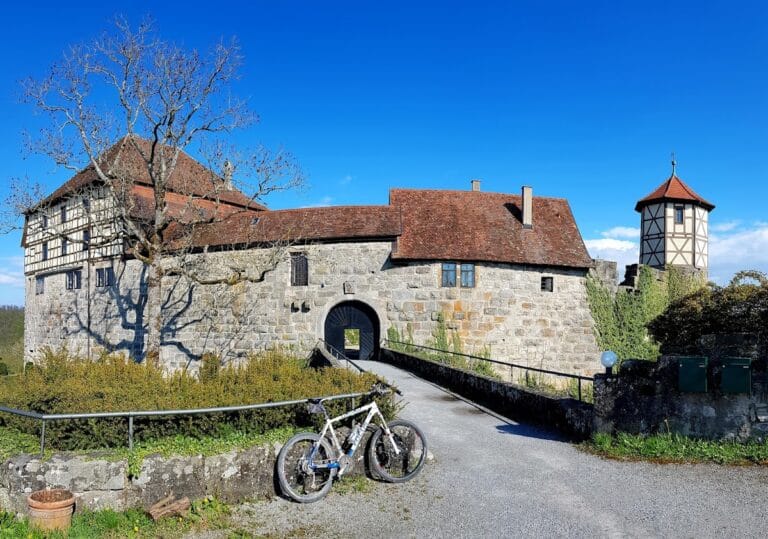
A bridge crosses the former moat to the entrance portal. The portal bears the coats of arms of Count Ludwig Casimir of Hohenlohe-Neuenstein and his wife, Anna von Solms-Laubach, linking the principal approach to the family responsible for the Renaissance transformation.
Halls, Kitchen, and Collections
Knights’ Hall
The Knights’ Hall extends for 41 metres and is more than 10 metres wide. It remains one of the principal interior spaces of the palace and continues to serve as a setting for concerts.
Imperial Hall and Castle Kitchen
The castle museum includes the Imperial Hall and a late-medieval castle kitchen. The kitchen remains largely in its original condition and is still fully functional, providing a surviving example of the working facilities associated with the historic residence.
Art and Rarities Cabinet
The collections include art-historically important objects, hunting weapons and trophies, Renaissance works of art, curiosities, and commemorative objects. The art and rarities cabinet, a collection of unusual natural specimens, artworks, antiquities, and other objects, contains a hat attributed to King Gustav II Adolf of Sweden, a shoe associated with Empress Catherine the Great, and a nearly fist-sized bladder stone belonging to the Count of Nimburg. Antiquities transferred from Kirchberg Castle also remain part of the Hohenlohe family museum holdings.
Nearby sites