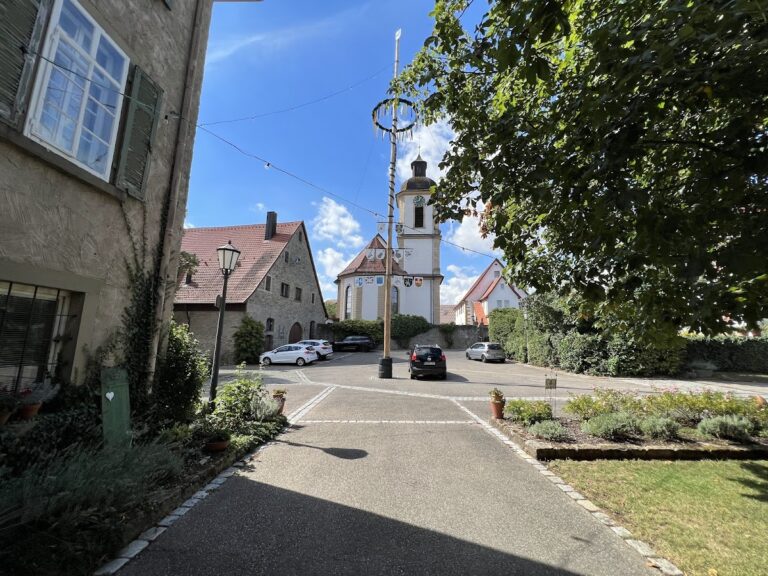
Domeneck: A Castle Estate near Möckmühl, Germany


Site at a Glance
- Rating
- 4
- Popularity
- Very Low
- Country
- Germany
- Primary era
- Early Modern
- External website
- Open
- Eras represented
- Medieval, Early Modern
- Civilizations
- Holy Roman Empire
- Site type
- Domestic
- Remains
- Castle
On this page11 sections
History
Domeneck is a castle complex in Germany near Möckmühl, beside the ruins of a medieval castle first mentioned in 1270. The complex stands near Züttlingen, now a district of Möckmühl, and its history reflects the division and transfer of feudal property among noble families and the territories of Württemberg, the Electoral Palatinate, and Würzburg.
Medieval origins and divided lordships
A castle belonging to the Tumminge von Domeneck was first recorded in 1270. It stood a few metres north of the present Domeneck Castle. The castle was originally held as a fief of the Lords of Weinsberg. A fief was property granted by a superior lord to a vassal in return for service and loyalty. The Lords of Weinsberg sold this fief to the Electoral Palatinate, a major principality of the Holy Roman Empire, around 1450.
In 1420 the castle passed to Engelhard von Berlichingen, who was married to a sister of Poppo von Domeneck. Four years later, the von Berlichingen family sold Domeneck Castle and Assumstadt to the Stumpff von Schweinberg family. Hartmann Stumpff von Schweinberg received Domeneck as a Palatine male fief in 1454. Philipp Stumpff von Schweinberg inherited it in 1473 and acquired Hartmann’s remaining share in 1485.
Fifteenth-century inheritances created a complicated division of the estate. One portion belonged to the Palatinate, and later to Württemberg, and was associated with the estate of Beringer von Berlichingen’s widow. Another belonged to Würzburg, an ecclesiastical principality ruled by a prince-bishop, and was associated with the estate of Bishop Friedrich von Domeneck. Both portions were sometimes divided further among different holders.
During the Landshut War of Succession, a Bavarian dynastic conflict that caused major territorial changes in 1504, the fief passed to Duke Ulrich of Württemberg. At the beginning of the sixteenth century, Götz von Berlichingen became involved in a feud with the sons of Philipp Stumpff von Schweinberg. The dispute may have grown from earlier disagreements over control of the divided fief.
Destruction and rebuilding
Peasants stormed and burned the castle in 1525 during the German Peasants’ War, a widespread uprising in the German-speaking lands in 1524 and 1525. After the Stumpff von Schweinberg family died out, the Lords of Hartheim and the sons of Ludwig von Helfenstein sought control of the Württemberg portion. Ludwig von Helfenstein had been murdered during the Weinsberg massacre.
In 1534 Duke Ulrich granted Domeneck Castle and its estate to the brothers Bernhard and Hans von Hartheim. Hans later transferred his share to Bernhard, who rebuilt the castle. This rebuilding created the foundation for the multi-wing complex that stands beside the medieval ruins.
Seventeenth-century changes
Georg Wolf von Hardheim received the estate from Duke Friedrich I as a fief in 1594. After Georg Wolf became involved in a manslaughter case in 1600, Württemberg temporarily took possession of the castle. Following his death in 1607, Würzburg and Württemberg reclaimed their respective portions.
Julius Echter von Mespelbrunn, Prince-Bishop of Würzburg from 1573 to 1617, granted the Würzburg portion to members of his family. The former Hartheim allodial lands passed to Johann Kaspar von Herda, who was related to the von Hartheim family. Allodial property was hereditary land held independently of a feudal lord. In 1624 the Württemberg portion was held by Hans Christof von Hermsdorf. In 1626 and 1628, the separate fief portions became allodial property and, through an exchange, came entirely to von Herda.
Later estate ownership
The estate changed hands repeatedly in the following centuries. It belonged to the Barons von Ellrichshausen from 1676 and was acquired by the Baden branch of the Barons Leutrum von Ertingen in 1692. It later passed to the von Raßler family and then to Uhl, a Heilbronn legal counsel to the Kraichgau knighthood, a regional association of lower-nobility families.
General Franz Karl von Troyff acquired the estate in 1830. In 1831, the king of Württemberg elevated it to a knightly estate, a landed property recognized as belonging to the lower nobility and associated with regional or imperial knighthood. Franz Karl von Troyff and his son helped preserve the estate and promoted fruit cultivation there. The von Simolin-Bathory family owned the complex in 1889.
Remains
Domeneck occupies an elevation of about 199 metres on a gently tapering spur between the Seehofer Schluchtbach to the northwest and another stream approaching from the northeast. The streams meet below the castle before flowing into the Jagst from the right. Züttlingen lies about one kilometre upstream and north of the complex on the left bank of the river. The surrounding landscape is a valley with mostly gentle hills, while the highest nearby point, about 287 metres high, lies approximately one kilometre northwest of Domeneck.
The rebuilt castle complex
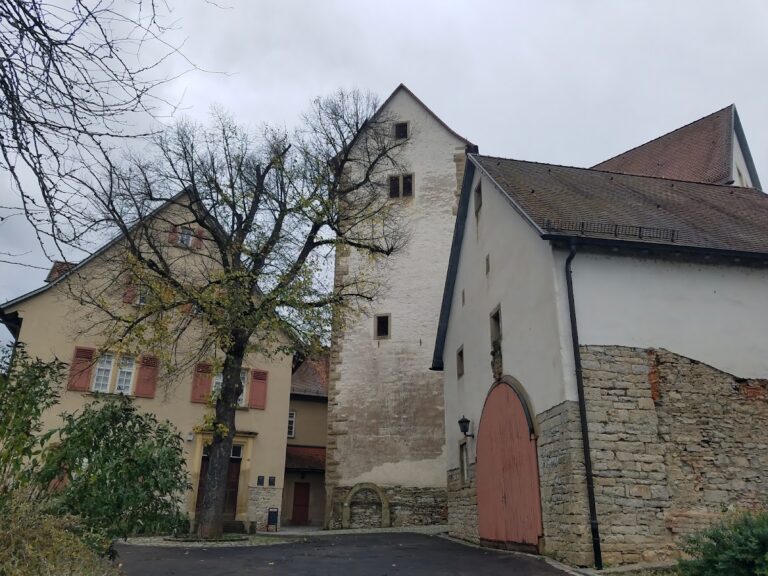
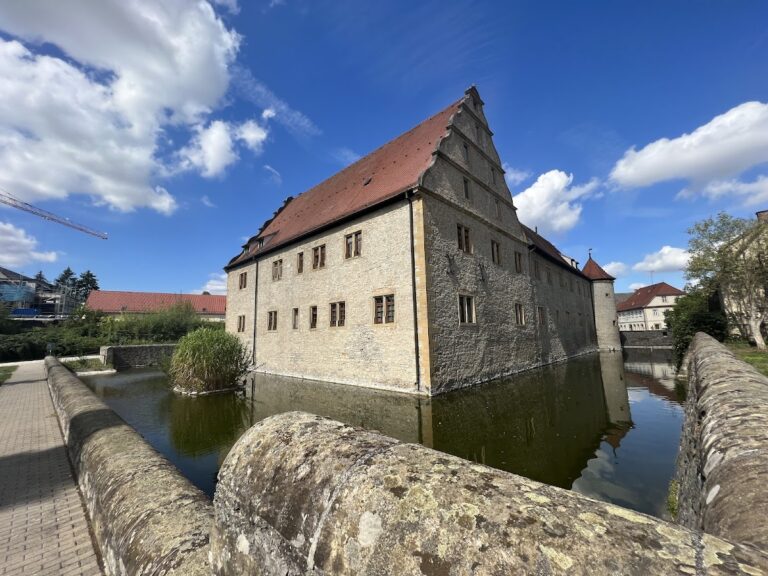
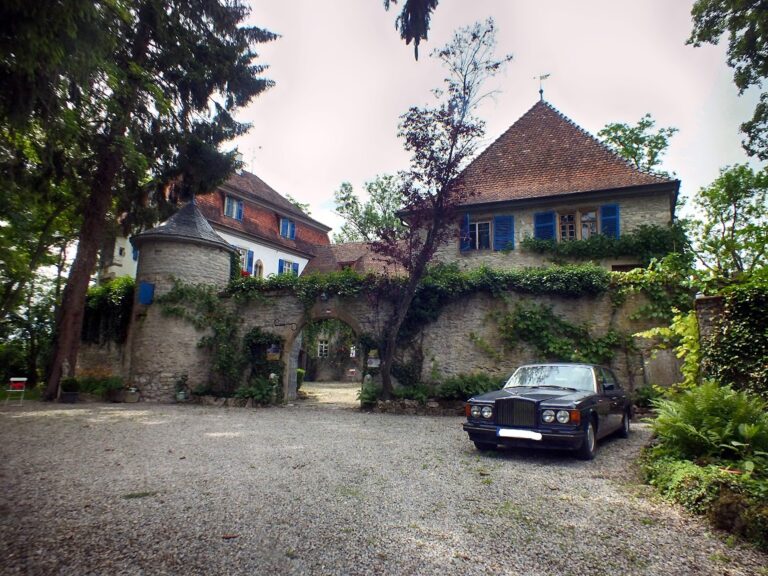
The surviving castle is arranged as several buildings around a quadrangular courtyard. Entry to the courtyard is from the west. The complex combines residential, agricultural, and service buildings, reflecting its development as an estate after the medieval castle’s destruction and the rebuilding carried out under Bernhard von Hartheim.
Manor house
The manor house forms the southern side of the courtyard. It is part of the later multi-wing arrangement associated with the residential use of the estate.
East wing and round tower
An elongated east wing extends along the courtyard. At its northeastern corner stands a round tower with a pointed roof, forming a distinct vertical element of the complex.
Farm buildings and wine press
Farm and service buildings occupy the northern and western parts of the enclosure. The wine-press building carries the coat of arms of the von Hartheim family, linking a surviving architectural feature to the family responsible for rebuilding the castle in the sixteenth century.
Medieval castle ruins
The remains of the medieval castle lie northwest of the later complex. Its principal tower survives as a stump approximately eight metres high. This tower was the castle’s main defensive and refuge structure. Remains of a round tower stand on the eastern side of the ruin, preserving another part of the earlier fortified site.