Burgruine Treffen: A Medieval Castle Ruin in Austria
Site at a Glance
- Rating
- 4
- Popularity
- Very Low
- Country
- Austria
- Primary era
- Medieval
- Eras represented
- Medieval
- Civilizations
- Habsburg, Holy Roman Empire
- Site type
- Military
- Remains
- Castle
On this page11 sections
History
Burgruine Treffen is a medieval castle ruin in Austria, west of Treffen, established by Count Markwart of Eppenstein around 1065. The oldest surviving parts probably date from the twelfth century. In the Middle Ages, the castle served as the administrative seat of the Lordship of Treffen, an extensive territorial complex whose control was contested by bishops, patriarchs, dukes, and noble families.
From estate to noble seat
The history of Treffen reaches back to 878, when King Carloman donated the estate, then called curtis ad Trebinam, to the Bavarian monastery of Ötting. The estate included 19 servants and 70 hides of farmland, and it later developed into the predecessor of the castle. Treffen belonged to the Archdiocese of Salzburg in the tenth century and was held by the bishops of Passau by 993. In 1007, the Passau bishops exchanged it with King Henry II.
Count Markwart of Eppenstein established the castle around 1065. The Eppensteins were a powerful medieval noble dynasty whose members also held the ducal title in Carinthia. Around 1090, the castle and other Eppenstein possessions passed by marriage to Wolfrad I, a Swabian count of the Veringen dynasty. Wolfrad was using the title “of Treffen” by 1121, and his son was designated Count of Treffen in 1125. The counts of Treffen held a prominent social position in the region.
The lordship of Aquileia
On 8 August 1161, Ulrich II of Treffen, the son of Wolfrad II and Hemma, was elected Patriarch of Aquileia. The Patriarchate of Aquileia was an ecclesiastical principality whose leader combined religious authority with territorial and feudal rights. Shortly before his death in 1163, Ulrich transferred the lordship of Treffen, the village of Tiffen, and the castle to the patriarchate. The castle is first explicitly identified as a castrum, or fortified castle, in this donation.
The Patriarchate of Aquileia held the castle and lordship from 1163 to 1245. Duke Hermann II of Spanheim besieged and occupied the castle in 1177, but Emperor Frederick I, known as Barbarossa, confirmed the legality of the donation and ordered the duke to return it. In 1199, the Archbishop of Salzburg claimed rights to the castle. Emperor Frederick II again confirmed the castle to the Patriarch of Aquileia.
Pledges, fiefs, and changing control
A dispute between Patriarch Berthold and Count Hermann of Ortenburg in the mid-thirteenth century reportedly continued for about three decades. During the conflict, Hermann captured the patriarch’s ministerial, Count Ulrich of Sternberg. A ministerial was a service-based medieval official who carried out military, administrative, and courtly duties. Because Ulrich could not pay a ransom of 1,000 marks, the patriarch pledged the lordships of Treffen and Tiffen to the Ortenburg counts for three years.
In 1277, Count Frederick of Ortenburg received Treffen as a fief from Patriarch Raimondo. A fief was a lordship granted by a superior in return for allegiance and service. In 1306, Patriarch Ottobonus pledged the castle, including its tower, to the Carinthian dukes Otto and Henry for 30 years. Two years later, the dukes transferred the pledge to Konrad of Aufenstein. In 1324, the Aufensteins sought to pass the lordship to Engelmar of Villanders as a sub-fief, a further grant made by the holder of a fief, although their legal authority to do so was disputed.
The Aufensteins’ power later declined. In 1361, the family returned Treffen to Aquileia and asked Patriarch Ludwig to enfeoff Duke Rudolf IV of Habsburg with the lordship. Habsburg rulers soon ceased to recognize the patriarchate’s feudal rights. In 1371, Duke Albrecht III enfeoffed Rudolf of Liechtenstein, who then transferred the lordship to Konrad IV of Aufenstein.
Destruction and abandonment
During the war between Emperor Frederick III and Matthias Corvinus, the fifteenth-century king of Hungary, the castle was destroyed. In 1489, Frederick III ordered the destruction of the Liechtenstein castles of Treffen and Seltenheim after Niklas of Liechtenstein supported Matthias Corvinus and concluded a private peace treaty with him. Niklas was outlawed, deprived of his hereditary office as marshal, and lost Treffen. In 1490, the lordship was granted to Lasla Prager, hereditary marshal of Carinthia.
Lasla Prager repaired the damage and strengthened the castle’s defensive works. In 1538, Emperor Ferdinand II returned the castle to Georg of Liechtenstein. By then, however, the Liechtensteins had built a new residence in the valley. The old hilltop castle was no longer inhabited and apparently fell into ruin by about 1540.
Georg’s grandson Otto VI sold the lordship in 1552 to Barbara von Seenuß. Christian Proy inherited it in 1623 and was killed during a boundary dispute involving angry peasants. His son Georg Philipp sold the lordship in 1647 to Anton Baron Grotta von Grottenegg. A severe earthquake completely destroyed the already ruined castle in 1690.
Later ownership and present condition
The Grottenegg family retained the lordship until the mid-eighteenth century, when Count Theodor Christallnigg acquired it. His daughter, Countess Marianne Goess, inherited it in 1781, followed by Josef Sebastian Pobeheim in 1808. Count Peter Goess bought the lordship back for his family in 1818. It remained with the family until 1885, when it was sold to Theodor, Count de la Tour en Voivre.
Rudolf von Gall inherited the property in 1916, and it passed to his daughter Ilse von Sallmann in 1961. Karoline Kramer, owner of the adjacent castle farm, subsequently became the landowner of Alt-Treffen. The old castle is now an unsecured ruin left to decay.
Remains
Hilltop setting and layout
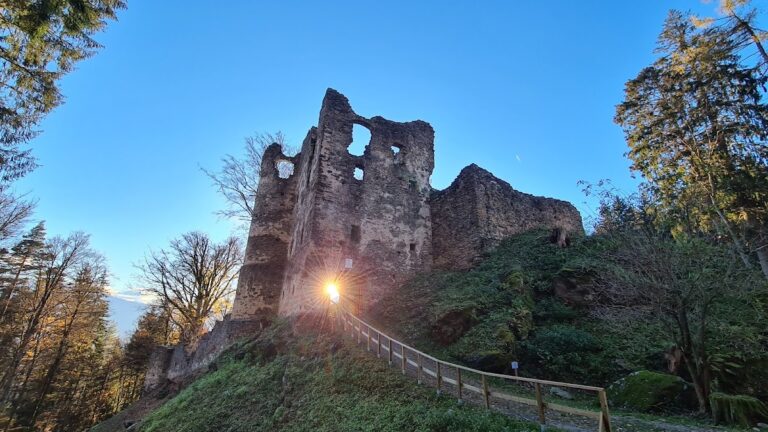
Burgruine Treffen occupies a substantial rocky outcrop of the Steinwender Hohe, on the western foothills of the Gerlitzen massif. The hilltop lies in woodland west of the settlement of Treffen, on the eastern side of the valley, about 220 metres above the valley floor and approximately 750 metres above sea level. Near Lake Ossiach and the outlet of the Gegental toward the Villach Basin, the elevated position connected the castle with communication routes through the Krastal toward the Drau and toward Finkenstein at Lake Faak.
The castle occupied approximately 5,400 square metres and was built largely of rubble-stone masonry, using irregular stones set in mortar or another binding material. Historical views and a plan preserve the layout of the extensive complex. The surviving remains are heavily deteriorated and include an entrance tower leading into the service courtyard.
Castle structures and later residence
Entrance tower and service courtyard
The entrance tower formed the approach to the service courtyard within the hilltop complex. It belongs to the castle’s fortified arrangement, which was strengthened after the destruction ordered in 1489. The tower and surrounding buildings now survive as heavily deteriorated rubble-stone ruins within the woodland setting.
Valley residence
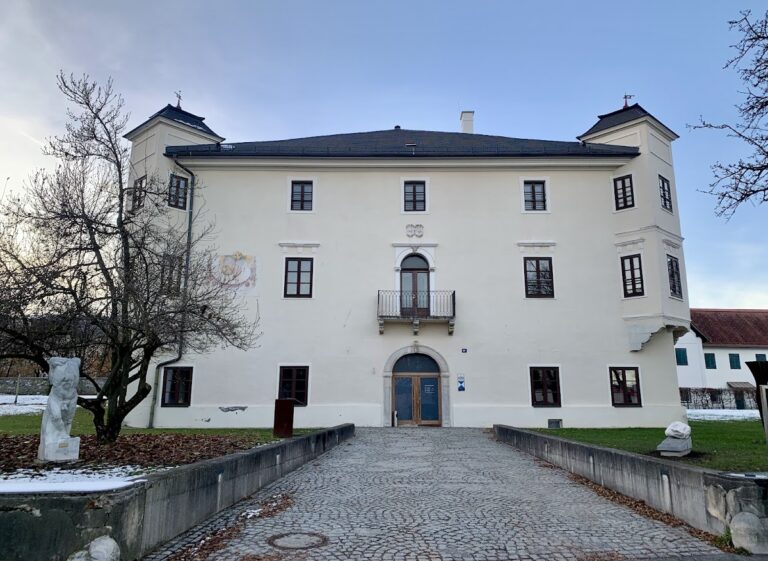
The later Liechtenstein residence stood separately in the valley from the old castle on the rocky elevation. Its construction contributed to the abandonment of the hilltop site, which was no longer inhabited by about 1540. The separate locations express the change from the earlier fortified residence to the newer valley seat.
Nearby sites