Schloss Altdorf: A Late Gothic Castle and Former Episcopal Retreat in Austria


Site at a Glance
- Rating
- 4.8
- Popularity
- Very Low
- Country
- Austria
- Primary era
- Medieval
- Eras represented
- Medieval
- Civilizations
- Holy Roman Empire
- Site type
- Domestic
- Remains
- Castle
On this page7 sections
History
The Lords of Alben and the Altdorfer connection
Schloss Altdorf is a late Gothic castle in Austria, in Hallein, Salzburg, and was formerly the seat of the Lords of Alben. The family held the hereditary river-ferryman office in Laufen and the hereditary cupbearer office in Salzburg. Hereditary offices were positions whose rights and duties passed within a family. The Lords of Alben became extinct in 1561 with Eustachius von Albm.
The castle was formerly used as a hunting lodge and is almost certainly the estate from which Georg Altdorfer, Bishop of Chiemsee, originated. His nephew, Albrecht Altdorfer, a German Renaissance painter and printmaker, lived there for a period. Several of Albrecht Altdorfer’s paintings depict the building and its surrounding landscape with unusual precision.
Episcopal ownership and later transformations
The property later passed entirely to the Diocese of Chiemsee, the historic Roman Catholic diocese that owned it after the Lords of Alben. Its land register, or Urbar, a record of landed property, rights, and revenues, named the estate Curia Altorf prope Salinam, meaning the Altdorf estate near Hallein. The Bishops of Chiemsee used the castle as a summer retreat until 1726. It then passed to the Jesuits, members of the Society of Jesus, a Catholic religious order founded in the sixteenth century.
During the nineteenth century, the castle became the agricultural estate known as Schlossbauer. The present residential building with an inn developed from this later use. Archduke Franz Ferdinand of Austria-Este considered buying the property, but acquired Schloss Blühnbach instead in 1909.
Legend and contemporary use
A local legend says that the Schlossbauer was tempted by a devil appearing as a woman and died as a result. A stone wayside shrine was reportedly associated with the supposed misfortune until the latest road construction. The column probably commemorates an accident during log driving on the Almbach instead. For about 30 years, Fritz Chizzola and, after his early death, Gisela Reitsamer operated the Spanish restaurant Torro Torro in the historic building. After a year of vacancy, Stefan’s in the Schlossbauer began operating there in November 2024 under Stefan Buhk and his husband.
Remains
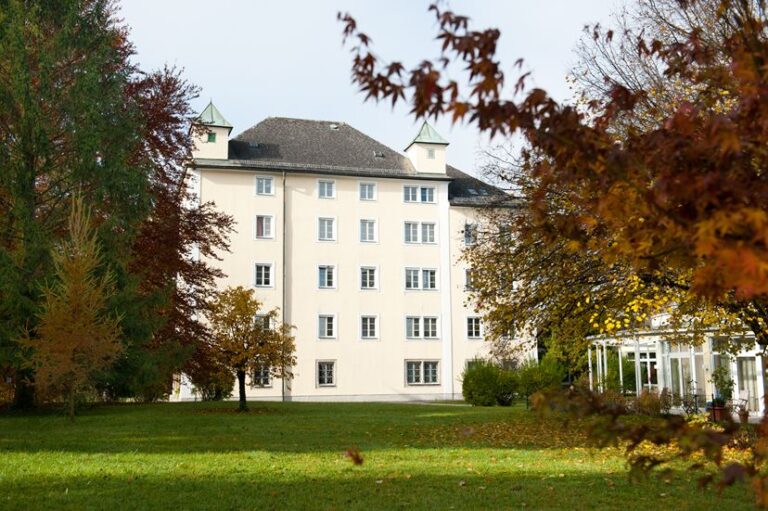
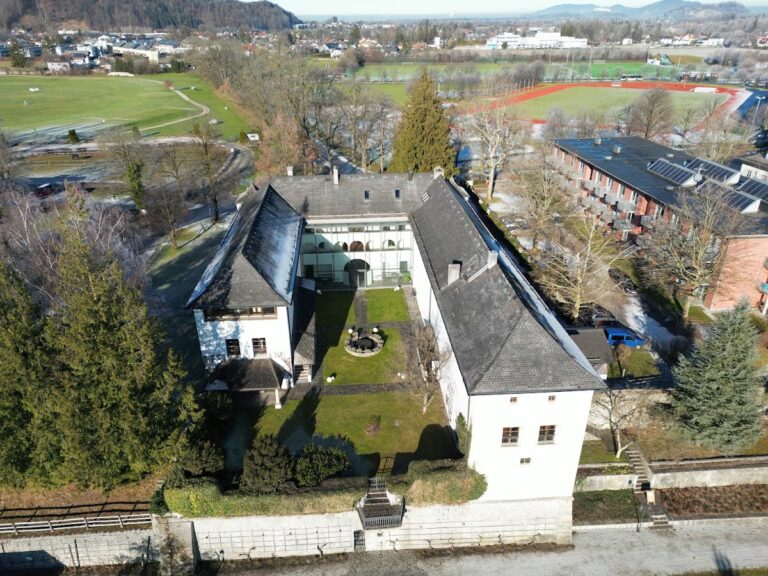
Schloss Altdorf retains the form of a three-storey building beneath a half-hipped roof. This roof has sloping sections at the ends, while the end gables remain partly visible below them. A section of the original enclosing wall also survives, preserving part of the castle’s earlier boundary.
Castle building
The main portal and the window reveals on the first floor retain Adnet marble, a red or variegated limestone quarried at Adnet in Salzburg and widely used in regional architecture and sculpture. The corresponding surrounds on the other storeys are painted imitations. The entire third floor forms a large hall, whose south side preserves remains of frescoes. Its painted wooden door was sold and has been located in Falkenstein Castle in Carinthia since 1913.
Wayside monument
The wayside monument associated with the Schlossbauer legend is a red Adnet-marble column engraved “F.I.F. 1757.” Its inscription and material connect it with the local tradition surrounding the estate, although the column probably refers to an accident during log driving on the Almbach rather than to the legendary death of the Schlossbauer.