Schloss Kahlsperg: A Historic Castle and Care Residence in Austria


Site at a Glance
- Rating
- 3.7
- Popularity
- Very Low
- Country
- Austria
- Primary era
- Medieval
- External website
- Open
- Eras represented
- Medieval, Modern
- Civilizations
- Holy Roman Empire
- Site type
- Domestic
- Remains
- Castle
On this page12 sections
History
Schloss Kahlsperg is a historic castle in Austria, located in Oberalm near Salzburg. Constructed in the thirteenth century, it developed from a fortified residential seat into an aristocratic estate before becoming a residential care home in the twentieth century. The later building history is uncertain, and the site’s development may have extended into the fourteenth or fifteenth century.
The Kahlsperger family
The name Kahlsperg derives from the Styrian Chalasperger family, whose name also appears in the forms Chalhochsperger and Kalchsberger. Members of the family occur in Salzburg documents from about 1250 until the fifteenth century, and the family was established in Oberalm by the fourteenth century. During the fifteenth century, further members served as officials of the Salzburg archbishops, probably as keepers of Kahlsperg Castle.
Ortlof von Chalochsperge held the office of bailiff for the Salzburg cathedral chapter and Admont Abbey. A bailiff was an official responsible for administration and oversight. After coming into conflict with Archbishop Friedrich of Walchen, Ortlof was besieged at Moosham Castle. He capitulated in 1281 and was expelled from the territory. His son Wulfing called himself “the Goldegger,” a title suggesting that the Kahlspergers were related to, or perhaps identical with, the Lords of Goldegg.
The family’s connections around Oberalm are also reflected in fourteenth-century property transactions. In 1338, Wulfing of Oberalm received the Rosenawe property near Oberalm from Eckhart, parish priest of Hallein, as a dower or endowment estate. In 1368, Bishop Friedrich of Chiemsee confirmed that Ulrich the Chalensperger had transferred an estate near Nockstein to his daughters.
Aristocratic ownership and rebuilding
From the middle of the fifteenth century, Kahlsperg belonged to the Nussdorf family, who rebuilt the seat into the form it later retained. Leonhart Lantzing was recorded as living at “Kalaschperg” in 1507. In 1532, David von Nussdorf, hereditary marshal and administrator of Tittmoning, sold the estate to Leonhard Harder. A hereditary marshal was a high-ranking court official whose office could pass within a family. Harder was an imperial official associated with the Gmunden salt and revenue office.
Harder’s heirs sold Kahlsperg to Hans Panicher von Wolkensdorf in 1570. Ownership then passed to Viktor Christalnigg in 1604 and to Wolf Sigmund von Haunsperg in 1612. Franz Rudolf von Haunsperg sold the property to Katharina von Lodron in 1637. The following year, she received permission to place the seat and its park within the Lodron primogeniture fideicommiss, an inheritable estate arrangement intended to keep property together and pass it through a designated line of succession.
Nineteenth-century changes
In 1812, Kahlsperg was removed from the fideicommiss and sold to Johann B. Maffei. His son, Peter Paul von Maffei, became sole owner in 1829, followed by Johanna Karl, née von Maffei, in 1831. She sold the estate to Count Ernst Coreth in 1836.
The property then changed hands repeatedly. Anton Gimpl and Katharina Pertinger acquired it in 1846, followed by Kajetan and Elise Mayr von Mayregg in 1852. Kajetan Schneeberger owned it in 1860, and Anton von Walterskirchen in 1861. Moritz, Flora, and Johanna von Walterskirchen became owners in 1872, followed by Adolf Wolff in 1873, Maurice Count Ressequier de Miremont in 1874, and Natalie Schimpf after she acquired the estate at auction in 1878. Otto Wilhelm Freiherr von Walterskirchen and his wife Karoline owned it from 1893, and Josef Wilhelm Count Walterskirchen and Freiherr von Wolfsthal were associated with the property in 1913.
Conversion to residential care
In 1952, Josef Wilhelm and Ladislaja von Walterskirchen transferred the entire estate to the Hallein Franciscan Sisters in exchange for a life annuity. The sisters established an old-age home at Kahlsperg, changing the site’s function from aristocratic residence to residential care. The Hallein School Sisters remained the legal body responsible for the senior residence until 2017. The care residence is now operated by Casa Leben im Alter and Caritas Salzburg.
Extensive alterations carried out between 1966 and 1968 changed the historic fabric of the castle. The former service courtyard was lost when the old-age home was expanded. Schloss Kahlsperg is protected as a historic monument and is listed as a protected monument under number 4956.
Remains
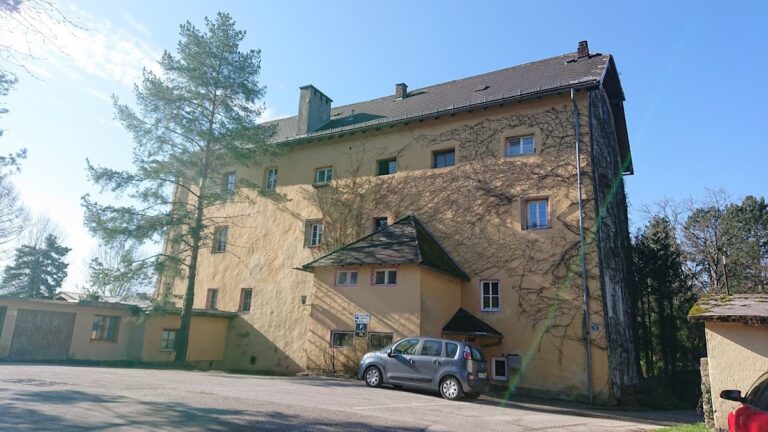
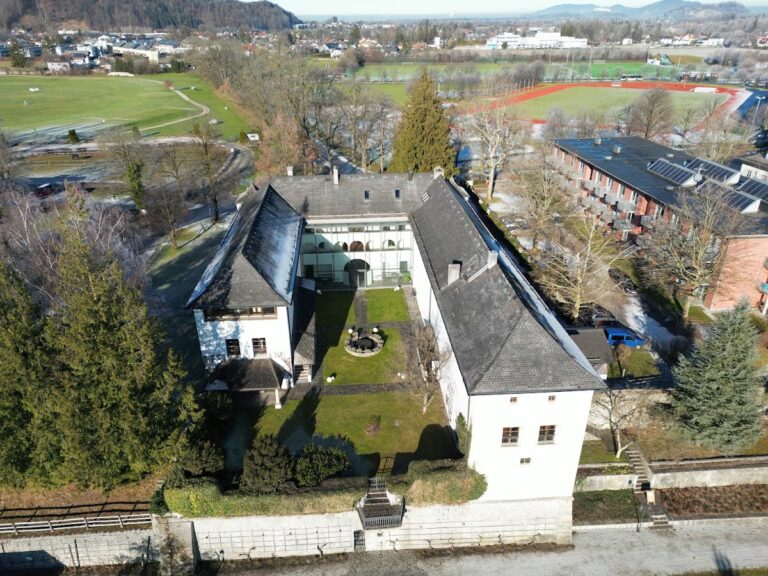
Schloss Kahlsperg began as a water castle, meaning a residential tower or fortified residence surrounded by a moat. The surviving main building is a solid five-storey structure with four window axes and four corner turrets. Together with its ancillary buildings, it formed a horseshoe-shaped complex. Later construction has altered the historic arrangement, including the loss of the former service courtyard.
Castle building
Main building
The principal building rises five storeys and has four window axes and turrets at its corners. A projecting structure now stands in front of the castle and is connected to the main building by a glazed passage. This addition obstructs the view of the historic structure. The interiors were substantially changed after the last change of ownership, and many historically valuable details were lost.
Ancillary complex
The main castle was accompanied by ancillary buildings arranged with it in a horseshoe shape. The former service courtyard formed part of this complex until the expansion associated with the old-age home in 1966 to 1968 removed it. The surviving arrangement therefore combines the historic castle building with later institutional additions.
Moat and park
Moat
A nineteenth-century cadastral survey, an official record of land parcels, buildings, and landscape features used for administration and taxation in the Habsburg monarchy, still shows the moat encircling the castle. The pond had dried by that period but remained identifiable in the nineteenth-century landscape record.
Park gates
A large park surrounds the castle. Its surviving gates have rusticated piers, whose roughly textured masonry gives the supports a strongly articulated surface, together with iron grilles. These gates remain among the visible elements of the estate’s historic grounds.