Thürndl Ruin: A Medieval Fortification in Austria


Site at a Glance
- Rating
- 4.5
- Popularity
- Very Low
- Country
- Austria
- Primary era
- Medieval
- Eras represented
- Medieval
- Civilizations
- Holy Roman Empire
- Site type
- Military
- Remains
- Castle
On this page7 sections
History
Thürndl Ruin is a medieval fortification in Hallein, Austria, probably built in the thirteenth century as the southern corner of a larger defensive system. Formerly known as Schozzries or Schoßrisen, it occupied the southern end of a ridge above Hallein and may have formed part of a protected connection between the town and the surrounding heights.
Medieval origins
A wall is said to have once linked the ruin with Hallein’s northern city gate, the Salzburg Gate, passing through the protected forest. In 1271, Berchtesgaden Abbey, an ecclesiastical institution based in Berchtesgaden, transferred a salt mine near the farmstead of Schozris to the Salzburg Cathedral Chapter, the clergy responsible for the cathedral’s administration. During the mid-fourteenth century, St. Peter’s Abbey, a Benedictine monastery in Salzburg, contributed to the construction of Schozris.
Early modern use
The fortification continued to serve a practical role in the sixteenth century. In 1583, Andree Mitterlechner became gamekeeper at the tower at Schosrissen and was also charged with guarding the castle. He lived at the site while carrying out these duties.
The castle still appeared on a map of Berchtesgaden made in 1628. A view of Hallein drawn by Johann Faistenauer in 1632 shows a second, lower crenellated structure beside the main building. This may have been the former gatehouse with an outer defensive enclosure, although that identification remains tentative.
Municipal ownership and conservation
On 21 February 1879, the tower became the property of the municipality of Hallein, which remains its owner. Later excavations commissioned by Austria’s Federal Monuments Office, the national authority for protecting monuments and archaeological heritage, investigated the extent of the former corner tower within the old town fortifications.
Restoration planning began in October 2003 after large quantities of masonry threatened to fall from the ruin onto the Arnoweg. The restoration was completed in 2008, helping secure the surviving structure.
Remains
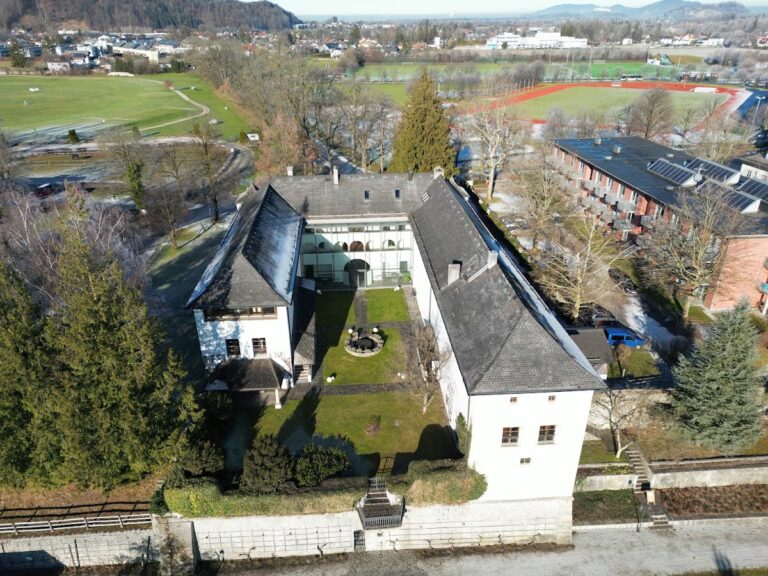
Thürndl Ruin stands as a hilltop castle on the southern end of a mountain ridge extending from the Barmsteine toward the area above Hallein. It lies about 300 metres east of the municipal boundary of Marktschellenberg, which also marks the German-Austrian state border at this point. The surviving remains are centered on a substantial tower, with evidence of a lower adjoining defensive structure preserved in a seventeenth-century depiction.
Surviving tower
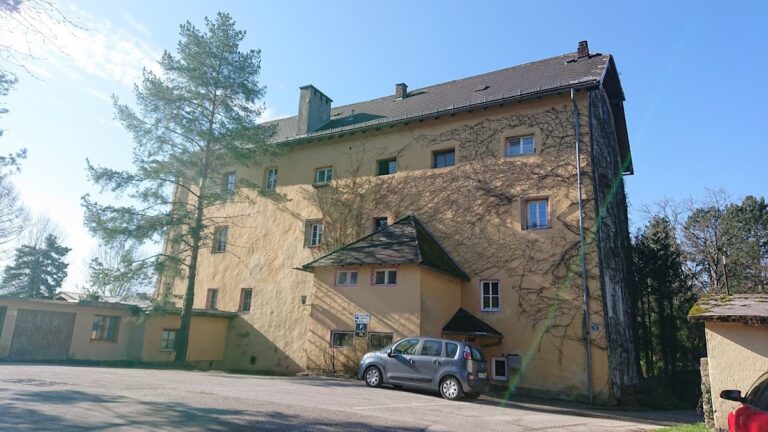
The tower measures approximately 9 by 10 metres at its base. It originally rose through four storeys, and masonry survives to a height of up to 15 metres on its northern and eastern sides. The remaining walls end in a crenellated upper section with a projecting cornice, preserving the defensive character of the medieval building.
Lower defensive structure
Faistenauer’s 1632 view shows a second structure below the main tower, also finished with crenellations. Its identification as the former gatehouse and an outer defensive enclosure remains provisional. The image nevertheless provides evidence for a more extensive arrangement around the surviving tower, beyond the masonry that remains visible today.