Château of Stuyvenberg: Belgian Royal Residence and Estate


Site at a Glance
- Rating
- 3.8
- Popularity
- Very Low
- Country
- Belgium
- Primary era
- Early Modern
- Eras represented
- Early Modern, Modern
- Civilizations
- Belgian, Habsburg, Holy Roman Empire
- Site type
- Domestic
- Remains
- Palace
On this page8 sections
History
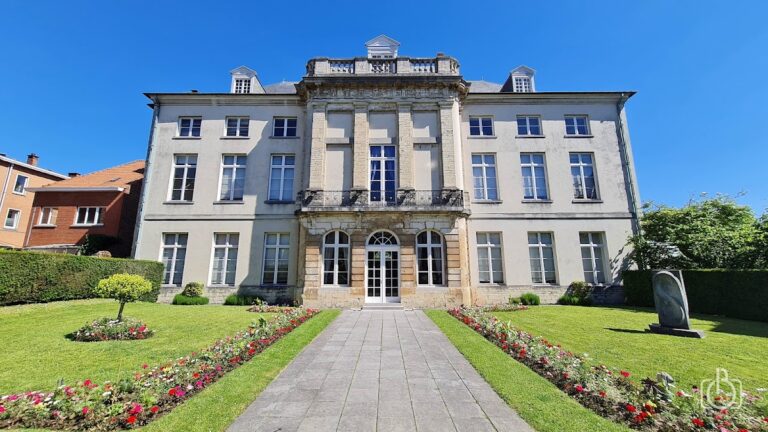
Château of Stuyvenberg is a neoclassical royal residence and estate in Belgium, in Laeken, Brussels. The château was built in 1725 and developed from an older château farm, an estate farm associated with a château rather than necessarily its principal residence. Its later history connected it to the Belgian monarchy, and the enlarged estate became part of the Belgian Royal Donation, the institution that administers properties associated with the Belgian royal family.
From château farm to landed estate
Stuyvenberg began as a château farm that belonged in the sixteenth century to the architect Lodewijk van Bodegem. During the early eighteenth century, Jacomo Joseph Sire Jacob rebuilt the complex, including a five-storey tower dated 1713. The property later passed to his only daughter, Marie-Anne, and her husband, Jérôme-Balthasar, Viscount de Roest d’Alkemade.
Inheritance brought the estate in 1796 to François-Charles-Joseph De Leeu de Moorsele, the son of Marie-Françoise Sirejacob. His grandson, François-Charles, Baron de Wolff de Moorsele, sold Stuyvenberg to Julien Deby on 8 November 1829. Deby later became mayor of Laeken, acquired additional land, and sold the nearly 20-hectare estate to the Belgian state in 1840. It subsequently passed to King Leopold II through an exchange operation.
Villa Stelenbosch and Leopold II’s alterations
In 1849, Deby commissioned Villa Stelenbosch on land adjoining the château farm. With financial and political support from Leopold I, the first King of the Belgians, Arcadie Claret acquired the villa in 1851 for 80,000 francs. It became known as Villa Meyer, or Campagne Meyer, after her official husband. Claret lived there with her children until Leopold I’s death in 1865, and their second son, Arthur von Eppinghoven, was born there in 1852. The property was enlarged to house Claret’s mother, sisters, and brothers.
Claret retained the villa until 1889, when Leopold II acquired it through an intermediary. He commissioned extensive alterations by the architect Alphonse Balat and combined the villa grounds with the Stuyvenberg château farm, which he had acquired in 1880. In 1890, Leopold II ordered further major changes to Stuyvenberg through the architect Elie Lainé. The combined estate was incorporated into the Belgian Royal Donation in 1900.
Royal residence in the twentieth century
During the reign of Albert I, King of the Belgians from 1909 to 1934, Stuyvenberg underwent substantial renovation for the residence of Prince Leopold and Princess Astrid. The architect Maurice Heyninx found that the building stood on sandy ground, a condition that considerably increased the construction costs.
From 1930 until Astrid’s death, Stuyvenberg was the home of Princess Astrid and her husband, Leopold III. Their sons, the future King Baudouin and King Albert II, were born there. Baudouin was born in 1930 and Albert II in 1934, and both spent their early years at the estate.
After the Second World War, Queen Elisabeth, the widow of King Albert I, lived at Stuyvenberg until her death in 1965. The Belgian state then used the property for almost three decades as a residence for foreign heads of state and other high-ranking guests. The household of Princess Astrid and Prince Lorenz later occupied the château. Queen Fabiola, the widow of King Baudouin, moved there in 1998 and died at Stuyvenberg on 5 December 2014.
Recent ownership and use
Stuyvenberg remained empty for three years after Fabiola’s death. In 2017, the Belgian Royal Donation rented the property on the private market to a private couple through Sotheby’s. The estate still belongs to the Belgian Royal Donation, although its current use is private residential rental.
Remains
The surviving estate combines the older Stuyvenberg château farm with the nineteenth-century Villa Stelenbosch. The farm stands along the present Abelenlaan and includes a square tower, while the large garden once formed part of the grounds of the Château of Laeken. Together, these elements reflect the successive enlargement of the property from an estate farm into a royal residence.
Château farm and tower
The older farm is positioned along Abelenlaan and retains a square tower rising five storeys. The tower bears the date 1713, linking it to the rebuilding carried out by Jacomo Joseph Sire Jacob in the early eighteenth century. The château itself belongs to the later 1725 phase and is described as neoclassical. Its physical history therefore includes both the earlier farm complex and the later residence that developed around it.
Villa Stelenbosch
Villa Stelenbosch was built in 1849 on a plot adjoining the château farm. The building was later enlarged to accommodate members of Arcadie Claret’s family and was extensively altered during Leopold II’s ownership. Its grounds were joined to those of Stuyvenberg, creating the combined estate that entered the Belgian Royal Donation in 1900. During the renovations prepared for Prince Leopold and Princess Astrid, the building’s sandy foundation ground was identified as a major construction difficulty.
Nearby sites